
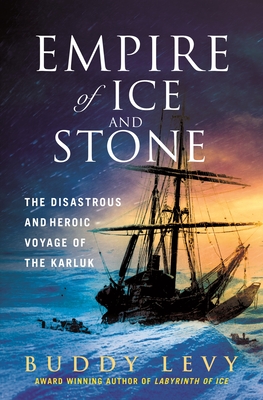
Empire of Ice and Stone tells of the voyage of the Karluk, a brigantine vessel that sailed from Canada to the Arctic in 1913. It was led by Captain Bob Bartlett, the world’s best ice navigator at the time, and Vilhjalmur Stefansson, a “visionary” leader in search of wealth and fame. My thanks go to Net Galley and St. Martin’s Press for the invitation to read and review; this book is for sale now.
This well told narrative details a part of history of which I have read very little. As school children, most of us in the Western developed nations read of the early explorers, but stories of voyages in the twentieth century are few and far between. This is why I take this one on, but I begin to wonder partway into it whether it is more than I have bargained for.
The first half is more than a little confusing, because there are so (so, so, so) many names to remember, and almost all of them are Caucasian men—as is usual for the time and situation. About halfway into it, I abandon my efforts to memorize all of them, and once I am satisfied with memorizing the names of the two leaders plus “Auntie,” (more in a moment) and the ship’s pets, I calm down a bit and it’s easier to follow. I am fortunate enough to receive the audio galley as well as the digital review copy, and that combination makes it easier to follow.
That said, this is not gentle reading. There is death—in many cases slow and terrible—and betrayal around every corner. I understood that there would be some of that when I took the book, but I’ll tell you right now, if you, dear reader, have any sort of mood disorder or are going through a dark time personally, you may want to stay away from this thing.
As the bodies begin to pile up, I start to feel angry, and I remain so, to some degree, until the book is done. Because this was a dumb thing that these men did. Their ship wasn’t up to the task, they cut too many corners at the outset, and this more or less spelled doom for many of those aboard. I can’t help speaking to these men as though they can hear me, and I’m asking what the fuck got into them to do this at all? If everyone had stayed home, most likely all of them would have lived to a ripe old age. True, they made some scientific discoveries; yet air travel was just around the corner, and the whole thing could have been done much more safely later on.
The story has a definite hero (Bartlett,) and a definite villain (Stefansson,) and the farther into the voyage we go, the more obvious this becomes. However, I would have liked to hear a good deal more about the other hero. Levy tells us that a lot of these men would have been dead before the rescuers arrived had it not been for the Innuit woman that was hired, along with her small children (!) to travel with them, and the narrative bears this out. Time and again, when they are on the razor’s edge of starvation, she comes up with an innovative way to use the environment around them to provide calories. Not always delicious calories, to be sure, but alive is alive. “Auntie” is a total badass, and deserves more ink; possibly not much information is available, given the biases of the time.
The book feels longer than it actually is; however, given the amount of complex information provided, it probably shouldn’t be pared down further. At the same time, I kept thinking that this would be so much more approachable if Jeff Shaara were doing the telling (via historical fiction.)
For those that are very interested in the history of early sea voyages, and to researchers, this immaculately researched book is recommended.

 Laila is just twenty-three when her mother dies, and she is astonished when her cousins appear at the funeral. Cousins? What cousins? In fact, they are from her father’s side of the family, long estranged—and they are very wealthy. Cousin Liberty wants to make amends, and nobody has to tell Laila twice. She ditches her home in Michigan, leaves her spouse, a dull dentist who’s blindsided by her sudden departure, and heads for New York City, to live in the style to which she would like to become accustomed.
 Seattle Book Mama