 3.5 stars, rounded upward.
Maggie swallows her misgivings and agrees to let her boyfriend, Chip, give her a ride in a small plane. He’s taken lessons, but doesn’t have a license yet. Naturally, he crashes. And naturally, he walks away without a scratch, but Maggie is paralyzed and burnt to a crackling crisp.
My thanks go to Net Galley and St. Martin’s Press for the DRC. This title is now for sale. I missed the release date and am sorry about that; I struggled with how to rate this title and how to review it. More on that in a minute.
Most of the story is set at a hospital, where Maggie is treated for burns and receives physical therapy to help her learn to move again. It’s painful and it’s horrible, and on top of that, nobody will let her have a mirror. Once she has one, she wishes she hadn’t looked.
“I would forever be a person that other people tried not to stare at in the grocery store. I would forever be someone who made other people uncomfortable.”
Maggie develops a crush on her physical therapist, a handsome, abrupt, unfriendly Scotsman whose poor bedside manner is surpassed only by his outstanding skill at helping Maggie learn to maneuver her body. At the same time, Chip—who for no reason I can understand, has not been arrested or cited for flying unlicensed or for stealing an airplane—goes all to pieces, turning his few hospital visits into a pity party for himself.
The story is quixotic in its combination of romance, medical information that is sometimes more detailed and gruesome than I want to read, and a beginning that is more an adventure or disaster tale than romance. 14% of the way in I flipped back to the cover, the tiny, almost unnoticeable plane flanked by giant floral bouquets, and I didn’t get how this story went with that jacket. I think the beginning scene with the plane, the toxic boyfriend turned fiancée, and the crash should have been edited down and presented as a prologue.
When Maggie is astonished to see a “lady firefighter”, I roll my eyes and check the copyright to make certain this isn’t a re-release of a title from the 1960s.
I originally designated this galley as my lunch and midnight snack companion, but soon it became obvious that there were too many detailed descriptions of bodily functions, particularly related to the bowel and the bladder, that I didn’t want to dine with.
The parts I like best here have to do with Maggie’s sister Kitty, who left suddenly many years ago and has been estranged due to a mysterious conflict with her mother. Kitty’s character is developed wonderfully and injects light and humor into the narrative.
The other characters at times seemed overdrawn. Chip is too obnoxious; I already hated him when he patted Maggie’s fanny and told her to get onto the plane. As ugliness is added to more ugliness, I find myself rolling my eyes and saying, yes, he’s a dick, I get it already. Maggie’s mother (is there a novelist out there that is comfortable with a protagonist and her mother having a solid relationship?) is too shallow, too obviously obsessed with surface beauty, and although there is some small redemption for her in the end, I want to see more than one attribute given this character, and I want it sooner.
And there’s the wealth, the privilege, and the wealth wealth wealth. When Maggie’s father brings a printer to her hospital room so he can crank out articles for her to read; when her mother hauls in curtains and lamps and redecorates the hospital room; a thousand times I find myself highlighting passages and arching my eyebrows. The hell?
The romance itself, however, is a winner. As I watch the electricity pop between Maggie and Ian, I can’t help smiling. The romance is what most readers are here for, and I find it heartwarming and satisfying. It’s a quick read, and although I had no trouble putting it down, I also had no trouble picking it back up again, which is not always true of the galleys I review.
Recommended to Center’s faithful readers, and to those that like a light romance.

 I received this book free from Net Galley and University of Wisconsin Press in exchange for this honest review. It will be available for purchase on September 18, 2018.
 “’All I know is I never had any advantages,’ Barry said. ‘I wasn’t even lucky enough to be born to immigrant parents.’”
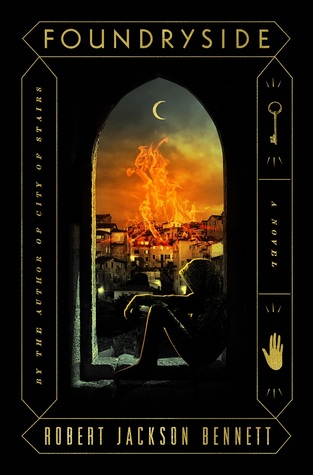 3.5 rounded up. This title is the first in a new series. Those that love fantasy, and especially those that already enjoy this writer’s work will want to check it out. My thanks go to Crown and Net Galley for the DRC, which I received free and early in exchange for this honest review. Bennett comes to this project with a list of awards as long as your arm, so I was excited to read him. I probably would have been more impressed by this book if there hadn’t been so much build up. Still, it has a lot going for it. It will be released August 21, 2018.
 Darl Moody and Calvin Hooper have been best friends forever, and so when Darl has the worst kind of accident, he knows who to turn to. You know what they say real friends will help you bury. The body in question is Carol Brewer; Darl was hunting out of season, and when he glimpsed something moving through the woods he thought it was a wild pig. Turned out he was wrong; turned out to be Carol, poaching ginseng on Coon Coward’s land. But you can’t bring the dead back to life, and you sure can’t call the cops for something like this. Carol is Dwayne’s brother, after all. Dwayne is a huge man, half- crazy and rattlesnake mean. There are no bygones in Dwayne Brewer’s world. There is only revenge.
 Grace is convinced that Carl Feldman killed her sister Rachel. The once celebrated photographer was tried for the murder of a young woman and acquitted; now he is very elderly, and residing in assisted living due to dementia. Grace poses as his daughter, and she wants to take him on a road trip.
 Leo Waterman is one of my favorite fictional detectives. Lucky me, I scored this eleventh in the series free courtesy of Net Galley and Thomas and Mercer in exchange for this honest review.
 Markley’s thunderous debut is not to be missed. My thanks go to Simon and Schuster and Net Galley for the review copy, which I read free and early, but this is one of the rare times I can say that if I’d paid full hardcover price, it would have been worth it. This is the summer’s best fiction, and it’s available to the public August 21, 2018.
 Connolly is one of a handful of writers whose names I search when I go to Net Galley. He’s consistently brilliant, and so I am grateful to Atria Books and Net Galley for the review copy. This book is for sale now.
 Jim Crace is an award-winning author with an established readership, but he is new to me. Thanks go to Net Galley and Doubleday for the review copy. This book will be available to the public Tuesday, June 19, 2018. Those that love literary fiction should take note.
