The Ballad of Jacquotte Delahaye**-***

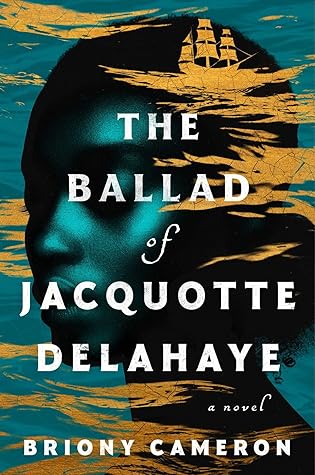
The Ballad of Jacquotte Delahaye marks Briony Cameron’s authorial debut. She is a talented wordsmith, and my thanks go to Atria Books and NetGalley for the invitation to read and review. While I enjoyed several exciting passages—I do adore a good pirate tale—in the end there were issues with credibility that got in my way.

 This story of a pirate woman’s derring do is for sale now.

When I read that Jacquotte Delahaye was a real person and that the book is based on true events, I was all in. However, there are passages that made me raise an eyebrow, and since there didn’t seem to be any notes that would indicate what is true and what is the author’s invention, I took to Google to find out more. This is where I learned that actually, she may have been a real person, or she may be only legend. The stories surrounding her life and exploits are also legend. There’s virtually no verified historical information on this character.

I love good historical fiction, which is where actual, documented facts are given warmth and life by an author that adds dialogue and perhaps fleshes out a few areas where the record is sketchy. Then, if the author is sharp and professional, there will be end notes that explain what is a matter of historical record, and what has been invented. That’s my happy place. Even better is when sources are provided for interested readers. Of course, a writer of any kind of fiction isn’t required to provide footnotes or other documentation, but when they do, it’s the cherry on the sundae, and it makes me love them all the more.

Because this story is not nearly as closely aligned to historical record as the promotional materials would have me believe, I nearly dropped my rating to two stars. I felt, and still feel, that the synopsis provided is misleading. I don’t like feeling as if I’ve been played. However, I realize that the author probably is not in charge of her own promotional blurb, and I can’t see penalizing her for what the publicist has chosen to do.

Do I recommend this story? Not so much. Had it been written in such a skillful way that I felt no need to do research of my own, I might not know that this is pure fiction based on little more than speculation. That’s not the case, though. It doesn’t ring true in a number of places, and that’s partly because it isn’t. However, should the reader decide to pursue it, I would advise that you get this book free or cheap, unless your resources are endless ones. Don’t pay full cover price.

Let Us Descend, by Jesmyn Ward*****

Reading Jesmyn Ward always hurts so good. In Let Us Descend, she conveys the heartbreak and sense of betrayal a young girl, Annis, faces when she and her mother are sold separately by their owner—who is also her father–and the ways that she copes, and also the ways she is helped by the spirits of her ancestors.

My thanks go to Scribner and Net Galley for the invitation to read and review. I’m sorry to be so late here, and am grateful that the literary world has recognized this book for the masterpiece that it is.

You may have seen other reviews in which I complain and gnash my teeth over historical inaccuracies; sometimes I rant over an author’s failure to portray a child in a way that is developmentally inaccurate. There will be none of that here. Ward has taken the time and done the research, and so her well crafted characters aren’t compromised by sloppy background details. I had to take this story in small bites because it is excruciatingly sorrowful.  For part of it I listened to the audio version; this is a treat in itself, as Ward reads her own novel.

Some reviewers have taken issue with the amount of magical realism Ward employs. I disagree with them. How can any novelist portray such a story and such a character as Annis with any glimmer of hope, unless they employ these literary devices? Does anyone really want to read a book that is miserable at the outset, miserable in the middle, and miserable even at its bitter, wretched conclusion? Without hope, there’s not much incentive to keep reading, nor would it have been satisfying to write; but Ward will not and does not revise history simply to make her readers more comfortable. There was only one way to tell this story and be true to history and her characters, and Ward found it.

Yes, it’s a rough read, but it’s so well written that many readers must have smiled through their tears. Know that, of necessity, this story is absolutely loaded with triggers; assuming that you can navigate them without coming undone, I highly recommend this story to you.

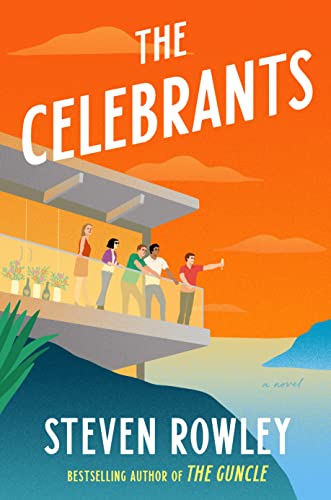
The Celebrants, by Stephen Rowley***

I enjoyed Rowley’s novel, The Guncle, which came out in 2019. When I was invited to read and review The Celebrants, I jumped at the chance. Unfortunately, it didn’t do a thing for me. Nonetheless, my thanks go to Net Galley and Putnam Books for the review copy. This book is for sale now.

As a child, we once had a bird bludgeon itself to death on our sliding glass door, unable to accept that the invisible barrier was really there. Reading this book made me feel just a bit like that bird. I’d liked Rowley’s last book. Other Rowley fans liked this book. So why…(BAM!)…why…(BAM!)…why could I not get into it?

I think it all boils down to privilege.

Had I read the premise more carefully, I might have avoided this trap. A group of seven college friends, grief-stricken after losing the eighth friend, agree to meet every few years and give each other mock funerals to celebrate the lives that still exist among them.

What rarefied conditions must exist to make such a thing possible? Imagine having the resources to be able to drop everything and fly off to wherever the meeting is held. Air fare. Childcare. Housing. But as I read the abundant dialogue in this thing, such trivialities are seldom mentioned. These are people that for the most part came from money, and they have money now, and they assume they will have as much, if not more, in the future.

Of course, the story is not about money and privilege. It’s about taking stock of their current lives and comparing them to their youthful expectations. There are secrets. There is baggage. And now, in their middle aged years, they are older, wiser, and in many ways, sadder.

Oh honey. They think they’re old now? My ass!  My children are middle aged. Get a fucking grip.

So okay, I am probably not the ideal audience; and yet, I will remind you that I didn’t volunteer for this. I was selected. Someone clearly believed that I am within the target audience.

I initially felt some of this when I began reading The Guncle. The protagonist there was a successful actor with a pile of money; and yet, the challenges he faced, first with the death of his partner, and then with the homophobic relative that tried to keep him from taking the children that had been entrusted to him, won out. The presence of well-written children helped a good deal, and the humor was completely on point. I cannot fail to appreciate an author that can make me laugh out loud.

I didn’t laugh out loud this time.  It’s grim, but it’s wealthy-people grim, not working class grim. If you don’t know the difference, then we all know which one you are.  I rolled my eyes a great deal, but it’s even harder to read when you do that, so I borrowed the audio from Seattle Bibliocommons. It didn’t help a bit, apart from making it possible to take in the book and roll my eyes at the same time.

I see that this title has been nominated for the Goodreads Choice awards, so clearly, a lot of people have loved this book. But I am not one of them.

Recommended to rich people that believe their lives to be harder than they actually are.

The Golem of Brooklyn, by Adam Mansbach*****

Len Bronstein is an art teacher. He has a whole lot of clay he’s filched from his employer’s supply closet, and now he’s stoned. He should make something. He should make a Golem. And friend, that’s just what he does.

Traditionally, The Golem is made by a rabbi to help the Jewish people during difficult times. Len isn’t a rabbi, and he doesn’t expect much from his creation:

Five minutes passed, and nothing happened. Len reminded himself that he didn’t actually expect anything to…he didn’t believe in any of this shit. He stood, dusted himself off, and went inside to grab a beer…Len deposited his beer in the sink just as The Golem ripped his back door off the hinges and flung it aside.

My thanks go to Net Galley and Random House Ballantine for the invitation to read and review. This book is for sale now.

Now that The Golem has awakened, he needs to know what his target is. His answer comes to him as he views the news on Len’s television. White Supremacists are railing about a Jewish conspiracy; the Holocaust, they say, was a hoax. The Golem was asleep during the Holocaust, but once it’s explained to him, he’s ready to get busy. But first, he must talk to the rabbi.

Our second main character is a woman named Miriam, Miri to you and me. She works at the bodega down the street, and Len recruits her to be a translator; The Golem, you see, only speaks Yiddish, and Len doesn’t. Miri has been drummed out of the temple because she is a lesbian, but The Golem likes her just fine. Before you know it, Len, Miriam and The Golem are on a road trip beyond all others, first to find a way in to see the Sassov Grand Rebbe, a wealthy and powerful man with a great many gatekeepers, and then to a scheduled White Pride rally down south.

This is, as may be obvious by now, very edgy humor. There’s a great deal of profanity, and whereas most of it is hilarious, at the beginning, the author could have varied his choices more. There are lots of cuss words out there, and not all of them begin with F. But this is a small matter. This novel’s action is interspersed with brief passages of Jewish history that I find very interesting, and they are so brief, and so skillfully woven into the narrative, that you may not notice that you’re learning some things.

My favorite passages involve a bombastic politician, and multiple encounters with cops. (The Golem doesn’t care for them.) As for me, I have read several very funny novels this year, but none made me laugh out loud as often as this one. And in the end–well, you don’t expect me to tell you how this ends, now do you?

Highly recommended to readers that lean left and can tolerate profanity.

Bright Lights, Big Christmas, by Mary Kay Andrews****

I tend to avoid heartwarming holiday stories and romances because so many of them are infused with saccharine and require the reader to put their I.Q. in a box until the book is over. But two years ago, I was happily impressed with Mary Kay Andrews’ The Santa Suit, and so when I was invited to read and review Bright Lights, Big Christmas, I happily agreed. My thanks go to Net Galley, St. Martin’s Press, and Macmillan Audio for the review copies. This book is for sale now.

The Tolliver Christmas tree farm is an institution, not only at home in North Carolina but as far north as New York City. As a child, Kerry sometimes accompanied her family to New York to set up a tree stand and sell the trees, but as an adult, she’s had other priorities. This year, though, she finds herself unexpectedly jobless, while at the same time, her father’s health prevents him from executing the task. Kerry must take his place, traveling to the Big Apple with her brother, Murphy. They set up the stand, and they sleep in the ancient pink trailer nicknamed “Spammy” because of its resemblance to a canned ham. Adventure awaits.

Kerry’s love interest pops up before we’re even ten percent into the story, but it appears that the author planned for us to know that, and it doesn’t hurt anything. Over the weeks they are in New York, various small (and large) crises present themselves and are worked out with team work, ingenuity, and the occasional well-placed bribe. They have Murphy’s dog Queenie with them, but she is primarily left in the background where she belongs.

What I appreciate most about this novel is how well grounded the plot is, and the author’s restraint in not permitting any elements to go over the top. There are a host of stereotypes possible, but every time I see one coming, Andrews chooses a different path, and it keeps the story fresh and original. Small details that might be overlooked by someone less detail oriented are seen to, and it keeps the narrative credible. Examples are the need for a shower or bath, given the length of their stay in a trailer without working plumbing; the cost of living in New York; the hazards of theft and vandalism, especially active at Christmas. None of these sidetracks the plot or slows the pace, but the questions a reader might have are tidied away, and this makes for greater enjoyment.

One small criticism involves a situation where theft and vandalism occur at a time when Murphy has to be away, and immediately, other men folk clamor over the need to have someone—someone with a Y chromosome, folks—to do lookout duty, protecting the fair damsel, her trees, and so on.

Apart from that, this is a delightful story. However, for awhile I wasn’t sure I liked it, because I was listening to the audio version, which is poorly done. The male characters are voiced in a way that is choppy, wooden, and unconvincing; but worse is Kerry’s voice, which is performed in a high-pitched, girly-girl voice so off-putting that it took me awhile to realize that the problem wasn’t the author’s, but rather the voice actor’s. The children’s voices are much better, and I actually howled with laughter when the baby in a stroller wailed!

As the story reaches its climax, Kerry has to make some serious choices, and I admire the way this part is resolved. The side character Heinz, an elderly man that lives in the neighborhood and often stops by the tree stand, is terrific.

When all is said and done, I rate the printed version of this novel 4+ stars, and the audio version 3+ stars, with an overall score of 4. I recommend the print version of this book, but not the audio.

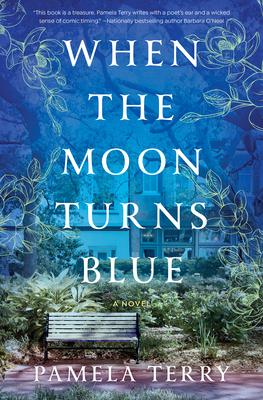
When the Moon Turns Blue, by Pamela Terry*****

Once in a while the odd thing happens,

Once in a while the dream comes true,

And the whole pattern of life is altered,

Once in a while the moon turns blue.

The tiny Georgia hamlet of Wesleyan is preparing to bury one of its own, and Mother Nature is preparing to cover the entire town in ice. But nobody—well, almost nobody—knows that a source of local tension is about to go nuclear, as someone is planning to topple and destroy the statue of a Confederate general in the park inside the boundaries of Old Man Griffin’s land. “The fight was just getting going good, and now somebody’s declawed the cat.”

This riveting, curiously charming and sometimes hilarious novel is the second by Pamela Terry, whose outstanding debut novel was The Sweet Taste of Muscadines. This one may be even better. My thanks go to Net Galley and Random House Ballantine for the invitation to read and review. This book is for sale now.

With the death of Harry Cline, we find ourselves at his funeral, a massively attended affair. But his wife, Marietta, develops a disabling, blinding migraine, and although they have been on the outs for years, Butter, her (former) best friend, comes to the rescue. By the time they’ve snuck out the side door of the church, we already know at least a little about both women, and now we want to know everything.

With just two novels published, Terry has already proven herself to be among the best authors when it comes to character development. Soon we’ll meet others—Marietta’s obnoxious brother, Macon and his beleaguered wife Glinda, who will have a large part in this story and is one of my favorite characters, as well as a host of others, who have smaller roles but are each so unmistakably established that it’s no work at all to keep track of them. But perhaps her finest achievement here is in creating a masterpiece that is ultimately a feel good book, despite the use of a red hot real world controversy within its pages.

I generally read several books at a time, and this one is the one that I saved for bedtime, because I wanted to be able to read it uninterrupted, and it is the one I wanted in my head when dreams came. It didn’t let me down.

This inspirational work of Southern fiction stands shoulder to shoulder with the finest classics, To Kill a Mockingbird and Fried Green Tomatoes. I wholeheartedly recommend it to you.

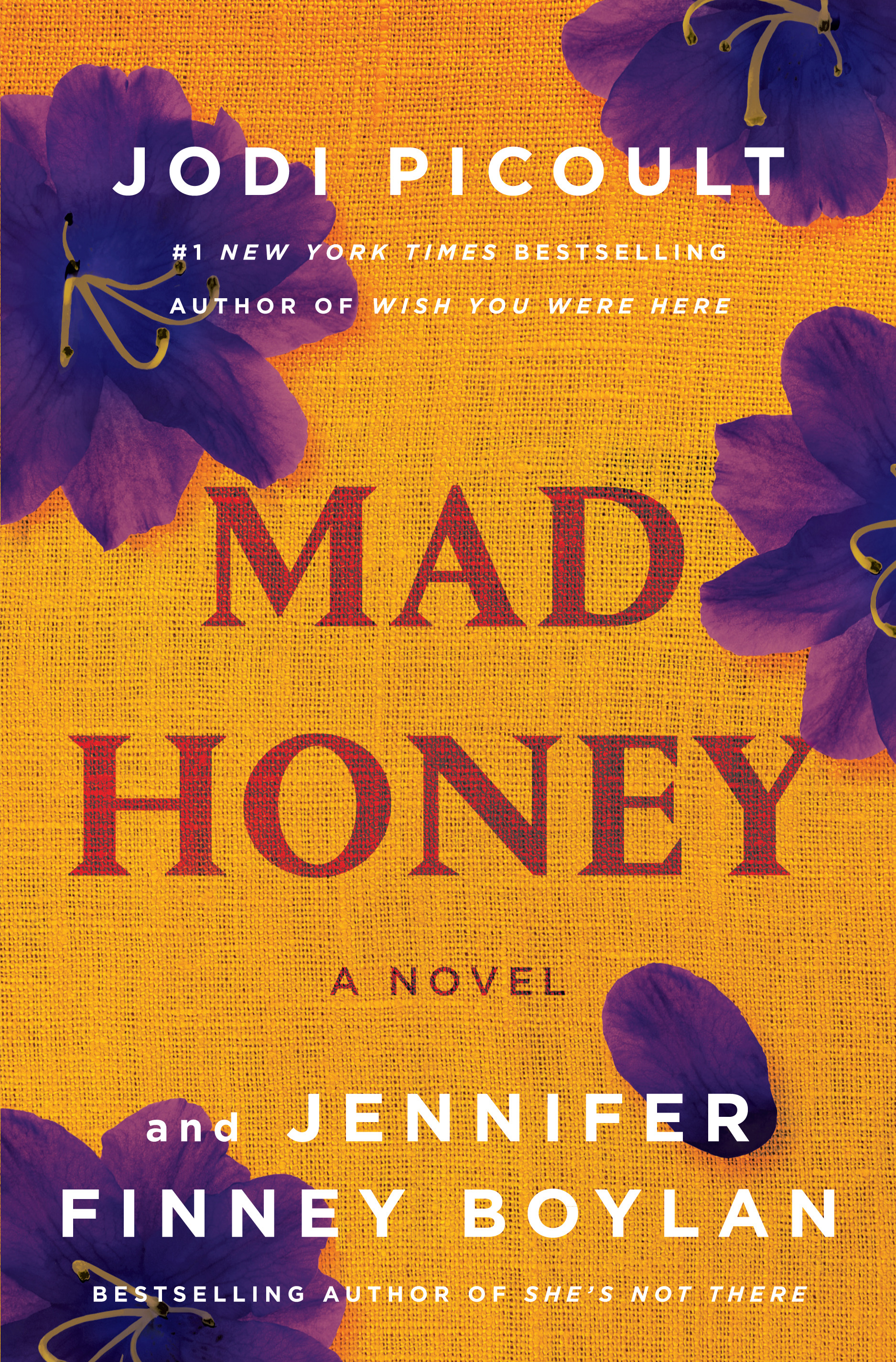
Mad Honey, by Jodi Picoult and Jennifer Finney Boylan*****

Mad Honey is the joint endeavor of bestselling author Jodi Picoult and Jennifer Finney Boylan. My thanks go to Net Galley and Random House Ballantine for the invitation to read and review.  This book is for sale now, and I recommend it to you.

The hallmarks of Picoult’s work are immediately evident. She frames her story around a particular area of interest, and so when one of our main characters, Olivia, is a bee keeper, I figure I am in for an education with regard to bees and honey; I am not wrong. Of late, Picoult has also used some of her fiction to promote social justice causes, and that’s here, too; I did a quick search on Boylan, her co-author, and learned that Boylan is one of the first transgendered Americans to write a bestseller, and this is the other focal part of Mad Honey, which features a trans character.

We have Olivia, then, the bee keeper, and her son, Asher, who is the light of her life. She took Asher and fled an abusive marriage, and enjoys her new life. She is close to Asher, and they talk openly and often; yet, there are things that Asher isn’t telling his mother, and she doesn’t see that.

Then there’s a new girl in town, Lily Campanello, a cellist, and Asher falls for her. Later, Lily is found dead, and suspicion falls on Asher. Olivia stands behind her son, and yet a corner of her mind has doubts. What if, when push comes to shove, Asher is his father’s son after all?

It’s tricky to write fiction that focuses on a controversial topic, and the critical ingredient is characterization. If the characters feel real to us, the story flows and the message becomes an integral part of their lives. We can’t reject the theme without rejecting the character. But it would take a true Grinch to step away from Olivia, Asher, and Lily. I want what’s best for the characters, and so I’m not focused on the authors and what they have chosen to discuss within this framework, but on the story. The writing flows like melted butter, smooth and inviting, and later, the suspense ratchets up almost unbearably, and I have to know what becomes of Olivia and Asher.

Because I am a bit behind, I check out the audio version of this novel at Seattle Bibliocommons.  There are multiple narrators, but the one that resonates most for me is the reader voicing Lily. I say this, despite the fact that she butchers the pronunciation of place names in the Pacific Northwest. Eugene, Oregon is not hard to say. Siuslaw and Willamette are trickier, but there’s only one pronunciation for each, and the reader should have done due diligence.

And now that I’ve said this, I can urge you to get this book and read it. For those unfamiliar with trans people, there’s some good information, and the story is a compelling one. There’s a twist at the end, and I would probably have left that out, as it doesn’t add much, although I can also see the reason it is included. Nevertheless, this is a story worth your time and money, whether as an audiobook or in print.

Patricia Wants to Cuddle: The Audio Version, by Samantha Allen and a host of excellent narrators

Note: after hearing the audio version, I changed my rating to 5 stars. 5 stars shouldn’t be reserved for Shakespeare, for Toni Morrison, for Elizabeth Strout. 5 stars means the book is among the very best in its genre; Patricia Wants to Cuddle is among the best humorous novels being published this century.

A further note: this is the first time I can recall an audio book making a narrative easier to follow rather than harder. The presence of multiple, very skilled readers (Cindy Kay, Justis Bolding, Laura Knight Keating, Susan Bennett, and Jasmin Walker) makes it easier to tell the Catch contestants apart.

It is great to encounter my favorite parts a second time; within the last twenty percent of the book, the figurative language involving a weathervane and a turkey absolutely slay me.

Below is my original review.
________________________________________

“You have to watch out for the quiet ones.”

I had an ugly upper respiratory flu, and this excellent novel was exactly what the doctor ordered. My thanks go to Net Galley, Recorded Books, and Zando Publishing for the review copy. Patricia Wants to Cuddle will be available to the public Tuesday, June 28.

As the story begins, we are midway through filming “The Catch,” which is a reality television show similar to “The Bachelor.” Our cast includes the four lucky women to have made it this far; producer Casey; a handful of crew members; and oh dear, Jeremy, a scuzz bucket if ever there was one. Jeremy is this season’s catch. We also have a handful of locals, since we are filming on location; included is a bashful cryptid in the woods, a lonely creature that reacts very badly to stressful situations. As you may guess, Patricia is that cryptid.

These people are on Otter Island, a fictional addition to the San Juan Islands off the coast of Washington State. Think deep woods, rain, and glamping. And…what the hell was that, just now? Too big to be a bear. And why are the sheep so agitated?

Baaaaa.

The contestants are mostly not interested in love; they are interested in publicity, for various reasons of their own. The shooting schedule leaves them sleep deprived on an almost permanent basis, and so given the premise of the show—competition, not cooperation—it doesn’t take long for the women to turn on one another.

Samantha Allen is new to me, but she’s on my radar now. This story is snicker-worthy at the outset, and by the time we reach the climax, I am howling with laughter. Part of the joy comes from the plot and pacing, but the biggest laughs for me are those that combine these outrageous events with some of the funniest figurative language I have ever read. In fact, were I to rate this story solely on its humor, without rating the more traditional elements such as character development, this would be a five star read.

This book will appeal most to those that lean to the left.

Recommended to those that love darkly hilarious fiction.

Patricia Wants to Cuddle****-*****

“You have to watch out for the quiet ones.”

I had an ugly upper respiratory flu, and this excellent novel was exactly what the doctor ordered. My thanks go to Net Galley and Zando Publishing for the review copy. Patricia Wants to Cuddle will be available to the public Tuesday, June 28.

As the story begins, we are midway through filming “The Catch,” which is a reality television show similar to “The Bachelor.” Our cast includes the four lucky women to have made it this far; producer Casey; a handful of crew members; and oh dear, Jeremy, a scuzz bucket if ever there was one. Jeremy is this season’s catch. We also have a handful of locals, since we are filming on location; included is a bashful cryptid in the woods, a lonely creature that reacts very badly to stressful situations. As you may guess, Patricia is that cryptid.

These people are on Otter Island, a fictional addition to the San Juan Islands off the coast of Washington State. Think deep woods, rain, and glamping. And…what the hell was that, just now? Too big to be a bear. And why are the sheep so agitated?

Baaaaa.

The contestants are mostly not interested in love; they are interested in publicity, for various reasons of their own. The shooting schedule leaves them sleep deprived on an almost permanent basis, and so given the premise of the show—competition, not cooperation—it doesn’t take long for the women to turn on one another.

Samantha Allen is new to me, but she’s on my radar now. This story is snicker-worthy at the outset, and by the time we reach the climax, I am howling with laughter. Part of the joy comes from the plot and pacing, but the biggest laughs for me are those that combine these outrageous events with some of the funniest figurative language I have ever read. In fact, were I to rate this story solely on its humor, without rating the more traditional elements such as character development, this would be a five star read.

This book will appeal most to those that lean to the left.

Recommended to those that love darkly hilarious fiction.

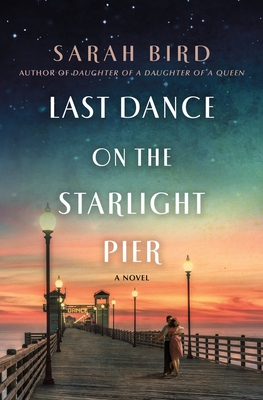
Last Dance on the Starlight Pier, by Sarah Bird***

I’ve been a big fan of Sarah Bird’s historical fiction since I read Daughter of a Daughter of a Queen, which was published in 2018. When I saw that she had a new book coming out, I was excited and couldn’t wait to start reading it. My thanks go to Net Galley and St. Martin’s Press for the review copy, and McMillan Audio for the recording. This book is for sale now.

Our protagonist is Evie Devlin; the setting is in Texas during the Great Depression. This is a time before government relief exists. Jobs for capable men are scarce, and for women, nearly nonexistent. Evie’s father is dead, and her mother has let her know that she won’t support her efforts to become a nurse. When hard work and determination land her a scholarship, Evie is over the moon, and she makes her way to St. Mary’s School of Nursing in Galveston. The director is not happy to see her; she disapproves of scholarship girls in general—a low class of girls, she believes—and in particular, a Protestant one! What is this world coming to? However, Sofia Amadeo likes Evie, and she wants her admitted, and since the Amadeo family’s money and power drive absolutely everything in Galveston, the director is forced to let Evie in. She and Sofie become roommates first, and then the closest of friends.

We follow Evie through nursing school, but on graduation day, she hits a snag and is sent away without her pin, which is the equivalent of a license to practice. Now homeless and nearly penniless, Evie is adrift, until she learns about the dance-a-thons that feature cash prizes. She was forced to dance for money as a small child and doesn’t care to do so again, but when she sees what passes for a nurse in the show—basically someone off the street recruited to play the role of nurse, but with no training of any kind—she persuades the manager to hire her instead. From there, romance and all sorts of other entanglements and complications ensue.

For roughly the first eighty percent of the book, I am enthralled. The plot is fascinating, the historical accuracy commendable. Soon this becomes my favorite galley. And this is why I feel such a colossal sense of disappointment, almost a sense of betrayal, in fact, when the ending is cobbled together with feel-good revisionism and wishful thinking. Without going into spoilerish detail, a member of an oppressed minority becomes Evie’s focus, and suddenly we roam so far from the historical truth that we never find our way back again. And make no mistake: the actual truth is ugly. But if you’re going to write in the kitchen, you have to be able to bear the heat. Or, something like that.

Sarah Bird is a badass writer. Just reading her figurative language alone gives me joy, and I am hoping fervently that this bizarre departure is an anomaly. I look forward to seeing what she writes next.

As for the audio, Cassandra Campbell does a serviceable job, though the Italian accent sounds a bit like Dracula. This is a common issue, I find, and so I’m not terribly concerned about this aspect. Everything else she does is right on point. If you are going to read this book—which, sadly, I cannot recommend—I’d say it’s a toss up as to audio versus print. Go with whatever you’re most comfortable with, but do it free or cheap if you decide to acquire it.