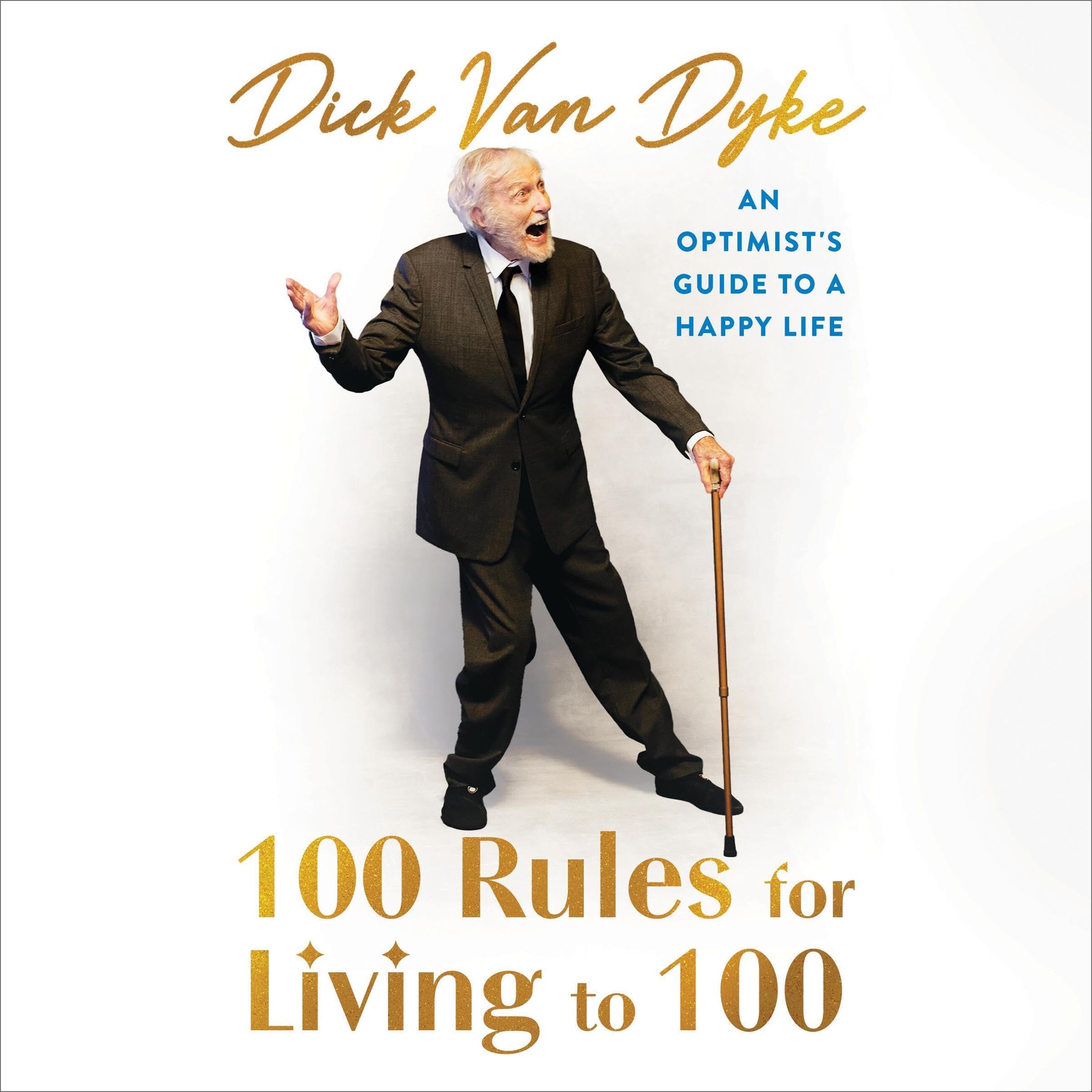
100 Rules for Living to 100, by Dick Van Dyke****

Version 1.0.0

Dick Van Dyke was a wonderful part of my childhood, and this lovely audiobook has put a little more bounce in my step. It’s not really about rules, of course, but the format is a perfect scaffold for a combination memoir and self-help book. My thanks go to NetGalley and Grand Central Publishing for the review copy; this book is for sale now.

Van Dyke entered my consciousness when I was a kindergartener, and the original movie Mary Poppins brought droves of families to theaters. I was not the only family member that was entranced, and all of us sang along to the sound track once the record was on our stereo turntable. The movie, and its lead characters, played by Julie Andrews and Van Dyke, glowed with humor and optimism.  What a wonderful message to share, the idea that the best we can give our children is our time and our attention. In the early 1960s, the suggestion that adults ought to listen to children was ahead of its time and much needed.

Many of the anecdotes the author conveys have to do with experiences shared between him and Arlene, his current wife. Despite the May-December romance, it sounds like a wonderful union. He talks about the recent and horrific events with the Santa Ana fires that took the homes of so many—though his own was spared. My favorite parts, though, are the ones in which he discusses the future roles he’d like to play, because he isn’t really retired from the industry. Way to go, Dick!

Reader Tom Bergeron does a nice job, and as a bonus, he sounds quite a bit like the author.

I recommend this little gem to everyone that could use some positive energy, and to all that love the author.

In the Time of Five Pumpkins, by Alexander McCall Smith*****

In the Time of Five Pumpkins is the 26th installment of the #1 Ladies’ Detective Agency mysteries by Alexander McCall Smith. This is hands down my favorite cozy series, and it may very well be my favorite series, period. Precious Ramotswe is our chief protagonist and owner of the business, and her easy-going manner with others and her capacity to smooth over a difficult situation are a breath of fresh air. Of course, Precious is fictional, but she feels real to me. I feel as if I have known her for decades, which in the literary sense, I have. My thanks go to NetGalley and Random House for the invitation to read and review. This book is for sale now.

As with all of my best loved, long-running mystery series, the joy of reading is only partly to do with the mystery. In fact, I almost think Smith could forget to include a mystery and I might take a good long while to notice; I enjoy greeting the continuing characters that I haven’t seen in some time. Mr. J.L.B. Matekoni, who is married to Precious and runs a garage in the same building where Precious has her office; Mma Potokwane, Precious’s “traditionally built” best friend, who runs an orphanage and always has fruitcake ready when Precious visits; Charlie, the formerly bumbling mechanic who is shaping up nicely as a part time detective trainee; and of course, Mma Makutsi:

Employees who leave it to their employers to promote them may have a long time to wait, but this was not the fate of Mma Makutsi. She had somehow managed to promote herself, first to the role of senior secretary, then without discussing the matter with Mma Ramotswe, to assistant detective, associate detective, associate director, co-director and so on, to the position she had most recently chosen for herself—executive president for development. This was a novel description and had rather puzzled Mma Ramotswe.

Passages such as this one leave me gasping! How many of us, in a similar situation, would allow someone that we had hired to give herself such exalted titles? It’s both bizarre and preposterous. But there’s never a question of salary; no matter what she calls herself, Mma Makutsi makes the same money as before, and no one here is making very much.

The stories usually have more than one thread, and so it is with this one. A woman arrives from the States to meet someone that turned up in her ancestry search, and the agency is hired to help her find them. At the same time, another case involving marital problems, though not the usual sort, is presented. And a third thread has to do with a shady character that has befriended Mr. J.L.B. Matekoni. Before all is said and done, Charlie has a “Clovis Anderson moment,” which has been a long time coming, and J.L.B. Matekoni saves his creepy new friend from a “government crocodile.”

This is a series that never gets old, and perhaps because the excitement is ramped up just a tick in this one—not too much, we do want to keep it cozy, after all—it may be my favorite so far. Highly recommended to all that love the genre.

Over Yonder, by Sean Dietrich*****

Sean Dietrich has written another fine novel, Over Yonder, one full of quirky characters, weird yet oddly credible situations, and a whole lot of heart. My thanks go to NetGalley and Thomas Nelson Books for the review copy. This book is for sale now.

Dietrich has been writing for a long while, but this is just the third of his books that I’ve read. As I begin this one, I develop a niggling suspicion, wondering whether this author uses a formula. This would be a sad discovery, because till this point, I have greatly loved his work. And so the question I have to answer before I can do much else is whether that’s true, or whether he is writing unique stories using a signature style. Here is what I am seeing: each story focuses on a girl—teen or child—who’s down on her luck, possibly facing a crisis, with no adult that will help her or advocate for her; an older man dealing with misfortune of his own such as a fatal or serious illness, and who is otherwise isolated and in need of redemption; and a chance meeting of the two in a small town in the deep South.

I suppose, after reading this third one I am inclined—as you can see from my rating—to say this is a signature style rather than a formula. I hate to be played. If I felt this was a formula, I would feel annoyed and my review would not be generous, but that’s not what happens.

Caroline is 17 and pregnant. Her boyfriend, Tater Bunson, is at the wheel of his ’93 Honda.

“Caroline stared out the lace-like cracks of the passenger window’s single bullet hole at downtown Knoxville…her hair was the color of a carrot. She was ninety-four percent freckles. Her small, upturned nose, full cheeks, and cherub face brought to mind a character from the highly successful Cabbage Patch Kids product line…Tater spun the wheel right. The car made a sound not unlike a Folgers can of rocks falling down a public stairwell. The spiderweb crack on the passenger window came from a .22 caliber bullet that had passed through the glass during Tater’s last heated disagreement with his mom.”

Woody Barker used to be a priest. He has a houseboat and a bad heart, and not much else. He can qualify for a heart transplant, but only after he quits smoking, and it’s not going well. He’s lonely; he had hoped to pick up with his ex-wife once he got out of prison, but now that he’s out, he sees that she has a boyfriend, and it looks like he’s out of luck. Then an old girlfriend summons him to her deathbed. She wants him to meet his 17-year-old daughter. Who? What??

Dietrich’s wry humor and visceral figurative language are out in force here. Highly recommended to those that enjoy strong Southern fiction with deeply developed characters.

The Autumn Springs Retirement Home Massacre, by Philip Fracassi*****

It’s not just every day that I run across a five-star slasher novel, but author Philip Fracassi hasn’t written just any slasher novel, either. The Autumn Springs Retirement Home Massacre is one of this autumn’s most agreeable surprises. My thanks go to NetGalley, Macmillan Audio, and Tor for the review copies; this book will be available to the public September 30, 2025.

When a friend recommended it, she said it was funny and also different from her expectations. I agree on both counts. I was anticipating a book with plenty of old-folks barbs, sort of like the satirical carol, “Grandma Got Run Over by a Reindeer.” I considered whether I was up for it, given that I am a grandma myself, and decided my sense of humor hadn’t aged out. Sure, let’s give it a go.

Instead, though the book is indeed darkly funny in places, it also has aspects I didn’t anticipate. How many humorous slasher stories have character development, for instance? How many have genuinely poignant moments? And finally, on a more traditional yardstick, I find myself completely surprised by the solution.

Our protagonist is Rose Dubois, a 70-year-old retired school teacher. She buys a unit in the retirement community, not because she’s too decrepit to remember her medications or because she needs constant monitoring, but because she is ready to live in a smaller home near other people her own age. Her daughter has been urging her to come live with her instead, but Rose has friends here. She likes her little place, and she values her independence. She doesn’t want to go anywhere else.

Then her pals begin dying. The first is her bestie, and it stings, but also raises questions. The death—without giving anything away—seems out of character. But surprises happen, and they’re not all nice ones, so she and Angela’s other friends grumble, but move on.

But as the title suggests, there’s another. And another. Where will it stop? Rose and her remaining friends vow to stop it themselves, since the local cops and the home’s administrators don’t seem terribly concerned.

The story also raises the issue, a very real one, of the public’s lack of concern for the elderly. Hey, old people die. That’s what we do! And moreover, before we go, older folks become nearly invisible. The author’s moving note in the afterword explains why he took the approach he did.

Not long after I began reading, I was given access to the audio version, narrated by one of my favorites, January LaVoy. Although the print version is delightful, I give a slight edge to the audio because its format, which is mostly linear, lends itself well to this medium, and also because LaVoy always brings something extra to her narration.

Highly recommended to all that enjoy mysteries and a little gallows humor.

Something to Look Forward to, by Fannie Flagg****

Nobody should ever say that Fannie Flagg doesn’t give us our money’s worth! There are over 30 short stories in this nifty collection, and I enjoyed it thoroughly. My thanks go to NetGalley and Random House for the invitation to read and review; had it been necessary, I would have paid hard cold cash for this collection, and I seldom say that.

This book is available to the public now.

Flagg has always been known for her feminist swagger and perceptive humor. Here she crosses into several genres, beginning with science fiction—a first for this author? —and continuing on more familiar ground with historical fiction, Southern fiction, contemporary fiction, LGTBQ, and of course, humor. There are a handful that start early and reemerge later, but most are just simple short stories, easy to read and for the most part, filled with the feel-good vibes that we all need right now.

My favorite of them all is “Darla Womble,” a story set in Pot Luck, Arkansas in 2004. Here’s how it begins:

“At 9:18 A.M., in and around Pot Luck, Arkansas, thirty-eight relatives of Darla Ann Womble received a frantic email, which read:

            ‘DARLA’S NOT DEAD, AND SHE’S MAD AS HELL!’

After seeing the email, two people threw up, one fainted, and another decided he would run for his life. This news came as quite a shock to all, especially since all thirty-eight had recently attended the reading of Darla’s ‘Last Will and Testament.’

It only gets better from there, and it was a near thing since I was eating lunch; I narrowly escaped spraying my cheese enchiladas all over my kitchen! Other favorites are “Beware of Weathermen” and “Don’t Mess with Texas,” both near the beginning of the collection, and “A Thinking Man,” which is near the conclusion.

As with her other works, these stories are primarily from female points of view and will appeal more to women than men; yet I suspect there are a good number of men that will enjoy them as well. I recommend this collection to Flagg’s faithful readers, and to anyone that needs to feel a little better than they do right now.

Too Old for This, by Samantha Downing*****

Too Old for This is author Samantha Downing’s wickedly funny novel about a female serial killer. She’s retired now, living under an assumed name, but then a journalist comes to her door. She knows things and intends to write about them, and she won’t be dissuaded; then, of course, a woman has to do what she has to do.

My great thanks go to NetGalley and Berkley Publishers for the review copy. This book will be available to the public August 12, 2025.

Lottie Jones is 75 years old, living the quiet life of a single retired woman. Her son, Archie, is grown; Lottie’s chief delights are the bingo nights at the church and a bit of gossip here and there. A quiet life. Years ago, she was suspected of killing three people. Her name was splashed on the fronts of tabloids; she became a local pariah. In the end, however, she wasn’t even arrested following all of the harassment, and she successfully sued the city for damaging her reputation. The settlement was enough to start a new life for herself and her little boy, including the purchase of her home.

After one gets to be a bit older, one’s priorities and pleasures begin to shift. She doesn’t date anymore, for instance, and

“Like so many other things, murder began to feel like a chore instead of a joy. So I stopped. And I hardly ever thought about it, except in that nostalgic way. I didn’t want to go back, but I enjoyed the memories.”

The whole story is just as droll. It’s a strange alchemy, creating a likeable murderer; in the same way, the dissonance between her homicidal activities and the humdrum routines into which she has settled creates a hilarious sort of mental whiplash. One minute she’s warming up her rechargeable chainsaw to dismember her victim; the next she’s stewing about the snide remark someone at church made about the potluck dish she contributed, and gossiping about that person to her more sympathetic friends. And then her future daughter-in-law surprises her by dropping in unexpectedly, and she is concerned about Lottie’s safety, what with living alone, so she brings her a stun gun. “This was very thoughtful of her. No one has ever bought me a weapon before.”

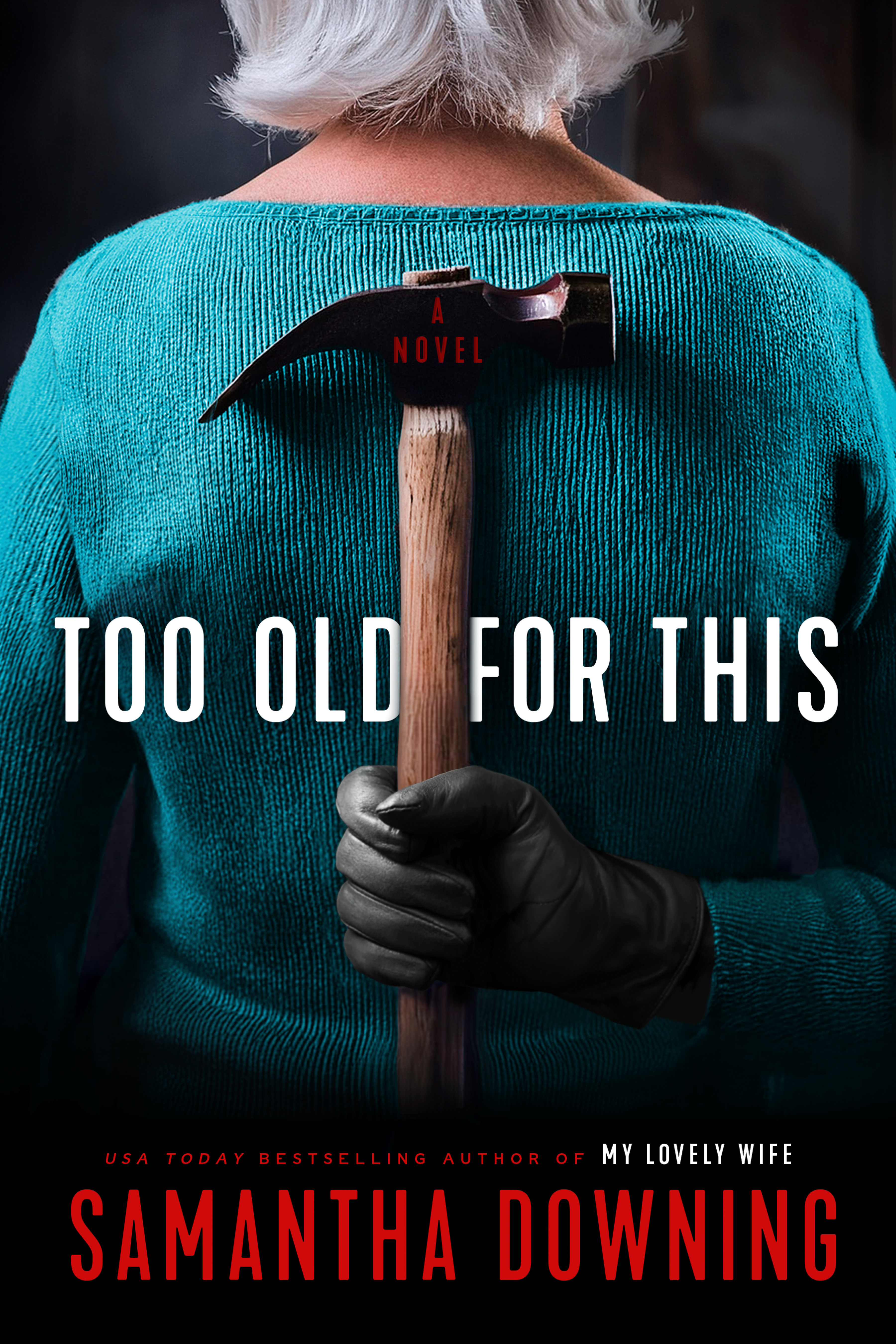
At some point, I realized that after seeing the back of her head on the book’s cover so many times, I had mentally edited in what Lottie’s face would look like if she turned around. I pegged her as a doppelganger for Camilla Parker-Bowles.

The book’s ending is pitch perfect. Highly recommended!

Fever Beach, by Carl Hiaasen**-***

What happened? I used to absolutely love novels by Carl Hiaasen. In his most recent release, Fever Beach, we see a conflict between good—in the person of our main character, Viva Morales—and evil, played by a variety of Proud Boys wannabees and other undesirables. The good person is always good; the bad guys have no redeeming qualities. Only Viva’s ex-husband is a dynamic character.

Still, my thanks go to Doubleday and NetGalley for the review copy. This book is for sale now.

As I read, I keep reminding myself that this is not a book I’m supposed to take too seriously, to lighten up and just roll with it. I certainly used to do so when reading Hiaasen’s work. But perhaps because of the stereotyping and complete lack of nuance, what might otherwise have seemed droll and satirical, instead comes across like a whole lot of cheap shots fired off the bow.

Mind you, I am certainly not a fan of ultraright organizations, and the rising tide of bigotry, fascist ideology and anti-Semitism concerns me greatly. But in an already highly polarized nation and world, all I can think as I read is that this story isn’t helping. It is the snobbery and elitism of the highly educated that has driven a large number of folks into the arms of extreme right; some intelligently reject the elitism and cancel culture consciously, but they aren’t in this book. In real life, those that are poorly educated and/or intellectually handicapped, as the bad guys in this book are, would in most cases give their right arms to wake up “clever” like Viva.  It strikes me as counterproductive to write a book that makes fun of right-wing intolerance, while practicing intolerance from a different angle.

Back in the day, before anyone judged anyone else by the color of their hat, I used to roar with laughter at this author’s work. Did it change, or did I? I would like to think it is the former.

I rated this book 2.5 stars and have rounded it upward, more from a fondness of his early novels than anything else. I do recall reading another of his more recent books—not for review, but just because I felt like it—and saw some of the same problems, so I will tell you that this book will probably work for you if you enjoyed his last one. Apart from that, I cannot recommend it.

Class Clown, by Dave Barry****-*****

4.5 stars, rounded upwards.

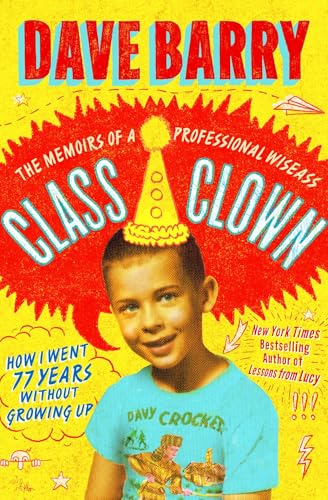
The first time I read a Dave Barry column, it was 1984, and a friend sent it to me. We had only snail mail back then, but it was so funny that she snipped it out of the airline magazine she’d read on a business trip and mailed it to me. I don’t remember which column it was, but it left me gasping for air, I laughed so hard. This was a difficult time for me, a young mother with two small children, a third on the way, and almost no money, and I floated along on the laughter that article brought me for a solid month. I hung it on the fridge where I could reread it whenever the urge struck me. That is how I became a Dave Barry fan.

Since then, his work has either hit or missed for me; almost all of the time, it has hit and although times are easier for me now, laughter is always a balm. When he misses—which is rare—he misses bigtime. But this time he’s golden, the Dave I remember reading that first time.

My thanks go to NetGalley and Simon and Schuster for the invitation to read and review. This book is for sale now.

It strikes me again how frequently the funniest humorists, be they journalists, novelists, standup comedians, or comic actors, have tragic backgrounds. Barry has experienced more than his fair share, with a schizophrenic sister who’s been institutionalized, a father that died too young, and a mother that couldn’t recover from his loss, and took her own life. Barry wrote about her when it happened, and he reprints some of it here.

He reprints some other things, too, and I expected that. I don’t think that it cheats the reader when he documents parts of his professional journey by reprinting some of the things he wrote; he’s been writing prolifically for thirty years, and it seems to me that it was probably a lot of work just choosing what to include and what to leave out. It feels strangely like a school reunion, rereading the excerpts from drop dead funny columns that I enjoyed for the first time when they were originally published. Oh, my heart, “Ask Mr. Language Person!” I’m an English teacher, and I’m in stitches all over again.

The thing about an autobiography is that the author is also the subject, and so when he decides what parts of his own life to write about and what to keep private, we readers need to accept that. At the same time, it does seem disingenuous to completely pass over his marriages and divorces. A paragraph for each, maybe? Just give us the benchmarks.

I hadn’t known that he was responsible for Talk Like a Pirate Day, and both I and my middle school students owe him for that one! But the thing that is most striking to me, and that I appreciate most, is his reflection about the political discourse in the U.S., and the way we have become polarized and too often, uncivil. In the past—and he cites the Kennedy/Nixon campaign—arguments between family and friends were “heated, emotional, sometimes angry, but never nasty. At the end of the night everybody hugged everybody, because they were friends, and they understood that they could disagree about politics without believing the other side was evil. Mistaken, maybe. Evil, no.” All I can say about that is thank you, Dave, and amen.

Because I was running late, I checked out the audio version from Seattle Bibliocommons. Barry does his own reading, and it’s even better that way.

There are a lot of hilarious experiences he recounts, but the thing about Barry that binds all of the experiences, the columns, and the books he’s written is his refusal to take himself too seriously, and it is his complete and delightful intolerance toward pretentiousness that keeps me coming back. I cannot imagine Dave Barry snubbing anybody, ever. Wouldn’t the world be a better place if everyone was like that?

Highly recommended.

The Medusa Protocol, by Rob Hart****

“’I’m Mark, and I haven’t killed anyone in two and a half years,’ I say.    ‘Hi, Mark.’”


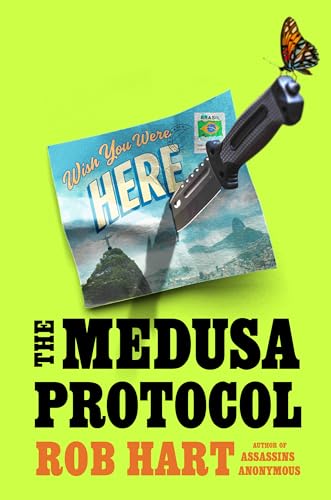
The Medusa Protocol is author Rob Hart’s second book in his Assassins Anonymous series. Happily for me, I didn’t notice that I was reading the second in a series; I didn’t read the first, and I might have sidestepped it had I realized I was entering mid-series. As it was, I had fun and enjoyed this satirical romp through a sea of professional murderers, sharks, and poisonous vipers.

My thanks go to NetGalley and Putnam Penguin for the invitation to read and review. This book is for sale now.

Our story commences with a group of recovering assassins meeting in a church basement. Then things start to go sideways; a member who’s expected isn’t there, but sends her personal choice of pizza to let them know she’s in trouble just as enemy assassins crash the meeting.

Huh? What?

From there, we dive down the rabbit hole, seeing the past and present alternately through the eyes of Mark, who is Astrid’s mentor in the program, and Astrid, a recovering killer who has been kidnapped and is being held in a Brazilian prison on an island in shark-infested waters, and which is home to a great many large, venomous vipers. How can her friends rescue her without having to kill anybody?

Just keep whispering the Serenity Prayer to yourselves, guys.

This is a fun read. Although the point of view shifts with every chapter, either between characters or time periods, these are clearly delineated, and I have no trouble keeping them straight. I only had the digital galley, not the audio, but I suspect that, assuming the reader provides the headings at chapter beginnings, it will be fine. The humorous moments when the rescuers worry about the mission threatening their sobriety are meted out exactly as they should be, not so many that it stops being funny, but frequent enough to keep me chuckling. There isn’t a lot of character development, but I don’t expect it from a satirical, action-packed novel like this one; there is some dialogue toward the middle that is overly wordy and should be edited down, but apart from that, it’s smooth as glass.

Some reviewers suggest not reading this one unless one has read the first; I am glad I didn’t see that advice till after I had read this one. I don’t care that this book provides spoilers for the first, because I am not going to read that one anyway. I will, however, cheerfully read the next in the series, whenever it becomes available. Meanwhile, I recommend this nifty little book to you.

Far and Away, by Amy Poeppel****-*****

Amy Poeppel is the queen of intelligent feel-good novels. Her newest work, Far and Away, is about two women that have never met, one in Dallas, one in Berlin, who exchange houses for several months. The deal is done fast, as both of them have a short time to line something up, and soon they will both regret their hasty decisions.

My thanks go to NetGalley and Emily Bestler Books for the invitation to read and review. This book is for sale now.

One of the things I love best about Poeppel’s writing is her ability to create a complex plot with a lot of moving pieces, along with believable, sympathetic characters; yet somehow, the whole thing is easily understood, never confusing. Our story starts with Lucy and her family in Dallas, Texas. Her eldest child, Jack, is about to graduate from a private high school, then attend M.I.T. At the last minute, however, he is expelled unceremoniously. He’s done something dumb, and it’s been interpreted as something more sinister. He isn’t even offered a chance to explain or to defend himself. And though there is a lot of other business involving other characters, I enjoy this part most for the message it sends us at a time it’s desperately needed. Before you judge someone, take a moment to listen. Ask some questions before you hurl accusations and seek vengeance. If the behavior is as deplorable as you think it is, there’s still plenty of time to accuse and avenge afterward.  We in the U.S. and also Europeans can benefit from this one tasty nugget. Plenty of others can, too.

On the other side of the world in Berlin, Greta’s husband Otto has been invited to teach for a term at a college in Texas. He’s accepted without even discussing it with Greta; he has to go right away! Where will they even live? Otto suggests a hotel; Greta is having none of it. In her desperate search for last minute housing, she is connected with someone that knows that Lucy has decided, quite suddenly, to relocate for the summer. The accusations against Jack have turned to harassment and vandalism, and she’s ready to get out of Dodge. Her husband is incommunicado, performing a simulation for NASA, a part of which is to be cut off from everyone else. Mason still thinks that Jack graduated, and that M.I.T. is Jack’s next step.

And so it is that Lucy and her brood relocate to Greta’s apartment in Berlin, and Greta and Otto take up residence in the massive experimental home in Dallas owned by Lucy and Mason. Not a lot of details have been exchanged about either place; there hasn’t been time. So, they get on the plane, and everybody gets what they get, to their sometimes consternation.

There are many hilarious moments here; I especially enjoy the foreign language errors made, both English to German, and German to English.

If there were one thing I could change, I’d rework the epilogue. There’s a considerable jump in time, but the chapter heading doesn’t tell us, and so I am taking in details while doing some mental calculations. That’s not so bad when it’s at the start of a book, but at the end, it’s disorienting and breaks the flow. I also feel as if there were too many things tied up with too many bows. A kindergarten teacher told me once that the key to having a kindergartner paint, was to know when to stop them. It may also apply to adults and their writing.

Nevertheless, I loved this book! Part of the magic is due to Poeppel’s understanding of human nature, which is inherently good, and part of it is her hilariously quirky humor that often drops in, seemingly out of nowhere. Highly recommended.