
The Making of Another Major Motion Picture Masterpiece, by Tom Hanks*****

Tom Hanks has more than one talent, that’s for sure; or perhaps he is an artist that’s ridiculously talented at telling stories, whether they be on the page or screen. One thing I’ll tell you now: I am completely convinced that he did indeed write this book himself, and it’s damn good, too.

My thanks go to Net Galley and Alfred A. Knopf Publishing for the review copy. This book is for sale now.

The story begins with a child prodigy, an artist living in Lone Butte, California, who as he matures, becomes a comic book illustrator. Fast forward about thirty years, and that comic becomes a movie.

Our story doesn’t have just one protagonist, and it is intentional, or so it appears to this reviewer. We have the big boss, Bill Johnson, his assistant, Candace, and the assistant she recruits in Georgia, Allicia. We learn something of their backgrounds and their personalities, but mostly, we see how important they are to the success of the movie. When the movie is finished with Atlanta, Allicia, who now goes by Al, comes along and is eventually promoted; she then finds someone to take her place. We learn more about other people that are working the production, and I am amazed by the sheer number of people involved, and how much must be done to keep everyone on an even keel. Eventually we meet the two big stars of this action movie; one is hardworking, cooperative, and comes up with a host of useful ideas; the other is an egotist, a Do-You-Know-Who-I-Am type, and everybody walks on eggshells in an effort to make him happy, and to make him want to show up and do his job.

In the hands of a less talented writer, this whole thing might feel list-like, but Hanks sculpts these characters so that I feel I know them, and I care about what happens to them.

There’s more than a little wry humor in this tale, and the copious footnotes at the end of each chapter are a part of that. I read them all, because some of them are hilarious, but readers that lack the patience for it can breeze right on by them without missing anything critically important. And here’s a nugget that cracked me up:

“Of late, Bill had been using military-style call words rather than expletives. Fuck was Foxtrot. Asshole was Alpha Hotel. Cocksucker? Charlie Oscar Charlie Kilo Sierra.”

As a bonus, artist Robert Sikoryak has written the comics themselves, and they are included in the book. Those that love comics should probably get this book in hard cover, because a lot of the detail is hard to see in the digital version that I read. As for me, I don’t give one single poo about comics, and I skipped them.

Movie buffs will be fascinated with the vast amount of movie making minutiae here. I am not a big movie viewer, but I eat it all up, anyway, because I had no idea of the amount of time, personnel, and materials necessary to creating a major movie, masterpiece or otherwise.

Although he doesn’t beat the drum hard enough to distract from the overall story, Hanks’s message is crystal clear: everyone involved in creating a movie is important. If the crew doesn’t have enough restrooms, it affects the movie. If nobody brings lunch to the set, some people will be miserable and perform below par, whereas others will slip away in search of food and not be available when needed. And if just one person is a horse’s ass and drags his feet, or if he blabs things to the press that aren’t supposed to be released yet, he can add millions of dollars to the cost of the production. Here’s a perfect quote:

“What advice can you give us to make it in Hollywood?” She talked about the great divide between solving problems and causing them, and the importance of being on time.”

Through all of this, I keep wondering when we will see the young artist that made the comic again. If we started with him, it makes sense we will see him again at some point, right? Yes. This detail—along with every other—is done beautifully.

There’s not one thing about this book that I don’t love, and the feel-good ending is icing on the cake. Highly recommended to those that love movies as well as excellent fiction.

Finding Dorothy, by Elizabeth Letts*****

“Don’t let anybody steal your marbles.”

Maud Gage Baum is one of a kind. The godchild of Susan B. Anthony, child of first-wave feminist Matilda Joslyn Gage and an indulgent, progressively inclined father, she is unhampered by many of the traditional expectations that shackled women born during the American Civil War. But though her parents encourage her to develop her mind and talents, they have little prepared her for the wider world that greets her, and when she arrives at the women’s dormitory at Cornell University, she is considered peculiar by her classmates. She is a lonely young woman, until her roommate sets her up with Frank, an eccentric, clever man whose whimsy equals her own. My great thanks go to Net Galley and Random House Ballantine for the galley, which I received free in exchange for this honest review. It will be available to the public tomorrow, February 12, just in time to be wrapped in red paper and given to the bookworm you adore.

Maud’s story comes to us from two different time periods, one of which starts in 1871 during her childhood and moves forward in linear fashion, and the other in 1939, when she comes to the set where The Wizard of Oz is being filmed to fulfill her beloved Frank’s dying wish; he has asked her to look after Dorothy.  And though it initially means gaining access to the studio through duplicitous means, Maude befriends the unhappy but massively talented Judy Garland, and advocates for the intention behind her character, sometimes successfully, sometimes not.

I love this book hard. It has an unusual appeal, not a thriller nor a grab-you-by-the-hair page turner, but rather a strangely comforting novel, one that offers us the chance to follow Maud to another time and another place. I read several books at a time, and this one became my bribe to myself, the reward I could look forward to after completing increments of other books that I wouldn’t abandon, yet didn’t love as I did this one.

How many times have I reviewed a book favorably yet with the caveat that it isn’t bedtime reading, and maybe not good for mealtime either? Listen up. This one is good for both. It will make you appreciate your meal as you move through the hungry years of the Depression, and as you read about poor Judy being starved with lettuce and cottage cheese, her penalty for reaching puberty when the studio wanted her to look like a scrawny waif. And at bedtime, even the sorrowful passages are wonderfully hypnotic.

The love story between Maud and Frank is one for the ages, and without Letts, who would have guessed? Midway through the story I felt the need to know how closely the author kept to the truth, and I skipped to the notes at the end. I am delighted to say that this writer did a great deal of research, and she tells the reader specifically where and when she departs from historical fact for the sake of the story.  The way that the character of Dorothy is invented, based on a string of actual events from the Baums’ lives, is riveting, and in fact had the author not told us otherwise, I would have assumed that much of it was made up, because it’s almost too cool to be true.

Letts develops her characters subtly, with never a caricature or stereotype. Though her settings are well drawn, this is a character based book if ever I read one, and it must truly have been a labor of love. I’ve read a dozen books between this one and the present, yet this is the title that makes me smile.

This beautifully crafted story is bound to rank high among the year’s best historical novels. Sweet, soothing, and highly recommended.

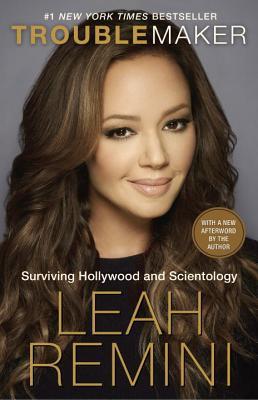
Troublemaker, by Leah Remini and Rebecca Paley****

TroublemakerActor Leah Remini was a child when her mother discovered Scientology; the church was in many ways her parent. When she rebelled against it, she was smart and very public, and she spells the entire thing out for us right here.

Scientology is a cult that relies heavily, as cults do, on secrecy and peer pressure. Children are seen as adults in children’s bodies; they have more agency than kids in normal families do, but they also have absolutely no support system. This is a thing that the states should have been all over a long time ago, but money talks, and the church cultivates relationships with people in key places. No wonder they didn’t want Remini—or anybody else—to talk about it. In turns her memoir is incisive, shocking, and sometimes very funny. Remini discovered that the emperor isn’t wearing a stitch when she challenged the double standard the church uses with regard to big names, in particular Tom Cruise. Her candor and wit make the story shine.

Should you buy this book? I did, thanks to a gift certificate from Powell’s City of Books. Had I known that there was an entire television series, in documentary format, I might have decided to buy something else, but it’s a well-written memoir, albeit with the assistance of someone else.  It flows well with never a slow point, and there are a lot of interesting pictures.

An interesting memoir, and a fast read.