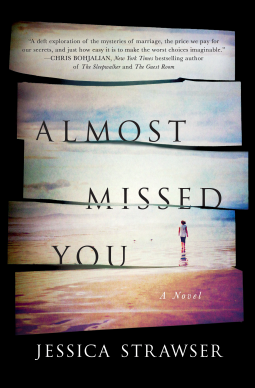
Almost Missed You, by Jessica Strawser****

almostmissedyo“Fate, people liked to call it. But Violet pictured it as dominoes. Somehow, they’d been positioned perfectly. And at the end of the line was Finn.”

Thanks go to Net Galley and St Martin’s Press for the DRC for this intricately crafted novel, which I received free in exchange for an honest review. Unique and tightly woven, it’s sure to arrest your attention until the last page is turned. This book goes up for sale March 28, 2017.

Violet meets Finn while on vacation in Miami, and wild coincidences draw them together. They went to the same obscure, short-lived summer camp, and they’re both from Cincinnati. How crazy is that? And so when they come together again, it feels like something out of a fairy tale. They marry and have an adorable son they call Bear. Later they return to Miami as a little family.

Then Violet returns, warm and fulfilled, to the hotel room…and both Finn and Bear are gone, along with their luggage.

This is a story that speaks to every mother’s worst nightmare, the abduction of her child. Her baby! And Strawser plots it cleverly, so that the obvious answers are no longer feasible. Of course the police are called, but since there was no divorce, no restraining order, there’s only so much they can do. They have other cases as well. Meanwhile, Violet is both frantic and bewildered. She had thought they were so happy together; what on Earth happened here?

Our main characters are these two parents as well as their closest friends, Caitlin and George. George is a ruling class scion, and at the start of the book it seems as if this is overemphasized. At one point I enter it in my digital notes: put the trowel away already, we get it! But here I am mistaken, because the frequent references are here for a reason; that’s all I will say about that lest I ruin the end for you.

An endearing side character is Gram, the woman that raised Violet after her parents died. Older women tend to be stereotyped in novels; they are either background characters that emerge with cookies or chicken soup and then depart again to make way for the real characters, or they are the cause of all that is bad—shrews, harpies, abusers, enablers, nags. Gram has shrewd advice and insights. She’s not just a cardboard cutout.

The inner narratives, which alternate and in doing so build suspense, are where the strongest voices are found. The dialogue is nicely done, but not as effective as the narratives. And more than anything I have read recently, this book is driven by the plot. The ending is a humdinger.

Ordinarily I would call this a strong beach read, but mothers of tiny children might want to read it somewhere else. It’s a fine debut novel, and Strawser will be an author to watch in the future. Recommended to those that like strong fiction.

The Weight of this World, by David Joy*****

It’s out! Get this one now, if you appreciate stark, immediate settings and hardscrabble characters. I will follow this author anywhere!

seattlebookmama's avatarSeattle Book Mama

theweightoftheworldDavid Joy is a writer that keeps it real, and that’s what made me lurch forward in my desk chair and grab my mouse when I saw his second novel was done.  Big thanks go to Net Galley and Putnam Penguin for the DRC, which I received in exchange for this honest review. This title will be available to the public March 7, 2017. Those that cherish strong fiction should buy it and read it.

The setting is Little Canada, North Carolina, a wide place in the road in the middle of nowhere. The family unit, such as it is, consists of April—the most unwilling of mothers—along with her son Thad, and his best friend, Aiden McCall, who shares the trailer at the rear of April’s property with Thad. The plot is centered on the inadvertent death of the local meth dealer, and a small fortune that is unexpectedly left…

View original post 448 more words

Ill Will, by Dan Chaon**

IllWillThe good news is that if you’re looking for something dark, then Chaon is your author. I received a copy free and in advance in exchange for an honest review; thank you Net Galley and Random House Ballantine. This book was released today and is available to the public.

The plot centers around a psychologist, recently widowed, who’s coming unstuck. One of his sons has developed an ugly drug habit right under his distracted father’s nose, but his dad just keeps giving him money and doesn’t ask questions. At the same time, the psychologist’s brother, who was sentenced to two life terms for the murders of their parents, aunt, and uncle, is exonerated when DNA analysis is done.  Simultaneously a patient of Dan’s comes to him with questions about a series of drowning of drunken college boys that he says he believes are linked. At first, Dan assumes these are paranoid ramblings, but over the course of time, the patient begins to assume greater and still greater importance in Dan’s life, until the reader begins to wonder which of the characters is the psychologist and which is the patient.

The quality of the prose is surreal and at times, dreamlike.

Every reader has a threshold for the level of violence he or she can sustain before a book ceases to be deliciously creepy and instead becomes a thing we wish we never read. I knew when I hit the term “snuff film” before the twenty percent mark that I might be in trouble, but it was a passing reference and since I had an obligation to the author and publisher, I brushed it off and kept reading.  I read multiple books at a time, usually half a dozen or so, and I found that this book was the one that I just didn’t want to read. With the publication date upon me, I forced myself through to the end, and have been slightly queasy ever since.

I didn’t have any fun here; it was just too disturbing.

I want to be fair, and so I read carefully in order to see whether there are any clever literary nuances that might improve my rating, and the second star is included here because of some interesting and innovative stylistic tools that are employed. I liked the triple narrative that appears to be taking place simultaneously, and am interested in the business employed with sentence endings that begins with the father and ends with someone else.

The story’s ending is both unpleasant and disappointing, in that it doesn’t present any sort of epiphany or surprise. My reaction to the end of this whole unfortunate thing is, “Oh.”

None of this means that you won’t like this story. There’s a lot of buzz right now about the now discredited belief in Satanic rituals that were in the news during the 1980s, and if this is in your wheelhouse, maybe you’ll like the book. If your tastes run way out on the edge of horror, you might find it more appealing than I do. On the other hand, it won’t make the ending any less anticlimactic.

Recommended to those interested in extreme horror stories and with a bottomless wallet, or that can read it free or cheaply.

The Devil’s Country, by Harry Hunsicker****

thedevilscountryHarry Hunsicker is the former executive vice president of the Mystery Writers of America as well as a successful author. Reading this suspenseful and at times almost surreal tale makes it easy to understand why so many people want to read his work. I’d do it again in a heartbeat. Thanks go to Net Galley and to Thomas and Mercer for the DRC, which I received in exchange for this honest review. This book will be available to the public April 11, 2017.

Arlo Baines, a former Texas Ranger, is on the road when it all unfolds; he’s stopped at the tiny town of Piedra Springs, traveling from one place to another by Greyhound Bus, and he doesn’t intend to stay. He finds a place to get some food, sticks his nose in a copy of Gibbon, and tries to ignore everyone around him. Friendly conversation? Thank you, but no.

Unfortunately for him, there’s a woman with kids, and she’s in big trouble. Clad in an outfit that screams sister-wife, she is terrified, tells him she is pursued, and next thing he knows, she is dead. What happened to the children? Before he knows it, Baines is hip deep in the smoldering drama of the Sky of Zion, a cult that has deep tentacles into the local business and law enforcement establishments.

The narrative shifts smoothly back and forth between the past and the present, and Baines’s motivation is revealed. He is on the move because his wife and child were murdered by corrupt cops, who he then had killed. One particularly chilling scene, the one in which Baines is told to leave town, gives me shivers. In general, however, I find that the scenes taking place in the present are more gripping and resonant than those in the past.

Interesting side characters are Boone, a retired professor with a crease on his head and flip-flops that are falling apart; the local sheriff, Quang Marsh; journalist Hannah Byrnes; and the bad guys in Tom Mix-style hats, with the crease down the front. Setting is also strong here, and I can almost taste the dust in my mouth as Baines pursues his quest in this little town with quiet determination. Every time I make a prediction, something else—and something better—happens instead. In places, it’s laugh-out-loud funny!

Readers that love a good thriller and whose world view leans toward the left will find this a deeply satisfying read. Hunsicker kicks stereotypes to the curb and delivers a story unlike anyone else’s. I would love to see this become a series.

Himself, by Jess Kidd*****

himselfbyjesskiddAh, feck me blind now, Jess Kidd’s written herself a novel, and it’s good enough for any ten others. It comes out March 14, 2017, and although I read it free via Net Galley and Atria, there’s surely a chance I will buy one or more copies to give to those I love anyway. You should, too. It’s too clever to miss, and if you don’t mind a bit of irreverence, if you have a heart at all for Ireland and for ordinary working folk just trying to get along as best they’re able, this book is your book. Sly as hell and fall-down-laughing funny, it will put a spring in your step for a goodly while thereafter. That it will!

Mahony has come to the tiny Irish town of Mulderrig, looking to find out what happened to his mammy, who left him orphaned when he was small. The townsfolk aren’t happy to see anyone related to Orla Sweeney, but Mahony is undeniable in his charm, with:

“A face that women can love on sight and men will smile upon. Mahony has the right tone in his voice and the right words to go with it. Mahony has a hand that people want to shake and a back they want to pat.”

But beneath the charm, the voice, and the handsome face, “He’s a Dublin orphan, which means that he could survive on an iceberg in just his socks.”

You see, like Orla before him, Mahony sees the dead, and they’re thick as flies here. They’re sitting on the rafters knitting; they’re smoking a pipe in the roll-top bath; they’re sitting on the cistern, just watching. Because “The dead are drawn to those with shattered hearts.”

But his mother isn’t among them; how can that be so?

As we follow Mahony on his quest, we get to know a number of the townspeople. Shauna runs the only decent boarding house in town, and since Mahony is staying there, we get to know her and her father, Desmond. We get to know Mrs. Cauley, the wealthy senior citizen that keeps the town afloat, ancient, wheelchair bound, and surrounded in her quarters by a “literary labyrinth” that’s positively magical. In her, Mahony finds an unexpected confederate. Though elderly enough to be fragile, when the chips are down Mrs. Cauley is at the ready, declaring that “I’m Miss Marple, with balls.”

We also get to know one of my favorite characters, Bridget Doosey, as well as the “crocodilian” parish priest, Father Quinn.

The lyricism of the text is owed to no small skill on the part of the author, partly with the use of figurative language—and here I tell my readers that are teachers, you’ll find no better passages for teaching the effective use of repetition anywhere, but select carefully, because the text is very spicy—but a certain amount of it is due to the intangible talent that some of us have, and that some of us don’t. I note that every chapter is ended brilliantly and the next also begun as much so.
I could reach into my notes all day long and find more passages that are lyrical, moving, or funny enough to make you wish you’d been to the bathroom first. But in the end I’d be doing you a disservice, because what you really need is the book itself. With a little planning, you can have a copy in your hands before St. Patrick’s Day. And you should do so.

Chaos, by Patricia Cornwell*****

chaos Patricia Cornwell has a publisher that doesn’t love bloggers, but her books kick ass. For this reason, this white-knuckle thriller was one of perhaps half a dozen books on my Christmas wish list for 2016. So here, in this spot where I traditionally thank the publisher and the site that facilitates them, I will instead thank Benjamin, his lovely wife Amie, and their baby boy. Between them, they gave me three delicious books, but this is the one I had to flip open as soon as the Christmas celebration was over; excuse me everyone, but I am off to bed with my box of Christmas candy and Patricia Cornwell. I am just now getting to the review, since DRCs get first priority, but I gobbled this book up before the New Year holiday.

Authors like Cornwell that write strong, long running thriller series have their work cut out for them. Whereas a debut novel and perhaps a few that follow can run along traditional lines, being trapped in a dark building with a killer on the premises somewhere; stuffed into the trunk of a vehicle (or the back seat with a gag and blindfold); held at gun point; family members kidnapped; it cannot go on forever. Eventually even the most faithful of readers is unwilling to buy into it anymore. Oh come on. No you didn’t.

The best of these writers—here I am thinking of Cornwell along with Sue Grafton, Sara Paretsky, James Lee Burke, GM Ford, and I know you are thinking of several more as you read this review—find a way to make the series deeper and richer through character development. There’s more inner narrative perhaps, and the tension is more of the psychological variety than constant action. And at this point in a series, the reader that really does want nonstop action will howl and toss down their book, but many others, myself among them, find myself more bonded to the character. And so it is with Kay Scarpetta, one of my favorite long running series protagonists.

This story is set in Boston, and at the outset, Kay is receiving some disturbing communications on her phone. The worst thing about them is that they play without her choosing to open them, and then they vanish, so she has no proof they were ever there. It doesn’t take long for her to conclude that the hack has been effected by nemesis Carrie Grethen, ex-lover of her beloved niece Lucy, whom she raised like a daughter and loves like no one else. Grethen has become Scarpetta’s Moriarty over the last several novels in this series. And Scarpetta wonders what these have to do with the young woman murdered in the park, a woman she spoke to briefly at an art exhibit and ran into later.

One of the things I love about this series is that Cornwell is unafraid to use her vocabulary. If someone out there doesn’t have the literacy level for it, let them stretch themselves to read this, or let them go away. In this era in which some writers are dumbing down their prose to meet the marketplace of American consumers with decreasing literacy levels, it’s a joy and a pleasure to find one that does not. The prose is richer, the descriptions more resonant than if she’d done otherwise.
As the story progresses, this psychological thriller takes on the contours of a nightmare in which everyone dear to Scarpetta—husband Benton, who’s with the FBI, Lucy, and Pete Marino—are all behaving in ways that make Scarpetta wonder whether they are deceiving her. Since every one of them has done so once before, the reader doesn’t regard Kay as paranoid, but rather fears for her.
Added into the picture is Kay’s sister Dorothy, who is Lucy’s mother. Kay and Dorothy hold a great deal of antagonism for one another, and an added twist is thrown in regarding sister Dorothy provides a huge surprise.

I note that cop Pete Marino, depicted in episodes gone by as a deeply flawed and disturbed individual, has been rehabilitated. Cornwell has tidied him up and Scarpetta has mostly forgiven his misdeeds of the past.

Should you pay full freight for this title? If you are a fan of the series and enjoyed the last one or two before this one, the answer is emphatically yes. Those new to the series might want to go for an earlier entry, as the series is much more fun when read in order. As of this writing, I also note that it’s available used online for less than five bucks, plus shipping charges. For others that are unsure, do remember that to develop character, Cornwell has to include a lot of details that have to do with the protagonist’s personal life. Some mystery readers just want the corpse, the puzzle, the guns, the action, and so if that describes you, see if you can read a sample before investing.

For fans of the series and of psychological thrillers, this book is highly recommended.

The Fall of Lisa Bellow, by Susan Perabo****

thefalloflisabellowI was fortunate enough to score a DRC of this suspenseful novel from Simon and Schuster and Net Galley. It’s a book that defies the usual genre niches, and for this and many other reasons I enjoyed it immensely. It will be available to the public March 14, 2017.

The premise is that Meredith Oliver, a middle school student, is present when the local deli is robbed. She and her frenemy, Lisa Bellow, are ordered to get down on the floor. When it’s all over, Lisa has been kidnapped, but Meredith is still there, traumatized but otherwise unharmed.

There are two key components that make this story a strong one. The first is characterization. Both Meredith and her mother, Claire, are so carefully rendered that by the end of the book I felt as if I could predict what either of them would say in any given situation. The second is plot, and here Perabo’s expertise in her field—she is a professor of English as well as a novelist—shines through. She gives us just enough information to keep us taut and engaged, skillfully meting out a taste here, an additional nugget there, while leaving us with some of our original questions and posing new ones.

You see, Meredith is here, but she isn’t; at least not all of the time. She suffers from survivor’s remorse, to be certain, but a completely second life, one in which she and Lisa are together, is woven into the narrative, and it leaves us wondering whether Lisa’s abduction has perhaps been arranged by Claire or even by Meredith, or horror of horrors, the two of them as confederates.

Another compelling aspect of this novel is the family. Prior to the accident, Meredith and Claire constitute half of a cozy middle class family. Both parents are dentists, her father the kind of upbeat but slightly clueless guy that operates in the day-to-day, gliding happily along life’s surface. He’s not a deep thinker. Meredith’s older brother Evan, who she adores, is an athlete with a future, a baseball player being courted by any number of colleges, until the accident occurs in which one eye is lost. The doctor that attends him tells the family bluntly, “Imagine stepping on an ice cream cone.”

As Meredith winks in and out of the world around her, the family also is strained almost to the breaking point.

Meredith’s voice is so richly crafted that it will take the reader back to middle school. The wrenching emotions, the jockeying for social position, the depth of devotion and the dark, searing hate are so powerful that as I look back on my years as an eighth grade teacher, I am amazed that any of my students was able to learn anything. The social subtext is impossible to ignore, and it sends little flags out constantly in small ways; shifted body language, the choice as to whether to speak to someone in the halls, choosing who to befriend not only based on the friend’s qualities but on what it will mean about one’s other school relationships—all these things constitute a full time job. Meredith loves algebra, and I thank the author for crushing the stereotype that says girls don’t do that. Yet the rest of Meredith’s classes tend to pass in a fog that is dominated by the social interaction that’s anticipated both in the next class and in the hallway during passing time. The locker room is a nightmare waiting to happen, a Lord of the Flies with meaningful glances and flipped hair taking the place of spears and fire.

I won’t give away the end of this story because it would completely ruin it for you, but at the same time, I found myself both relieved and oddly let down by the denouement.

Recommended to those that love strong fiction.

Everything Belongs to Us, by Yoojin Grace Wuertz****

everythingbelongstousI was invited to read this novel by Random House and Net Galley, and although I read multiple books at a time, this was the one I saved for bedtime, after the lights were out, the hound snoring at the foot of the bed, and everyone else was asleep. This is prime reading time, and this was the story I wanted to follow uninterrupted. You can get a copy for yourself this Tuesday, February 28, 2017.

This story is set in 1978 in Seoul, South Korea, and features the political demonstrations by workers and students against the notoriously repressive Park regime. The main characters are all involved briefly with these protests, either as participants or as witnesses. While the setting is handled competently, the success of this novel is owed to character, character, and character.

We are introduced to three young adults. First is Jisun, a bright young daughter of a ruling scion. Jisun harbors tremendous anger toward her father, and as the story unspools, we find out why, little by little. One hint I’ll offer that doesn’t spoil the ending is that it isn’t about rape or sexual abuse of any kind, and I was glad not to see this overused device employed here. Everything in this story is fresh and original.

Our story comes to us from multiple viewpoints. My favorite character by far is Namin, a striving member of the working class battling to rise through hard work and intellectual talent. An unlikely but wholly believable friendship develops between Jisun, who is trying to grasp what ordinary people experience day to day, and Namin. Namin’s parents labor nearly every waking hour running a food truck, and her sister works in an auto plant so that Namin can attend the university. The choices that are made in order to fuel Namin’s success, and by extension that of her family, are hard ones, and this is just one aspect of the book that would make for excellent discussion in a literature class or book club.

The third main character is Sunam, a young man from a middle class family who finds himself in a love triangle with these two young women. At one point I feared the book would turn melodramatic, but in the author’s capable hands it is deftly maneuvered and is made believable. In fact, while I didn’t always like these characters, by the halfway point I absolutely believed all three of them.

The only weakness here is the way in which the protestors are depicted; they seem addled and the struggle appears to have no political platform whatsoever. Liberal Christian missionaries appear and vanish with no clear role, and although a purpose becomes apparent eventually, I felt they were more of a distraction than a worthwhile component.

The struggle against the Park government was a more worthy one than Wuertz’s narrative suggests. Had this been given firmer contours, this would be a five star read.

For those looking to broaden their literary horizons or just looking for a good story, this novel is recommended.

The Mercy of the Tide, by Keith Rosson****

themercyofthe The Mercy of the Tide is Keith Rosson’s debut novel, and it’s a strong one. Set in a tiny, depressed town on the Oregon Coast during the Reagan Administration, things start out dark, and they’re about to get a whole lot darker. Thank you, Net Galley and Meerkat Press for the DRC, which I received free of charge for this honest review. This book will be for sale February 21, 2017, and those that love good fiction with a working class perspective will want a copy.

The tiny town of Riptide, Oregon is knee deep in grief. A recent head-on collision claimed the lives of Melissa Finster, mother of Sam and Trina, and June Dobbs, the town’s beloved librarian and wife of Sheriff Dave Dobbs. The blow has left everyone reeling and on edge.

Someone else is missing Melissa too, though he can’t say so. Deputy Nick Hayslip–a Vietnam veteran who has no patience for the madness associated with that category, a vet who figures that you go home when the war is over, you put on your clothes and go to work and therapy is for losers–is coming unstuck. Nobody knows about his past with Melissa, and he finds terrible ways to keep her memory alive.

The teaser for this novel tells us that the story centers around Sam and Trina, and since the author generally writes the teaser, that must be his intention. However, I found Trina to be the weakest element here, and it was the other characters that made this story work for me. Part of this is just pure fickle bad luck for the author; I actually taught deaf kids of the same age as Trina, as well as gifted kids that age; and in one instance, a gifted deaf kid that age. It’s true that the gifts of highly capable children vary widely in scope and range, and that every child is unique, but the vocabulary and abstract concepts Rosson bestows on this kid are just not within the realm of the possible, and so Trina isn’t real to me until later in the book, when things other than her obsession with nuclear holocaust are used in the development of her character.

The most interesting character and unlikely hero here is Hayslip. Also beautifully developed are Sheriff Dodds and Sam’s closest friend, Todd, known familiarly as “Toad”. Alternating points of view from the third person omniscient give us ready access to their thoughts, impulses, and feelings.

An interesting side character is zealous Christian wingnut Joe Lyley, who says in a somewhat uncharacteristic understatement, “These are unlovely times.” I also liked Leon Davies, whose role I will let the reader discover, because it’s such a fun surprise.

The setting is almost an anti-tourist brochure. The Oregon Coast is well known for its wild, rugged beauty, but Rosson chooses to introduce the other reality, that of the many local denizens that endure a hardscrabble working class existence in small, chilly, damp coastal communities that rarely see the sun. The moldering smell of rotting wood, porches and floors with a sponge-like give under foot are dead accurate, although the town of Riptide is fictitious; the recession of the 80’s plunged small beach towns into a depression from which there has never been a moment’s relief.

This is a strong story with a tight, tense climax and a powerful resolution. This darkly delicious novel shows that Rosson is a force to be reckoned with; I look forward to seeing more of his work in the future.

Heartbreak Hotel, by Jonathan Kellerman*****

Happy release day! Fans of Kellerman’s are in luck; this one is for sale today.

seattlebookmama's avatarSeattle Book Mama

heartbreakhotelThis is #32 in the Alex Delaware series, and Kellerman’s writing just seems to get better with every entry. Thanks go to Net Galley and Random House Ballantine for the DRC, which I received free in exchange for this honest review.

For those unfamiliar with the series, Alex Delaware is a semi-retired child psychologist who’s also an adrenaline junkie. His nest is already well padded, his wife still happy in her career, and so he spends most of his time assisting his best friend, an LA homicide detective named Milo Sturgis. The premise is the hardest thing to swallow, but Kellerman makes it easier by letting us know how affluent Delaware is, and recently there’s the added twist that because Sturgis is gay, nobody on the force really wants to be his partner. Thus it seems more natural—for the sake of a good yarn—for Delaware to slip into that position…

View original post 275 more words