Heal the Beasts, by Philipp Schott***-****

Veterinarian Philipp Schott brings us another charming book, Heal the Beasts: A Jaunt Through the Curious History of Veterinary Arts. My thanks go to NetGalley and ECW Press for the invitation to read and review. This book is for sale now.

In his trademark style, Schott provides veterinary history through a series of brief vignettes. My favorite deals with Manvir, the constipated elephant. And with that, a word of caution: there’s plenty of gross material here, as one might expect; be advised in case, like me, you are fond of reading and eating simultaneously.

Among other things, we see a series of firsts—for example, Dr. Elinor McGrath was the first veterinarian in the world to perform tonsillectomies in dogs, in 1888. Chicagoans, be proud! The ancient Egyptians tended to spoil their pets every bit as much as many of us do today, and it was a crime to mistreat an animal.

There are also some fictional anecdotes and myths woven into the narrative, and I am not a fan of this, particularly since they are interspersed with factual material within the same chapter. My first preference would be to have everything here be nonfiction, but failing that, for goodness’ sake, separate out the fictional material. Put a little border around those anecdotes or something, don’t just drop them into the middle of true information!

That aside, I like this collection. Most animal lovers will enjoy it, but it would be especially nice to have in veterinary office or hospital waiting rooms. Recommended to those that love their pets—or other people’s.

Night and Day, by John Connolly****

“Surely, once a book is out in the world, and being read, the world is altered, for better or worse.”

John Connolly is one of my favorite authors, and because of this, I automatically snap up any book that appears with his name on it. But this one is unlike the others I’ve read, and that might be good news for some, but not for others. One way or the other, my thanks go to NetGalley and Atria Books for the review copy. This book is for sale now.

Night and Day is an odd one. The first half is dedicated to nine outstanding short stories, all in the horror genre; the second half is a nonfiction discussion of a film titled Horror Express. This is such a strange thing that I don’t believe it at first, and I read the first half of the film critique expecting the characters to come bursting onto a busy freeway, or commence kidnapping and eating employees at the film studio. Once I discover that this is truly the world’s longest film review, and of a film I haven’t seen, I am annoyed. The author says that one needn’t necessarily have seen the film to find interest in his article, but I must respectfully disagree. On the other hand, I am not much of a film buff.

Now let’s talk about the first half, where I have much nicer things to say. When Connolly writes fiction, he is incomparable. All of these short stories are of stellar quality, and hugely memorable. The last, titled “Our Friend Carlton,” is my favorite; it’s about a friend that really, really overstays his welcome. The first story, “The Pilgrim’s Progress: A Tale of the Caxton Private Lending Library and Book Depository,” is about a most unusual library. Here’s an excerpt that describes it:

“On a basic level, the operation of the Caxton was easily explained. When a novel achieved a singular status with the reading public (generally after the death of its author), a first edition of the book in question, wrapped in brown paper and tied with string, would appear on the Caxton’s doorstep, soon to be followed by the fictional character or characters responsible for its popularity.”

As you might have guessed, characters from The Canterbury Tales are squabbling in the back yard, and that’s just the beginning. It’s hilarious, despite the fact that I barely remember the Chaucer I studied in high school. Trust me, you don’t need a lot of backstory to enjoy it.

The above two stories are my favorites, but all of them are excellent.

Now comes the question of how to rate the book as a whole. Obviously, if you love brilliant horror short stories and have seen the movie discussed in the book’s second half, this is a five star book. My own sense is that the short stories are so wonderful that even if you stop reading after the first half, the book is worth having. But that’s easy for me to say; I read it free. Had I paid full cover price plus tax, and done so believing I was getting an entire book of the usual Connolly fare, I might be churlish enough to crank it down to three stars. Some readers will obtain the book for free via other means, such as libraries, subscription services and the like. And so, I will split the difference and rate it four stars; as for you, now you know what you’re getting, and you can decide accordingly.

The Message, by Ta-Nehisi Coates****

Ta-Nehisi Coates is an eloquent writer, and I look forward to reading whatever he publishes. My thanks go to NetGalley and Random House for the invitation to read and review. This book is for sale now.

This book is brief, and it consists of four essays. The first and briefest is about returning to Howard University to teach writing. The second details his first trip to Africa, specifically Senegal; it’s surprising that it took him this long, he says, what with being raised in an Afrocentric home, the child of a Panther. But it’s expensive, it’s time consuming, and now, he can finally do it. As I read both of these, I admire the way he crafts an essay, but at the same time, I also feel as if I am not his intended audience; at times I feel almost as if I am listening in on someone else’s conversation. But I remind myself that I am reading this thing at the publisher’s invitation, so I push on, and it’s outstanding material.

The third essay is the one I enjoy the most, particularly because I had just finished reading a harrowing memoir about book banning. Coates attends a South Carolina school board meeting in which his own book, Between the World and Me, is being challenged. He’s invited by a teacher there that wants to continue using his book in her classroom, and he’s amazed at the assertions being made by some of the speakers in attendance, right in the shadow of George Floyd’s murder. And speaking of this, he says

“I understand the impulse to dismiss the import of the summer of 2020, to dismiss the ‘national conversations,’ the raft of TV specials and documentaries, even the protests themselves. Some of us see the lack of policy change and wonder if the movement itself was futile. But policy change is an end point, not an origin…and whereas white supremacy, like any other status quo, can default to the cliched claims and excuses for the world as it is—bad cops are rotten apples, American is guardian of the free world—we have the burden of crafting new language and stories that allow people to imagine that new policies are possible. And now, here in Chapin, some people, not most (it is hardly ever most), had, through the work of Black writers, begun that work of imagining.”

The final essay, which is also the lengthiest, is about his trip to the Middle East. At the outset he mentions his trip to the World Holocaust Remembrance Center, and seeing the vast Book of Names, which catalogs all of the nearly 5 million Jews killed in the Holocaust. But a few pages later he gets to the meat of the matter and decries the way that Israel is treating Hamas. No wait, that’s not the way he words it. He dislikes the treatment of the Palestinians that chose to be ruled by Hamas. Whatever. All I know is that when he states flatly that he isn’t interested in hearing the other side of this conflict, completely ignoring the pogrom that set this entire conflict in motion, he loses me. I skim the rest of the essay in case there’s a surprise for me somewhere in there, but of course, there isn’t. Bandwagons are easily joined, but I would have expected a writer of his caliber to think and write more critically.

So, should you read this book? There’s no denying that Coates is a skillful writer, and the essay regarding censorship is worth reading all by itself. And in that spirit, I won’t say that you shouldn’t read this because I happen to disagree with the last nearly fifty percent of the book; but when you do so, keep your brain engaged and don’t take everything he says at face value.

The Battle Cry of the Siamese Kitten, by Philipp Schott*****

Philipp Schott is a Canadian veterinarian, and he’s very funny. This meaty compendium of essays runs the gamut, and the overall effect is a calming one, like the fish tank in your doctor’s waiting room, but more entertaining. My thanks go to Net Galley and ECW Press for the review copy. This book is for sale now.

I came to Dr. Schott’s work through the back door, so to speak. A friend on social media recommended a mystery he wrote, Fifty-Four Pigs. While I was requesting the galley for that one, I saw that this was also available, so I put in for it as well. I am glad I did, because while the mystery is pretty good, this little gem is even better.

I have never said this before without intending it as an insult, but I do so now: this book is great for insomnia. Here’s what I mean. I’m tossing and turning and after half an hour of that, studies suggest that one must give the battle up and go do something for a bit in order to reboot the brain. When we cannot sleep, it eventually upsets us, and when we are upset, it’s even harder to get to sleep.

When I am sleepless, I am too groggy to do much. I’ve had a sleeping pill, and my motor skills make me unfit to clean house or do anything else that is useful. Once my eyes are able to focus on text, reading is the obvious activity to breach the difficult night hours, but I cannot be certain I’ll remember what I’ve read the next day, and I’m not with it enough to take in complex literature or nonfiction. Thrillers are completely out; they’ll wake me up further, once I’m coherent enough to understand what I am reading.

When all is said and done, short stories or collections of essays, are the best, and Dr. Schott’s are particularly congenial. Each is engaging; a few are tear-jerkers, and while some are persuasive or informational, most are humorous. Although Dr. Schott’s practice is almost entirely there for house pets that are mammals—so, cats and dogs—he has a handful of essays describing cases where he has gone far afield. The zoo wants an ultrasound of that pregnant snow leopard? He’s on it! Beluga whales? YES!

There’s one in which he waxes eloquent about the healing bond that occurs between the very elderly, particularly those in assisted living facilities, and elderly cats and dogs, and he decries the way most such facilities exclude pets; he advocates for a large scale effort to remedy this, including volunteer corps to assist with the extra labor that including these beloved beasties creates. He makes a strong case.

Funniest of all, however, is the title piece, in which he and his wife attempt to take their own cat to the office for shots and whatnot:

I don’t think we veterinarians appreciate how difficult it is to bring some cats to the clinic. Dogs are more easily fooled, only catching on once they get to the clinic door, but it is the rare cat who cheerfully saunters into their carrier, purring in euphoric anticipation of the double joy of a car ride AND a veterinary visit…

“Lucy, look! Extra treats today! And that special catnip mouse! Don’t you want to go in?                                                                                                      Her facial expression was clear: ‘How dumb do you think I am?’                         Play our cards wrong, and she could bolt for the cat sanctuary above the basement ceiling tiles.  The cats think of it as their secret rebel base; we know where it is, but we still can’t get them out of there.

 The pandemic has inspired countless previously petless households to seek out four-pawed companionship, and so, during the period when many businesses have suffered from a lack of customers, Dr. Schott has been even busier than usual. It’s lucky for us that he’s found the time to sit down and write these agreeable essays. In addition to aiding the sleepless, it’s a fine addition to a guest room or yes, the bathroom, because each entry is fairly brief, and the reader can be assured that they’ll have time to finish what they’ve started. Regarding the book, I mean.

Highly recommended.

Dirtbag, Massachusetts: A Confessional, by Isaac Fitzgerald***-****

I enjoy a good memoir, and so I was all in when I saw this singular work; my thanks go to Bloomsbury and Net Galley for the review copy. It’s by “the beloved founding editor of Buzzfeed Books,” but somehow, I either missed that part or forgot about it, so I read it and assessed it as if he were just some random guy, and ultimately, that’s probably the fairest way to do so anyway. This book is for sale now.

Fitzgerald has seen and done just about everything. His family life growing up is dreadful, and he is delighted to bail out of the screaming, wretched mess called home in order to attend boarding school. He is the scholarship kid, but he benefits plenty from the largesse of his classmates. Post education, he takes himself to San Francisco, with an entire continent stretching between himself and his family. Upon arrival, he continues his favorite pastime, drinking, which he began doing with his older brother when he was just twelve. His parents didn’t do it, so he figured it might be a good choice.

The promotional blurb says that this is the story of the author’s “search for a more expansive vision of masculinity.” Perhaps this is why I find it so hard to relate to. There are moments, though. A huge chunk of the first half in particular describes his affinity for bars, which he identifies as his safe spaces. My notes from the start of this segment say “Oh boy, I always wanted to read yet another alcoholic memoir.” Soon afterward, though, he says, as if reading my mind, that if we expect him to discuss the way he quit drinking, we’ll be in for a long wait, because he still drinks, though not nearly as much. That much was good for a chuckle. Then there’s another segment about his period with the porn industry. I confess I straight-up skimmed some of that, although again, there’s a moment, when he talks about the importance of consent, and how the porn industry, in his experience, is more careful and respectful of this boundary than anyone else he’s encountered.

The book is billed as being humorous, but this is a massive overstatement. Most of the content is dead serious. But then again—yes, you guessed it. There are moments.

What takes me by surprise, and happily so, is the message that he’s spent the whole book building toward, and I never see it coming until we’re there. I highlighted it in case I wanted to use it as a quote here, but that would be an epic spoiler. You didn’t know that memoirs can have spoilers? Oh yes. They can. And when I see this one, my disgruntlement fades and I am once again a perfectly gruntled reader and reviewer.

One aspect that I appreciate, and particularly appreciated during the rougher patches, is that the brief essays that, strung together, make up the memoir, make very short chapters, and they’re clearly marked. This is a terrific bedtime book, because I am able to find a reasonable stopping place when I need to turn out the light (or, as it happens, turn off my Kindle.)

If you’ve read this review and are interested, then I recommend it to you. I anticipate that men will enjoy it more than women.

The Soul of a Woman, by Isabel Allende*****

Isabel Allende has long been a guiding light for women, immigrants, and social justice activists. She is an old woman now, and her wisdom and word smithery have only grown deeper and wider. Thanks go to Net Galley and Random House Ballantine for the review copy. This book is for sale now.

There are four sections to this compact memoir, and overall, it is a memoir of Allende’s feminist philosophy and experiences. She also describes the trajectory of the feminist movement and the gains that have been made.  One of Allende’s most agreeable attributes is her candor, and she discusses her relationships with the men she has married with disarming frankness and humor. Her voice is like nobody else’s.

Generally speaking, I find it annoying when an author uses space in the book they’ve sold us to advertise a product or beg for funds, nonprofit or not; however, this time I wanted to stand up and cheer! Allende’s foundation exists to support women’s reproductive choices, and that includes abortion. Out of all the years I’ve blogged, over one thousand reviews I’ve scribed, and I have never seen abortion rights advocated so forcefully. I bow in admiration.

If I could have something more from this iconic writer, it would be an overall autobiography. She has written numerous memoirs, but all of them focus fairly narrowly on one particular aspect or time period. I would love to have her whole story in her own words.

Highly recommended.

Broken, by Jenny Lawson****-*****

4.5 stars, rounded up.

Jenny Lawson, AKA The Bloggess, has a new book out, and I do believe it’s my favorite. My thanks go to Net Galley and Henry Holt for the review copy. This book is for sale now.

Lawson bucks a somewhat disquieting trend, and I am so glad. The trend is to make the first three chapters—most likely what sells the book—sterling, and then fill the rest with mediocre, highly missable prose. In contrast, the earliest part of this memoir is good, but it’s not great. She starts slow and then builds toward most of her best material, leaving me smiling as the book concludes.

But let’s go back to the material at the start, which I find to be random in a way that yearns for the hand of a high profile editor. I’m throwing my hands up, wondering just why a professional writer would blather on like this. Can she write a coherent sentence, and then end it when it’s over? Of course, I continued reading and loved the essays in the middle, and as we draw near the end, she refers to the challenges she encounters in writing, citing her inclination to overwrite, and the resultant paragraphs that contain “a run-on sentence that would make an English teacher cut herself,” and I howled, because that’s it, exactly. Almost exactly, I mean; I was moaning, but I hadn’t reached for anything sharp.

What is it about depression and humor, and the connection between them? It’s hard to tease apart all of the components that make Lawson’s writing so compelling; to a certain extent, it’s alchemy of the human spirit, I suppose, combined with skill at self-expression. But there are other components much easier to spot. One is her disarming frankness; for example, she mentions that people, remarking on her twentieth wedding anniversary, ask about her secrets for a long and happy marriage, and she tells us that actually, not all of those years have been happy. There are good periods, and there are bad periods. And then she adds, not entirely jokingly, that part of the reason she is still married is that there are things in her marriage that she doesn’t write about.

But even more compelling is her level of perception, and her ability to understand the subtext of just about everything.

I’ll mention my favorite parts, but I am not giving up any more humorous quotes, because that’s a crappy thing to do to a humor writer. There’s a funny part having to do with shoes, and the kayaking trip from hell, which she dubs “Divorce Creek.” The chapter about Transcranial Magnetic Stimulation, which is a serious bit for the purpose of informing us, is interesting and may be of help to a number of readers. (However, the searing honesty about her suicidal impulses might actually be a trigger for a profoundly depressed reader.) And the infuriating experiences she has had dealing with insurance makes me want to throw things, but it is important that she includes them here.

If you’re a fan of The Bloggess’s writing, you have to get this book. If you are new to her work, you can dive into this memoir without reading her previous ones. Highly recommended.

Well-Read Black Girl, by Glory Edim, editor****

Ahem. Yes, I am in fact, over two years late with this review. I can explain.

My dog ate…no, wait. I got a flat tire when…oh. Yeah, that doesn’t work.

So now I have to tell the truth, having failed miserably, as I usually do, at lying. Here it is. About a month after I received the galley to this book, courtesy of Net Galley and Random House, national news and social media went into a virtual frenzy discussing cultural appropriation. And I froze. I started examining everything I did through that lens, and I may have gone overboard. I looked at this galley and I thought, I have no right to review this thing. And when I read the introduction anyway, I feel it even more so. Not written with me in mind, was it? Was this the literary equivalent of reading someone else’s mail? And so I did the easy thing, which was to shove it onto the back burner and read something else. Repeatedly.  

Several months later, it occurred to me that nobody would even have to know if I were to sneak it out of my files and just read the article by Jesmyn Ward, which was actually why I had originally requested it. Ward is on my read-anything list. I read it, and I liked it, and then I shuffled it back into the file. No harm done.

This spring, as the world tentatively emerges, one hopeful toe at a time, from the isolation imposed on all of us by the horrific pandemic, I realize what I should have known all along: that anybody can read anything, and form an opinion about it; and that since I was granted the galley, I actually owe a review. I straightened my spine, dusted myself off, and sat down to read it. There was no blinding light or thunder from the heavens. Nothing smote me. I read it, and I lived to tell the tale.

Most of the authors here are new to me; in addition to Ward, I also know Jacqueline Woodson’s work a bit, mostly from my years teaching language arts, when I used her YA book. Everyone here included in this compendium is a strong writer, and they are largely preaching to the choir, since the audience are also bibliophiles. But the common thread, the point they drive home—and rightly so—is the importance of finding literature about girls that look like themselves. They speak of it as empowerment and validation.

Back in the stone age, when this reviewer was enrolled in a teacher education program, we were likewise taught the importance of inclusive literature. It seemed so obvious to me, this obligation teachers surely have to make sure all of their students are represented in the books their students read, or have read to them. I figured it was a no-brainer. But when I arrived at my first teaching position in elementary school, (heaven help me and those children both,) I was shown the supply closet and there were the classroom book sets. The main characters were Caucasian boys; Caucasian boys and girls; fluffy woodland animals, mostly male; and more Caucasian boys. I sadly examined my battered Visa card and drove to the bookstore to order better books. And I was further amazed to learn, later, that my colleagues, all of whom were Caucasian, believed that the school’s book collection was terrific. Their students loved those books, and that included the children of color that made up approximately half of the population there, they told me.

Sure they did.

The essays in Well-Read Black Girl are a much-needed reminder that racism isn’t always overt; sometimes racism is exclusionary, unintentionally so. And what silences young voices, and what teaches children that books, and life in general, are not about them, worse than discovering that they are not important enough to be included in books?

When I moved to secondary education, where I belonged, I visited the book room there, and I found a set of books about African-American boys, but the message inherent was that they are constantly exposed to drugs and gangs, and it will be hard as heck not to be drawn in. And once again, I scratched my head. These Black kids, most of them were from middle class homes, or loving, well supervised working class homes. Drugs? Not so much. And what did these books teach their Caucasian classmates about Black people? I sighed and got back in the car, already apologizing silently to my Visa once more.

This collection of essays is important, not because of any particular brilliance in composition; they are well written, but not memorable for the writing itself. Instead, they are the key to understanding, from primary sources, why Black girls need books that depict Black girls and women in a positive light.

I’ve assigned four stars to this book for general audiences, but for teachers in training, it is five stars. Every teacher training program should include these essays as required reading. We have to read it until we get it right.

Fight of the Century, by Michael Chabon et al*****

In celebration of the 100th anniversary of the American Civil Liberties Union, a large cross section of the finest writers alive have written essays, each about one landmark case. Chabon and his co-editor, Ayelet Waldman, contributed their advance to the organization, and all of the contributing authors did so free of charge. As for this reviewer, I’d have been interested in an ACLU publication, even if I hadn’t heard of the writers involved; and I’d have been interested in anything written by Chabon, even if the story or topic wasn’t in my lane. As it is, I count myself beyond lucky to have scored a review copy courtesy of Net Galley and Simon and Schuster. It’s for sale now.

This is the sort of book that invites skipping around, either according to subject, or according to the authors you love best. Because of this, I recommend buying it in paper rather than digitally, because flipping around out of order in digital format is a pain in the butt. Also, this is the sort of classical reference material that you’d want on your shelf. In fact, I want a physical copy for myself.

I haven’t read all of the entries, but I’ve read enough of them to recommend it to you. The cases discussed are meaty and interesting, and they aren’t the standard fodder that shows up in every undergraduate course on Constitutional law. Each entry is succinct, and the writers refrain from self-promotion. The entries I appreciate most so far are by Jesmyn Ward, who discusses the use of anti-loitering laws to transform free Black boys and men into slave laborers; Timothy Egan, who details a 1962 decision regarding the right to receive Communist literature in the U.S. mail; and Louse Erdrich, who discusses digital snooping and surveillance used against the Dakota Pipeline protesters in 2016. I know there are many more I want to read, but I am posting this now so that you can get a copy while it’s in the stores.

Here’s your chance. You can get an outstanding addition to your home library while contributing to a worthwhile organization whose work is more crucial now than ever. Highly recommended.

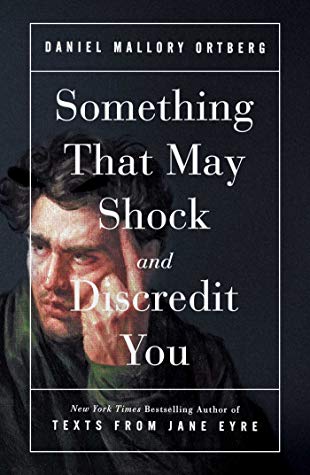
Something That May Shock and Discredit You, by Daniel Mallory Ortberg***

Ortberg wrote The Merry Spinster, a work of dark humor that convinced me that he is a genius. This book is a lot different, although at times the same voice peeks through. My thanks go to Atria Books and Net Galley for the review copy. This book is for sale now.

Many of the essays in this book are recycled from Ortberg’s blog, but since I never saw the blog, all of it is new to me. The essays describe his experience as a trans man, and though it is funny in places, most of the pieces ooze pain and bitterness. And to be fair, a trans man brought up female in an evangelical Christian home, taught to consider the Rapture in every choice made, every road followed, is bound to have these things in spades. However, there is a good deal of redundancy here. After awhile I found my attention wandering, and by thirty percent of the way in, I was watching the page numbers crawl by. How much longer…?

Some of the chapter titles are full of promise, but then the chapter itself disappoints. What, this again? I did enjoy the passage on parallel parking, and the chapter on Columbo (the only man Ortberg has ever loved) cracked me up.

I have rated this title three stars for general audiences, but I suspect that for those transitioning to manhood, or for those close to someone doing so, the rating will be higher.

Recommended to those transitioning, considering transitioning, and their loved ones.