
Over Yonder, by Sean Dietrich*****

Sean Dietrich has written another fine novel, Over Yonder, one full of quirky characters, weird yet oddly credible situations, and a whole lot of heart. My thanks go to NetGalley and Thomas Nelson Books for the review copy. This book is for sale now.

Dietrich has been writing for a long while, but this is just the third of his books that I’ve read. As I begin this one, I develop a niggling suspicion, wondering whether this author uses a formula. This would be a sad discovery, because till this point, I have greatly loved his work. And so the question I have to answer before I can do much else is whether that’s true, or whether he is writing unique stories using a signature style. Here is what I am seeing: each story focuses on a girl—teen or child—who’s down on her luck, possibly facing a crisis, with no adult that will help her or advocate for her; an older man dealing with misfortune of his own such as a fatal or serious illness, and who is otherwise isolated and in need of redemption; and a chance meeting of the two in a small town in the deep South.

I suppose, after reading this third one I am inclined—as you can see from my rating—to say this is a signature style rather than a formula. I hate to be played. If I felt this was a formula, I would feel annoyed and my review would not be generous, but that’s not what happens.

Caroline is 17 and pregnant. Her boyfriend, Tater Bunson, is at the wheel of his ’93 Honda.

“Caroline stared out the lace-like cracks of the passenger window’s single bullet hole at downtown Knoxville…her hair was the color of a carrot. She was ninety-four percent freckles. Her small, upturned nose, full cheeks, and cherub face brought to mind a character from the highly successful Cabbage Patch Kids product line…Tater spun the wheel right. The car made a sound not unlike a Folgers can of rocks falling down a public stairwell. The spiderweb crack on the passenger window came from a .22 caliber bullet that had passed through the glass during Tater’s last heated disagreement with his mom.”

Woody Barker used to be a priest. He has a houseboat and a bad heart, and not much else. He can qualify for a heart transplant, but only after he quits smoking, and it’s not going well. He’s lonely; he had hoped to pick up with his ex-wife once he got out of prison, but now that he’s out, he sees that she has a boyfriend, and it looks like he’s out of luck. Then an old girlfriend summons him to her deathbed. She wants him to meet his 17-year-old daughter. Who? What??

Dietrich’s wry humor and visceral figurative language are out in force here. Highly recommended to those that enjoy strong Southern fiction with deeply developed characters.
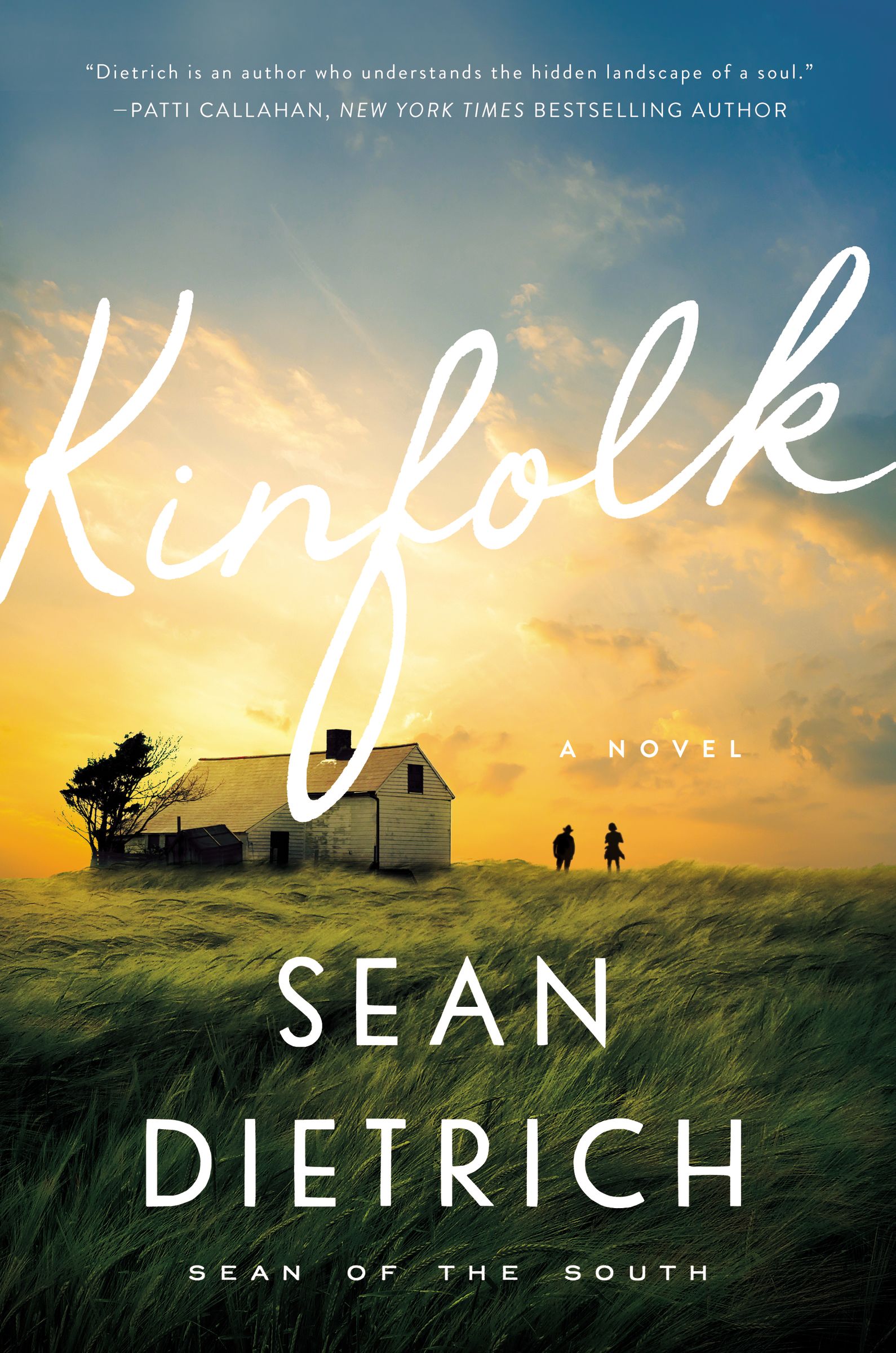
Kinfolk, by Sean Dietrich*****

“Thanksgiving is not about being happy. The holiday is not about mirth and beauty and the warmth of gaiety. Thanksgiving is about fulfilling family obligations and being miserable the way the good Lord intended.”

When we meet our protagonist, Nub Taylor, it is Thanksgiving night, and he and his cousin and best friend Benny are three sheets to the wind, idling in a rusty old truck across the street from the dignified, stately home of Nub’s daughter, Emily. Nub has been invited to dine there, but knows better than to attend. Emily is a widow; she married up, and every mover and shaker in town has shown up. No, Nub won’t be joining them. Nothing good would come of it.

My thanks go to Net Galley and Harper Muse for the review copy. This book is for sale now.

Our story is set in the 1970s in a tiny town in Alabama. Nub is long divorced from Emily’s mother, who keeps her distance these days. He takes his meals at the Waffle House, and that includes today:

“Waffle House did not close on Thanksgiving because Waffle House never closed. Waffle House was like the Vatican, only with better hash browns. Nobody on staff at the Waffle House had a key to the store, not even the manager. Because there were no keys. The doors were never locked. Waffle House just went on and on. Sort of like a disco.”

It is here that he meets Minnie. Minnie is fifteen years old and well over six feet tall. Why is this girl spending her holiday here, instead of with her kin? The answer is that she has none. Her father is in prison, and her mother has just recently killed herself.  

Of course, Nub doesn’t know these things at first, but something about her calls to him. Perhaps all children of suicide victims wear something similar in their expressions; Nub had lost a parent the very same way, and he has never gotten over it. How does anyone? He knows “the cardinal rule about suicide. You don’t talk about it.”

Now, Minnie is orphaned and she is pregnant, courtesy of a thoughtless, spoiled local boy that told her he loved her, then laughed behind her back. And so it is that Nub realizes, as he learns more about Minnie Bass, that perhaps he may have a chance to redeem himself.

This is a wonderful story, full of warmth and a lot of heart. Dietrich is a master story teller, able to create viscerally real characters that leap from the page and a narrative that billows with home truths. There is no question that Kinfolk is among the finest books to be published this year.

Highly recommended.

The Incredible Winston Browne, by Sean Dietrich****-*****

4.5 rounded upward.

The time is the 1950s; the place is Moab, Florida, a tiny town where everyone knows everyone else. Winston Browne is the sheriff; Eleanor Hughes is a frustrated single woman that fears she is headed for spinsterhood; and a small girl, Jessie, is on the lam from a creepy cult that considers her to be “a little abomination.”

I read this book free, courtesy of Net Galley and Thomas Nelson Publishers. It’s for sale now.

The story begins with Winston in his doctor’s office. There’s bad news about his chronic cough. Tests show it’s not only malignant; it’s metastatic. In other words, Winston should put his affairs in order.

Winston is a friendly guy, but he’s also an introvert. He tells no one of his condition. He’s single, and there’s no family to warn, so he goes about his life about the same as before he learned his diagnosis.

Jessie is awakened in the middle of the night by one of the Sisters, who hustles her into a waiting vehicle. She’s being busted out of the Temple compound by softhearted women that know the girl is doomed if she remains. Jessie has an independent spirit, and so when she is dropped off at the train station with instructions of where to go and who to trust, she follows her instincts instead. Her instincts take her to Moab, Florida.

Eleanor—you can call her Ellie—is fed up with Jimmy. They’ve dated for year upon year, and she is so frustrated by his inaction that she can scarcely stand the sight of him. If he is so crazy about her, then why doesn’t he propose? She’ll never have a husband or a family, and it’s all his fault. But then Winston comes along, and the birds sing in the trees.

For the first half of this book, I thought it would be a four star read. It was a good enough tale, but I had my reservations. For starters, where are the Black people in Moab? If we’re meeting the townsfolk—and we surely are—how is it that all of them are Caucasian? A visit from Jackie Robinson is all well and good, but this is Florida, for heaven’s sake. Is Moab a sundowner town?

I run a quick search, knowing that the African-American population during this mid-1900s was much lower than it is now, and I am grudgingly convinced that there might well be a little town in the boondocks with only white residents. Back then, it could have happened, so…okay.

It is during the second half that everything falls together and I am swept away by the characters. No more consulting the Google oracle; the intimacy has become too strong for me to step back.

It’s difficult for me to find a feel-good book without schmaltz. Most books that are billed as heartwarming tend to make me roll my eyes or retch a little. Dietrich works magic, though, and although it takes a minute or two to reel me in, ultimately I am captivated. The droll, understated humor that drops in and out at just the right moments is a key element. The captions that appear regularly make me guffaw more than once; don’t skip over them! They’re terrific. The text is punctuated now and then by contributions from the Moab newsletter, whose minutiae underscores just what a dull place this town usually is.  

However, let me also say a quick word here about the audio version. I began reading this book close to the publication date, and so when I was partway into it, I checked out the audio book from Seattle Bibliocommons. By doing so, I could extend my reading sessions, switching over to the audio when I had to do something else with my eyes and hands. The author reads his own narrative, and he has a wonderful voice, warm with just the right amount of drawl. The best way to enjoy this book is to access both the print version and the audio; if you must choose one or the other, it’s a toss-up, perhaps with a slight edge toward the audio.

Some readers will be pleased to know that there is no off color language or sex involved. If a movie were made based on this book, it would most likely show a General Audiences rating.

Highly recommended to those that love a feel good story, historical fiction, or Southern fiction.