Violeta, by Isabel Allende*****

Violeta is an epic tale that spans, along with its protagonist, a century-long period that begins during the Spanish Flu and ends with our modern day pandemic. Technically, then, it is part of the growing body of pandemic literature, but as is always true for Allende’s novels, it is so much more.

I received a review copy, courtesy of Net Galley and Random House Ballantine, but had I not, I’d have found a way to read this glorious story anyway. It’s available to the public now.

Violeta is born to wealth and privilege, the only daughter in a large family. Schooled at home by a nanny, sequestered in a mansion with servants to do her bidding, she is unaware that her luxurious standard of living comes at a tremendous cost to others. Then the market drops, and her father, who has overextended himself with unwise investments, is ruined. Most of her brothers are already grown and gone, but one brother, Jose Antonio, had remained at home, groomed by their father to take over the business one day. “He was the model son, and he was sick of it.” After their father’s abrupt departure, Jose Antonio finds himself responsible for the family; with the local populace in a state of near insurrection, the only thing left to do is to take his family—including Violeta—and leave town. They remove themselves to a distant farm owned by poor but generous friends, and they learn to make do as they’ve never done before.

We follow Violeta through her early marriage to a German immigrant who was “so bland and boring that he inspired instant trust,” and then through a long, tempestuous relationship with a handsome thug named Julian, who makes his fortune in dark, horrible ways involving illegal substances, the CIA, and the Mafia. And here, Allende’s startling sense of humor is in full brilliant flower, as she describes his retrieval of ill gotten funds from the septic tank of their Florida home:

He pulled a filthy bag from the hole, dragged it to the kitchen and poured the contents out on the floor; rolls of wet bills covered in poop. Gagging, I saw that Julian planned to clean the money in our washing machine. “No! Don’t even think about it!” I shouted hysterically. He must’ve understood that I was willing to draw blood to stop him, because I’d instinctively grabbed the largest knife in the kitchen. “Okay, Violeta, calm down,” he begged, frightened for the first time in his life. He made a call, and a short while later we had two mafia goons at our disposal. We went to a laundromat and the gangsters paid everyone to leave. Then the men stood guard as Julian washed the poop-covered bills. After that he had to dry them and pack them in a bag. He brought me along because he had no idea how to operate the machines. “Now I understand what money laundering is…”

As with all or most of Allende’s protagonists, Violeta becomes a strong woman that can stand on her own, and who picks and chooses the men she wants to be with. She is beautiful, intelligent, and ends up with piles of her own money that she has earned in an ethical manner. And here is my one, very small issue with this book; just once I would like to see an Allende main character that doesn’t get rich, but is fine anyway.

I am late in reviewing this book, but it’s important not to try to rush through a story such as this one, because the literary alchemy Allende creates is the sort that must be appreciated at one’s leisure. Her novels are not page turners; they don’t try to be. Instead, Violeta is the sort of book you take with you on a spa date, or to your very own bathtub with bubbles, candles, and your favorite beverage.

Highly recommended to feminist readers that enjoy top quality literary fiction.

Chevy in the Hole, by Kelsey Ronan***-****

3.5 stars, rounded up. Chevy in the Hole is Kelsey Ronan’s debut novel. I love strong working class fiction, and the title and book cover spoke to me. But while it shows a good deal of promise, it’s also a cautionary example of how, in trying to do too much, one can do too little. My thanks go to Net Galley and Henry Holt for the review copies. This book is for sale today.

The protagonists are Gus Molloy, who is Caucasian, and Monae Livingston, who is Black. The book opens as Gus is being revived with Narcan on the floor of a dirty restroom in Detroit. We follow him as he meets Monae, a student working at a farm outside of Flint. Their stories are told alternately with bits and pieces of the lives of their predecessors.  

The story is promoted as a love letter to Flint, and a tribute to the resilience of its people; it’s a story of “love and betrayal, race and family.” And we do surely see all of those things, but as soon as one aspect or another is touched on, I wink and poof, it’s gone. Gus and Monae are both sympathetic characters, and I can’t help pulling for them, but I suspect the author could have developed them more fully had we not spent so much time and detail on fragments of their parents, grandparents and so on.

If the author’s purpose is to use these characters from the past to showcase the various struggles through which Flint has gone—sit-down strikes, Civil Rights marches, and now, this horrifying industrial sludge that has polluted the town’s drinking water—it could have been done in a paragraph or two, or through some other device than shifting the point of view. The frequent changes of character and time period make it confusing as heck, particularly while listening to the audio version; that’s a shame, because Janina Edwards is a warm, convincing reader.

But we frequently shift from one protagonist to the other, even after they are married, and all of these people from the past have to be sorted by both time period, and by which protagonist they are related to.  A story like this should flow. As it is, it’s work listening to it, and had I not been granted a digital review copy as well to refer to, I might have given up.

My other frustration is that both the labor history and the Civil Rights issues—with Black people shut out of company housing in the past, and the issues with cop violence as well as the pollution that is visited most within the Black community—are huge. The pollution problem is immense, and ties back into both of the other issues. This book could be a powerhouse, a call for change to reward to the plucky souls that have stuck with this place through hell and high, toxic water. Instead they present almost like postcards; oh, look at this! Now look at that! Okay, never mind, let’s go on back to the present.

That being said, the author’s mission is an ambitious one, and her word smithery is of high caliber. I look forward to seeing what else she publishes.

If you choose to read this book, I recommend using the printed word, whether digitally or as a physical copy.

Black Cake, by Charmaine Wilkerson****-*****

“I was not the first person to go through the world living two separate lives, one out in the open and the other locked up inside a box.”

Elly Bennett dies and leaves a detailed recording for her children. Wilkerson’s novel is about Elly’s life, but more than that, it’s about secrets. Everyone in this book has one or has been impacted by one in a major way, and for most, both are true. Elly and her late husband had a whopper, and they built their lives and their family around it. Their two children are Byron and Benny, and Benny’s secret is all consuming for much of her life; it has had a role in estranging her from her once-adoring older brother and parents. Meanwhile, there’s a child—now grown to middle age—in Europe that is herself a secret, and whose very identity has been obscured by one. Elly’s closest childhood friend carries a particularly potent secret, and so does the nanny that raised her. Even the lawyer that handles the estate has one.

When is it safe to let go of a secret?

I was invited to read Wilkerson’s debut novel by Random House Ballantine and Net Galley, and I thank them for the review copy. This book is for sale now, and everyone is talking about it. You’ll want to get in on it.

Our story unfolds with seventeen year old Coventina Brown, known as Covey, quietly launching a plan to join her boyfriend, Gibbs, in London. He’s gone there to go to school, and when she’s done with school, she will join him. That is, until her father, who has raised her alone, gets into big trouble with a loan shark, a local thug who now holds title to her father’s store and his home, and now wants the one thing this father has left: Covey. If Covey marries this nasty old man, the debt will be squared. Most fathers would send their daughters to safety, and then square their shoulders and solve their problem, even when their own lives hang in the balance. But alas, Johnny Lyncook is not most fathers. He’s not a particularly nice man. As one of our characters will observe later, “A shit is a shit, young or old.”

Covey escapes on her wedding day (at which Black Cake, similar to fruitcake, is traditionally served), and her experiences from that time forward will form the foundation of her own life, her (future) husband’s, and their children and other loved ones.

The story is told in the third person omniscient, with the point of view changing by chapter, along with the time period. Readers will find themselves wretchedly confused if they fail to note the chapter titles, which are the key to everything that follows. The result is a story that is assembled like building blocks, and although it works out in the end, with everything coming together for a satisfactory resolution, I am frustrated at times, because just as a character begins to take shape for me, we leave them and join someone else.

I would have enjoyed more integration and perhaps a wee bit of streamlining. For example: we learn that Johnny, Elly/Covey’s father, is ethnically Chinese, and that there are a lot of them in the Caribbean, but there appears to be no reason whatsoever to include this. It is as if Wilkerson wants to include every interesting fact about life in the Caribbean, and so there are components her that add nothing to the narrative. It’s a distraction. The story is complex enough without tidbits thrown in for no benefit. There are some small credibility issues as well. Two people within the story become famous enough to be recognized on the street, and receive breaks that they ordinarily wouldn’t; one is a distance swimmer, and the other an oceanographer. I can imagine how one or the other might be charismatic and photogenic enough to achieve this, but two? Name a famous oceanographer. Name a famous distance swimmer. See what I mean?

Nevertheless, this is in many ways a story for our time, and as such, it will make meaty discussion material in book clubs and in classrooms.  When is a person black enough, and must a biracial person choose one side of their heritage over the other? How much information do adoptive parents owe their child, and when should they provide it? What about biological parents? When is it acceptable to keep secrets related to their children’s heritage, and when not? There are MeToo and other women’s issues at play, and there are issues of race. You could probably read this thing three or four times and still come away with observations, ideas, and questions that you hadn’t found the other times.

I am grateful that this story never devolves into a cookbook.

As debuts go, this is a strong one, and I look forward to seeing what else Wilkerson publishes. I recommend this novel as a welcome distraction from the stormy months ahead.

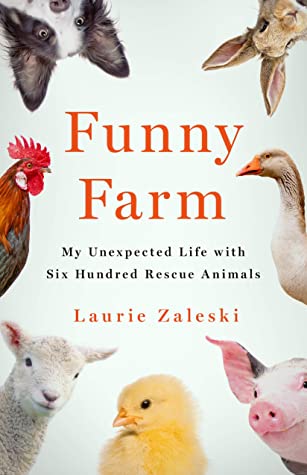
Funny Farm, by Laurie Zaleski*****

“You never know what you are capable of until the day comes wen you have to go places you hadn’t planned on going.”

Laurie Zaleski knows how to make a debut. Funny Farm: My Unexpected Life With 600 Rescue Animals has created a tremendous buzz, and all of it is deserved. My thanks go to Net Galley and St. Martin’s Press for the review copy. This book will be available to the public Tuesday, February 22, 2022.

Laurie’s early childhood was in many ways an enviable one; her mother stayed home to raise Laurie, her brother, and her sister, and her father made enough money to hire household help and buy a couple of vacation homes, too. There was nothing they lacked for, other than physical safety. Because while her father could be warm, and loving, and generous, and funny, he could also be a monster. His reign of terror was worsened by alcohol consumption. As the beatings became uglier and more frequent, Annie, their mother, chose poverty for the children and herself over the constant terror and danger of living with their dad.

“’I almost became a nun,’ Mom would joke years later. ‘Then I met the devil…’ Annie McNulty and Richard Zaleski fell in love like tripping into an open manhole: one wrong move followed by a long dark plunge.”

There’s one searing episode Zaleski recounts, toward the end of their life with Dad, in which they are all hidden in a bedroom with the door blocked shut, and their father is sneaking up on them, commando crawling up the hallway toward them so they won’t see his shadow approaching, and he has a large knife between his teeth. It sounds like something from a Stephen King novel, doesn’t it?

And so, when Annie’s efforts to build a modest nest egg to finance their flight is uncovered, she has no other option but to leave without the money. She finds a dumpy cabin in the woods, half fallen down and in no way legally rentable, and strikes a bargain with the owner. To say that their standard of living decreases is the understatement of the year, but they make it work.

Once she has made her escape, apart from the creepy forays from an unseen enemy that occur from time to time, Annie can’t turn away anyone else, human or otherwise, that is in a dark and vulnerable place. The woods surrounding their little shack begin sprouting makeshift outbuildings; there’s a little lean-to here, and a sort-of paddock there. And it keeps growing.

Zaleski is a gifted storyteller, and she alternates her narrative from the present to the past, breaking up the nightmarish episodes of her childhood with hilarious stories, most of which are about the critters. Her writing is so nimble that I find myself repeatedly checking to see what else she’s published, because there’s just no way this can be her debut. But then, that’s what they said about Harper Lee, right?

Perhaps the most glorious aspect of this book is seeing how Annie McNulty’s can-do attitude, sterling work ethic, and positivity transformed her life and lit a path for her children. She provided them with an outstanding role model, and in return, they did everything possible for her when cancer forced her to slow down.

This book will inevitably be compared to Educated and The Glass Castle because it is a memoir of someone that has overcome horrifying challenges in childhood and emerged triumphant. But make no mistake, Zaleski’s story is in no way derivative, and likely will be held up as an example for future writers. It makes my feminist heart sing!

Highly recommended.

Don’t Say We Didn’t Warn You, by Ariel Delgado Dixon***-****

I was invited to read and review by St. Martin’s Press and Net Galley, and it sounded like a winner; a debut to boot. I am disappointed not to be able to read further, because this is clearly a writer with talent, and the story is an interesting one thus far.

Here’s the thing:  I see foreshadowing that suggests the family dog is going to meet with a lot of pain, and I am not up for it.

There’s been a trend away from this lately, and I suspect this is why: there’s a lot of push-back against it these days. There was a time when the sacrifice of a (fictitious) pet was considered a lesser evil. Rather than kill or torture a character that the protagonist loves and the reader may have bonded with, take out the dog, cat, horse, etc. It’s sinister foreshadowing, but nobody is dead yet. But these days, animals in general and pets in particular are out of bounds. If a writer goes there at all, it must be well in the past and with as few details as possible. Less is more, and usually, none is even better.

Were it not for the animal cruelty that other reviewers have referenced, both with the dog and the wilderness camp, I would gladly finish and review this galley. I wish the author well, and look forward to seeing what they publish next, assuming this deal breaker doesn’t make it into their next endeavor.

My rating isn’t based on much because I didn’t get far; four stars is the rating I give most often, but this time it should be taken with a grain of salt.

Psycho by the Sea, by Lynne Truss*****

Lynne Truss is hilarious, but with this fourth installment of the Constable Twitten series, she has outdone herself. My thanks go to Net Galley and Bloomsbury for the review copy. This book is riotously funny, and it’s for sale now.

Truss first came on my radar with her monstrously successful nonfiction grammar primer, Eats, Shoots & Leaves: The Zero Tolerance Approach to Punctuation. A decade later I began reviewing, and one of my first reviews was for Cat Out of Hell, and later, the first in the Constable Twitten series, A Shot in the Dark, followed by the second, The Man That Got Away. I somehow missed the review copy for the third, Murder by Milk Bottle, which I discovered when I received the review copy for this fourth in the series; after sulking for a bit, I took myself to Seattle Bibliocommons and checked it out so that I’d be up to date when I began reading this one. It proved to be a good idea.

I tell you all this so you’ll see why I thought I had this author figured out. She had proven to have a distinctive, rather odd fiction writing style, which began in a sort of corny, groaning, oh-my-God-is-this-the-best-you-can-do style, but then sneakily grew better and funnier until by the second half, I’d be laughing my butt off. So as I open Psycho by the Sea, I have fortified myself to give Truss a minute or two to warm up. It will be funny, I am sure, but probably not just yet.

Surprise! This time, Truss had me laughing right out of the gate.

For the uninitiated, this satirical series is set in Brighton, a coastal resort town in England, in the 1950s. Our protagonist, Constable Twitten, is brilliant but irritating. He joins a small force that consists of Chief Inspector Steine, who has, until recently, been more interested in boosting tourism by pretending that Brighton has no crime, than in breaking up the formidable organized crime gang that runs amok, than in solving any of the crimes that have been committed. That was true until the last installment, when he inadvertently covered himself in glory and is now basking in the limelight, some of it literal as he is invited to speak on television or receive yet another award for his cleverness and courage. We also have Sergeant Brunswick, who would solve crimes gladly if he weren’t so everlastingly stupid; instead, he yearns to go undercover, even when there is no earthly purpose in it; when he does, he always manages to be shot in the leg at least once.

By now the readers know that the cleaning lady in charge of the station is a criminal mastermind. Mrs. Groynes is part cleaner, part den mother, and part overlord, and she makes herself loved and indispensable by showing up with cake, providing constant cups of tea, and listening to the cops to make sure that her operation is nowhere close to being discovered. In the first of the series, Twitten discovers what Groynes has been up to, but not a single, solitary cop or civilian will believe him. He’s new, after all, and they’ve known Palmyra Groynes forever. Mrs. Groynes, a crime lord? Don’t be ridiculous!

Now it seems that Palmyra has a competitor, someone that wants her turf and is willing to mow down her operatives in order to take it. I never would have seen this coming, and it’s an ingenious development. Old characters come back, and a new one, a formidable secretary sent down from London, turns the cop shop into a much more legitimate enterprise, and also sends Groynes packing. Even Twitten wants her back.

My favorite moment is when Twitten is being held at gunpoint, and he is so pedantic and obnoxious that he bores his assailant out of shooting him.

Not only does this book hit my funny bone right away, it also features a more complex, well balanced plot, and more character development. Until now, I had assumed no real character development was being attempted, because it’s satire, satire, satire, but now, it appears one can do both, and Truss does both bally splendidly.

“Flipping hedgehogs!” You have to get this book, but it will be more enjoyable if you read the other three first. Highly recommended.

The Eternal Audience of One, by Remy Ngamije*****

“Life is not hard in Windhoek, but it is not easy, either. The poor are either falling behind or falling pregnant. The rich refuse to send the elevator back down when they reach the top. And since cities require a sturdy foundation of tolerated inequalities, Windhoek is like many other big places in the world. It is a haven for more, but a place of less. If you are not politically connected or from old white money, then the best thing to be is a tourist. The city and the country fawn over tourists. The country’s economy does, too. That is when it is not digging itself poor.

That is Windhoek. The best thing to do in the city is arrive and leave.”

And now, raise your hand if you find yourself wondering where Windhoek is. Don’t be shy. You’ll have plenty of company…ah. Yes. I applaud your bravery, being the first. And you, and you…and you in the back. Anyone else? That’s what I thought. Look around. Almost all of you. So now, I’ll relieve your discomfort and tell you, it’s in Namibia. Our protagonist, Seraphim, and his family must relocate there during the upheaval in their native Rwanda. This is his story, told in the first person.

My thanks go to Net Galley and Gallery Books for the review copy. This book is available to the public now.

Seraphim’s parents are strivers, working industriously to ensure that he and his siblings will have excellent educations and better lives. As a young man, he works hard and is fiercely competitive in school, but once he is at university in Cape Town, he becomes a party animal, using Cliffs Notes to dodge the assigned reading and embarking on booze fueled, all night romps. Ultimately, this is a coming of age story in a different time and place than that which most Western readers are accustomed to. And oh, my friend, if you are going to spread your wings and stretch your global literacy just a teensy bit, then this is one painless way to do it.

Once he’s inside South Africa, Sera deals with Apartheid, and during the course of his education, is advised by a wise friend, who tells him that if you want decent notes, you must befriend BWGs. These are Benevolent White Girls, and they seem to know some sort of educational code that young Black men have somehow been shut out of. There’s a funny passage about how to tell if a Caucasian is the sort one can hang out with, and to explain the difference in his own social class growing up, in contrast to others in his social group, he describes a problem with desks. There are fifty children in the class, he says, and not everyone can have a desk. Little Sera gets busy, and eventually is able to rise from chair number 50, to chair number three. Then, after a struggle with Gina and Hasham, the first and second place students, he rises to the first chair, first desk. When a friend asks what became of Gina and Hasham, Sera shrugs with his characteristic cocky arrogance, and he tells him, “I like to think they married and had second and third place children.”

Part of what I love is the way the voice here sounds like young men in their late teens and early twenties, here, there, or probably just about anywhere. In my experience, his demographic is the most hilarious of any in real life, and it comes shining through here, full of irreverent wit.

The narrative isn’t linear, and there’s some creative jumping around that, when combined with the internal discussions the narrator calls “The Council of the Seraphims,” can be difficult to keep up with. Don’t try to read the second half of this novel after you’ve taken your sleeping pill.

All told, this is a brainy, hilarious work, which is perhaps why Ngamije is being compared to Chabon and Zadie Smith.  He resembles neither, apart from being very literate and extremely funny. In fact, this book is worth reading just for the snarky texts sent by Sera and his friends; their handles crack me up even before I see what they have to say. Highly recommended, even at full price.

Hypnosis is for Hacks, by Tamara Berry****

Eleanor Wilde is a sham medium, a fraud who’s used her dramatic talents and the trust of her clients to bilk them. But lately things have changed; she has received intelligence from the great beyond, specifically from her deceased sister. As a businesswoman that now resides in a small town in the UK and doesn’t want her neighbors to hate her, she’s shifted most of her business to herbal cures and such. As it happens, this doesn’t keep all hell from busting loose.

My thanks go to Kensington Books and Net Galley for the review copy. This book is for sale now.

Eleanor–you may call her Ellie—is the protagonist in a satirical cozy mystery series, and this is the fourth. I read and reviewed the first two, but somehow missed out on the third. The first two took place in a tiny village where the ruling family lives in an honest-to-goodness castle. She went there, in the first in the series, to conduct a bogus séance, but instead fell in love with Nicholas, heir to the estate. Now the castle is in need of serious repairs. It’s summer, and the castle is hot enough to be uninhabitable, and so Ellie accompanies the elderly Vivian, matriarch of the castle, to the seaside. Her brother Liam, who is visiting, joins them. And once there, all sorts of things go wrong. We have a menacing, possessed doll that reappears in or near Ellie’s room, no matter what she does to destroy it, and a sinister figure from Ellie’s checkered past shows up as well. And of course, of course, of course, Ellie witnesses a murder shortly after arriving, but nobody will believe her.

I came away of two minds about this particular installment. The thing I’ve appreciated most about this series is that Berry’s writing is hilarious, and whenever an obvious plot device is utilized, it’s done in such an over-the-top manner that we can imagine the author winking and guffawing. Nothing here is to be taken seriously. In the past there’s been very little character development, and I was okay with that, because I wasn’t looking for great literature; I was looking for a laugh.

Here I find some changes. There’s less humor, although two particular bits, one involving lobsters and another involving, per the title, hypnosis, made me snicker. But I also find more character development. Realistically speaking, a series can’t last long if there’s no character development, and so I’m pleased to see Berry adding a bit of depth, but at the same time, what I really want is to laugh out loud. We live in tense times, and there’s a growing body of evidence that we live longer if we laugh. A silly, escapist novel that lets us forget current events entirely for a brief while, forget our own troubles, whatever they may be, and sit back and howl at what our clever author has cooked up, is worth more than many can imagine.

Nonetheless, this story is better by far than most of what’s out there within the humor genre, and I recommend it to you. Now…where’s that cat?

At the Edge of the Haight, by Katherine Seligman****

At the Edge of the Haight tells the story of a homeless youth, Maddy Donaldo, who lives with her dog, Root, in San Francisco’s Golden Gate Park. But one day she runs across a young man lying dead, and the man that is almost certainly his killer locks eyes with her. He tells her, “Keep a handle on the fucking dog…I know where to find your ass.”

I was invited to read and review this award-winning novel by Algonquin Books. My thanks go to them and Net Galley for the review copies. It’s for sale now.

At first, I am not sure I’ll like this book. It seems a bit self-conscious, a bit like a public service announcement or an infomercial. I wonder what I have gotten myself into. But about a quarter of the way in, it wakes up and begins to flow. It becomes my dedicated bathroom book, since I’ve been given a physical review copy, and I find myself brightening when I enter the loo. There are any number of places when the author has the opportunity to use an obvious plot device, but she chooses something better. By the end of the story I believe Maddy as a character, and I appreciate the way it ends.

My home town, Seattle, has an enormous problem with homelessness, estimated in the tens of thousands, and most of them are native Seattle-ites that have been priced out of the housing market. I know one of the people out there; others have squatted in my yard until my dog made them feel unwelcome. Not one part of this city is entirely free of tents, cardboard shacks, and other makeshift shelters. So this subject is never far from my thoughts.

The fact is that there aren’t nearly enough shelter beds, whether in open rooms with mats on the floor, hotels with doors that close and provide privacy, or other options, but in reading this book, it is also clear that there are times when it’s better to walk away from free shelter. Take our friend Maddy. The shelter she sometimes frequents is one where the probable killer has seen her. She can’t go there safely. There are shelters where she can’t take her dog. There are others that sound pretty good, but a night filled with the screams of a neighbor experiencing a mental health crisis make the private niche way deep in the park more appealing. The cops range from businesslike 3 AM bush beaters (“You can’t camp here!”) to the overtly cruel, and most of the homeless know better than to try to confide in them. And so it goes.

The main part of this story involves a couple—Dave and Marva—that are the parents of Shane, the murder victim. They live on the other side of the country, and they never understood why Shane wouldn’t come home. No one besides Maddy recalls having seen Shane, and so although she has only seen him once—dead—they latch onto her, vowing to help her since they couldn’t help him. Between their grief and ignorance, however, they bumble around and breach boundaries in ways that are outrageously presumptuous, and when they drag her to their home for Thanksgiving, they introduce her as someone that “knew Shane,” which of course she didn’t. Maddy feels bad for these folks, but she doesn’t want to be their project. It’s a bizarre situation for her to be in.

Though it is marketed as commercial fiction, I think a lot of teens would embrace this story. I suggest that Language Arts teachers in middle and high schools add it to their shelves, as should librarians. The vocabulary is accessible, and despite the quote I lead with, there’s very little profanity.

Recommended especially for teenage readers.

Autopsy, by Patricia Cornwell*****

Autopsy is number 25 in the Kay Scarpetta series, the first forensic thrillers ever to see print. This series began in 1990, and I have read every single one, but this is the first time I’ve scored a review copy. My thanks go to William Morrow and Net Galley.

When the series began, Scarpetta was the chief medical examiner in Virginia. When last we saw her, she was working in Massachusetts, but now she’s come full circle, brought back to her old position in order to root out corruption and restore the office to the integrity it held when last Scarpetta was in charge. She didn’t expect it to be easy, and it surely isn’t.

There are long running characters that have been so well developed over the years that I almost feel as if I would know them on the street. Her husband, Benton Wesley, holds a sensitive position within the FBI, and the necessary secrecy and sudden need to pack a bag and go somewhere has led to marital tension over the course of the series, but not so much this time. Kay’s niece, Lucy, is more like a daughter; she has been estranged from her mother at times, a high-strung, self-absorbed woman that looks out for number one every minute of every day. The mother—Dorothy—is now married to Pete Marino, with whom Scarpetta has worked closely for the length of the series, and they live nearby.

At this juncture, new or inconstant readers may wonder if there’s any point to jumping into a book this far into the series. I read it with that question in mind, and whereas you won’t have the background and depth of context that faithful fans possess, you can understand everything that happens here; Cornwell doesn’t burden the reader with assumed knowledge.  And if you are a new reader, likely as not, you’ll find yourself headed to the library or bookstore to pick up others from this series. It’s that addictive.

The only background information that might make a difference is that from the outset, Kay’s whole family (except Dorothy, of course) fears for her well-being. A murder occurs in the area, and the victim is a neighbor of Pete and Dorothy’s. Immediately, there’s this sense of urgency, and it’s more than one would ordinarily expect. A neighbor has been killed; the circumstances are weird, and we don’t know whodunit; everyone is edgy about personal security, and again—especially regarding Kay’s safety. So let me help you out, if you’re new: over several of the most recent episodes, someone has attempted to kill Kay, nearly succeeding more than once, and though the occasional thug has been caught, the schemer behind the attempts is still out there somewhere. The narrative makes no specific references to any of this, which I appreciate. It’s obnoxious when a book costs as much as new books do these days, for the author to insert what amount to advertisements to buy her other books. But for those not in the know: If the beginning seems a little overwrought, that’s why.

Add to this that the old guard is still entrenched in Kay’s workplace, with people whispering behind her back, and her secretary clearly plotting against her. She’s just arrived, but she is on the back foot, trying to find out what’s going on and who can be trusted, and trying to establish her own authority without making enemies unnecessarily. As I read, I find myself urging her to assert herself. Because to me, Scarpetta isn’t a fictional character at all. I believe in this character, and I believe in Benton, Lucy, and Marino, too. I’ve known them longer than a lot of people I see in real life, after all.

Those of us that read a lot of mysteries, thrillers, and so forth become accustomed to timeworn plot devices. I have a little list of things I hate to find in books of this genre, and Cornwell avoids them all. There is no alcoholic protagonist that just wants a drink, a drink, a drink. There’s no kidnapping of the protagonist and stuffing her in the trunk (or backseat, or whatever,) nor does this happen to any of her loved ones. Scarpetta is not being framed for a murder she didn’t commit, nor is anyone she loves.

Instead, we get an autopsy in outer space, supervised remotely by Scarpetta. How cool is that?

One other aspect of this book, and this series, that I love, is that there is just enough interesting information included about forensic investigation without the story turning into some tedious science lecture, as I have found in books scribed by Cornwall’s imitators.

The pacing is swift, the dialogue crackles, and a new character, Officer Fruge, is introduced. Hers is the last word in the book, and for some reason, it made me laugh out loud, a first for this series.

Welcome home, Scarpetta.