
 Since when do I read westerns? Since never…until a Goodreads friend recommended this title. He knew I liked history and historical fiction, and I couldn’t dismiss the recommendation, not only because this person has never steered me wrong, but because this book won the Pulitzer. That doesn’t guarantee I will like it either, of course, but it certainly enhances the likelihood. So on one of my increasingly-rare ventures to my favorite local used bookstore, I searched out the title. There it was, 857 pages bound in a beautiful hard cover, foliated-paged tome, for less than ten bucks. Sold!
It took me a long time to read, not because of its length—psssh, my readers know me better than that—but because of its physical size. A very lengthy book in an electronic reader is light weight no matter how many pages it has, but this gorgeous, old school novel was hell on a frozen shoulder. So for a long time I read it in little chunks, propping it on top of pillows on top of my lap. It took awhile, but it was worth it.
McMurtry earned his laurels, that much is certain. I was mesmerized by the way he took us to a place that no longer exists, immense swaths of nothing across the Midwestern USA and Northern Rockies. The idea that a person could travel long and hard for days and still not even be out of Texas just blew me away, and then there was still most of the journey yet to come. There are no roads; the protagonists have a kind-of, sort-of map; a list of rivers to sustain themselves, replenish their drinking water; water their mounts, with water being the equivalent of gassing up; and also water their herd.
I realized that one reason I never chose to read westerns is because I grew up during a time when cowboys were considered the enemy of the American Indian. I didn’t want to be allied with the white guys on the horses. And of course, that was one stereotype I later realized I should not have bought into, because not all cowboys were white guys; most were, for sure, but some were of Mexican heritage, some were Black, and once in a rare while there would be an American Indian riding with the cowboys. And cowboys did not always fight Indians; sometimes they were just moving cattle.
Apart from the almost tangible settings the author creates, we also have some complex relationships. I confess that some of the more peripheral characters among the cowboy crew were hard for me to keep straight. Which one is Dish, and which is Pea Eye? But it didn’t matter that much in terms of ability to enjoy the novel, because the main characters were so well developed, and there wasn’t a stereotype in the pack. Gus is the chief protagonist, and in my mind he was somewhere between Ralph Waite and Tom Hanks. Call, his very quiet, solitary partner, was a tow-headed version of Robert Redford. Lorena, the complicated woman that fell in love with Gus, eventually formed herself in my own mind to resemble country singer Miranda Lambert. Sometimes you just need a face to go with your main characters. Jake turned up as Dan Ackroyd without the sense of humor. Blue Duck is one of the most terrifying villains in literature!
Why go north? There was never any really good reason apart from Call’s wanderlust, and Gus’s unwillingness to be separated from his partner, with whom he had worked since their days as Texas Rangers. Gus also wanted to look up a woman from his past who had settled in Nebraska, and I loved how that played out.
And when all was said and done, I realized that this is one of those haunting stories that will forever remain in my mind. That’s saying a lot; I usually read 8-10 books per month, and often by the time I am invited to host a book giveaway or blog tour by the publisher, I have forgotten the name of the main character and all but the broadest contours of the story being promoted. They approach me 3 months after I wrote the review, and there are 30 books in between that story and the present. But that won’t happen here. In fact, because this wasn’t a galley, I waited to review it until I had the time and felt the urge. I still remember so much, and there have been several books gone by in the interim.
If you have the stamina to read a book of this length—and I have to tell you, though it’s a western it is not all actionactionaction, but rather deeply insightful in many places—and if you enjoy historical fiction, you ought to give this book consideration. It isn’t hard to find it used, and given its exalted status in literature, your local library probably also has a copy. But even if you have to pony up the cover price—pun intended—you could do much worse for your reading dollar.
An outstanding novel.
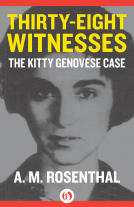 AM Rosenthal was a journalist, but in the 1960’s he was moved to write this relatively brief book—if fictional it would be considered a novella—about the failure of neighboring New Yorkers to come to the aid of Kitty Genovese, a woman that was murdered in 1964. I received this DRC free of charge from Net Galley and Open Road Integrated Media in exchange for an honest review.
 A few years ago I read and reviewed this author’s first memoir, Why I Left the Amish. Her reasons were compelling, some of them inherent in the Amish tradition, others probably atypical of most Amish families, but all together they provided a powerful impetus, that little voice inside all but the dullest that cries out, “Man the life boats! Save yourself!” I understood, having read it, why Furlong would choose to bail, but I was left with other questions, mostly regarding a gap between the end of the book and the author’s biographical blurb. Happily, I heard from her a couple of months ago; she had written a sequel, and this is it. She volunteered kindly to send it in my direction for a chance to read and review, and it is just as riveting as the first.
 I suspect just about everyone in the USA, or who frequently has to travel to the USA, is heartily sick of the extreme security measures that raise our taxes through the roof and cause so many delays, inconveniences, and even the confiscation of ordinary products that cost us a fair amount of money, on those occasions that we foolishly forget not to take them with us on the plane. The racial profiling makes it even worse. And so I requested this DRC from Net Galley and Oxford University Press with the expectation that I would agree with it wholeheartedly and immediately form the virtual simpatico with its writers that readers form with their favorite authors. Alas, not so much.
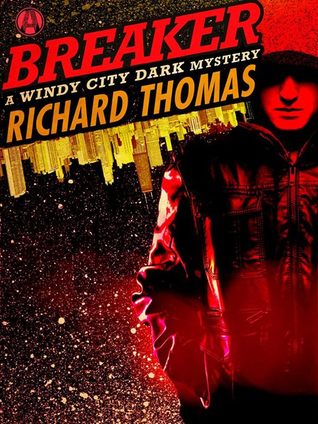 Richard Thomas is a monstrously great writer. In Breaker, a Windy City Dark mystery, he presents us with Ray, a man of unusual and intimidating appearance; a sinister stranger in a white van who victimizes Chicago’s working class school girls; and Natalie, the girl that lives next door to Ray. Though this is the first Windy City Dark mystery I read, I fell in, only extricating myself close to bedtime, because this is not the kind of thing you want entering your dreams. This smashing thriller came to me free of charge from Net Galley and Random House Alibi.
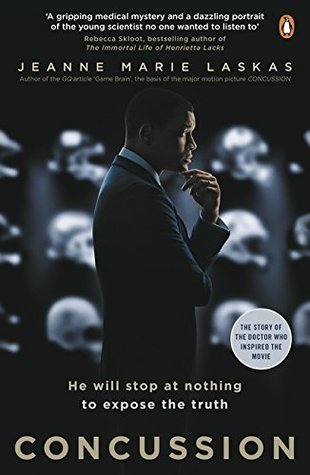 You don’t have to enjoy football to appreciate Concussion, the riveting new biography of Bennet Omalu, the Nigerian neurological pathologist that discovered CTE, a type of permanent brain damage caused by repetitive concussions, such as that experienced by football players. Not only the content, but the engaging voice with which it is told, make it worth everyone’s while. I was fortunate enough to read it free, courtesy of Net Galley and Random House, but when it comes out Tuesday, November 24, I recommend you get a copy for yourself. It’s information everyone really ought to have, especially those that play American football, or have family members that do.
 As a rule, I am not fond of British fiction; I prefer working class protagonists to the silver-spoon variety; and I like urban settings more than pastoral ones. But The Lake House is written by the author that produced The Forgotten Garden, and so when I had the chance to grab the galley, I went for it. And once more, experience proves that a brilliant writer can sell any story, in the setting of her choice, with the protagonists of her choice, and she can make it flow smooth as warm butter.


