Friendly Fire, by C.D.B. Bryan****

friendlyfireBryan was a journalist and author during the mid-twentieth century, and Friendly Fire, which originally began as a story for the New Yorker and grew into something more, tells the story of the Mullen family and their response to the death of Michael, a clean-cut young man that answered his draft notice, dutifully served and was killed by friendly fire not long after he was sent to Vietnam. Thanks goes to Open Road Integrated Media and to Net Galley for the invitation to read and review. This is right up my alley and I found it compelling. It was published digitally May 10, 2016 and is now available for purchase.

Michael Mullen was the favorite son of Iowan farmers Gene and Peg Mullen, working farmers steeped in traditional values and respect for authority, who had never questioned the US involvement in Vietnam. If the government said that US forces were fighting there to contain the spread of communism and keep Americans safe, then it must be so. Michael was the kind of young man that called people “ma’am” and “sir”.  When his effects were delivered to his family following his death, there were no fewer than three rosaries he’d carried on his person. He had expected to return from service, as his father had done from an earlier war, and inherit the family farm. His family was part of the Silent Majority to which governmental authorities referred when defending the role of the USA in Indochina.

In short, they were the last people anyone would have expected to see become anti-war activists.

Michael’s death rocked parents Peg and Gene, and their grief eventually alienated them from the three children left to them. The part of their story that galvanized me was in reading their intelligent, sharp responses during the initial period following their bereavement. For many of us facing the loss of any loved one—and the death of a child is the worst loss of all—ferreting out information about that person’s days, weeks, even months is our last link to them. But Peg and Gene took it to another level when they realized that some of the information they had received was untrue. Peg became an organizational whirlwind, searching for the names and stories of other Iowa boys that had died in that conflict and she realized that the casualties that were being reported to and in the media were incorrect. The responses she received from everyone from US officials to the parish priest were so insensitive, so baldly insulting that she and husband Gene made the war and those near their son when he died into an immense research project, reaching out to newspapers and television news widely. This reviewer grew up during this period and when I read that Peg was on the phone with national newscaster Chet Huntley’s secretary in New York, my jaw dropped!  In this era before satellites gave us phones in our pockets and information available at the touch of a keyboard, they typed letters, made long-distance phone calls, and in time even traveled to Washington D.C. in order to know how and why their son had been killed and who was to blame.

The fifth star here is denied because the beginning of the story, which goes into overmuch detail about the family’s genealogical beginnings and its long history in Iowa soil, is deadly dull. When the book was first published, the video game had not yet been invented and readers had longer attention spans.  Today if a book does not hook a reader from the start, chances are excellent it will be immediately and forever abandoned. Although the point that the Mullen farm had stood for five generations is surely relevant to the story, the author drags this portion of the story out sufficiently to glaze even the eyes of this history teacher, and together with an awkward introduction that appears to substitute for a bibliography or end notes, a lot of readers won’t get to the interesting part, and that’s a crying shame.

Ultimately the Mullens’ cause alienated them from their community, probably because they were so free in dispensing blame to everyone that drew breath. Everyone that had not actively opposed the war was called out at some point. The heat of their rage and grief lacked focus.  In many ways they undid a lot of the good they had done by cursing old friends and neighbors simply because they had never done anything about the war.

The story will interest those that research conspiracies. The Mullens believed more deception was in play than actually was, yet when a person knows he has been lied to about one thing, it is the intelligent thing to do to wonder how much more one was told is also untrue. And so as they relentlessly sought to find one particular officer that might be to blame for the friendly fire that killed their son, I wanted to bang my head on the wall, because it was so much more than that; the conspiracy, we know now, was seated in the Oval Office, jotting more names, possibly their own, onto his enemies’ list. Targeting this soldier or that minor officer was just wrong-headed, but when people are hurt, they lash out, and the Mullens did so exponentially.

The end of the book deals with the author’s own motivation in following the Mullens and their search for the truth so diligently; nevertheless, it seemed strange to find a host of author photos at the end of the book rather than of the Mullen family.

Had the editing of this digital edition been given to me along with permission to do anything I wished, I would have tightened up the beginning, put the author’s notes at the end of the book rather than the start, and deleted the photo section entirely.

Nevertheless, those with an interest in the struggle to end the US war in Vietnam will find this story well worth reading, and to them I recommend this memoir.

Immunity: How Elie Metchnikoff Changed the Course of Modern Medicine, by Luba Vikhanski***-*****

immunityElie Metchnikoff is credited with several medical discoveries, some of which were found before Mother Russia was entirely ready to receive them. This interesting though technically challenging text is the story of his life, and especially of his scientific career and achievements. Thank you Net Galley and Chicago Review Press for the DRC, which I received in exchange for an honest review. This title will be available to the public April 1, 2016.

In the latter half of the nineteenth century, Russia still had a tsar—a royal ruler with power similar to that of an emperor—and it still had serfs, who legally could not leave the plots of land assigned to them to farm for the benefit of royal landowners. It was not an ideal climate for science or any other aspect of enlightened thinking, but Metchnikoff was not only gifted, he was immeasurably stubborn, and by such methods as posing as a college student in order to sneak into lectures, he achieved an excellent education and began to pave new inroads toward discovering how the human immune system works.

His theory that cells in the human body swarm around and dispose of microbes that enter the body in order to kill germs was true, but proving it to those with authority in Russia was not an easy thing to do. Only recently had germs been discovered to cause disease; not so long before, it was assumed that God smote certain people or their loved ones in retribution for their bad behavior or thoughts. Being a scientist in such a place was challenging, and eventually, after being snubbed repeatedly by the German academics he sought to win over, Metchnikoff found his way to Paris, and the Pasteur Institute, where he would spend the bulk of his career.

His refusal to participate in elitist cliques that feasted on 8 course gourmet meals while half of London starved warmed my heart, as did his refusal to be roped into other social pretensions. Really, in another time and place, this would be my kind of guy.

Here I must disclose the fact that the sciences are not my forte. Only since retirement from teaching in the humanities have I found the time and confidence to explore memoirs of famous scientists. Last autumn I read and reviewed the biography of Dr. Bennet Omalu, the man that discovered a brain disease that was the result of repeated blows to the head consistent with American football. Cheered by my success in understanding and reviewing that fascinating story, I decided to tackle this one…with less satisfactory results.

I have never been good at understanding science. It’s that simple.

So if science and in particular the history of immunology or disease is your wheelhouse, this may be a four or five star read for you. But although I am not scientifically minded, I do have a sturdier education than the average American, and so I think I’m being fair in saying that the average reader-on-the-street that picks this up due to general interest rather than exceptional training may find it to be a great deal of work.

I did check the endnotes; I always do. So unless the author has simply invented a lot of sources in other languages than English—which seems very unlikely indeed—then I can safely say that this author has relied primarily on sources that the average English-speaking reader will not be able to tap into. Strong documentation from a wide variety of sources.

Recommended to those with a higher than average facility for matters of science, and for those interested enough to wrestle with challenging material.

Lincoln Reconsidered: Essays on the Civil War Era, by David Herbert Donald**

lincolnreconsideredI received this DRC free in exchange for an honest review. Thanks go to Net Galley and Open Road Integrated Media for letting me read it; Donald won the Pulitzer for his Lincoln biography, and I was sure this series of essays written for the purpose of dismantling myths surrounding the most revered president ever to occupy the White House would be hidden treasure rediscovered. What a crushing disappointment.

In the introduction, Herbert mentions that his section on abolitionists has drawn a great deal of criticism. Unfortunately, he appears not to have used such criticism as an opportunity to reevaluate the framework that limits his thinking in that section. More on that later;  I realized that since this is a collection of essays on various aspects of Lincoln, primarily as president, I needed to set aside the sharp distaste that overwhelmed me initially in reading this selection and see what I thought of the other entries.

I found Donald’s essay regarding Mary Todd Lincoln interesting. Another, which addressed the folklore surrounding Lincoln, part of which involved every possible religious denomination attempting to claim him as one of their own when in reality, he just wasn’t all that religious, was interesting; I could have done without the Rastus-style written dialect provided to the African-American source he quoted.

In fact, it is Donald’s writing—and lack of it—regarding African-Americans that put my hackles up. I realized part way into it that this problem is going to be a common one for any Caucasian American scholar whose main body of work around the Civil War was written before the Civil Rights movement. For a long time, the American intelligentsia was tremendously segregated, and those at almost entirely white institutions of learning would never have deigned to call upon professors at traditionally Black universities or utilize the publications of Black historians. (It’s also before the first wave of feminism of the 60’s and 70’s, and so no woman is considered a credible resource; but that is a secondary consideration to the grave matter of Donald’s easy dismissal of Black historians, due to the topic at hand.)

Anyone that has delved deeply into the study of abolition and the Underground Railroad has to know that the majority of abolitionists in the North were free Black people. They didn’t turn up in Caucasian newspapers, but they were certainly quoted in the Black press. In most cases they did not attend meetings hosted by Caucasians unless specifically invited, as happened sometimes in Quaker-sponsored gatherings. But if WEB DuBois could find this information, then David Pulitzer Donald could have found it, too. His supercilious, offhand treatment of Black people when they are mentioned at all tells us why he chose not to go there.

Had Donald done all the work, rather than choosing those that suited his personal biases, he would have known how extensive the line of support was for John Brown. But he would have had to access publications that featured the writing of Black journalists, because according to DuBois and other sources, Brown did not discuss his plan with any other Caucasian abolitionists except his sons. In short, African-Americans and the information they left behind could have better informed Donald’s essays, but in dismissing them, he came up with incorrect conclusions.

Any essay that touched on what should happen to Black slaves in the south, or that could have included what was being said and done by Black citizens in the north, shared this deficit of information and necessarily misinformed Donald’s conclusions.

The final essay, “A. Lincoln, Politician”, gave me an accurate and interesting tidbit: Lincoln had an understanding with Stanton, one that made its way into private correspondence and was thus documented, that when he came up with an idea that for reasons beyond his own knowledge was absolutely impossible to implement, Stanton was to denounce it, and then Lincoln would passively accept that his cranky Secretary of War had made the call. This makes a great deal of sense; in a way, Stanton was Lincoln’s version of Spiro Agnew—but without the corruption and financial scandal. Every president needs someone close by in their administration to play the role of bad cop in smothering popular but ill-advised initiatives, and for Lincoln, Stanton was that man.

Before reading this collection of essays, I was so impressed with Donald’s achievements that I had gone to my wish list and added his biography of Lincoln in the hope I might receive a copy—even a used one—for Mother’s Day. As soon as I reached the essays dealing with race in this collection, I went back to that list and removed the biography.

I’ve read enough by this guy.

Grant, by Jean Edward Smith*****

grantWhat, another one? Yes friends, every time I find a noteworthy biography of Grant, it leads me to another. This is not a recent release; I found it on an annual pilgrimage to Powell’s City of Books in my old hometown, Portland, Oregon. I always swing through the American Civil War shelves of their history section, and I make a pass through the military history area as well. I found this treasure, originally published in 2001 when I was too busy to read much of anything. It was a finalist for the Pulitzer; A New York Times and American Library Association Notable Book; and Publishers Weekly Book of the Year. But in choosing a thick, meaty biography such as this one—it weighs in at 781 pages, of which 628 are text, and the rest end-notes and index—I always skip to the back of the book and skim the sources. If a writer quotes other secondary texts at length, I know I can skip the book in my hand and search instead for those the writer has quoted. But Smith quotes primary documents, dusty letters, memos, and military records for which I would have to load my wide self into the car and drive around the country to various libraries in out of the way places. Source material like Smith’s is promising, so I bought a gently used copy for my own collection and brought it on home. And unlike the DRC’s I so frequently read at a feverish pace in order to review them by a particular date, I took my time with this one, knowing that if I only read a few pages each day and then reflected on them before moving on, I would retain more.

Usually the best place to read about a famous person is to read their own account. Grant’s autobiography was, at one time in US history, the second most commonly book owned by ordinary families. He was so deeply loved that many homes held two books: the Bible, and Grant’s memoir. That says a lot. And I did read that memoir quite awhile ago, and it was great. I recommend it. However, there are areas where we need an outside party to discuss things. For one thing, Grant was exceptionally modest. It takes an outsider to tell the full extent of his remarkable achievements, which Grant tended to soft-pedal. Also, alcoholism was not considered a disease during Grant’s lifetime, and his memoir simply makes no note whatsoever of his struggles with it; he doesn’t tell us about his early problems with it, or when he quit, and so he also doesn’t defend himself against later charges by enemies at times when most scholars say he was likely dry as a bone. And finally, of course, Grant was unable to tell us how the nation would respond to his death. So for those with a deep and abiding interest, it’s worth it to read multiple histories in which he is largely figured, as well as multiple biographies.

The fact that I had read a handful of Grant biographies in addition to Grant’s autobiography, yet came away with this volume studded with sticky notes marking new information as well as new insights and perspectives on known information is a good indication that Smith’s biography has met the gold standard.

We start with Grant’s childhood and his early gift for working with even the most difficult horses. Grant was physically quite compact, even by the standards of the day, about five feet five, weighing not more than 120 pounds. In another life, he could have been a jockey, but the purpose his life served gave us so much more. His education at West Point was not part of an initial plan toward a military career; his family could not afford to send him to college, and Grant sought higher education. A connected friend of his father’s got him into West Point, which charges no tuition but requires a period of service after graduation; until war broke out, his plan was to become a professor of mathematics, at which he excelled.

The war with Mexico is where he first saw service, and his job as quartermaster taught him a thing or two about priorities. Although many biographers say that Grant had no head for business, Smith argues that his early misfortunes in business were flukes for which outside causes were really to blame. As quartermaster, Grant succeeded in actually turning a profit for the army by buying flour, baking enough bread with it to feed the army and also sell to the local Mexican populace, with whom he kept friendly relations, and so Uncle Sam was able to feed his troops at bargain prices, since Grant put the profit back into food purchases and did not have to requisition the amount of other food ordinarily required. While in Texas and Mexico, he grew to greatly admire his commanding officer, General Zachary Taylor, whose understated, unpretentious manner and friendly relationships with those he commanded Grant would later emulate.

Smith carries us through all of Grant’s major battles, including Donaldson, Shiloh, Vicksburg, and The Wilderness. He argues convincingly that Grant was never corrupted, but that those that would overturn the victory for African-Americans gained by the Civil War by denying them suffrage went out of their way to smear Grant’s reputation. Grant was also somewhat naïve when it came to politics. Surely he had had to deal with military politics—struggles for control between generals and generals, between generals and bureaucrats—but he did not understand initially how limited the executive power is, and how much Congress can undermine a president.

Grant had not wanted to become president, had in fact hoped to return to the beautiful West Coast after the war, but Andrew Johnson, who succeeded Lincoln as president after his assassination, so brutally and intentionally set about dismantling Lincoln’s legacy that he felt compelled to run. He was nominated by his party unopposed, never even attended the nominating convention, and won the general election by a landslide.

The American people loved him. I myself feel he was our last truly progressive president, and although Smith never makes such a flat assertion as mine, he gives me plenty of documentation to back it with, should I ever again find myself in a position where it’s called for.

This tome is not for the novice. If the reader is new to the American Civil War, I recommend James McPherson’s Pulitzer winning Battle Cry of Freedom, which is lengthy, comprehensive, and fascinating. For those looking for less of a time commitment, Michael Shaara’s The Killer Angels, well researched historical fiction which also won the Pulitzer, is excellent. If you like it and want more, his son Jeff has continued the series one battle at a time, and I have yet to find a book he’s written that is not worth your time and money. All of these titles are reviewed on my blog.

For those that know the basics of the Civil War but are interested in learning more about Grant himself, this biography is the best I have read to date apart from his autobiography, which is also excellent.

Highly recommended to those with a strong interest; basic knowledge of the American Civil War; and college level literacy skills and stamina. Brilliant work.

The Man Who Cried I Am, by John A. Williams*****

TheManWhoCriedIAmThe Man Who Cried I Am was originally published during the turmoil of the late 1960’s, in the throes of the Civil Rights and antiwar movements, and following the assassinations of President Kennedy, his brother Bobby, Martin Luther King Junior, and Malcolm X. Now we find ourselves in the midst of a long-overdue second civil rights movement, and this title is published again. We can read it digitally thanks to Open Road Integrated Media. I was invited to read it by them and the fine people at Net Galley. I read it free in exchange for an honest review. It is available for purchase now.
The story is a fictionalized account of the life of writer Richard Wright, one of the giants within African-American literature. I am ashamed to say that although I did pick up a copy of both Native Son and Black Boy, his two most famous books, they were still perched on my to-read pile when this invitation rolled in. I found myself perusing this meaty material without knowing anything about Wright himself, apart from his legendary stature and his occupation. I wanted to be able to give my readers a strong critical analysis of this novel, but I have really struggled with it. I found myself having to do a Wiki search in order to figure out whether Max Reddick or Harry Ames was supposed to be Wright. It’s embarrassing. I will read it over again and try to publish something more useful than this review in the future, but I promised to publish my thoughts on the book no later than today—a week following its release—and so I’m going to tell you what I can.

As literary fiction, it’s strong. Ames, who is Wright, as it turns out, and Reddick, who is James Baldwin fictionalized, go on an Odyssey all their own, leaving the USA and its myriad racial issues behind for Europe. A number of other historical luminaries are recognizable in its pages by different names, in addition to those called by their real names, such as Dewy and Truman, and philosopher Camus. The time period spans from post-World War II to the Civil Rights movement.

So many social issues are embraced here that I found myself making far more notes and highlighting more quotes than I can use. The debate unfolds as to how the Communist Party USA treats artists, as opposed to workers, and even touches briefly on the assassination of Trotsky at the hands of a Stalinist agent. Discrimination against African-American (then referred to as Negro) soldiers in the Buffaloes is part of Reddick’s inner narrative. Black Pride had not yet had its day, and Black men often coveted relationships with Caucasian women, partly, as Malcolm X later pointed out, from self-hatred, partly as a social status symbol, and occasionally for the practical material benefits of marrying into, or becoming aligned with, a woman that had access to money. But this was also a double-edged sword, because the women’s movement hadn’t occurred yet either, and women were supposed to stay home and have babies while their men went off to work.

The whole thing is very complicated.

In this time prior to the 1973 Roe vs. Wade decision that made abortion legal for American women, an unwanted pregnancy is dispatched by a doctor who is supposed to be quite good and risk free, but of course, the procedure is not legal, and there are no emergency facilities available. One of the characters loses the woman he loves when she bleeds to death after a back-alley abortion. This is not intended to be the primary focus of the book, but it’s huge to me, and so it stayed with me.

Be aware that there are scores of ugly racist terms, used for the purpose of highlighting racism, as well as sexist terms and references to gay men as the f-word. All references are either there because of the time period in which the story is set or for the purpose of defining the struggle of the Black man in America, but readers have a right to know and to brace themselves. There are descriptions of the atrocities visited upon European Jews during the war, as well as references to their struggle in the USA, primarily New York City; again, there are some ugly terms used.

Should you read this title? Not at the beach. This excellent novel is for the serious student of African-American history and for the history student focused on social justice. It’s more than worth your while, and I will re-read it myself after I have read Wright’s work. Just understand that there are many, many historical references that will make you reach for Google. The story was written during a time when the average reader had most of these things—from clothing styles such as zoot suits and pegged pants, to offhand references to the cigarette jingles that once punctuated our radio and television broadcasts as frequently as Coke and Pepsi do now, to slang terms whose use is either gone or worse, changed to mean something else. For example, if someone is high, they haven’t been using street drugs; they are drunk. None of these things is explained to the reader. We must have them stored in our memories; search for the meanings of unfamiliar references; or attempt to understand the text without knowing them.

I consider this literature to be accessible only to those that read at college level.

Highly recommended for those that take African-American literature and history seriously, and whose reading ability is well above average.

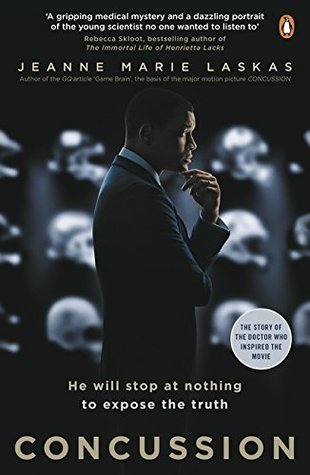
Concussion, by Jeanne Marie Laskas*****

concussionYou don’t have to enjoy football to appreciate Concussion, the riveting new biography of Bennet Omalu, the Nigerian neurological pathologist that discovered CTE, a type of permanent brain damage caused by repetitive concussions, such as that experienced by football players. Not only the content, but the engaging voice with which it is told, make it worth everyone’s while. I was fortunate enough to read it free, courtesy of Net Galley and Random House, but when it comes out Tuesday, November 24, I recommend you get a copy for yourself. It’s information everyone really ought to have, especially those that play American football, or have family members that do.

As for me, several years ago the middle school where I taught was rocked by the news that a young man we had taught had been killed on the football field while playing for the high school next door to us. DeShawn had died in a way the Seattle Times assured its readers was unheard of, a terrible tragedy with little explanation other than that of the coroner, who said he died of a traumatic brain injury. Our in-house football coach, whose frustrated students were stuck playing the “dumb”, safe version known as flag football, opined that maybe DeShawn hadn’t burped his helmet. One of DeShawn’s team members, a friend of my son’s and a frequent guest at our home, considered that DeShawn hadn’t “kept his head down like Coach said”. But the fact is, he was gone, and he wasn’t coming back. Dead at 16.

So I was interested indeed to read about the discovery made by Omalu, the pathologist that by coincidence was in charge of the autopsy of Iron Mike Webster, who played for the Pittsburgh Steelers. But I was equally interested in Omalu’s own story, a man of great enthusiasm and character, a faithful Catholic who used “Gee!” and “Gosh!” with youthful vigor as he uncovered one discovery after another, certain, so very certain that the NFL would want his discovery announced right away so that they could modify the game and make it safer. That poor man.

Omalu left Nigeria, which some Boomers will remember as having once been Biafra, home of genocide and terrible corruption, and he could not wait to live the American dream. The USA was free and open; there were no checkpoints at any of the highways; it was the home of Michael Jackson and Whitney Houston. Oh yes, he could shake the dust of Africa off the soles of his shoes and never look back. He had a full scholarship to the University of Washington, so although he had no idea where Seattle was, he had a ticket through the gates, and he would never live anywhere else.

Laskas uses Omalu’s own narrative in places, a wonderful thing given his buoyancy and eloquence:

Having seen this game [football] played on satellite TV on a few occasions in Africa, all I knew was the players ran into one another a whole lot and banged their heads repeatedly like guinea pigs running around…What an odd and inelegant game…If it hurts so much that you have to bubble-wrap your body, maybe you should play something different.”

But until he examined the brain of Iron Mike, the local hero who had lost his sanity following retirement, tasering himself in the hope he would be able to sleep, trying to fix his rotting teeth back into his own mouth with crazy glue, this was a side issue. His interest was in pathology, in the stories the dead had to tell.

But to Bennet, it seemed obvious enough, when the topic arose, because

“Anybody who knew anything about the anatomy of the head knew…It was a simple matter of physics. The brain floats, is suspended in a kind of thick jelly inside the skull. If you hit the head hard enough, that brain is going to move, no matter what kind of protection you put around the skull. A helmet protects the skull. A helmet can’t keep the brain from sloshing around in that skull. If you hit your head hard enough, the brain goes bashing against the walls of the skull.”

The helmet, it turns out, is more a weapon than protection for the brain.

Huh. No wonder Europe didn’t rush to join us in playing this sport.

Omalu’s story, from beginning to old age, is vividly told, and he is such a fascinating individual that you won’t want to put this story down once you’re into it. I could tell you more, but why ruin it? You really just have to read it. Order it now, or go out next week and buy a copy. You won’t be sorry!

Petty, by Warren Zanes*****

pettyOh my my, oh hell yes! If Tom Petty and the Heartbreakers is a band that lights your fire, you have to read this biography, which comes out Tuesday, November 10. You’ll be happiest if you can do it near a source of music, and the very best of all is to be near a desktop or other screen where you can view and hear the music videos as you read about their inception. Petty made it big just as I graduated from high school. By the time my first-born entered elementary school, I had a backseat full of little kids who bounced their heads along to the unquestionable rhythm of his music playing on the radio. And right about now I am supposed to tell you that I got this DRC free for an honest review, courtesy of Net Galley and Henry Holt Publishers.

Zanes has really done his homework here, interviewing Petty extensively, and also interviewing members of the band past and present, as well as other musicians (Stevie Nicks foremost among them) with whom he occasionally partnered. This was my first exposure to the Traveling Wilburys, a superstar group formed just for the sheer joy of it and consisting of George Harrison, Roy Orbison, Tom Petty, Bob Dylan, Jeff Lynne, and Jim Keltner. Well, here:

and after Orbison died, his chair was represented in the circle, with his guitar (I assume it’s his anyway):

Petty’s story is one of the ultimate success in spite of everything. Born into the kind of messed up, abusive, impoverished Southern home that America’s shot-to-hell social work system can’t even begin to repair, with a father that got along better with alligators than children and a mother who was stricken with both cancer and epilepsy, Petty was ready to get the hell away from the swampland and Florida immediately if not sooner. Petty tried school several times, but English (oh yeah, poetry right?) and art were the only courses that held any magic for him. He had one marketable skill, and unlimited ambition. As it happens, that was plenty.

If you want to read his story, this is the place to get it. Zanes has filled it with lots of vignettes, some of which are very funny. When a particular episode or situation is remembered differently by different musicians, producers and what have you, he tells what each has to say.

What you won’t find much here is his family, and that is oddly appropriate. Petty himself recognizes that when a guy is a professional musician doing the album cycle—write the songs, record the songs, make whatever changes need to get made, release the album, then go on tour to promote the album, and come back and do it all over again—family just gets left out. His first wife Jane developed some serious problems with chemical dependency and mental illness, and he experienced serious guilt over leaving their two daughters with her, but what else was there to do? Taking them on the road wouldn’t exactly be a healthy environment. Even if he quit making music, who’d pay the bills then? And so it went. So his elder daughter Adria puts in her two cents here and there, but mostly this is a story of Tom’s life as a musician. But reading about Jane’s addiction issues and then watching this video gave me chills (not great for small children, if you have them near you):

There aren’t really any slow parts to this biography; the least interesting to me were the various bands he formed or joined prior to his success as a soloist and then as the leader of the Heartbreakers.

That much said, this is the first, the VERY first time this reviewer (and all the reviews on this site are mine) has ever gone back to read a galley a second time before reviewing it, not because I didn’t get enough notes (oy, the notes!) but because it was just so much fun to follow Petty’s music and read the stories behind the songs.

If you don’t like Tom Petty, I question why you are even still reading my review. But if you’re a fan, this is a great bio to read, intimate without being tawdry or prurient, carefully researched, tightly organized. I am glad I didn’t have to edit it, because he probably had a mountain of extra information that was either cut or not included in the first place. But from anyone that loves good rock and roll, it’s uplifting and absorbing.

The ultimate holiday gift for someone close to you that loves Petty’s music would be his giant discography, the Traveling Wilburys DVD and CD, perhaps the documentary (which is on my own Christmas list), and this book. Rock and roll forever!

The Invention of Wings, by Sue Monk Kidd*****

theinventionofwingsTwo of today’s hottest political topics have to do with equality. As we follow and sometimes participate in the Black Lives Matter movement, along with the fight to keep Planned Parenthood funded and maintain a woman’s right to own her body and say what happens to it, this elegantly crafted work of historical fiction could not, strangely enough, be more timely. The Invention of Wings is a fictional biography of Sarah and Angelina Grimke, abolitionists and feminists, the first to make screaming headlines by speaking out publicly decades before women would see the right to vote, and decades before the first shots of the American Civil War were fired. As is essential in dealing with the rights of then-enslaved African-Americans in the south, Kidd adds an additional character, a slave named Hetty, written alternately with the Sarah’s story. I say it is essential to do so; this is because it is wrong to write about the marginalization and subjugation of an entire people, and then not include a representative of that group into the plot. As usual, Kidd doesn’t disappoint.

Much as I love historical fiction, one thing that makes me a little crazy is wondering where the research ends and fiction commences. In her afterword, the author lets us know specifically what is true and what isn’t. She even gives us a brief bibliography to pursue if we feel moved to do so; the only other historical fiction writer I know of that does this is Laurence Yep, my hands-down favorite YA author. Thus, Kidd places herself in outstanding company.

The Grimke sisters were born into the elite planter class, a tiny minority among Caucasians in the South, and in the very belly of the beast: Charleston, South Carolina. Partially because of the tremendous brutality meted out to the plantation’s slaves right before her tiny eyes there at home, Sarah Grimke grew up opposed to slavery. As a much older sister, she had a formative role helping her mother raise Angelina, who also became a fierce, uncompromising abolitionist.

It is one thing to take up a cause that is small but in which one has a support base. For the Grimkes, there was nothing. Eventually both had to move north for their own safety. And although, as a history major and a feminist of the 1970’s I had read about the Grimke sisters many times, it is within the well-crafted, deeply thoughtful, well researched pages of this novel that they first came to life for me.

Hetty, the slave depicted within these pages, actually existed, but the story Kidd writes for her is entirely fictional. The real Hetty died before Sarah was grown. Still, her character felt as real to me, and was easily as well developed as either of the Grimke sisters. Hetty is not passive, not waiting to be “set” free. She understands that the only freedom she is likely to receive will be what she can do for herself. A nice touch Kidd adds is in making Hetty one of the children of Denmark Vesey, the free African-American that attempted to organize and lead a slave revolt.

Everything here is carefully constructed and absorbing. Kidd has long demonstrated formidable talent in constructing well developed characters and vivid settings; the difference here (as opposed to The Secret Life of Bees and The Mermaid’s Chair, the two others of hers I have read) is the research involved. As with everything else, she blends fact and detail into a well spun tale.

I should add here that the literacy level required to deal with this text is higher than most. Don’t toss it out there for your average middle schooler to read, because it will prove too difficult. Because of the way she builds her story, brick by brick, the pace doesn’t really pick up until about halfway into the book. This isn’t a rip-roaring page turner; it’s a series of quiet nights by the fire, or curled up on your favorite window seat, or by the side of your bed. Give it the time it deserves.
Though I got my copy from the Seattle Public Library, I consider this title worth the cover price. Highly recommended.

U.S. Grant and the American Military Tradition, by Bruce Catton****

usgrantandtheamericanmilThis brass-tacks biography of US Grant, who served as America’s finest Civil War general and also two terms as US president, was originally written for young adults. Now it is something of an anomaly, and yet not a bad read for the right audience. Thank you, thank you to Open Road Integrated Media and to Net Galley for providing me with the DRC. This book will be for sale in digital format November 3.

Reading this nifty little book reminded me—not entirely happily—of how much sturdier literacy in the United States stood during the 1950’s, when this biography was originally written, compared to now. True, it was a less egalitarian, less inclusive school house that could throw this level of reading at its teenagers, and that is a different debate for a different day. Right now, I just have to tell you that Catton’s boiled-down biography is going to be over the heads of most high school students. In addition, there are a couple of slang terms no longer in use that may confuse the reader. I understood one of them—and I was born in the late ‘50’s—but another phrase left me scratching my head. My two fields, when teaching, were literature and US history, primarily the American Civil War and government, so if I don’t get it, then high school kids will miss some of it also. The book could be used for honors students, most likely, but is no longer ideally suited to high school students.

However, I can see its use today for community college students, and also for adults who are not doing research and don’t care to see Mr. Catton’s sources or argue his perspective. He takes a few enormously controversial aspects of Grant’s life and makes his own pronouncements, some bold, some bland, with absolutely not one shred of evidence to back them up, apart from his own excellent reputation, and so scholars in the field are more likely to find his Civil War trilogies more satisfying than this little nugget. But for the history buff who just wants a thumbnail sketch, one book and we’re finished thanks, this could be it. It is certainly less of a meal than Grant’s own memoir; also, unlike Grant’s inarguably excellent memoir, Catton addresses the rumors about Grant and liquor that Grant himself refused to even discuss.

Catton focuses primarily on the Civil War years, which I believe is the right way to remember the man, but he also talks about the setting into which Grant was born, and in a relatively short amount of text provides us with the lifestyle and expectation of the average American farmer, which is what the vast majority of Americans were at that time. He carries us through Grant’s time at West Point, then through the wars with Mexico.

He takes apart and casts aside, brick by brick, the nasty allegations that Grant’s detractors made then and in contemporary times, and shines an authoritative light on them. What about Grant and the booze? Was Grant really a bad businessman who lost his own money and that of other people? Was he really Grant-the-butcher, as a brief but ugly period in revisionism charged, willing to plow willy-nilly into any and every battle regardless of the number of soldiers’ lives lost? What about his presidency, and the scandal that clouded it?

Grant is one of my heroes, and I appreciate the way Catton defends him here. I particularly was interested in his very convincing defense of Grant as businessman. I found Catton slightly abrasive in his tone toward Grant’s defense of the rights of African-Americans during Reconstruction; it was clearly this, rather than anything else, that caused the glow of his wartime glory to dim, because the Klan and Southern white reactionaries were absolutely hell-bent on creating a stratified society in which the Black man did not have equal rights to those of Caucasians, and one determined U.S. president was not able to stem that tide. That’s really what Grant was up against, and what tarnished his reputation. Catton feels he should have been more, um, “flexible”. I personally am pleased that he was willing to ride his principles to hell and back if need be…and that was about what happened.

I find it so sad, so ironic that the vast overload of expensive cigars sent to General Grant by patriotic admirers are what most likely lead to his death; throat cancer checked him out of this world only 48 hours after his memoir was completed.

Although there are no citations for the facts provided in the text, there is a nice little index that will prove useful to students.

Recommended for adults at the community college level, and to history buffs who just want to read one relatively simple biography of Grant.

MJ: The Genius of Michael Jackson, by Steve Knopper****

MJthegeniusofmichaeljacksonJackson was a musical prodigy whose talent was almost limitless. His brilliant career was derailed by scandal, and his final 50 city tour was aborted by his death the night before it was to commence. Knopper does the best job of objectively recounting Jackson’s life and death that I have seen so far. His portrait is intimate without being prurient. Thanks go to Net Galley and Scribner for the DRC, which I received in exchange for this honest review.

Jackson was born in the 1950’s, a time when the race barrier kept Black performers from being seen by a general audience, with only the rarest exceptions. Black folks could play music for Black folks, and nobody else. The family was terribly poor, with eight or nine people crowded into a house better suited to three or four. They lived in Gary, a steel town in which Black poverty was more the rule than the exception. His father was a struggling musician until it became obvious that his sons had inherited his talent plus some. By the time Michael was five years old, he was the charismatic center of the Jackson Five, who soon were contracted to Motown, the center of African-American music in the USA.

Knopper explains how the family’s progression from a Motown act, where they were not allowed to actually play their own instruments on stage and could not use music they wrote themselves; to an independent family act, apart from one son who chose to remain with Motown; to the final day when Michael got himself an agent and a lawyer and set out on his own, divorcing his family so that he could have full control over a solo act. Until he was independent, iconic creations such as Thriller and Smooth Criminal would most likely never have been launched. And he recounts the family drama that ensued, with bodyguards pulling guns to discourage Michael’s angry brothers when they tried to force their way past the gates of his estate, shouting that he owed them money.

As a fan of excellent music and performance, I was sucked into the maelstrom produced by the press both during his life and afterward. It’s embarrassing to admit how completely I was played. For years I would not permit Jackson’s music to be played in my home because I thought he was a sick creep who used his fame to gain private, inappropriate contact with smooth-faced young boys. Somehow it escaped me that he had never been proved guilty in a court of law; on the one hand, it made sense to pay one family off in order to take the heat off his career, and Knopper documents the advice experienced, famous musicians gave Jackson to do whatever he had to do to shut that shit down so he could go back to focusing on music. But the press was merciless, and the payoff, which came too late to do damage control effectively, was portrayed as a tacit admission of guilt. And I bought it.

A few months after Jackson’s death, I was in a hotel room on vacation with my family, and my youngest son, who is Black, turned on the television, and there was the second round that Knopper documents, the round of memorial tributes that brought a lump to one’s throat as we saw Jackson’s miraculous career unspooled. He pioneered music videos in so many ways I had failed to appreciate, and he employed so many Black musicians that might never have had a steady job, while at the same time reaching out to Caucasian performers as well, creating a bridge between Black music and Caucasian sounds, transitioning from disco-like R and B to the “King of Pop”. I was horrified at the way I had misjudged him.

About a year ago, I read Michael Jackson’s memoir, Moonwalk, and while I took parts of it with a grain of salt, I also came to believe that the guy just didn’t know what was socially appropriate at times because he had never had a normal childhood. I was sold. Poor Michael.

Knopper has a more realistic take on all this. He certainly should; he used over 450 sources, and he wasn’t anybody’s mouthpiece. And so the truth turns out to be more complicated.

What left me somewhat stunned, in the end, was not the sex scandal, and it wasn’t the postmortem resurrection of Jackson as some sort of musical saint. Instead, I was absolutely floored at the number of people that worked for the guy, some of them for a lot of years, who he left without paychecks for weeks, then months on end. Jackson had a tremendous load of debt, was on the verge of bankruptcy and was saved only by his investment in song publishing, a piece of advice given him by friend Paul McCartney that he had followed through on. Yet he continued to buy one extreme luxury estate after another, holding residences he would likely never use again, shopping extravagantly (the example of taking a new friend shopping and telling him to do it “like this”, as he swept entire shelves of merchandise into his cart, astounded me) while leaving his employees, regular working folk with bills to pay for the most part, with no paychecks. There was money for shopping, but not for them, and some of them took him to court for it. It made me a bit sick. This man knew what it was like to be poor, and he knew what hunger was like, but as long as he didn’t have to see the people that he had betrayed, he could continue to play out the Peter Pan thread, irresponsibly trashing the lives of those he had told they could count on him, then leaving them with empty wallets and eviction notices.

Maybe you think I have over-shared. I have news; this is only the tip of the iceberg. If you have followed this review all the way to its conclusion, you will like this book. It is available for purchase October 20.