Apostle’s Cove, by William Kent Krueger****-*****

Apostle’s Cove is the 20th novel in the Cork O’Connor mystery series by William Kent Krueger. The series takes place in a fictional town of Aurora, Minnesota near an Indian Reservation. Most of the characters are all or partly Ojibwe (also known as Chippewa, or Shinnob). Apostle’s Cove is an area with spectacular views, and it is home to the malign widow of an enormously wealthy man, who built a mansion there.

My thanks go to NetGalley and Atria Books for the review copy. This book is available to the public now.

This story commences with Cork receiving a call from his son, Stephen, who’s working with The Great North Innocence Project, an organization that helps people that have been wrongly convicted. Cork is a restauranteur and private detective now, but Stephen tells him that during his time as sheriff, Cork sent an innocent man to prison. For 25 years, Axel Boshey has been serving out a lifetime term for a murder he didn’t commit. He confessed to it in order to shield the person he thought to be the actual killer. Now Stephen wants Cork to go back, untangle the mess, and get Axel out of lockup.

The story—and the series—is helped considerably by its appealing recurring characters. The two most compelling ones are the very oldest—Henry Meloux, an ancient wise man that lives in the forest and counsels those that seek his help—and the very youngest, the seven-year-old grandson affectionately known as Waaboo, a child with supernatural powers to whom the spirits speak.

Halloween is fast approaching, and there is great excitement as the small community prepares for it. Waaboo is excited, yet also troubled. The Windigo, a cannibalistic spirit, is nearby, and it’s hungry. It isn’t here for Waaboo, but nevertheless, he is disturbed by it.

The story is complex and, in most regards, believable. I read multiple books at a time, but while I read this one, the others became sidelined much of the time. This series is reliably well written and entertaining, and so it is with Apostle’s Cove.

Can you jump in mid-series? I did. I began reading it with the 18th in the series. Whereas it’s more fun once you recognize the characters, there’s nothing that will confuse a new reader.

Highly recommended to those that enjoy the genre.

My Friends, by Fredrik Backman***-****

“Being human is to grieve, constantly.”

Well now. Fredrik Backman’s many fans ought to brace themselves for his latest novel. The feel-good stories he’s written, and written brilliantly, in years gone by are nowhere in evidence here; those of us that look to this author to bolster our sense of optimism and to remember that human beings are innately good are not going to find it. This book is far darker than anything he’s written to date, and I have no idea what is behind this sorrow and misery sandwich, but I am sorry it’s come to this.

My thanks go to NetGalley and Atria Books for the review copy. This book is for sale now.

Our premise is that a homeless teen artist, grieving the death of her best friend, befriends an older, dying street artist who turns out to be someone famous and revered in the art world. The artist senses in her a kindred spirit, and so his last act is to have his friend and business agent sell everything that the artist owns in order to purchase back one of his most iconic paintings and give it to her after he dies, because “She’s one of us.”

Okay. It’s a stretch, but it’s fiction, and after all, Backman generally delivers, so I’ll suspend disbelief and roll with it.

Nearly the entire remainder of the book consists of the friend, whose name is Ted, spilling his and the artist’s past to the girl, whose name is Louisa. He’s traveling by train, and so he takes her with him. We hear all about their childhoods together, along with the two other friends that made up their tightly knit friend group. At one point she runs off, and at another, they lose the painting and the artist’s ashes, but these constitute minor breaks in the otherwise unending conversation, which is nearly a monologue.

It didn’t take me long to be heartily sorry I had ever taken the galley; I finally bonded with the narrative at about the 60% mark, and from that point until just past the 80% mark, I was reading because I wanted to know what would happen next, or be said next, rather than from a sense of duty. For most of the final 20%, I was watching the page numbers and wondering if this thing was going to end, ever.

It’s hard to rate a book like this, because so much of my disappointment stems from my earlier admiration of Backman’s works. If this was written by someone with whom I was unfamiliar, would I rate it a little higher? But then, if the author wasn’t known to me, I likely wouldn’t have picked it up in the first place. The stark shift in the author’s world view is shocking, and I am still not entirely over it. I can only recommend this book to you if you need a grief book, because anyone in need of a good ugly-cry will surely find it here.

Far and Away, by Amy Poeppel****-*****

Amy Poeppel is the queen of intelligent feel-good novels. Her newest work, Far and Away, is about two women that have never met, one in Dallas, one in Berlin, who exchange houses for several months. The deal is done fast, as both of them have a short time to line something up, and soon they will both regret their hasty decisions.

My thanks go to NetGalley and Emily Bestler Books for the invitation to read and review. This book is for sale now.

One of the things I love best about Poeppel’s writing is her ability to create a complex plot with a lot of moving pieces, along with believable, sympathetic characters; yet somehow, the whole thing is easily understood, never confusing. Our story starts with Lucy and her family in Dallas, Texas. Her eldest child, Jack, is about to graduate from a private high school, then attend M.I.T. At the last minute, however, he is expelled unceremoniously. He’s done something dumb, and it’s been interpreted as something more sinister. He isn’t even offered a chance to explain or to defend himself. And though there is a lot of other business involving other characters, I enjoy this part most for the message it sends us at a time it’s desperately needed. Before you judge someone, take a moment to listen. Ask some questions before you hurl accusations and seek vengeance. If the behavior is as deplorable as you think it is, there’s still plenty of time to accuse and avenge afterward.  We in the U.S. and also Europeans can benefit from this one tasty nugget. Plenty of others can, too.

On the other side of the world in Berlin, Greta’s husband Otto has been invited to teach for a term at a college in Texas. He’s accepted without even discussing it with Greta; he has to go right away! Where will they even live? Otto suggests a hotel; Greta is having none of it. In her desperate search for last minute housing, she is connected with someone that knows that Lucy has decided, quite suddenly, to relocate for the summer. The accusations against Jack have turned to harassment and vandalism, and she’s ready to get out of Dodge. Her husband is incommunicado, performing a simulation for NASA, a part of which is to be cut off from everyone else. Mason still thinks that Jack graduated, and that M.I.T. is Jack’s next step.

And so it is that Lucy and her brood relocate to Greta’s apartment in Berlin, and Greta and Otto take up residence in the massive experimental home in Dallas owned by Lucy and Mason. Not a lot of details have been exchanged about either place; there hasn’t been time. So, they get on the plane, and everybody gets what they get, to their sometimes consternation.

There are many hilarious moments here; I especially enjoy the foreign language errors made, both English to German, and German to English.

If there were one thing I could change, I’d rework the epilogue. There’s a considerable jump in time, but the chapter heading doesn’t tell us, and so I am taking in details while doing some mental calculations. That’s not so bad when it’s at the start of a book, but at the end, it’s disorienting and breaks the flow. I also feel as if there were too many things tied up with too many bows. A kindergarten teacher told me once that the key to having a kindergartner paint, was to know when to stop them. It may also apply to adults and their writing.

Nevertheless, I loved this book! Part of the magic is due to Poeppel’s understanding of human nature, which is inherently good, and part of it is her hilariously quirky humor that often drops in, seemingly out of nowhere. Highly recommended.

The Children of Eve, by John Connolly*****

If Stephen King and James Lee Burke had a baby—an unnatural one, of course—it would probably look a lot like John Connolly. Connolly has a genius for creating tales that take place on Earth, and are in most regards realistic, while adding elements of the supernatural that go well beyond magical realism. There’s the mystery, and there’s the horror, and if we’re reading a Charlie Parker mystery, we cannot have one without the other, nor should we.

My tremendous thanks go to NetGalley and Atria Books for the review copy of The Children of Eve, the 22nd Charlie Parker mystery. This book is for sale now.

The story commences when Charlie is contracted to find and protect a man named Wyatt Riggins, who has disappeared. Riggins has thrown in his lot with some baddies, and may have bitten off more than he can chew. As Charlie—and we—pursue Riggins, we learn of some seriously nasty skullduggery that’s afoot involving international art thieves. Added to the mix are four missing children, believed to have been kidnapped. There’s not a single slow moment as Charlie tracks Riggins, and we see, through the third person omnipotent, the manner in which these thieves have fallen out, and the trail of bodies that are left in their wake. This is grisly business, and not for the squeamish, although I will say that some horror and hardcore detective novels do go places that I can’t, but Parker novels always manage to stay just inside my own boundaries.

Recurring characters Angel and Louis, perennial favorites, return briefly. At one point, Parker has been roughed up and is in the hospital. Angel and Louis have been listed as his next of kin, and they seem unlikely nurturers. While guarding Parker’s room, for instance, Louis amuses himself by making those that pass by him nervous. And when he is discharged on the condition that he not be alone for the next 24 hours, Angel and Louis make the doctor uneasy as well. She asks Parker whether he has “any other friends? Any at all?” I would have loved to see more of these two, but perhaps Connolly is keeping them in the shadows, lest they grow stale. That’s hard to imagine, but no other reason makes sense. I also enjoyed the brief glimpse of the Fulci Brothers, hired (but not brilliant) muscle men that resemble “bears in green leisure suits.”

Perhaps the most disquieting aspect of this novel—scratch that, not “perhaps”—is the development of Connolly’s dead daughter, Jennifer, who has come to him periodically and watches over him. I won’t say anymore about that, but I finished this book 2 days ago, have been reading several other books, and yet I can’t get Jennifer out of my head. For those that love gritty detective novels, and for those that are drawn to things that go bump in the night, this book, and this series is strongly recommended.

The Family Recipe, by Carolyn Huynh*****

“We all need to feel needed. Otherwise, what’s the point of living?”

Carolyn Huynh made her authorial debut in 2022 with The Fortunes of Jaded Women. It was one of my favorite novels not only of that year, but of all the thousand-plus galleys I have read since I began reviewing. She’s back again with The Family Recipe, and it’s every bit as good as the first. My thanks go to NetGalley and Atria Books for the invitation to read and review, but make no mistake: I would have hunted this thing down and bought it with my Social Security check if it came down to it. I wouldn’t have been sorry, either.

This book is available to the public now.

Once again, our protagonists are Vietnamese and Vietnamese-Americans, mostly women, and once again, they are siblings and other family members that must come together; it isn’t a voluntary reunion. And that’s where the similarities between the first book and this one end.

Duc Tran, the patriarch, has laid out the terms by which his children may inherit his fortune. Once upon a time, he was the Vietnamese sandwich king, and in order to become his heir, each of his four daughters must relocate to a city she doesn’t want to live in, and revive a down-at-the-heels restaurant in a now undesirable end of town. It’s a contest; that is, unless Duc’s one son, Jude, succeeds in getting married within the one year’s time limit of the contest. If he can do that, he wins. (His sisters aren’t worried; who would marry Jude?)

The story is told from several points of view; these include the siblings, their uncle—a shady lawyer, and Duc’s best friend; their mother, who abandoned them when they were small, when her mental health collapsed, and never went back; Duc’s second wife; and briefly, Duc himself, who mostly serves as a mysterious figure that doesn’t even return to the States to lay out his children’s requirements, sending their uncle as his proxy.  As the story unfolds, we learn more about each sibling, and about the traumas they have experienced, as well as their successes.

The thing that makes it work so well is Huynh’s unerring sense of timing. It’s a dramatic tale, but it’s shot full of humor, as we see at the outset, when we learn the sisters’ names. Their father was a huge fan of the Beatles, and so the girls are named Jane, Paulina, Georgia, and (wait for it…) Bingo!

There are plenty of twists and turns, and the dialogue crackles. The internal monologues are mesmerizing. This book would make a fantastic movie.

Since I was reading this galley digitally, I highlighted quotes that I thought I’d like to use in this review, but there are 28 of them. Obviously, I cannot share them all here, but let that inform you, if nothing else here has, how much I love this book.

Highly recommended to anyone that has a beating heart, at least a passing interest in Vietnamese-American culture and/or family stories, and can use a few good laughs.

Night and Day, by John Connolly****

“Surely, once a book is out in the world, and being read, the world is altered, for better or worse.”

John Connolly is one of my favorite authors, and because of this, I automatically snap up any book that appears with his name on it. But this one is unlike the others I’ve read, and that might be good news for some, but not for others. One way or the other, my thanks go to NetGalley and Atria Books for the review copy. This book is for sale now.

Night and Day is an odd one. The first half is dedicated to nine outstanding short stories, all in the horror genre; the second half is a nonfiction discussion of a film titled Horror Express. This is such a strange thing that I don’t believe it at first, and I read the first half of the film critique expecting the characters to come bursting onto a busy freeway, or commence kidnapping and eating employees at the film studio. Once I discover that this is truly the world’s longest film review, and of a film I haven’t seen, I am annoyed. The author says that one needn’t necessarily have seen the film to find interest in his article, but I must respectfully disagree. On the other hand, I am not much of a film buff.

Now let’s talk about the first half, where I have much nicer things to say. When Connolly writes fiction, he is incomparable. All of these short stories are of stellar quality, and hugely memorable. The last, titled “Our Friend Carlton,” is my favorite; it’s about a friend that really, really overstays his welcome. The first story, “The Pilgrim’s Progress: A Tale of the Caxton Private Lending Library and Book Depository,” is about a most unusual library. Here’s an excerpt that describes it:

“On a basic level, the operation of the Caxton was easily explained. When a novel achieved a singular status with the reading public (generally after the death of its author), a first edition of the book in question, wrapped in brown paper and tied with string, would appear on the Caxton’s doorstep, soon to be followed by the fictional character or characters responsible for its popularity.”

As you might have guessed, characters from The Canterbury Tales are squabbling in the back yard, and that’s just the beginning. It’s hilarious, despite the fact that I barely remember the Chaucer I studied in high school. Trust me, you don’t need a lot of backstory to enjoy it.

The above two stories are my favorites, but all of them are excellent.

Now comes the question of how to rate the book as a whole. Obviously, if you love brilliant horror short stories and have seen the movie discussed in the book’s second half, this is a five star book. My own sense is that the short stories are so wonderful that even if you stop reading after the first half, the book is worth having. But that’s easy for me to say; I read it free. Had I paid full cover price plus tax, and done so believing I was getting an entire book of the usual Connolly fare, I might be churlish enough to crank it down to three stars. Some readers will obtain the book for free via other means, such as libraries, subscription services and the like. And so, I will split the difference and rate it four stars; as for you, now you know what you’re getting, and you can decide accordingly.

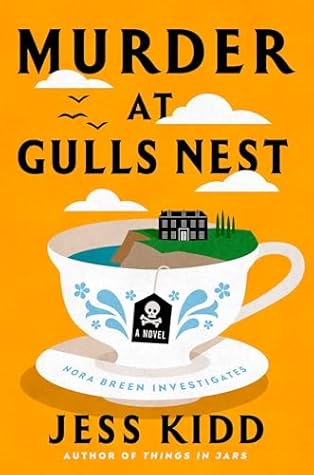
Murder at Gull’s Nest, by Jess Kidd*****

Nora Breen has sprung the coop, run away from her home of the past thirty years and come to Gull’s Nest, a rooming house near the sea. “Gull’s nest is that sort of place, isn’t it? Where the dreamers and schemers wash up.” And indeed, that’s our Nora. “A washed up nun…An abandoned friend. Flotsam and jetsam.”

Murder at Gull’s Nest is the first mystery in a series by one of my favorite novelists, Jess Kidd. I’m grateful to NetGalley and Atria Books for the review copy. This singular story will be available to buy in the U.S. April 8, 2025.

Nora is indeed a former nun; she’s shed her holy orders along with her tunic and scapular; she’s asked Christ for a divorce. Now she’s middle aged, and dressed in whatever castoffs were available when she departed. She has very little money, and is appalled at what inflation has done to prices between the time that she entered the monastery and the present day. Her first order of business now is clear, regardless: she must find her beloved friend Frieda, who left the order, came to live at Gull’s Nest, corresponded faithfully, then apparently dropped off the surface of the earth. If she’s alive, Nora will find her; if not, Nora will find her anyway.

She settles into the rooming house, and as she gets to know the other boarders, we get to know them along with her. The owner is a stickler for rules, and the cook and housekeeper—one person—is a tyrant. The food is dreadful! Nora resolves to float along beneath the radar for a bit, get the lay of the land before she does any obvious snooping about. However, since this is a murder mystery, someone dies while she’s still getting her bearings. And in time honored tradition, she irritates the very bejesus out of the local law man, Inspector Rideout, who is still deciding whether this death is due to murder at all.

“’I am not yet investigating a murder, Miss Breen.’

“’Are we not?’

“’No, I am not.’”

Don’t ask me to give away anything else about what happens here, because I won’t. I will tell you, however, that it crackles. Jess Kidd writes everything well: internal monologue? Check! Dialogue? Check! Denouement? Check, check, check!

Get this book and read it. You won’t be sorry.

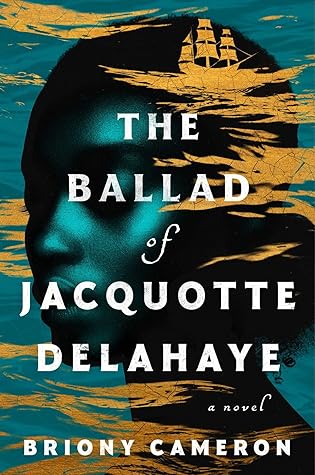
The Ballad of Jacquotte Delahaye**-***

The Ballad of Jacquotte Delahaye marks Briony Cameron’s authorial debut. She is a talented wordsmith, and my thanks go to Atria Books and NetGalley for the invitation to read and review. While I enjoyed several exciting passages—I do adore a good pirate tale—in the end there were issues with credibility that got in my way.

 This story of a pirate woman’s derring do is for sale now.

When I read that Jacquotte Delahaye was a real person and that the book is based on true events, I was all in. However, there are passages that made me raise an eyebrow, and since there didn’t seem to be any notes that would indicate what is true and what is the author’s invention, I took to Google to find out more. This is where I learned that actually, she may have been a real person, or she may be only legend. The stories surrounding her life and exploits are also legend. There’s virtually no verified historical information on this character.

I love good historical fiction, which is where actual, documented facts are given warmth and life by an author that adds dialogue and perhaps fleshes out a few areas where the record is sketchy. Then, if the author is sharp and professional, there will be end notes that explain what is a matter of historical record, and what has been invented. That’s my happy place. Even better is when sources are provided for interested readers. Of course, a writer of any kind of fiction isn’t required to provide footnotes or other documentation, but when they do, it’s the cherry on the sundae, and it makes me love them all the more.

Because this story is not nearly as closely aligned to historical record as the promotional materials would have me believe, I nearly dropped my rating to two stars. I felt, and still feel, that the synopsis provided is misleading. I don’t like feeling as if I’ve been played. However, I realize that the author probably is not in charge of her own promotional blurb, and I can’t see penalizing her for what the publicist has chosen to do.

Do I recommend this story? Not so much. Had it been written in such a skillful way that I felt no need to do research of my own, I might not know that this is pure fiction based on little more than speculation. That’s not the case, though. It doesn’t ring true in a number of places, and that’s partly because it isn’t. However, should the reader decide to pursue it, I would advise that you get this book free or cheap, unless your resources are endless ones. Don’t pay full cover price.

Spirit Crossing, by William Kent Krueger

Spirit Crossing is the spellbinding new novel in the Cork O’Connor series by William Kent Krueger. The book starts with two missing women, and an accidental discovery of a fresh grave. Readers faithful to the series will recognize the characters; there are enough of them, mostly related to one another, to provide depth and interest, without confusing the reader or making the plot too complex.

Lucky me, I read it free and early. My thanks go to NetGalley and Atria books for the invitation to read and review. This book is for sale now.

The story begins innocently enough, with the series protagonist, Cork, out berry picking with his son, son-in-law, and grandson, who is known by the Ojibwe nickname Waaboo. While searching for blueberries, they come across a fresh grave. Waaboo sees the victim standing before him, as if she is still alive, and he’s distraught because she is so unhappy. Waaboo is not the first one in his family to have this ability; nobody doubts that he sees what he says he sees. And so the men immediately wonder whether this is the grave of Olivia Hamilton, daughter of a wealthy Anglo, who’s been reported missing with massive headlines everywhere; or that of Crystal Two Knives, a missing Native girl whose name barely elicits more than a yawn from law enforcement.

And so right away, we are looking at not only the characters, but the longtime issue of missing Native girls and women, and the way that law enforcement neglects their cases for those whose families have money and connections.

One of the things I admire most about Krueger’s writing is the way that he incorporates urgent issues that especially impact the place where he lives—northern Minnesota—into the plot, blending them in so seamlessly that the reader isn’t distracted, because the issues are part and parcel of the mystery to be solved. He does the same thing with pipeline protests similar to the Dakota pipeline that lit up the headlines in recent years. Other aspects of the story include Ojibwe (Chippewa) culture and history, which is part of every book in the series, since most of the family is Ojibwe, and in this case, a character with a brain tumor. When significant events occur and the woman with cancer is the only one to witness them, did they really happen, or is it the brain tumor talking? This adds a layer of psychological tension not present in most of Krueger’s book; I’m not a fan of that subgenre, and am pleased to see that this doesn’t take over the plotline. It’s dealt with tastefully and without sensationalism.

Those that read my reviews know that I have an interest in seeing how authors develop child characters, particularly in a story such as this one, in which the child plays a major role. It makes me crazy when an otherwise competent author searches for shortcuts, such as a child that’s precocious or gifted, to explain away their own failure to craft the child’s character in a way that is honest developmentally. This is one more reason I enjoy this series. Yes, Waaboo has unusual powers, but he is still a small boy. The notion of going home without blueberries is a major blow. Tears threaten. I love the way Krueger develops this kid, and I can’t wait to see more of him in the future.

My one criticism involves a specific passage between the 88th and 90th percentiles, just as we rise toward the climax. Without going into spoilerish details, I will say that one character does something that everyone in the family agrees they must not do, and without any explanation, everyone in the family is fine with them doing it this time. This, of course, puts the character in danger, which anyone that’s paying attention can predict the very moment the action commences. It’s clumsy in a way that is atypical of this author, and I have no idea why he makes the choice he does, but it affects my enjoyment of the book, because suddenly I am not thinking as much about the characters as I am about the author. Having this occur a split second before the climax is especially grating.

On the other hand, I am picky. Very picky. I suspect that this passage will annoy only a small percentage of readers.

I do recommend this book, and this series, to those that love a good mystery. Although it can be read as a stand-alone, those with the time and inclination might enjoy going back a few titles, or even to the beginning of the series.

Middletide, by Sarah Crouch*****

Sarah Crouch makes her authorial debut with Middletide, a mystery set in the Pacific Northwest near where she grew up. Atmospheric and tense, it’s a damn fine start to what is sure to be a promising career.

My thanks go to NetGalley and Atria Books for the invitation to read and review. This book is for sale now.

The premise is that Elijah Leith leaves home when he reaches adulthood, eager to flee his violent alcoholic father, and make a name for himself in San Francisco. But his father dies, and when his first novel goes nowhere and he runs out of money, Elijah returns and takes up residence in the cabin where he grew up. He hopes to rekindle a relationship with his teenage sweetheart, but she has moved on, and since he was unreliable the first time around, she is reluctant to trust him anyway.

Then the cops find the body of Dr. Erin Landry hanging from a tree on Elijah’s property.

This whodunit is original and intelligently written. The pacing is perfect, and I never would have guessed the ending, at least not until nearly the end when the author spells it out. Elijah is not the most lovable protagonist, but Crouch develops him so that, although not a prince or a hero, he is nonetheless a decent human being by the end. Some will consider the solution to be over the top, but it’s only far fetched if the author fails to convince us that it’s true, and I am persuaded.

Those looking for a fun read to pack for a vacation, or just to occupy a weekend at home, here you go. Grab your book, your lemonade or your whatever, and head for your happy place. You can thank me later.