
Biting the Hand, by Julia Lee****

Julia Lee is not amused, and she’s decided to say the things nobody else is saying. In this deeply analytical, provocative memoir, she tells us about her own experiences growing up, and the issues faced by Asian immigrants and Asian Americans in the United States, where “we are critical to the pyramid scheme of the American Dream.”
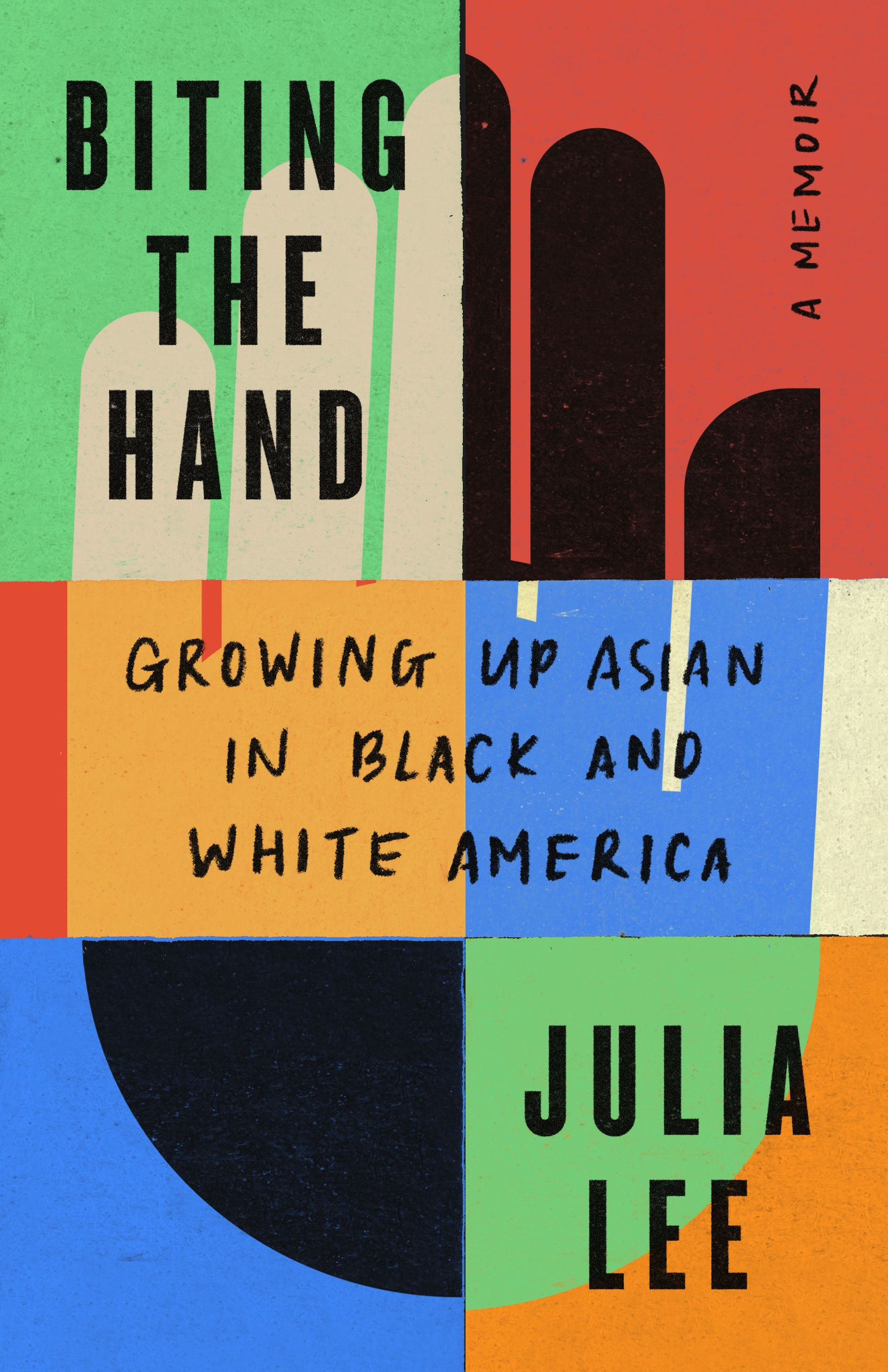
My thanks go to Net Galley, Henry Holt Publishers, and Macmillan Audio for the review copies. This book is for sale now.

In some ways, I feel as though I am reading someone else’s mail as I read this, because it is clearly intended for an audience of people of color. However, I did read it, and I’m going to review it.

When the discussion of race in the U.S. comes about, it is, as Lee states, almost always a conversation about Black people and Caucasians. Those that don’t fit into either group are sidelined. Perhaps more harmful is the way that people of Asian descent are presumed to be sympathetic to the status quo. Ever since a major news periodical dubbed Asians as “the model minority” back in the early 1960s, expectations and assumptions have leaned in that direction. And the roots of this division—Black versus Asian—make this a particularly thorny assumption to untangle. After all, a large percentage of African-Americans can trace their lineage to slavery; their ancestors weren’t born in the States, nor did they choose to come here, but were kidnapped and brought by force. Angry? You bet! But Asian immigrants came of their own accord, oftentimes fleeing untenable circumstances in their countries of origin. And so, their children, and those that have come after, have largely been indoctrinated to be appreciative. If things don’t go well, they tell them, then we must work harder!

This Caucasian reviewer comes to you without the Asian background, appearance, or experience that Lee speaks of; yet I live in a city that has one of the largest Asian populations in the U.S., and am married to an Asian immigrant, and parent to a child that is half-Japanese. So many of the stories—strangers that ask where you’re from, and won’t accept the truth of “California,” where Lee was born, or “Seattle,” my daughter’s hometown, are familiar ones.

Lee is fed up with the mainstream news stories that endeavor to pit Asian and Black people against each other. Her parents were small business owners in a mostly Black part of Los Angeles during the riots of 1992, and her experiences inform her conclusion, that there must be solidarity between all people of color in order to successfully fight for significant change.

The one bone I have to pick is the casual manner in which she dismisses the question of social class as a key factor. Her very brief note about this is that it’s a tomato and to-mah-to issue, not worth much discussion, because most people of color are working class. This is simply untrue, and it enforces a stereotype of Black people as being mostly poor and dispossessed, when in actuality, eighty percent of Black people in the US live above the poverty line. There are African-Americans that have far more money than I will ever see; some of the many Asian groups have a higher median income than Caucasians. So yes, social class is a huge factor here, one that Lee should examine more critically. There are working class Whites that can be allies; there are wealthy families of color that would shut down the struggle, given half a chance. The missing star in my rating reflects her failure to recognize this, and to offer concrete solutions to this problem.

The book’s title comes from Lee’s mentor at the otherwise very white-supremacist dominated Harvard—Jamaica Kinkaid. I actually gasped when I saw this. What a luminary she found to guide her!

Both the audio and print version of this book are equally readable, so go with whatever you usually prefer.

This is a fine resource for those seeking to examine Asian and Asian-American racial dynamics. Read it critically, but do read it. There’s a lot here that has needed to be said for a long, long time.

The Fortunes of Jaded Women*****

The Fortunes of Jaded Women by Carolyn Huynh, is hilarious and oddly touching. It’s the best debut novel of 2022, and it isn’t as if there was no competition. My thanks go to Atria Books and Net Galley for the review copy; this book is for sale now.

Mrs. Mai Nguyen was born in Vietnam, but has lived most of her life as a Californian. When we meet her, however, she has flown to Kauai, the home of a renowned Vietnamese psychic. The psychic tells her that the year ahead will be a pivotal one, the one in which she must repair her relationships with her sisters and her daughters. There will be one wedding; one funeral; and one pregnancy.

Well, now.

Nobody likes to be estranged from a family member, and yet it happens. But all of them? Both sisters, and her daughters, too? (No brothers, and no sons, either.) But surely, it isn’t her fault; after all, there’s the curse.

Chapter four is when everything kicks up a gear, and I have seldom laughed so hard. Mrs. Minh Pham is the first to arrive, and she has my attention from the get-go when she slips the waitstaff some money and explains there could potentially be a “small, tiny, little shouting match, with a propensity for small, tiny, little objects to be thrown through the air.” Mrs. Pham is the middle daughter, and is accustomed to being the mediator in any dispute. She takes all the precautions she feels are wise; she parks near the door for a fast getaway if necessary. She removes the sharp utensils as well as the chopsticks from the table, and requests paper plates and plastic cutlery. “Mai had a reputation for throwing things.”

As the women arrive at the dim sum restaurant, they flash their fake Louis Vuitton handbags and immediately set about trying to one-up one another with regard to social status and affluence, and especially—oh yes, especially—that of their respective daughters. Within three minutes, a donnybrook ensues, and the other diners, who are also Vietnamese and well acquainted with the curse of the Duong sisters, begin placing wagers on the winner. The sixty-something sisters commence throwing things at each other and are gently escorted out of the restaurant. They head for a bakery, and they get kicked out of there, too. Finally, the three of them end up on a park bench, their hair and clothing in dishabille, and yet none of them makes any move to leap up and go home.

These are not spoilers; this all takes place within the first 17 percent.

The chapters change points of view, moving between the sisters, their elderly mother, and their daughters, all in the third person omniscient. The fascinating thing is, these crazy behaviors, and the ways that they mold and shape their daughters and their relationships, all fit perfectly.

Although the setting changes, from Orange County, California to Hawaii to Vietnam to Seattle and beyond, this story is character based, and that’s my favorite type of novel. The skeezy men they date—mostly white boyfriends with Asian fetishes—make it even funnier.

The ending is perfect.

This is one of those rare galleys that I may actually read a second time for pleasure. One thing I know for sure is that Huynh is on my radar now. I can’t wait to see what her next book looks like!

All We Are Saying, by David Sheff*****

This is a digital reprint of the last interview of John Lennon and Yoko Ono, two days before John was murdered on December 8, 1980. David Sheff is a journalist and also a die-hard fan of the Lennon’s. Lucky me, I read it free. Thanks go to Net Galley and St. Martin’s Press for the review copy. It’s for sale now.

This interview is a treasure trove for anyone interested in John Lennon, Yoko Ono, or the Beatles. 192 pages makes for a short book, but as interviews go, it’s a whopper. Lennon and Ono were about to release an album together, and so when Playboy requested an interview, they consented. The most wonderful thing about it is that because of the format, nearly everything is a direct quotation of either John’s or Yoko’s. Nobody knew during the course of the interview, which took multiple days, that John would be shot to death by a stranger two days later.

It makes for interesting reading. There are passages I love and others that make me see red, but I am not irritated with the author, who’s done a bang-up job, but rather, in places, at things said by his subjects. Most of it is tremendously entertaining. And in some places, it is almost unbearably poignant. At the outset, John makes a comment, almost off the cuff, about how the way to be really famous as an artist is to die in public, which he surely isn’t planning to do. Later, he quotes someone that says it’s better to burn out than to rust, and he says he disagrees, that “It’s better to fade away like an old soldier than to burn out.” And he notes that he has another forty years or so of productivity ahead of him.

Lennon was a happy man when this interview took place. He’d been a “house husband,” staying home and taking care of Sean, their son, although they acknowledge that it’s easier to do that when there’s a nanny available anytime he needs to go out for some reason, and someone else that will clean the house and so forth. Ono, on the other hand, is the one who’s handling their finances, and it’s a princely fortune at that.

And to me, the most interesting aspect of this interview isn’t him, it’s her. I was a child in elementary school when John left his first wife and married Yoko, but I remember the virulent, nasty things that appeared in the media. Those that don’t think any progress has been registered regarding race and gender should look through some archives. And John comments that the press treated their relationship as if he were “some wondrous mystic prince from the rock world dabbling with this strange Oriental woman.”

Ono said, “I handled the business…my own accountant and my own lawyer could not deal with the fact that I was telling them what to do…”

 John continued that there was “…an attitude that this is John’s wife, but surely she can’t really be representing him…they’re all male, you know, just big and fat, vodka lunch, shouting males…Recently she made them about five million dollars and they fought and fought not to let her do it because it was her idea and she’s not a professional. But she did it, and then one of the guys said to her, ‘Well, Lennon does it again.’ But Lennon didn’t have anything to do with it.”

There’s a lot that gets said about the women’s movement and all of it is wonderful. Once in awhile John holds forth about something he knows nothing about (anthropology and the early role of women) and he makes an ass of himself. He may have been more enlightened than most men, but he still hadn’t learned to acknowledge that there were some things he just didn’t know.

There are passages that make me grind my teeth, and all of them have to do with wealth in one way or another. Ono is from a ruling class Japanese banking family, and the airy things she and John say about being rich make me want to hit a wall. People shouldn’t pick on them for being wealthy. And oh my goodness, when Sheff mildly suggests that John and the other former Beatles surrender and do a single reunion concert for charity, his response is horrifying. He points out that the concert for Bangladesh that George Harrison roped them into doing turned out to raise no money at all for the cause because all of it went to red tape and lawsuits; ouch! But the truly obnoxious bit is when he whines about how the world just expects too much of him. He wants to know, “Do we have to divide the fish and the loaves for the multitudes again? Do we have to get crucified again? We are not there to save the fucking world.”

The part that makes me laugh is when Ono describes how The Beatles broke up at about the same time she and John got together: “What happened with John is that I sort of went to bed with this guy that I liked and suddenly the next morning I see these three guys standing there with resentful eyes.”

Those that are curious about Lennon and Ono, or that are interested in rock and roll history, should get this interview and read it. There’s a good deal of discussion about the roots of the music, and about the music he made that the radio never played. There’s a good deal here that I surely never knew. For these readers, I highly recommend this book.

Bestiary, by K-Ming Chang

It’s the best of books, but it’s the worst of books. K-Ming Chang has made her mark on modern literature, and her debut novel, Bestiary, has already made a number of prestigious lists. My thanks go to Net Galley and Random House for the invitation to read and review; sadly, its twisted edginess is too intense for me.

This much-buzzed-about book is for sale now.

How many triggers are packed into this one little book? All of them. Every trigger you can possibly think of, plus she may have made a few more up on the spot. There is violence a-plenty here, and the graphic child abuse and elder abuse provide such visceral imagery that I may never get it out of my head. I abandoned this book faster than just about any I can recall, and although I was certain it was the right thing to do for myself, I nevertheless experienced a twinge of regret along with it, because it is obvious from the first page that this author can write.

My gut hunch is that younger adult readers with cast-iron stomachs and level dispositions will be the most appreciative demographic for this one, but wimps like me will need to give it a pass. It is to the former that this book is recommended.

Your House Will Pay, by Steph Cha*****

The quality that distinguishes Cha from other top-tier mystery writers is her absolute fearlessness in using fiction to address ticklish political issues.  Your House Will Pay is impressive. I read it free and early thanks to Net Galley and Harper Collins. I am a little sick at heart that I’m so late with my review, but this book is rightfully getting a lot of conversations started without me. It’s for sale now, and you should get it and read it.

Our two protagonists are Grace Park and Shawn Matthews. They don’t know each other, but their families intersected one critical day many years ago.  The Parks are Korean immigrants, the owners of a small pharmacy.  The Matthews family is African-American, and they have never stopped grieving the loss of sixteen-year-old Ava, who was shot and killed one evening by Grace’s mother in a moment of rage and panic. The other thing shared by Grace and Shawn is that both were quite young when it happened. Shawn was with his older sister when she was killed and has memories of what happened; Grace has been shielded from the event and knows nothing about it until the past opens itself up in a way that is shocking and very public.

The story alternates between the initial event, which happened in the 1990s, and today; it also alternates between the Park family and the Matthews’.  The development of the characters—primarily Grace and Shawn, but also Shawn’s brother, Ray and a handful of other side characters—is stellar. Throughout the story I watch for the moment when the narrative will bend, when we will see which of these two scarred, bitter families is more in the right, or has the more valid grievance. It never happens. Cha plays it straight down the middle. Both families have been through hell; both have made serious mistakes, crimes against one another. And ultimately they share one more terrible attribute: both families have been callously under-served by the cops and local government, for which relatively poor, powerless, nonwhite families are the dead last priority.

Cha bases her story on a real event, and she explains this in the author’s notes at the end of the book.

As a reviewer, I am closer to this than many will be: my family is a blend of Caucasians, Asian immigrants, and African-Americans. I read multiple galleys at a time, shifting from one to another throughout the reading parts of my day, but it is this story that I thought about when I wasn’t reading anything.

The first book that I read by this author was from her detective series. When I saw that she had a galley up for review, I was initially disappointed that this wasn’t a Juniper Song mystery, but now that I have seen what Cha is doing and where she is going with it, I see that this had to be a stand-alone novel. There isn’t one thing about it that I would change.Highly recommended to those that love the genre and that cherish civil rights in the U.S.; a must-read.