
All In, by Billie Jean King*************

There are books, and then there’s this: the autobiography of an icon that will be read for generations. I passed—perhaps foolishly—on a review copy, because I was afraid there would be large passages of minutiae about tennis, which doesn’t interest me. I was mistaken in my concern, but it worked out well, because I borrowed an audio version from Seattle Bibliocommons, and the author reads her own book. She is an old woman now, and hearing her detail her own remarkable life is a matchless experience. It’s hard to imagine there will be a more important, or more enjoyable book published in the coming year.
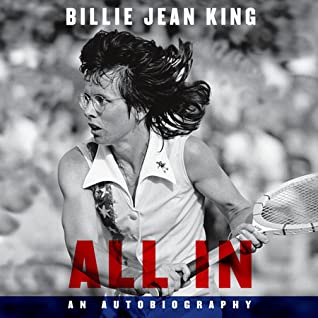
Billie Jean Moffitt King is born in 1943 and grows up in Southern California in a conservative working class family; her dad is a firefighter, and her mother stays home, as most mothers did back then. There is Billie, and there is her brother, and the family are devoted Methodists. Who is to know that both children will be famous one day? Brother Randy becomes a professional baseball player, and Billie Jean becomes a record-breaking tennis star and a passionate social justice activist. If you, reader, are younger than sixty, you probably don’t even know how much you owe Billie Jean.

Growing up, King enjoys all sorts of sports, but when she is introduced to tennis, a light comes on. The problem is, tennis is a sport for the elite, even more so back then than now. To find a tennis court, you needed to either have a private court built on your palatial estate, or belong to a country club, and of course, to do that, you also have to be Caucasian. Billie Jean’s family is nowhere near affluent enough to belong. And so, early on, her passion and her obvious talent draw support from people with enough pull, or enough money, to give her access. She takes the time to thank them, but doesn’t let this bog the story down.

Over and over, however, she is shut out on account of her gender. Prize money typically pays enough to help an athlete pay their own travel expenses and buy equipment, but when women are allowed to compete in competitions prestigious enough to offer prize money, it’s only for the men. Women are expected to be grateful that they are included at all. And as King gets better at her sport and her confidence grows, she begins to push back. Nobody wants to watch women play tennis? Since when? And since when should people of color be shut out?

Although she doesn’t say so, it becomes obvious to me that in addition to athletic talent, confidence, intelligence, and almost endless energy, King has one more talent, one that isn’t recognized as such in the mid-twentieth century: she has amazing people skills. Over and over, she is able to reach compromises, make deals, and shorten the gap between conservative perceptions of women athletes, and what all athletes deserve. She discusses the various battles (though she doesn’t use this word) and how they are resolved, and I am amazed at the grace and dignity she demonstrates. Perhaps the most telling moment is when she befriends Bobby Riggs, the obnoxious bastard that she has defeated in front of the world, and later, when he is on his deathbed, takes a call from his wife. Riggs is asking for her, and he doesn’t have much time left. She is too far away to get to him in time, but she tells him on the phone that she loves him. Wow.

If you are or were a girl that participated in high school sports, or if you or your loved ones have benefited from Title IX, thank Billie Jean, who testified before Congress. She also started the first professional tennis circuit for women.

Over the years, King wins 39 Wimbledon Grand Slam titles and a host of others as well. I am a child when she plays Bobby Riggs in “The Battle of the Sexes,” and she beats him squarely. What I don’t know (and would still not have known if I’d been paying attention,) is that she does her very best not to play this tournament. Riggs is much older than she, and he hounds her—in fact, today his behavior would violate anti-stalking laws. But she calmly tells him, over and over, that she isn’t interested, and then she ignores his calls and turns away from his in-person visits. But when a fellow women’s tennis champion plays him and loses, Billie turns to her husband and manager, Larry King, and with a sigh, says, “Okay. You’d better set it up.”

At this point, I turn away from the audio book and head to YouTube to watch The Battle of the Sexes. This trip back to the society in which I grew up is hair-raising. The ways that men talk about women, in public forums! The remarks by Howard Cosell, who was the most liberal of sportscasters, about her physical appearance, and the patronizing remarks of others are appalling. I wouldn’t go back for anything in this world! But when she is asked antagonizing questions, Billie Jean comments, briefly, calmly, and without showing even the slightest offence. Her coolness on the court is mirrored in her cool public appearances. It’s remarkable.

When Gloria Steinem starts Ms. Magazine, King supports her, but she is always either asleep or busy, so husband Larry handles the mail. When he sees the request to add her name to a list of famous women that support a woman’s right to choose, as the controversy over Roe v. Wade heats up, he signs for her and then forgets to mention it to her; had he read more carefully, he would have noted the line, “I had an abortion!” King doesn’t know it’s about to be public knowledge, and her parents didn’t know she’d terminated a pregnancy. It’s not a good moment.

Later, when her feelings for other women grow stronger, she and Larry separate, but not completely. For years, she stays with him when they both show up in town at the same time, and they continue a romantic relationship, though infrequently. It is when she grows close to South African tennis player Ilana, and Ilana makes her choose, that she divorces Larry; again, they remain friends.

I could carry on all day about this woman, a champion on the court and off, but if you are interested enough to read this entire review, then you’re interested enough to get this book. I’m sure the print version is lovely, but the audio book—which sounds like a garrulous old lady telling her story, like Forrest Gump, but authentic and more accomplished—and hearing her voice wobble when she speaks of her most moving experiences, is simply unmissable.

Go get it.

Black Cake, by Charmaine Wilkerson****-*****

“I was not the first person to go through the world living two separate lives, one out in the open and the other locked up inside a box.”

Elly Bennett dies and leaves a detailed recording for her children. Wilkerson’s novel is about Elly’s life, but more than that, it’s about secrets. Everyone in this book has one or has been impacted by one in a major way, and for most, both are true. Elly and her late husband had a whopper, and they built their lives and their family around it. Their two children are Byron and Benny, and Benny’s secret is all consuming for much of her life; it has had a role in estranging her from her once-adoring older brother and parents. Meanwhile, there’s a child—now grown to middle age—in Europe that is herself a secret, and whose very identity has been obscured by one. Elly’s closest childhood friend carries a particularly potent secret, and so does the nanny that raised her. Even the lawyer that handles the estate has one.

When is it safe to let go of a secret?

I was invited to read Wilkerson’s debut novel by Random House Ballantine and Net Galley, and I thank them for the review copy. This book is for sale now, and everyone is talking about it. You’ll want to get in on it.

Our story unfolds with seventeen year old Coventina Brown, known as Covey, quietly launching a plan to join her boyfriend, Gibbs, in London. He’s gone there to go to school, and when she’s done with school, she will join him. That is, until her father, who has raised her alone, gets into big trouble with a loan shark, a local thug who now holds title to her father’s store and his home, and now wants the one thing this father has left: Covey. If Covey marries this nasty old man, the debt will be squared. Most fathers would send their daughters to safety, and then square their shoulders and solve their problem, even when their own lives hang in the balance. But alas, Johnny Lyncook is not most fathers. He’s not a particularly nice man. As one of our characters will observe later, “A shit is a shit, young or old.”

Covey escapes on her wedding day (at which Black Cake, similar to fruitcake, is traditionally served), and her experiences from that time forward will form the foundation of her own life, her (future) husband’s, and their children and other loved ones.

The story is told in the third person omniscient, with the point of view changing by chapter, along with the time period. Readers will find themselves wretchedly confused if they fail to note the chapter titles, which are the key to everything that follows. The result is a story that is assembled like building blocks, and although it works out in the end, with everything coming together for a satisfactory resolution, I am frustrated at times, because just as a character begins to take shape for me, we leave them and join someone else.

I would have enjoyed more integration and perhaps a wee bit of streamlining. For example: we learn that Johnny, Elly/Covey’s father, is ethnically Chinese, and that there are a lot of them in the Caribbean, but there appears to be no reason whatsoever to include this. It is as if Wilkerson wants to include every interesting fact about life in the Caribbean, and so there are components her that add nothing to the narrative. It’s a distraction. The story is complex enough without tidbits thrown in for no benefit. There are some small credibility issues as well. Two people within the story become famous enough to be recognized on the street, and receive breaks that they ordinarily wouldn’t; one is a distance swimmer, and the other an oceanographer. I can imagine how one or the other might be charismatic and photogenic enough to achieve this, but two? Name a famous oceanographer. Name a famous distance swimmer. See what I mean?

Nevertheless, this is in many ways a story for our time, and as such, it will make meaty discussion material in book clubs and in classrooms.  When is a person black enough, and must a biracial person choose one side of their heritage over the other? How much information do adoptive parents owe their child, and when should they provide it? What about biological parents? When is it acceptable to keep secrets related to their children’s heritage, and when not? There are MeToo and other women’s issues at play, and there are issues of race. You could probably read this thing three or four times and still come away with observations, ideas, and questions that you hadn’t found the other times.

I am grateful that this story never devolves into a cookbook.

As debuts go, this is a strong one, and I look forward to seeing what else Wilkerson publishes. I recommend this novel as a welcome distraction from the stormy months ahead.

Happy Release Day!

I reviewed this outstanding collection earlier, but today it is available to the public. Hill won awards for the first collection, and this is, if anything, even better.

https://wordpress.com/view/seattlebookmamablog.org

Invisible Child, by Andrea Elliott*****

I was invited to read and review this book by Random House and Net Galley, and immediately I accepted, because it’s right in my wheelhouse. However, I also understood that it would be a painful read, and I postponed it for months, because 2021 was already a terrible year, and I wasn’t feeling brave. So my apologies for the delay; at the same time, this book is not quite as wrenching as I expected, and the research and writing are stellar. It’s for sale now.

Dasani Coates is the firstborn child of an impoverished, disorganized African-American mother with few marketable skills.  She is named after the premium brand bottled water, because her mom thinks it’s a beautiful name. (Wait till you see what the next baby’s name will be!) They live in Brooklyn, and not long after Dasani is born, she has a sister. And another. And another, and then eventually a brother and a couple of step-siblings. None of them are the result of poor family planning; all are planned and wanted. But at the same time, they have very few resources, and the slender safety net provided by relatives doesn’t last forever; and the city fails to protect its most vulnerable denizens.

As a retired teacher that worked in high poverty schools, I have seen families similar to this one, and the children suffer the most, every stinking time. I’ve also seen children take on the role that Dasani assumes without ever planning to do so, that of the adult in the house (when there is a house,) caring for a large group of tiny people when the actual adult isn’t adulting. If you watch closely enough for long enough, it can eat you alive; as for the far-too-young surrogate parent, I have seen them cope admirably, right up until they become adults themselves, and often, it is then that they fall apart. I don’t know whether that holds true for Dasani, because we don’t see her as an adult, but I can well imagine.

Elliott, a Pulitzer winning journalist from The New York Times, follows this family closely for eight years, sometimes sleeping on the floor of their house or apartment. In her endnotes, she explains her methodology, her relationship to the family during this project, and the parameters determined by the paper, for whom she originally did this research. Dasani was the subject of a front page series on poverty in New York which ran for five days. Elliott’s documentation is impeccable, and she can write like nobody’s business.

Because I am running behind, I check out the audio version of this book from Seattle Bibliocommons, and I want to give a shout out to Adenrele Ojo, the narrator, who is among the very best readers I’ve yet encountered. Though I continue to use my review copy at times, I like Ojo’s interpretation of the voices for each of the large number of characters so well that I find I prefer listening to reading.

As I read, I become so attached to Dasani that I skip to the end—which I almost never do—because if she is going to get dead, I need to brace myself for it. I’ll tell you right now, because for some of you, this might be a deal breaker, and I’d hate for you to miss this important biography: it’s dark, but not that dark.

I don’t find myself feeling nearly as sympathetic toward Dasani’s mother, Chanel, as the author does, but I do think Dasani’s stepfather, who is the only father she knows, gets a bad, bad break. He jumps through every single bureaucratic hoop that is thrown at him in an effort to get some help for the seven children left in his care, and every time, the city turns its back on him, right up until a social worker comes calling, finds that they don’t have the things they need, and takes his children. This made me angrier than anything else, apart from a few boneheaded, destructive things that Chanel does.

For those that care about social justice and Civil Rights issues, this book is a must read. I highly recommend it to you.  

Breath Better Spent, by DaMaris B. Hill*****

At the start of this, her second published poetry collection, Hill mentions the lessons we have learned from Audre Lord and others. I like Lord’s poetry, too, but it’s time for Lord to move over and make some space. Hill is a powerhouse. Her recent collection about imprisoned women, A Bound Woman is a Dangerous Thing, is phenomenal, and it’s won her awards and many accolades, but this new book, an ode to Black girlhood, is better still. Her perception, intimacy, vulnerability and fearlessness all come through in what is most likely the best poetry collection we’ll see in 2022. My thanks go to Net Galley and Bloomsbury for the invitation to read and review; it becomes available to the public January 25, 2022.

In the preface, Dr. Hill discusses her influences, as well as the way she has divided this collection into sections. She starts by discussing the murder of Breonna Taylor, right there in her home state of Kentucky, and she goes on to point to the increasing incidents of disciplinary measures against Black girls in school, along with a disturbing rise in their incarcerations. Society is failing Black girls, and we need to do better.

In reading this collection, I find I process the poems best if I only read one or two each night. As I go, I highlight the titles of my favorites. There’s not a bad one in the bunch, but I am most taken with the first, “Jarena Lee: A Platypus in A Petticoat;” “How the Tongue Holds,” which is completely horrifying, and and so well done; “What You Talking ‘Bout;” “Hotter Than July;” and one dedicated to a family member that served in the military, “Those Sunless Summer Mornings.” At the end is a series themed around missing Black girls, here and in Africa. Again, I am drawn to a segment dedicated “to my niece and her bullies.” And breaking up the intensity are occasional moments of surprising humor that make me laugh out loud.

The thing that comes through, strong and long, is Hill’s affinity for, and understanding of Black girls. I have written scathing reviews several times, one quite recently, when authors include children prominently in their books without having taken the time to learn the developmental stages of their characters. Here, it’s the opposite. Hill knows girls, and she knows them well and deeply. She mentions that some parts of this collection are “semi-autobiographical,” but her knowledge runs much, much deeper than one gets simply by having been a girl. And so, though this collection will be useful to those teaching or studying courses in Black Studies, Women’s Studies, and of course, poetry, the people that absolutely need to read this collection are teachers in training. This should be mandatory reading for anyone planning to go into education. For that matter, it would also be excellent material for teacher in-services.

Several of Hill’s poems are contextual, dealing with the current political climate, and it’s now, with voting rights in question, cop violence rampant, and racism becoming increasingly overt, that we need books like this to counter the reactionary elements. It’s brave and powerful writing, and if you don’t order a copy, you risk missing out. Highly recommended.

Beautiful Country, by Qian Julie Wang*****

“Secrets. They have so much power, don’t they?”

Qian Julie Wang is born in China to a professional couple living under the shadow of governmental disfavor. Her father’s elder brother has written critically about Mao Zedong, naively signing his own name to the article, and as a result, the entire family lives under a cloud and the threat of violence, courtesy of Chinese Stalinism. When her father finds a way to relocate himself and his family to New York, it is under a tourist visa, and so they cannot legally remain in the USA, or get any sort of legitimate employment. Wang’s memoir tells of the deprivation and terror, combined with occasional lifesaving windfalls and ingenuity, of growing up as an “illegal,” and of how, against all odds, she ultimately finds success and citizenship.

My thanks go to Net Galley and Doubleday for the invitation to read and review, along with my apologies for being inexcusably late.

Wang comes to the USA, which in Chinese translates to “Beautiful Country,” as a small child. From the moment her feet touch American soil, her parents drill the story into her: “I was born here. I’ve lived here all my life.” Because they are in the US illegally, they must find work to do under the table, and so they are exploited by the most malevolent sweatshop owners. At first, Wang is also employed, toddling off to do piecework with her mother, but eventually she is enrolled in school, where she proves to be highly capable once she overcomes the barriers of language and culture.

More than anything, her life and that of her parents is dominated by fear and secrecy. Opportunities that would otherwise be helpful must often be bypassed because of the documentation required. Her parents’ emotional stability, their marriage, and her mother’s health are broken.

If this story seems unbearably grim—and I confess, this is why I delayed reading it, moving other, pleasanter stories to the top of my queue—it is ultimately a story of resilience and of triumph. Wang is a gifted writer, and she breaks up the horror by recounting small victories and pleasures that punctuate her youth. But the most important aspect of how the memoir is presented, is that everything is told through the lens of childhood, and so we see everything as a seven-year-old Chinese girl, a nine-year-old, etc. would see it.

Because I had fallen behind, I checked out the audio version of this memoir from Seattle Bibliocommons, and Wang does her own narration, which is my favorite way to hear a book, because there’s no danger that the reader will add emphasis or interpretation that conflicts with the author’s intentions. The climax arrived as I was wrapping Christmas gifts, which made me all the more aware of my level of privilege.

Wang tells us:

“Most of all, I put these stories to paper for this country’s forgotten children, past and present, who grow up cloaked in fear, desolation, and the belief that their very existence is wrong, their very being illegal. I have been unfathomably lucky. But I dream of a day when being recognized as human requires no luck—when it is right, not a privilege. And I dream of a day when each and every one of us will have no reason to fear stepping out of the shadows.”

Highly recommended.

Three Girls From Bronzeville, by Dawn Turner****

Dawn Turner is an award-winning journalist who grew up in Bronzeville, the historic home of the Black Community in the south end of Chicago. My thanks go to Simon and Schuster and Edelweiss for the invitation to read and review; I also extend my apology for missing the date of publication. This well written memoir is for sale now.

Turner looks back at her life through the lens of sisterhood. The two other girls mentioned in the title are her younger sister, Kim, and her best friend, Debra, whom she meets in elementary school. She takes us through the benchmarks of her life in a narrative that is both intimate and conversational, but that also features a keen depth of analysis, as she examines their experiences with regard to race, gender, social class, and of course, a few random, intangible but significant aspects of their experiences.

I enjoyed this book. There’s some terrific humor—for example, as a child, Dawn ascertains that a trip to the hospital is the equivalent of a death sentence, and when she needs a tonsillectomy, she gives away her most prized possessions, explaining that she is “going home to be with the Lord.”

And…about that. The humor is terrific, but the Lord dominates this story in a way that makes me uncomfortable, with passages that go far beyond the brief and the pithy. It’s her story, and she should tell it the way she chooses, but the almost constant religious references make this more of a Christian memoir than one for general audiences. It has a lot of nice moments and is told by a skillful scribe, but at the same time, I’m not sure I’d read another memoir of hers, should she choose to write it, because I find these frequent references tiresome. I have to wonder if the story would be any less authentic if this aspect were included with a gentler hand.

There are lots of meaty issues, thought provoking and common to the experience of a great many people. At one point, for example, she gives a speech at school, and although it is exhilarating and more than successful, Debra passes her a note asking why she sounds white when she speaks to an audience. Later, as an adult, Dawn and her husband confront other choices. Is it better to get a house in a low crime area that is mostly Caucasian, or should one stay in the Black community, even if there are fewer opportunities for their child there? Then the same issue arises regarding school choice. There are many other thought-provoking situations, but I’ll leave you to find these on your own.

This is a powerful memoir written by an accomplished wordsmith. For those that can read it with Jesus riding shotgun, this book is recommended.

The Soul of a Woman, by Isabel Allende*****

Isabel Allende has long been a guiding light for women, immigrants, and social justice activists. She is an old woman now, and her wisdom and word smithery have only grown deeper and wider. Thanks go to Net Galley and Random House Ballantine for the review copy. This book is for sale now.

There are four sections to this compact memoir, and overall, it is a memoir of Allende’s feminist philosophy and experiences. She also describes the trajectory of the feminist movement and the gains that have been made.  One of Allende’s most agreeable attributes is her candor, and she discusses her relationships with the men she has married with disarming frankness and humor. Her voice is like nobody else’s.

Generally speaking, I find it annoying when an author uses space in the book they’ve sold us to advertise a product or beg for funds, nonprofit or not; however, this time I wanted to stand up and cheer! Allende’s foundation exists to support women’s reproductive choices, and that includes abortion. Out of all the years I’ve blogged, over one thousand reviews I’ve scribed, and I have never seen abortion rights advocated so forcefully. I bow in admiration.

If I could have something more from this iconic writer, it would be an overall autobiography. She has written numerous memoirs, but all of them focus fairly narrowly on one particular aspect or time period. I would love to have her whole story in her own words.

Highly recommended.

The Vanishing Half, by Brit Bennett***-****

This book wasn’t on my radar until it hit the best seller lists. The premise is a provocative one, and so I hopped online and ordered a copy of the audio book from Seattle Bibliocommons. It held my attention all the way through, but when it concluded, I felt a little cheated.

The chief protagonists are two girls, twins, raised in a tiny (fictional) town deep in the American South. The whole town is Black, and everyone—everyone—is light skinned. Sisters Stella and Desiree become restless as they come of age, and they conspire to run away to the big city. They pack a few things, gather what money they can, and head for New Orleans. The time is the mid-1900s. They arrive, find a place to stay, and get jobs. One day Desiree comes home from work, but Stella doesn’t. She’s gone. Enough of her things are missing to suggest that she hasn’t met with foul play, yet Desiree is her twin, and she is undone by Stella’s unexpected departure. Not even a note!

Stella is in the North; Stella is passing for Caucasian. But to do so, she has to cut all family ties. Her new husband has no idea.

The story progresses, and Desiree does the opposite, marrying a man who is very dark. Their daughter is what might be called blue-black. Now neither twin can comfortably return to Mallard, with one too Black, and one not Black at all, as far as anyone can tell.

The story progresses through various life changes, and eventually the focus is on the twins’ daughters, one each. Of course, the reader must wonder whether the sisters will ever be reunited, and if so, what will happen then.

When the book is over, I feel as if I am leaving the table before I’m full. There were so many opportunities here, and the author squandered all of them. The protagonists never develop to the point where I bond with any of them, and I cannot tell what the author’s purpose is here.

This book is for sale, but don’t break the bank to get it. Read it free or cheap, or give it a miss.

Well-Read Black Girl, by Glory Edim, editor****

Ahem. Yes, I am in fact, over two years late with this review. I can explain.

My dog ate…no, wait. I got a flat tire when…oh. Yeah, that doesn’t work.

So now I have to tell the truth, having failed miserably, as I usually do, at lying. Here it is. About a month after I received the galley to this book, courtesy of Net Galley and Random House, national news and social media went into a virtual frenzy discussing cultural appropriation. And I froze. I started examining everything I did through that lens, and I may have gone overboard. I looked at this galley and I thought, I have no right to review this thing. And when I read the introduction anyway, I feel it even more so. Not written with me in mind, was it? Was this the literary equivalent of reading someone else’s mail? And so I did the easy thing, which was to shove it onto the back burner and read something else. Repeatedly.  

Several months later, it occurred to me that nobody would even have to know if I were to sneak it out of my files and just read the article by Jesmyn Ward, which was actually why I had originally requested it. Ward is on my read-anything list. I read it, and I liked it, and then I shuffled it back into the file. No harm done.

This spring, as the world tentatively emerges, one hopeful toe at a time, from the isolation imposed on all of us by the horrific pandemic, I realize what I should have known all along: that anybody can read anything, and form an opinion about it; and that since I was granted the galley, I actually owe a review. I straightened my spine, dusted myself off, and sat down to read it. There was no blinding light or thunder from the heavens. Nothing smote me. I read it, and I lived to tell the tale.

Most of the authors here are new to me; in addition to Ward, I also know Jacqueline Woodson’s work a bit, mostly from my years teaching language arts, when I used her YA book. Everyone here included in this compendium is a strong writer, and they are largely preaching to the choir, since the audience are also bibliophiles. But the common thread, the point they drive home—and rightly so—is the importance of finding literature about girls that look like themselves. They speak of it as empowerment and validation.

Back in the stone age, when this reviewer was enrolled in a teacher education program, we were likewise taught the importance of inclusive literature. It seemed so obvious to me, this obligation teachers surely have to make sure all of their students are represented in the books their students read, or have read to them. I figured it was a no-brainer. But when I arrived at my first teaching position in elementary school, (heaven help me and those children both,) I was shown the supply closet and there were the classroom book sets. The main characters were Caucasian boys; Caucasian boys and girls; fluffy woodland animals, mostly male; and more Caucasian boys. I sadly examined my battered Visa card and drove to the bookstore to order better books. And I was further amazed to learn, later, that my colleagues, all of whom were Caucasian, believed that the school’s book collection was terrific. Their students loved those books, and that included the children of color that made up approximately half of the population there, they told me.

Sure they did.

The essays in Well-Read Black Girl are a much-needed reminder that racism isn’t always overt; sometimes racism is exclusionary, unintentionally so. And what silences young voices, and what teaches children that books, and life in general, are not about them, worse than discovering that they are not important enough to be included in books?

When I moved to secondary education, where I belonged, I visited the book room there, and I found a set of books about African-American boys, but the message inherent was that they are constantly exposed to drugs and gangs, and it will be hard as heck not to be drawn in. And once again, I scratched my head. These Black kids, most of them were from middle class homes, or loving, well supervised working class homes. Drugs? Not so much. And what did these books teach their Caucasian classmates about Black people? I sighed and got back in the car, already apologizing silently to my Visa once more.

This collection of essays is important, not because of any particular brilliance in composition; they are well written, but not memorable for the writing itself. Instead, they are the key to understanding, from primary sources, why Black girls need books that depict Black girls and women in a positive light.

I’ve assigned four stars to this book for general audiences, but for teachers in training, it is five stars. Every teacher training program should include these essays as required reading. We have to read it until we get it right.