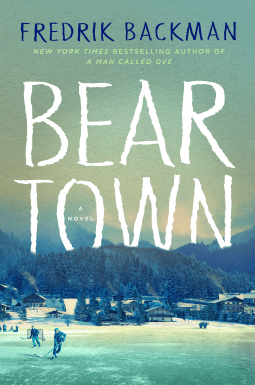
Beartown, by Fredrik Backman****

beartown“You can fuck any girl you like here tonight; they’re all hockey-whores when we win.”

Fredrik Backman is a sly writer, and he has a way of spiraling around his central point so that readers are mighty close by the time they recognize where they are. He writes with philosophical grace tinged with wit, and his novels are popular because of it. And so it cheers me to see him examine what might happen to a small depressed town whose hopes are all hinged on youth sports. Thanks go to Net Galley and Atria Books for the DRC, which I read free of charge in exchange for this honest review. Beartown is available to the public today.

In Beartown, everyone dreams of hockey, and those that don’t are stuck on the outside looking in. A man’s glory days are done before he’s 40; a woman has no glory days at all, since women cannot play on the men’s team and there is no women’s team. Everything comes second to hockey: education, social skills, and even the law are bent, sometimes to the breaking point, in order to accommodate star athletes. Hockey is the town’s only remaining business, and it seems to provide the only possible hope for young men that have grown up in the forest and don’t want to leave it to seek work.

Backman has a genius for drawing the reader in. Some of the scenes in this story actually make me laugh out loud. His respect for women is a breath of fresh air as well. In literary terms, though, the greatest success of this piece is the way a large number of characters are developed so that readers genuinely feel that we know not just a protagonist, but a whole town. We know who is related, what private baggage exists between individuals and families, which marriage is happy and which is not, and it’s delivered to us in a way that never feels gossipy or prurient. Rather, Backman makes us feel as if we are part of the town, and so everything is important to us as well.

Fans of Backman’s will be pleased once again here. My sole quibble is that I see a character at the end behave in a way that is so inconsistent with what we know of him so far that I can hear the violins play. It’s heartwarming, but if the same thing had been achieved more subtly, it would be credible as well.

Nevertheless, you won’t want to miss this book. Regardless of the ugly things that are said and done at various points, the author comes back, as he always has before, to the innate goodness of the human spirit, and it’s messages like this one that we need so badly today. Recommended to those that enjoy good fiction.

It Happens All the Time, by Amy Hatvany***

ithappensallthetimeI was invited to read and review this title in advance by Net Galley and Atria Books; it is written by a rape survivor, who tells us bravely of her own experience in the introduction. I wanted to love this book and to scream it across the internet and from the top of the Space Needle, that everyone should get it and read it, but instead, I came away feeling ambivalent. The rape passage is resonant and horrifying, and it’s written in a courageous way, and I’ll go into that in a minute. The rest of the book, however, is flat, and so in some ways this proves to be an opportunity squandered. There are spoilers, so don’t proceed if you don’t want to know how the book ends. It is available for purchase today.
The premise is that Amber and Tyler are best friends. They dated when they were teenagers, but a lot of time has gone by, and they have agreed to be buddies, talking often. Amber does not know that Tyler’s torch is still burning for her, brighter than ever; he is waiting for her to come around. Meanwhile, she has become engaged to someone else.

Amber is also a recovering bulimic, and now she is a specialist in nutrition and fitness. The level of detail regarding Amber’s meals hijacks the narrative at times; I don’t care how many ounces of lean this, that, the other she is about to eat. If we’re going to write about diet and fitness, that should be another book, and otherwise it should stay in the background.

The rape itself is where the story shines, and of course, it is the central scene to the story. Hatvany wants us to recognize who rapists are, and who they aren’t:


“They’re not greasy-haired monsters who jump out from behind the bushes and tie up their victims in their basements.”


The story is told from alternating perspectives, so we hear from both Amber and Tyler. Amber is believable to a degree; a more richly developed character would be more convincing, but the story is one that countless girls and women have lived. It’s a date that goes badly wrong; sometimes the woman is one that expects that she will want sex, but then decides she doesn’t, and her date forces the issue. Is that rape? Unless she says yes to sex, it is. Sometimes it starts with kisses—drunken or otherwise—but when the man wants to go further, she decides she wants to keep her clothes on and not follow through. If she says stop, or wait, or fails to say she wants to do this, yes, it is rape. And so this part of the narrative is important, and once I have read it, I want more than ever to like the rest of the book so that I can promote it.

Tyler is just straight up badly written. I am sorry to say it, but I rolled my eyes when I read his portion of the narrative. The ending is way over the top, and it distracts us with morally questionable deeds done by Amber that we would never commit. If it was rendered brilliantly, it could perhaps come across heroically, like Thelma and Louise, but it isn’t, and it doesn’t.

What happens here, is that Amber kidnaps Tyler post-rape at gunpoint. She forces him to drive to her family’s vacation cabin, and she makes him say that he raped her. He won’t do it, so she shoots him. She refuses to take him to a hospital until he says what she wants him to say. Once all of this happens, he has a huge epiphany, and from then on, Tyler’s wails about what a bad thing he has done, and how he knows he deserves everything that will happen to him as a result.

Sure.

But in addition, I find myself squirming. At one point when Amber holds him hostage, Tyler points out to her that kidnapping is a felony. Having Amber muddy the waters morally by kidnapping and shooting her assailant is distracting and morally tenuous at best. He has to tell the truth; she doesn’t. He owes it to her to lose his job and career, and to serve his time; she never expresses any sort of remorse and never suffers the consequences of her actions. And whereas brilliant prose stylist could turn Amber into a vigilante folk hero, this isn’t that.

I know that the author intends to tell a story that is deeply moving and that will improve the social discourse regarding what rape is, and how we as a society deal with it, both institutionally and as individuals. Instead, the distractions and tired prose prevent this story from reaching its potential.

Dear Friend, from My Life I Write to You in Your Life, by Yiyun Li**

dearfriendfrommylifei  It’s an honor to be invited to review any book by Random House and Net Galley, and so when the email came, I accepted without hesitation; I thank them for thinking of me and wish I could honestly recommend this one. Others have referred to this memoir, whose title is taken from a quote by Katharine Mansfield, as “exquisite, intimate, and lyrical”, and the author has won awards for her novels. I looked carefully to see if I could locate the genius in this book, but it eluded me completely.
The intimacy of the work is surely apparent. In essence, this is a mental health memoir, and the author writes of her fight with depression, her multiple suicide attempts and hospitalizations, of the expectation of others that she should continue to live when she didn’t want to. It’s brave writing, although mental health battles are now a fairly mainstream topic, but I am unable to find anything tangible to engage my interest.

My only real pleasure is in discovering that Li is already a successful writer; had it been a debut, I would have been scared silly. After all, if I say I don’t like the book, will the writer harm herself? What if I simply dodge the whole thing and let it get lost in the shuffle; will it happen then as well? But in seeing that this is someone with an established career and a wall full of accolades, probably the displeasure of one humble blogger won’t create a great deal of trauma.

The whole thing is bleak. The writer reminds us repeatedly that her life is private, that no one has the right to know any of its details and all I can think is, so what are we doing here, exactly?

Those that have read and enjoyed Li’s novels may find more to hang their hats on than I have found. All I know is that it is painful to read, has no beginning, middle or end that I can find, and is devoid of the literary qualities that can sometimes make a sad book enjoyable. I can’t recommend it.

Setting Free the Kites, by Alex George*****

settingfreethekites“Hope is a curious thing. It emerges in the most unexpected places.”

Robert Carter is an introverted boy with few friends and loving but preoccupied parents. His life changes forever when he is befriended by a new kid at school. Nathan stands up for him when he is being assaulted by a bully, and a friendship is forged that will last for life. Thank you Net Galley and Penguin Putnam for the DRC, which I received in exchange for this honest review.

Our story is set in a small Maine town in 1976. Nathan’s parents are creative people, sculpting, writing, building one-of-a-kind kites, but tragedy strikes early in the story and Nathan’s mother retreats into herself, and is not available to her only child. Robert’s parents are fond of Nathan, who also befriends Robert’s terminally ill brother Liam, and soon Nathan has found a second home.

Most reviewers describe Setting Free the Kites as a tragic tale, and they’re right, but what few people mention is how many really funny scenes lie in between the somber stuff. George’s writing has tremendous voice, one that brings these adolescent boys to life as few others do. I actually laughed out loud more than once, and this not only makes this a more enjoyable read, but also underscores the tragedy, taking the reader through a whole wide range of emotions.

The genre crosses between adult and young adult fiction. If I were still teaching highly capable language arts students, I’d want half a dozen copies of this book to use in a reading circle; that said, the sexual content would also force me to send home permission slips, because conservative parents would otherwise rampage into the district office with torches, hot tar and feathers. However, I consider this an outstanding enough read that I’d jump through some hoops to use it.

In some ways, however, it is more suited to literate adults. George uses a high vocabulary and uses it well. It’s certainly not a story I’d recommend to someone whose mother tongue is not English, because there’s too much cultural nuance and subtlety for that audience, and likewise, most adolescents won’t benefit from such a novel.

There are a couple off odd extraneous reveals toward the end of the story that startled me, and that did nothing to enrich the story or develop its characters. However, the rest of the book is so outstanding that it’s a five star read regardless.

This book is available to the public February 21, 2017. Highly recommended to those that love great literary fiction.

Forever is the Worst Long Time, by Camille Pagan****

Happy release day! This title is available to the public today.

seattlebookmama's avatarSeattle Book Mama

 “Each story is different. Every story ends with loss.”

foreveristheworstCamille Pagan is the author Life and Other Near Death Experiences. Thank you Net Galley and Lake Union Publishing for the DRC, which I received in exchange for an honest review. This title is for sale February 7, 2017.

The story starts in the second person, with the narrator speaking to us intimately; he is James Hernandez, and soon we realize that he is speaking to a child about her mother and his memories of her. The narrative is therefore intimate in tone, but also carefully measured and paced, beginning in 1998 when James meets Lou and unspooling toward the present.  I have read oh so many novels in which alternating viewpoints are used to keep the reader’s attention from wandering, and this fresh approach had me at hello.

James is Rob’s best friend; James’s own childhood home was dysfunctional…

View original post 357 more words

Always, by Sarah Jio****

alwayssarahjioAlways, Sarah Jio’s much anticipated new release, takes on the homelessness epidemic using the powerful medium of fiction. I received my copy in advance in exchange for an honest review; thank you Net Galley and Random House Ballantine for the DRC. This title is available to the public today, and if you have enjoyed Jio’s other novels, I am confident you’ll like this one too.
Kailey Crane is a journalist living in Seattle during the 1990s, and she has the whole package: a great job, a wonderful city, and a wealthy, handsome fiancée. It’s the life other little girls dreamed of but didn’t get.  Then one night as she and Ryan are leaving a restaurant, she literally bumps into a long lost love. Cade McAllister is the man Kailey had been going to marry until he disappeared. He practically vaporized. Stunned and humiliated, she picked herself up and rebuilt her life, and now here he is, a half-crazed homeless man living downtown on the streets.

What the heck happened?

Kailey wants to marry Ryan, but she also wants to help Cade find housing, medical care, and food. Ryan makes it easier by agreeing that she should do the right thing. Quickly she learns that it isn’t as simple as it seems. There’s a whole safety net in place for people like Cade, except that it doesn’t work. In fact, without her own ready access to Ryan’s money, she can do virtually nothing for Cade. But it’s all right, because Ryan is on the side of the angels; he sees that this cause is a just one, and he’s a generous guy. He’s in love, and he’s feeling expansive.

The problems begin when Kailey starts missing key wedding events because she’s off helping Cade, or trying to. She becomes so involved with one thing and another that before she knows it, she’s over an hour late. There are out of town relatives that are present, but where’s the bride? And before we know it, she’s telling lies, and sometimes they don’t even seem necessary. I want to reach through the pages of the book, yank Kailey into the kitchen and talk to her.

What  are you doing, girl?

Fissures in her relationship with Ryan turn into fractures as he senses the level of her obsession, and he doesn’t see things as she does anymore. His material interest is involved, since a project his development corporation is about to undertake conflicts with an already established homeless shelter in Pioneer Square, a historic part of Seattle’s downtown. He questions why so many resources are required for the homeless; aren’t these mostly drug addicts and crazy people? There ought to be a simple way to dispatch the problem.

A strong story overall is somewhat tarnished by what feels like a glib ending. I recall a favorite episode of the Muppets when Miss Piggy is working a jigsaw puzzle, and she hates to be wrong, so she slams a piece into a hole where it doesn’t belong and howls, “I’ll make it fit!” The ending of this story brought the episode back to me, because Jio seems to be doing more or less the same thing.

Recommended to fans of this successful romance writer.

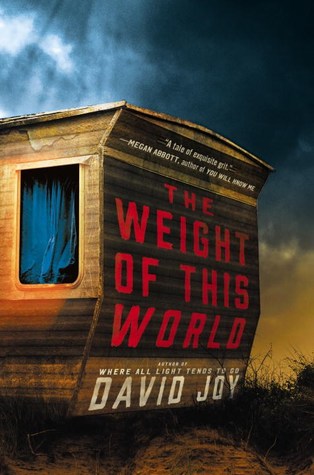
The Weight of this World, by David Joy*****

theweightoftheworldDavid Joy is a writer that keeps it real, and that’s what made me lurch forward in my desk chair and grab my mouse when I saw his second novel was done.  Big thanks go to Net Galley and Putnam Penguin for the DRC, which I received in exchange for this honest review. This title will be available to the public March 7, 2017. Those that cherish strong fiction should buy it and read it.

The setting is Little Canada, North Carolina, a wide place in the road in the middle of nowhere. The family unit, such as it is, consists of April—the most unwilling of mothers—along with her son Thad, and his best friend, Aiden McCall, who shares the trailer at the rear of April’s property with Thad. The plot is centered on the inadvertent death of the local meth dealer, and a small fortune that is unexpectedly left in the custody of Thad and Aiden.

They are not stellar decision makers.  In fact, some of the time they seem as if they are half feral.

Aiden came to live with Thad when he was on the run from the law, young and desperate. Thad offered him shelter, and that was more than anyone else had ever done. In fact,


“Nothing about this place had changed in all of Aiden McCall’s life, and maybe that’s why he’d come to hate it so badly. Everything was exactly as it had always been, the haves having and the have-nots starving to damn death.”


Thad, unfortunately, is the last person in this world anyone should become overly attached to. Between his unloving childhood, his time in Afghanistan and the meth he’s used to self-medicate since then, he’s more than half crazy more than half the time. It’s just him, Aiden and his dog, a crossbreed named Loretta Lynn. But things get out of hand, and the bits of baling wire and rusty screws that were barely holding his poor savaged brain together come undone:


“Something broke inside him then. His mind retreated to a place more familiar. There was a sergeant who told Thad the infantry were the hands of God, and that idea made sense to Thad because it was no different from what he had heard all his life growing up in church. The old-timers said some prayers needed feet. But there was evil in this world that had to be strangled. And so it wasn’t just a matter of giving those prayers legs. Sometimes a prayer needed hands just the same.”


As you can see, it’s gritty prose, and it features hardscrabble characters that are not entirely lovable. And so, reader, if you are one that needs a character you can fall in love with, you may have to look elsewhere. Some reviewers have found the story too harsh for their liking, and so to some degree it’s a matter of taste.

But I can tell you this: the settings here are stark and immediate, and the characters are well drawn and completely believable. I appreciate a story that fits the time in which we live, one in which young people have a rough time becoming independent due to economic woes and  the rampant drug addiction that seems to live in the shadow of every economic downturn. I believe Aiden and Thad, and I believe Thad’s mother April as well, a woman that only became a mother because someone spit on her as she came out of an abortion clinic. This is a story that resonates, and nobody can tell it like David Joy does.

Highly recommended!

The Animators, by Kayla Rae Whitaker*****

 “I always heered that art was for ugly girls and queers.”

theanimators

The Animators is the right story at the right time, outstanding fiction that is too impossibly good to be debut fiction, and yet here it is. I nearly let the DRC pass me by, because apart from its female main characters, there is nothing here that would ordinarily hook me. I am too old, too straight, and too un-artistic to be part of the target demographic. But I had been in a rut lately, reading too many mysteries, and so I decided to step out of my comfort zone; in doing so, I hit the jackpot. Sometimes rewards come when we aren’t expecting them, and it would be a sad thing to let a golden moment pass by unmet. Thanks go to Net Galley and Random House for the advance copy, which I received free in exchange for this honest review.

Our story revolves around the lives of two women that meet at art school. Sharon Kisses is a shy kid from Kentucky, self-conscious but ambitious. Mel Vaught is hilarious, outrageous, and riotously extroverted, a noncomforming thrill-seeker from Florida.  Mel appreciates Sharon’s art in a way that no one else does, and Sharon is grateful to finally have someone understand her. Together they form a team that will become famous.

The entire story hinges on development of our two characters and the relationship that unfolds between them. The plot is original and interesting, but it wouldn’t go anywhere if I didn’t believe Sharon and Mel. I buy both of them immediately, and before we’re even halfway through the story I am making predictions—mostly unsuccessful ones, and it’s the chewy ambiguity that makes the whole thing so fascinating—about what one or the other of them will do. I made one accurate prediction midway through, but nothing else went where I expected it to. That being said, however, everything here made complete sense, and these are two such viscerally relatable characters that I carry them in my head still, though I’ve read at least half a dozen other books since I finished this one. In fact, a hallmark of the very best fiction is that I have to let what I have read cook in my head for awhile before I am ready to describe it. I take notes, but they aren’t enough.

Mel is gay, but Sharon isn’t. On the other hand, Mel is also about ninety percent of everything that Sharon has in this world, once the partnership develops. Sharon always introduces Mel as “my business partner,” and this is both true and safe, but here I wrestle with my own thoughts. Is there anyone else alive that Sharon can love the way she loves Mel, whether she recognizes it or not?

How many women of days gone by—let’s say the early twentieth century—lived with another woman their entire adult lives, never even considered touching one another sexually for fear of their mortal souls, and maybe propagated a myth to the neighbors that they were related? I think there were a lot of them. Being a lesbian was on a par, back then, with having barnyard sex with Old Bessie. No decent person was; no decent person did. So instead, they labeled themselves ‘spinsters’ and invented a story, and just lived together, decade after decade. And when I look at the community from which Sharon has sprung, I can understand how this mindset carries over to some people even today.

Yet there’s another reality, too. Sharon really likes having sex with men. When she isn’t doing it, it’s on her mind.  How many women have pledged their lives to someone that does not physically attract them, because they find the person good company and don’t want to break their heart? And so when I think of Sharon, I remind myself that perhaps Sharon really isn’t gay. Maybe she will never want Mel sexually, and maybe that’s a fair thing to recognize.

The story contains so much life, so much sorrow, and it’s so damn funny at times.  And the rage! Both women carry a tremendous amount of anger, and it provides fuel for their creativity. Hearing their stories is like peeling an artichoke, one layer after another to get to the best part, which is way deep inside.

As the story progresses, we come face to face with the pasts both women carry with them. Mel’s tortured upbringing is the subject of their first animated film, and it’s clearly therapeutic; yet good therapy can only do so much. And as we see the world through Mel’s eyes, the depth of analysis is both brainy as hell and absolutely riveting.

Sharon is the introvert, and so it makes sense that her own story comes out more slowly, and it may never have done so without Mel’s assertive nature insisting that they stop by Sharon’s home town on the way back to New York.

The critical thinking here is deep and dark. Those that have regarded art as a soft discipline will have to sit up and take notice.

This story is for geeks, artists, and anybody burdened by at least one dark secret. It’s a story for strong, unapologetic women and those that love them.  And it’s for sale Tuesday, January 31, 2017. Get a copy. You can’t miss this one!

The Signal Flame, by Andrew Krivak*****

Happy release day to Andrew Krivak! This one is head and shoulders above the rest. If you are ready to get lost in a book, it’s for sale now.

seattlebookmama's avatarSeattle Book Mama

thesignalflameThere are good writers, excellent writers, and of course, indifferent writers, but once in a rare while there’s a writer that makes me sit up straight and take notice, someone with that special spark of genius that no money can buy nor school can teach. Krivak’s work is exquisite, the product of both power and restraint. If you love historical fiction, you have to read this book, which comes out January 24, 2107.

I was lucky and read it free in exchange for an honest review, thanks to Scribner and Net Galley. If you read my last review of a DRC, you know I call them as I see them; I see this one as standing, at the end of 2017, as one of perhaps a dozen that will still shine after I’ve read between one and two hundred others.

Bo, our protagonist, is the grandson of Slovakian immigrants, and…

View original post 578 more words

Forever is the Worst Long Time, by Camille Pagan****

 “Each story is different. Every story ends with loss.”

foreveristheworstCamille Pagan is the author Life and Other Near Death Experiences. Thank you Net Galley and Lake Union Publishing for the DRC, which I received in exchange for an honest review. This title is for sale February 7, 2017.

The story starts in the second person, with the narrator speaking to us intimately; he is James Hernandez, and soon we realize that he is speaking to a child about her mother and his memories of her. The narrative is therefore intimate in tone, but also carefully measured and paced, beginning in 1998 when James meets Lou and unspooling toward the present.  I have read oh so many novels in which alternating viewpoints are used to keep the reader’s attention from wandering, and this fresh approach had me at hello.

James is Rob’s best friend; James’s own childhood home was dysfunctional and bleak, and so Rob’s family included him on family vacations and other family-only events. They weren’t just close friends growing up; they were almost brothers. And so when James falls head over heels in love and decides to marry, the first thing he does is send for his BFF. They are introduced and James is asked to be best man at the wedding.  But in one of those blind random moments of fate, James himself falls madly in love with Lou the minute he sees her.

What would you do in a similar circumstance? Get over it and do it fast, of course. It’s just not possible. But years later, when the marriage founders and Lou walks, James can’t help himself.

There is foreshadowing in plenitude here, and the voice at the outset and at the end are what keeps those pages turning. Of course, there’s also mystery, because the speaker is telling us some things, but clearly withholding others.

If you have to like a protagonist in order to enjoy a novel, then this may not be your book. James isn’t merely flawed; in the book’s middle, he’s whiny.  I check my notes and find that in one place I wonder if Woody Allen will option the rights, and in another, I curse and request a violin. Seriously, I want to smack James upside the head and say sure, you shouldn’t have, but you did and it’s done, so man up and get over it already. But around the three-quarters mark, the whole thing takes another turn, one entirely consistent with what has gone before, and once again, it is a book I don’t want to put down till the last page is turned.

Those that enjoy fresh new fiction should consider this book even if romance is not generally a favorite genre. Pagan is an interesting writer, and now that I’ve read this, I want to go back and read the other things she’s written.  She’s already gained a lot of buzz—and a movie deal—with her first title, and I suspect she will be someone to watch in the future.

Don’t get left out.