The Briar Club, by Kate Quinn*****

I had never read a novel by Kate Quinn, but my friends on Goodreads raved about it and I was overcome by the fear of missing out. Happily, I was not too late to get a review copy; my thanks go to NetGalley and William Morrow, along with my apologies for lateness. From the get go, I could tell this book was too good to speed read, and so I set it aside for a time when I could sink into it and appreciate it. This fall I was able to get the audio version from the library to help me along; narrator Saskia Maarleveld is outstanding, and those that enjoy hearing their books should strongly consider ordering that format.

Our story takes place just after World War II, and it takes place almost entirely within the confines of Briarwood House, a women’s boarding house owned by the selfish, odious Mrs. Nilsson. The book’s prologue comes to us from the point of view of the house, and for a brief spell I wonder whether the house itself will become the main character. It doesn’t, and that’s probably just as well, because the women that rent its rooms, along with Pete and Lina, Nilsson’s two children, fill the story quite nicely, and all are beautifully developed, some more than others, with Nilsson herself being the only truly static character. In fact, I could argue that even the house’s character is developed somewhat.

I seldom do this, but the prologue is so juicy that I’m going to reprint a considerable chunk of it here, because Quinn’s voice—and okay, the house’s—provide a more convincing incentive to read on, than anything I can offer:

If these walls could talk. Well, they may not be talking, but they are certainly listening. And watching…Now its walls smell of turkey, pumpkin pie, and blood, and the house is shocked down to its foundations. Also, just a little bit thrilled. This is the most excitement Briarwood House has had in decades. Murder. Murder here in the heart of sleepy white picket fence Washington, D.C.! And on Thanksgiving, too. Not that the house is terribly surprised by that; it’s held enough holidays to know that when you throw all that family together and mix with too much rum punch and buried resentment, blood is bound to be shed sometimes…This was a very enthusiastic murder, the house muses. Not one moment’s hesitation from the hand swinging that blade…Briarwood House doesn’t like Mrs. Nilsson. Hasn’t liked her since she first crossed the threshold as a bride, complaining before she’d even shaken the rice out of her hair that the halls were too narrow (My halls! Too narrow!), and still doesn’t like her twenty years down the road. No one else in this kitchen does, either, the house knows perfectly well. It knows something the detective doesn’t. The killer is still very much in this room.

Now that the murder has been mentioned, I must caution you not to identify this story foremost as a murder mystery; it isn’t. The murder doesn’t come till nearly the very end, and the reason that it affects us so deeply is because of the author’s success in making every character here feel tangible and known to us. By the time anyone is enraged enough to swing anything, we know all of these women, or most of them at least, well enough to feel as if they are family. Boarder Grace March is revealed to us more slowly than the other women, but there are reasons for that, and by the end, I may love her best of all. No, this is first and foremost a stellar work of historical fiction.

At the outset, no one knows anyone else. Some are married, waiting for spouses to return from the conflict; some are single; some are professionals. Almost everybody has at least one serious secret. But as they grow to know one another, bonds are established that in some cases are stronger than those of blood relatives.

I won’t go through the plot or describe individual characters; as far as I’m concerned, that would be gilding the lily. Instead, I urge you to get a copy of this outstanding novel in whatever form is your favorite, with a slight nudge toward audio if you’re undecided. Highly recommended!

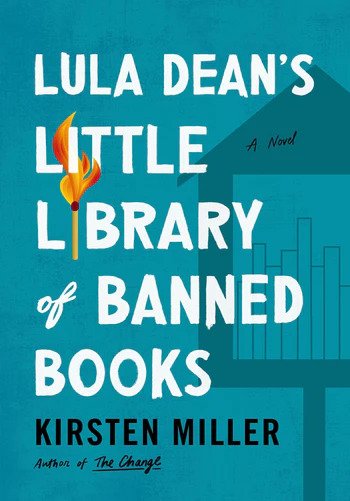
Lula Dean’s Little Library of Banned Books, by Kirsten Miller

Lula Dean is a deeply unhappy woman. Neglected by her children, alone and unappreciated, she strikes on a way to gain the attention she knows that she deserves. She embarks on a crusade to remove books she deems objectionable from local libraries, and she sets a sterling example for her town by erecting a little library on her lawn, a collection of the wholesome material she thinks is most appropriate. Little does she know that one of the town’s youths has snuck out in the dead of night and inserted banned books inside the dust jackets of the books she originally placed there. Her library becomes wildly popular, and Lula hasn’t a clue why.

My thanks go to NetGalley and William Morrow for the review copy. This book is for sale now.

The moment I saw the synopsis for this novel, I knew I had to read it. The First Amendment is a hot button for many people in the U.S., and as a language arts teacher, it’s been at forefront of my mind for most of my adult life. And I think I can safely say that Lula Dean is a soft sell; readers are generally a receptive audience, and so any novel containing the word “book” or “library” in its title should, I would argue, be held to a slightly higher standard. It’s not that hard to preach to the choir.

I love the premise of this story, and I laugh out loud more than once at the beginning. After that, though, things flatten out a bit. There are a lot of characters here, and whereas I have no difficulty keeping them straight, their numbers may have prevented author Kirsten Miller from fully developing them. I feel as if I am reading, for the most part, about cartoon cutouts rather than real people;  had I felt as if the characters were real, I would have been more deeply invested in their outcomes. However, everyone in this thing is either a fine, enlightened character or a despicable, ignorant blowhard. It accurately represents the way many Americans regard those around them, blue versus red, and that is not helpful. Two characters that stand out better than others are side character Beverly Underwood, and the young Elijah. However, even these are not dynamic characters. Nearly everyone here is the same going out as they were coming in.

Those looking for a short, funny novel to toss in their suitcase over the holidays could do worse; they could also do better. The sad thing is that had this been written in a more intentional way, with the literary standards one would hope to see in any novel, it could have been impressive, might even have changed a few hearts. This book isn’t going to do that, and so I see it as an opportunity squandered.

The Message, by Ta-Nehisi Coates****

Ta-Nehisi Coates is an eloquent writer, and I look forward to reading whatever he publishes. My thanks go to NetGalley and Random House for the invitation to read and review. This book is for sale now.

This book is brief, and it consists of four essays. The first and briefest is about returning to Howard University to teach writing. The second details his first trip to Africa, specifically Senegal; it’s surprising that it took him this long, he says, what with being raised in an Afrocentric home, the child of a Panther. But it’s expensive, it’s time consuming, and now, he can finally do it. As I read both of these, I admire the way he crafts an essay, but at the same time, I also feel as if I am not his intended audience; at times I feel almost as if I am listening in on someone else’s conversation. But I remind myself that I am reading this thing at the publisher’s invitation, so I push on, and it’s outstanding material.

The third essay is the one I enjoy the most, particularly because I had just finished reading a harrowing memoir about book banning. Coates attends a South Carolina school board meeting in which his own book, Between the World and Me, is being challenged. He’s invited by a teacher there that wants to continue using his book in her classroom, and he’s amazed at the assertions being made by some of the speakers in attendance, right in the shadow of George Floyd’s murder. And speaking of this, he says

“I understand the impulse to dismiss the import of the summer of 2020, to dismiss the ‘national conversations,’ the raft of TV specials and documentaries, even the protests themselves. Some of us see the lack of policy change and wonder if the movement itself was futile. But policy change is an end point, not an origin…and whereas white supremacy, like any other status quo, can default to the cliched claims and excuses for the world as it is—bad cops are rotten apples, American is guardian of the free world—we have the burden of crafting new language and stories that allow people to imagine that new policies are possible. And now, here in Chapin, some people, not most (it is hardly ever most), had, through the work of Black writers, begun that work of imagining.”

The final essay, which is also the lengthiest, is about his trip to the Middle East. At the outset he mentions his trip to the World Holocaust Remembrance Center, and seeing the vast Book of Names, which catalogs all of the nearly 5 million Jews killed in the Holocaust. But a few pages later he gets to the meat of the matter and decries the way that Israel is treating Hamas. No wait, that’s not the way he words it. He dislikes the treatment of the Palestinians that chose to be ruled by Hamas. Whatever. All I know is that when he states flatly that he isn’t interested in hearing the other side of this conflict, completely ignoring the pogrom that set this entire conflict in motion, he loses me. I skim the rest of the essay in case there’s a surprise for me somewhere in there, but of course, there isn’t. Bandwagons are easily joined, but I would have expected a writer of his caliber to think and write more critically.

So, should you read this book? There’s no denying that Coates is a skillful writer, and the essay regarding censorship is worth reading all by itself. And in that spirit, I won’t say that you shouldn’t read this because I happen to disagree with the last nearly fifty percent of the book; but when you do so, keep your brain engaged and don’t take everything he says at face value.

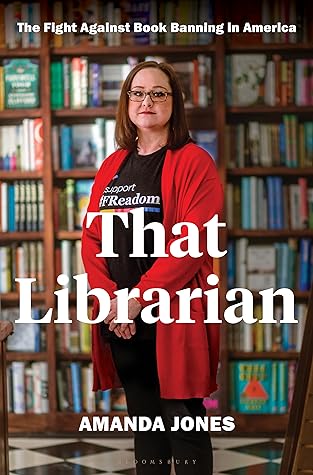
That Librarian, by Amanda Jones****

If ever a clarion call were needed in defense of the First Amendment in general and libraries in particular, that time would be now. Amanda Jones is an educator in a small Louisiana town, where she has lived all of her life. When a censorship battle presented itself, primarily at the behest of organized outsiders with an agenda, she turned up and spoke in a public meeting; in doing so, she unwittingly entered the most chilling chamber of horrors one might imagine.

My thanks go to Bloomsbury and Net Galley for the review copy. This book is for sale now.

Amanda describes herself as a committed Christian and a political moderate; she blushingly confesses to have voted for Trump in 2016. How could a Southern Baptist teacher and librarian suddenly find herself at the heart of a maelstrom, being referred to online as a pedophile, a groomer, and a member of the “woke” left? In a place in which outsiders hold less credibility than those with longstanding roots, how could so many native residents be convinced that pornography is being peddled to children by one of their own? Of course, the only way to create such an atmosphere is through fear and convincing lies.

“Book censors will often say there are books containing pornographic, or sexually explicit, material in children’s sections of the library to rile up public fear. They decry the need to protect children from the evil smut they say is next to Dr. Seuss books. As if a kid could be looking for The Very Hungry Caterpillar and whoops, there’s The Joy of Sex or The Kama Sutra right next to it. That’s never the case. Libraries have collection development policies for ordering books, and appropriate books are placed in the appropriate section. Public libraries do not purchase pornography. Adult books are not in the library’s children section, and to suggest otherwise is ridiculous.”

The American Library Association has guidelines for challenging books. This is essentially what Amanda tells those in attendance at the meeting called by book burners that evening. She is one of more than twenty other locals that show up for the same purpose.

What occurs at this meeting turns out to be a formula frequently used by the extreme right. A page of alarming material is blown up on a big screen for attendees to see. The presenter explains that this very book was found in an area easily accessed by children, right here in the public library in Livingston Parish. It’s a lie. The book isn’t there at all. But most people are decent and tell the truth most of the time; it doesn’t occur to audience members that this is a complete fabrication.

Why Amanda was chosen by these sinister visitors to be the sacrificial lamb is anyone’s guess. Perhaps she is more persuasive than others, or better organized in her remarks. Who knows? By the following day, social media has blown up with vile, horrifying accusations against her. Worst of all, there are people that she has known all of her life and considered friends, that add approving reactions to these poisonous lies. People she always believed would stand up for her, disappear instead, or join the opposition. Her family, her closest friends, and her fellow librarians across the country are the core of her defense, which eventually finds its way into the courtroom. Fellow educators at work? Not so much.

Although this takes place in the deep South, Amanda points out that these challenges are taking place across the country, with the ultimate goal of defunding public libraries. She mentioned a challenge in my hometown, Seattle, Washington, and I gasped. And so, this is an issue that must be monitored, and libraries and free speech defended, by all liberty loving readers everywhere.

The first half of the book is beautifully organized and compelling. I believe my jaw dropped when she wrote of sleeping with a shotgun under her bed, and checking for bombs or tracking devices on the undercarriage of her car. Death threats? Oh honey. Yes. The second half is also good, but could probably use a bit of tightening up. However, were I in her shoes, I would no doubt ramble endlessly.

This would make a terrific movie, and if well done, would certainly deliver the message to still more people.

I wholeheartedly recommend this memoir to all readers that support libraries and the First Amendment.

Margo’s Got Money Troubles, by Rufi Thorpe****

Margo’s Got Money Troubles, by Rufi Thorpe, is a bold, inventive, and very funny novel about a young woman cut adrift in a difficult, expensive world. My thanks go to NetGalley and William Morrow for the invitation to read and review. This book is for sale now.

Margo is the daughter of a Hooters waitress and a former pro wrestler, an absentee father with a family of his own; her mother had been his woman on the side. Consequently, Margo has always understood that she would have to hit the ground running when she grew up, and so she’s enrolled in a junior college. When the brief affair with her English professor leaves her pregnant, she has nobody reliable to advise her. The women she confides in urge her to terminate the pregnancy, and of course, the professor does, too; yet Margo likes the idea of becoming a mother, and it’s her fetus. Nobody can make her do anything. She decides to keep it.

Her mother is about to marry a man with money and conservative values, and she sees Margo as a loose cannon that just might upset the whole ship, so she tells her to terminate or be cut off.

Wow, Mom. Really?

Margo’s roommates hadn’t agreed to share an apartment with a baby. They need to sleep! They have to get up early!

Early on, I’m rolling my eyes. Part of me is thinking that Margo is about as dumb as they come; part of me is wondering why no author in this entire world is writing—or, more likely, why no major publishing house is publishing—novels in which a young woman chooses to have an abortion and take back her body and her life. But I’m overthinking, because soon, Margo—who after all, is just young, naïve, and rudderless—admits her error. She loves her little boy, but she had no idea he would be so expensive, or that motherhood would be so difficult. She tells her father, who re-enters her life as her mother steps away,

 “’I shouldn’t have had him,’ as though some rip cord had been pulled inside her. ‘I know that, okay? Everyone told me it would ruin my life and it did. They were right, and I was stupid, and I didn’t get it. Okay? But now I’m here.’ And her father, who strangely enough becomes the most reliable adult in her life, says, ‘Yes. Now we’re here.’”

Later, Margo will comment that nothing can make a person pro-choice like having a baby.

Margo has been waiting tables, but she can’t find child care, and when she brings the baby to work, she’s fired. And the truth is, she doesn’t like leaving her baby. Then one day, while looking at her naked self in a full length mirror, she observes that she has huge boobs for the first time in her life. Men would pay to see this. She opens an account on OnlyFans.

And so this controversial choice becomes the crux of the story. Some friends reject her, and her mother has really had it with her now. But there are a lot of meaty conversations that are thought provoking, and so, even though this old lady schoolteacher reviewer is mighty uncomfortable reading about an online sex worker’s film process, there are related questions that cannot be ignored. For example, Jinx—her father—advises her against it, saying that she shouldn’t get mixed up with these kinds of girls, and she asks him, “What are ‘those kinds of girls’?” And it’s true. A man can send his dick pix out into the world any number of times and places, and whereas many will consider these gross, or obscene, which they are, how many people will condemn the guy’s entire character, his moral fiber, for having done it? So the double standard is screaming to be recognized.

Margo goes through a lot of grief, defending custody of her son when the skeevy professor resurfaces, as well as having to deal with housing crises and other problems. But the central issue lurking in the shadows is that of a young mother choosing sex work as a career.

I have to tell you quite frankly that I was way out of my comfort zone through much of this book. I am probably not part of its target audience, despite the fact that I was approached to cover it. Partway in, I considered not finishing it, but the quality of the writing is so strong that I kept going, and I’m glad I did.

The story is told from a third person omnipotent perspective, but it shifts in a surprising and funny way, and that’s all I will say about that, lest I ruin it. I wonder from time to time if we have an unreliable narrator, but this is more than that. This unusual point of view a brave choice, and I think she carries it off well.

There are a lot of worthwhile discussions that can spring from this novel; it’s fertile territory, if you’ll pardon the expression, for book clubs. It’s also being adapted for Apple TV. I recommend this book for any feminist that likes to laugh, and isn’t afraid to think outside the box.

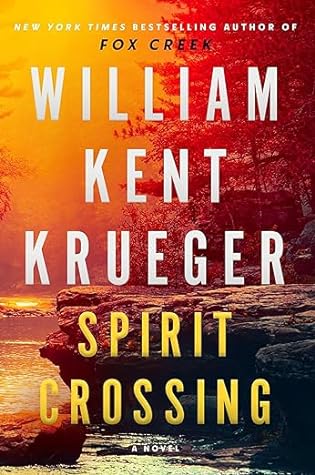
Spirit Crossing, by William Kent Krueger

Spirit Crossing is the spellbinding new novel in the Cork O’Connor series by William Kent Krueger. The book starts with two missing women, and an accidental discovery of a fresh grave. Readers faithful to the series will recognize the characters; there are enough of them, mostly related to one another, to provide depth and interest, without confusing the reader or making the plot too complex.

Lucky me, I read it free and early. My thanks go to NetGalley and Atria books for the invitation to read and review. This book is for sale now.

The story begins innocently enough, with the series protagonist, Cork, out berry picking with his son, son-in-law, and grandson, who is known by the Ojibwe nickname Waaboo. While searching for blueberries, they come across a fresh grave. Waaboo sees the victim standing before him, as if she is still alive, and he’s distraught because she is so unhappy. Waaboo is not the first one in his family to have this ability; nobody doubts that he sees what he says he sees. And so the men immediately wonder whether this is the grave of Olivia Hamilton, daughter of a wealthy Anglo, who’s been reported missing with massive headlines everywhere; or that of Crystal Two Knives, a missing Native girl whose name barely elicits more than a yawn from law enforcement.

And so right away, we are looking at not only the characters, but the longtime issue of missing Native girls and women, and the way that law enforcement neglects their cases for those whose families have money and connections.

One of the things I admire most about Krueger’s writing is the way that he incorporates urgent issues that especially impact the place where he lives—northern Minnesota—into the plot, blending them in so seamlessly that the reader isn’t distracted, because the issues are part and parcel of the mystery to be solved. He does the same thing with pipeline protests similar to the Dakota pipeline that lit up the headlines in recent years. Other aspects of the story include Ojibwe (Chippewa) culture and history, which is part of every book in the series, since most of the family is Ojibwe, and in this case, a character with a brain tumor. When significant events occur and the woman with cancer is the only one to witness them, did they really happen, or is it the brain tumor talking? This adds a layer of psychological tension not present in most of Krueger’s book; I’m not a fan of that subgenre, and am pleased to see that this doesn’t take over the plotline. It’s dealt with tastefully and without sensationalism.

Those that read my reviews know that I have an interest in seeing how authors develop child characters, particularly in a story such as this one, in which the child plays a major role. It makes me crazy when an otherwise competent author searches for shortcuts, such as a child that’s precocious or gifted, to explain away their own failure to craft the child’s character in a way that is honest developmentally. This is one more reason I enjoy this series. Yes, Waaboo has unusual powers, but he is still a small boy. The notion of going home without blueberries is a major blow. Tears threaten. I love the way Krueger develops this kid, and I can’t wait to see more of him in the future.

My one criticism involves a specific passage between the 88th and 90th percentiles, just as we rise toward the climax. Without going into spoilerish details, I will say that one character does something that everyone in the family agrees they must not do, and without any explanation, everyone in the family is fine with them doing it this time. This, of course, puts the character in danger, which anyone that’s paying attention can predict the very moment the action commences. It’s clumsy in a way that is atypical of this author, and I have no idea why he makes the choice he does, but it affects my enjoyment of the book, because suddenly I am not thinking as much about the characters as I am about the author. Having this occur a split second before the climax is especially grating.

On the other hand, I am picky. Very picky. I suspect that this passage will annoy only a small percentage of readers.

I do recommend this book, and this series, to those that love a good mystery. Although it can be read as a stand-alone, those with the time and inclination might enjoy going back a few titles, or even to the beginning of the series.

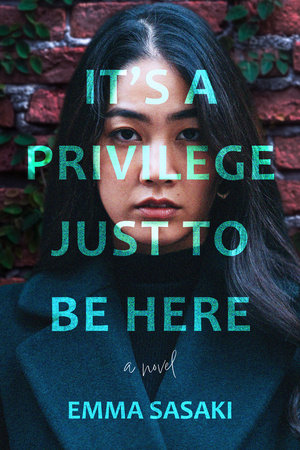
It’s a Privilege Just to Be Here, by Emma Sasaki****

Emma Sasaki makes her fictional debut with the darkly amusing story of a mother and daughter caught up in a scandal at a prestigious private school. My thanks go to NetGalley and Dreamscape Media for the audio galley. This book is for sale now.

Wesley Friends School is the prep school to which presidents and other high placed politicos send their teens, a place where they are nurtured as completely as any hot house flower, and then sent onward, hopefully to an ivy league college. Aki Hiyashi-Brown abandons her PhD and accepts a teaching job there in order for her daughter, Meg, to be able to attend; otherwise the tuition would be impossibly expensive. The school is overwhelmingly Caucasian, and so perhaps it’s unsurprising that Aki finds her face prominently displayed on all of the promotional materials the school disseminates, along with those of the few other teachers of color.

That’s all fine and good until the day when the fence outside is vandalized by spray paint reading, “Make Wesley white again.” Aki is ready to do what she’s been taught from the cradle: keep her head down, do her job, and not say anything. But Meg and her classmates have no intention of remaining silent. Before she knows it, Aki finds she has been assigned to be the head of the Racial Equity Task Force, a token job on a token committee that has more to do with appearances than with any actual desire for change.

She is given a script to follow and told not to offer up any of her own observations or opinions.

Soon, things spiral beyond the control of Wesley’s administration, and Aki is caught between doing what her bosses want her to do, and supporting her daughter and students in their quest for genuine change.

This book, which the author notes is based on her own experience, has me at hello. Though I am not a wealthy or connected individual, I did send my child to a private school for a few years, one which was very white, and which used my half-Japanese daughter’s face on its pamphlets a lot. I can’t not read this book, and whenever I have earbuds in, this is what I listen to. I find it well paced and engaging, setting just the right tone without over-moralizing or becoming strident. There are some great side characters as well; I like Aki’s husband and mother particularly, and appreciate the bond between Aki’s half-Japanese daughter and her Issei (first generation) grandmother.

However, my own husband is also Issei, and I asked him to listen to the reader during one of the many passages in which the grandma speaks to Aki in Japanese. “Is this reader’s Japanese as good as I suspect?” I asked, somewhat proud of my first year Japanese skills. He listened to two lines, laughed, and shook his head.

For this, I really do have to knock one star off my original five star rating. Perhaps if I had a digital review copy I could have rated that version higher, but I have what I have, and it’s problematic. Nevertheless, I appreciate this novel and the message it delivers, and I greatly look forward to reading whatever Sasaki publishes next.

Rednecks, by Taylor Brown*****

“Law only serves them that’s in power. Ain’t no different than always…’Tis the victor who writes the history—and counts the dead.”

I’ve been an enthusiastic fan of author Taylor Brown since reading Gods of Howl Mountain, which was published in 2018. His new novel, Rednecks, is out now, and as with his earlier work, it is outstanding. My great thanks go to NetGalley and St. Martin’s Press for the invitation to read and review.

Brown tells the story of the Battle of Blair Mountain, a very real large scale battle, complete with machine guns, helicopters, tens of thousands of angry, armed miners, and the U.S. Army, an event which really did take place in the Appalachian Mountains in 1921. Over a million rounds were fired, and then the story was suppressed by the government, bosses, and big business media.

 In his author’s note, Brown tells us that the character of Dr. Muhanna, a heroic individual sympathetic to the cause of the miners, is based on his own great-grandfather. There is a meaty explanation of what parts of the story are based on the actual historical record, and what parts—small ones, to be sure—he has changed.

Apart from his skill as a writer and researcher, the thing that I have always loved best about Brown is his deep respect for the working class. It shines through every page of this novel. Mother Jones, the fiery Socialist labor organizer, is here as well, and she is possibly my favorite figure in American history. Unfortunately, she is not at her best here. Past ninety years of age and in poor health, she attempts to deceive the miners into quitting their struggle early once she learns that Washington, D.C. intends to send troops. It’s a pity that her many years of inspirational organizing and leadership are not on display here, but the facts are the facts, and this story is not, after all, chiefly about Mother, but about the miners, so I suppose that Brown has written it in the only honest way that it could be written. There are indeed passages that demonstrate her eloquence and loyalty to workers of every race and ethnicity.

As I read, I like to highlight passages to include as quotes in my review. This time, I came away with 53 quotes. Reluctantly, I am setting most of them aside; you will have to find them yourself. They’re better within the context of the story, anyway.

As a personal aside, I will mention that my own grandfather—“Papaw”—died of Black Lung disease in 1978 after having worked in a nonunion mine in South Dakota beginning in the eighth grade. He had to leave school and work fulltime, as there was not a social net back then, and he and his family would have starved if he had done otherwise. World War II brought him better fortunes, but coal dust, once lodged in the lungs, never leaves.

This is a gritty tale to be sure, one full of bloodshed and suffering, but also of immense courage and inspirational leadership. I read it in small bites lest it work its way into my dreams, until I reached the climax, at which point I had no choice in the matter, and was unable to put it down. This book is one of the year’s best. I highly recommend it to those that love labor history, historical fiction, or that just love a well-told story.

Instrument of Darkness, by Charlie Parker*****

It’s a funny thing about long running series, how some of them become stale after a time while others just keep building. The Charlie Parker series by John Connolly is one of the latter, and with every addition to it I am more riveted, more amused, and more engaged than I was before. The Instruments of Darkness is the 21st in the series. My thanks go to NetGalley and Atria/Emily Bestler for the review copy; that said, this is one of the rare times that I would have laid out full jacket price if that was the only way I could obtain a copy.

This book is for sale now.

Charlie Parker is a former cop turned private detective with a terrible past. He stepped out to buy a newspaper one morning and returned to find his wife and small daughter savagely butchered; the guilt at not being home to defend them was overwhelming, if irrational. He dedicated himself to finding the person that had done it, and making certain they never did it again. Since then, he’s served as a professional snoop on behalf of other wronged persons. Because he often upsets people with money, power, and twisted morals, he often brings along his own muscle when he works, or in some cases, contracts with them to bodyguard his clients during the process. So it is this time.

The job has to do with a young mother whose baby has been kidnapped from its crib during the night. Colleen woke from the first sound sleep she’d had in forever only to find the nursery window open, and Henry gone from his bed. Later her husband Stephen finds a blanket in the trunk of her car, soaked in blood, which, when analyzed by law enforcement, turns out to be the boy’s blood. Stephen tells the police that he is sure she must have done it, and he leaves her.

But she didn’t. Of course not.

In his last few Charlie Parker novels, Connolly has added touches of horror and magical realism, and it’s only made his stories better. In particular, he is adept at sentient houses or other buildings. Sometimes it really is the structure; at other times there’s some sort of being that lives there, unseen. In this case it’s an old house built from a Sears Roebuck kit over a century ago, and so he names it “Kit No. 174,” and after it appears a time or two in the story, generally as the opening of a new chapter, I get the shivers just seeing the name. The narration tells us, “No one had ever spent long in it—or no one had ever lived in it for long, which is not the same thing. No, not the same thing at all.” There are some minor references to other houses that have appeared in the series, and these will delight the faithful readers that remember them; it did me. However, newbies that are just starting this series will be fine.

The recurring characters shine brightly here. The attorney that often hires Parker, Moxie Castin, opens the book, and we get a resonant character sketch:

“Moxie Castin was easy to underestimate, but only on first impression. He was overweight by the equivalent of a small child, didn’t use one word in public when five others were loitering nearby with nothing better to do, and had a taste for ties reminiscent of the markings of poisonous insects or the nightmares of LSD survivors…He lost cases, but not many, and his friends far outnumbered his enemies.”

Other recurring characters are the Fulci brothers, and when I see their names, I smile. They’re described as “two wrecking balls in human form.” Another is Sabine, a shy, tortured psychic that just wants the dead to go away and leave her alone, and best of all, Angel and Louis, a lawless couple of friends—the word “couple” applies in two different ways here—that Parker hires when things get spicy. If I smile when we are joined by the Fulcis, I beam when I see Angel and Louis. And in a nod to series regulars, there’s a point when Parker simply tells someone, “They’re coming,” and he doesn’t say who, but of course, we know exactly who. (Later he explains them for the uninitiated.) There’s a favorite passage of mine in which Parker is concluding an interview, done in a restaurant, and when he and the other person emerge, she sees them and asks,

“Are they with you?’

“They’re my associates.’

“They don’t look like private detectives. Don’t take this the wrong way, but they look like criminals. If they came into the store, I’d lie down on the floor with my hands behind my head.’

“Sometimes that’s precisely the effect we seek.’”

Oh, there’s so much more, but you need to find these things for yourself. The story is on the gritty side, but not nearly as much so as some of the others in the series. In fact, I generally have a policy of not reading this series at bedtime, lest it enter my dreams. I violated that policy once, and I did indeed have a dreadful night afterward. And so I behaved myself until I hit the last twenty percent, and at that point, I knew I would read it until it was done, regardless of the time or proximity to lights out, because I had to see the resolution. I had guessed, long before, whodunit, but that felt beside the point. So I stayed up and saw it through…and I’m not a bit sorry.

Highly recommended to those that love the genre, and especially to Charlie Parker buffs.

Pay Dirt, by Sara Paretsky*****

Sara Paretsky is a badass author with a badass protagonist. Her hero, Vic Warshawski, is a rough and ready private eye, and though based in Chicago, she sometimes—as now—finds herself elsewhere when duty beckons. Author Paretsky is one of the three that pioneered the hardboiled female private eye subgenre; the first in this series, Indemnity Only, came out in 1982, over 40 years ago, and that is how long I have been reading them. And though I was lucky to receive a review copy, thanks to NetGalley and William Morrow, this is one of those rare books that I would have paid full price to read if that was the only way I could get it.

This book is for sale now.

This story finds Vic in bad shape, both mentally and physically. She has attempted to help a student of her boyfriend Peter’s, a trans youth whose father blew out the kid’s brains rather than accept their new identity. The brains stuck to Vic, and the experience sent her reeling emotionally. She’s been forgetting self-care, not eating or exercising. What she needs is rest and quiet.

But that’s not how it goes.

Her godchild Bernie persuades Vic to attend a basketball championship game in Kansas. A group of them will be going down there; it’s just what Vic needs, she says. Reluctantly, Vic agrees, but once they are there and the game is over, one of the parties disappears, and Vic is enlisted to find her. When Vic finds the missing basketball player, she inadvertently finds a dead body. The cops in Lawrence, Kansas as well as the FBI like her for the killing. It’s so convenient to have a mouthy, street smart outsider blunder in; hopefully, they can pin it all on her, and then life will go on as it has been. And so Vic must stay behind because she’s been told not to leave town, but also in order to clear her name.

Now, this is one of the elements that generally irritates me in most mysteries; the whole clearing-my-name trope is desperately overdone. There’s another trope that shows up later in the story, but I won’t share it here because it’s a spoiler. But for every rule, there is an exception, and in the case of both tropes, Paretsky breezes through, and I barely bat an eye; this is because the characters are so real to me, and the situation they’re in is so immediate, that I blow it off so I can find out what happens next.

And as is so often the case, Vic Warshawski finds herself up against the town’s wealthy power brokers, who have a vested interest in not having the real killer caught. As for Vic, she makes friends with a few people that have no wealth and no power, but the small ways they assist her make all the difference.

Once she solves the crime, persuades the local police and others that she is innocent and that the blame lies with the men in the suits, are they hauled off in shackles? Don’t hold your breath. As one of her new pals reflects, “That is justice in America, plain and simple, before you wrap it up in a pretty package of Constitutional rights that only the rich get to have.”

The thing that sets this particular book apart from the other very good mysteries I’ve read recently is the development of the protagonist. She’s vulnerable because of her earlier trauma; her boyfriend left the country on business, and he hasn’t been responding to her texts. She is miserable, and she’s isolated. But as the pressure builds, Warshawski delivers. The last quarter of this novel is impossible to put down, and even before that, I set aside my usual rotation of books, because I wanted to read this, and only this.

This novel is written in such a way that a first time reader can jump into the series, but chances are good that once you do, you’ll reach back for some or all of the others. Highly recommended to those that love gritty, rough and tumble detectives; feminists; and those that lean to the left.