
Second Daughter: the Story of a Slave Girl, by Mildred Pitts Walter**

seconddaughterstoryofaslavegirlSecond Daughter is historical fiction based on the true story of an enslaved woman that went to court and won her freedom in New England around the time of the American Revolution. I received this DRC free from Net Galley and Open Road Integrated Media in exchange for an honest review. And it’s just as well, because if I had paid any money at all for this brief but troubled book, I would be deeply unhappy.

First, let’s examine the positive aspects that allowed the second star to happen. Walter has nailed setting, and when Aissa, the girl that serves as our narrator, describes the kitchen of her master’s house, we are there and can see it all. Here she does an excellent job. Other settings are also well told.

Second, the length, just 119 pages, is accessible for young adult readers, many of whom find it difficult, in these technologically advanced times, to focus all the way through a full length novel.

Unfortunately, the problems outweigh the virtues. I have two issues that plant this story on my literary wall of shame. The first is technical, the second philosophical.

Technically I see this as a decent if unmemorable read, and were I to judge this strictly on the writer’s skill, I would call this a three star novel. Overlong passages of narrative, often unbroken by action or dialogue and in lengthy paragraphs, are likely to hit the average adolescent’s snooze button early on. The choice to tell everything in past tense as opposed to the more widely used literary present deadens the pace further. When we finally do get a passage of dialogue, it is so stiff and stilted that not even the most engaging teacher, when reading this out loud to her class, could possibly breathe life into it. One character is depicted as speaking with a Sambo-like dialect, all “dis” and “dat”. If one is going to use a dialect, make it respectful and readable.  This verges on mimicry, and any Black students in the room that haven’t tuned out or gone to sleep yet are going to be pissed, and rightly so.

I can see that Walters meant well in writing from the point of view of a Black slave girl and in depicting a victory gained by Black people on their own behalf, as opposed to the usual torture, death, and despair that represented those kidnapped and forced into slavery. But this is also where I have to step back and ask what the ultimate effect of this book will be on students that read it.

For the average or below average middle school student, reading all the way through even a fairly brief novel such as this one will likely be the only book they make it through during the term in which slavery is covered in the social studies, humanities, or language arts/social studies block. Part of the power of good literature—which this isn’t, and in some ways that may be for the better—is that it drives home a central message. I can envision students that pay attention to this book, perhaps because the teacher is particularly engaging and has driven home its importance, and then walking away from the term’s work convinced that all any slave in any part of the USA ever had to do to get out of his or her predicament was to find a good attorney, take the matter to court, and bang, that’s it, we’re free. Let’s party.

This novel addresses a relatively brief period in the northern states, where slavery had been legal but had not been as widespread as in the Southern states. King Cotton had not become the dominant economic mover it would become by 1850, when its grip on all of US governmental institutions would be absolute. By then, northerners made their money indirectly from the cotton industry in everything from shipping, boat building, rope making, and banking to growing crops for consumption by Southerners and in some cases, for their slaves.

If one is going to teach about slavery, far better to do so as part of an American Civil War unit. It’s a tender, sensitive, painful thing for children of color, but it’s not okay to deceive them, however unintentionally, with the misimpression that all slaves had options that they didn’t.  Better to use portions of Alex Haley’s Roots; teach about the vast but much-ignored free Black middle class in the north that was the primary moving force behind the Underground Railroad; or to show the movie “Glory” in class to emphasize the positive, powerful things that African-American people did during this revolutionary time, than to emphasize something as obscure, limited, and potentially misleading as what Walter provides here.

I am trying to think of instances in which this book might be part of a broader, more extensive curriculum such as the home-schooling of a voracious young reader, yet even then I find myself back at the technical aspect, which results in a book that is dull, dull, dull. Literature should engage a student and cause him or her to reach for more, rather than make students wonder if it will ever end.

In general I have resolved to read fewer YA titles than when I was teaching and treat myself to more advanced work during my retirement. I made an exception for this title because the focus appeared to be right in my wheelhouse, addressing US slavery and the civil rights of Black folk in America. I regret doing so now, but it doesn’t have to happen to you too.

Save yourself while there’s time. Read something else. And for heaven’s sake, don’t foist this book on kids.

Long Walk to Freedom, by Nelson Mandela*****

longwalktofreedomI read this memoir, one of the most important of our era, before I was writing reviews. I bought it in the hard cover edition, because I knew I would want it to last a long time and be available to my children and their children. It was worth every nickel. It’s lengthy and requires strong literacy skills and stamina, but if you care about social justice and are going to pull out all the stops for just one hefty volume in your lifetime, make it this one.
The first two or three chapters flow like molasses on a hot day. Mandela is laying his ground work, but it’s tedious at the start. Fight your way through it, because the story to follow–and we’re talking about the huge majority of the book here–is absolutely riveting, and in many ways is a tremendous lesson in struggle as well.

Mandela is gone, but he is still a luminary figure in world history. In writing his memoir, some of which he did in prison, he was not following any publishing house’s advice about grabbing the reader right at the get-go. He didn’t need to toss in the usual teasers or follow a blueprint, because he was Mandela. An immensely articulate individual, an attorney before he devoted his life purely to the downfall of Apartheid South Africa, he was capable of telling his story brilliantly in many languages, and he did it.

This autobiography chronicles Mandela’s life, first as the son of a tribal chief, then as an educated Black man under apartheid (a dangerous thing to be), then the journey, both outward and inward, from attorney to the leader of a revolution. You will read about his time on Riecher’s Island, the notorious prison, and the various experiences he had in the courtroom and in captivity. He tells of the cunning ways those who were jailed for political reasons created to communicate and to an extent, continue to lead from inside prison. And he breaks up the horror with an occasional vignette of a surprisingly kindly jailor or other authority figure who does small, decent things when no one is looking.

If you are interested in the history of South Africa and the defeat of Apartheid, this is a must-read. If you ever, as I did, had a “Free Nelson Mandela” poster in your living room…read this, and celebrate.

The Tin Roof Blowdown, by James Lee Burke*****

thetinroofblowSometimes people say they “ran across” a book, and that is close to how I came to read James Lee Burke for the first time. I had been tidying up for company, and my daughter had selected this book from the “free” pile at school, then decided she didn’t want it. She is a teenager, so instead of finding our charity box and putting it there, she dropped it on the upstairs banister. I scooped it up in irritation..then looked at it again. Flipped it over…read the blurb about the writer. This man is a rare winner of TWO Edgars. Really? I examined the title again; I hadn’t read any novels based on Hurricane Katrina, so why not give it a shot?
There are about a dozen writers whose novels I will read just because they wrote them. This man is now one of them. I appreciated his ability to develop characters, deal respectfully but realistically with the tragedy and travesty that was Hurricane Katrina (followed by Rita) and recognize it as such; and keep about a million plot threads going without ever dropping anything. In fact, the complexity of the character line-up–somewhere between a dozen and fifteen important people to remember, when I was on the verge of falling asleep for the night–gave me pause, but then this is #6 in a series, so it is possible that if I’d begun with #1, some of them would have been old friends by now, with just a few new ones introduced (and some disposed of before the story was over).

The setting was entirely unfamiliar to me; I have never spent time in the deep southern part of the USA, unless you count a trip with my family to Disney World, and have never set foot in Louisiana. Burke knew it well enough for both of us. His word work was sufficient to lay the canvas before me,and the devastation that was visited upon those who had previously been poor but stable was laid bare:

“They drowned in attics and on the second floors of their houses. They drowned along the edges of Highway 23 when they tried to drive out of Plaquemines Parish. They drowned in retirement homes and in trees and on car tops while they waved frantically at helicopters flying by overhead. They died in hospitals and in nursing homes of dehydration and heat exhaustion, and they died because an attending nurse could not continue to operate a hand ventilator for hours upon hours without rest.”

He gave due credit to those who, in an official capacity or otherwise, worked tirelessly for up to 72 hours on end to save the lives of the vulnerable who had been unable to get out in time, or whose parents had made the wrong choice for them. But he also tells the truth about the condition of the levee that was supposed to protect the residents of New Orleans, and how it had been permitted to deteriorate, when Federal funds were dropped by 50% without a moment’s notice or explanation, and permitted to deteriorate worst in the Black part of town. The narration spills out with disgust the “latent racism…that was already beginning to rear its head.”

Meanwhile, our hero, cop Dave Robicheaux, is trying to find out the whereabouts of a “junkie priest” who perished trying to evacuate his parishioners, but died in the flood waters when criminals stole his boat. He also keeps track of his best friend Clete, a bail bondsman and private detective who will follow him around if he is not included in the search, because some of the people Robicheaux is trying to locate are also bail skippers, and therefore also his bread and butter. Clete is an alcoholic and makes some really bad decisions; Robicheaux tirelessly tries to keep him under his wing and under control, all the while also trying to keep his wife and daughter safe from a local mercenary he’s investigating. The bad guy knows that Robicheaux’s family is his greatest treasure, and threatens them as an attempt to make him back off.

While parts of New Orleans appear untouched by Katrina, others have had their entire infrastructures destroyed, and there are virtually no navigable roads; the waters are treacherous as well, with downed power lines and debris just below the surface. In short, he has his work cut out for him.

Burke’s bad guys are complicated characters. All come from hideous family situations, and childhood has left its unalterable mark on them, but they are layered in the depths to which they will stoop in seeking wealth, power, or simply revenge. One is capable of property crime, violence, even rape, but finds he cannot look an unarmed man in the eye and shoot him; another can do it without a hitch in his heartbeat. The street smart voices I heard within these chapters felt real to me.

But the consistent thread which lies at the core of the story, of the storm, of everything that takes place between its covers, is one which the writer has hold of like a pit bull with a rat. He has his jaws around it and shakes it without ever letting loose of it, whatever other events weave in and out of his pages, the racism that caused the most harm to be brought upon those with the fewest resources, intentionally and maliciously. He will not let go of the racism that rules New Orleans.

“The original sympathy for the evacuees from New Orleans was incurring a strange  transformation. Right wing talk shows abounded with callers viscerally enraged at the fact evacuees were receiving a onetime two-thousand-dollar payment to help them buy food and find lodging. The old southern nemesis was back,naked and raw and dripping–absolute hatred for the poorest of the poor.”

I can see why this guy has a pair of Edgars to bookend his mantel. He spins a compelling, absorbing tale, and the values and priorities that lay at the core of his work are ones I share and appreciate. It was in reading this novel that I became a die-hard James Lee Burke fan. I wrote this review before I had a blog on which to put it, and this book is a must-read for those that love good fiction, good mysteries, or that care about social justice.

Major Pettigrew’s Last Stand, by Helen Simonson*****

majorpettigrewHad this story not received such wide acclaim and been made into a movie (which I’ve yet to see, but I watched the Oscars), I would probably never have gone near it. I like working class protagonists, and I don’t read many romances, because often as not, they are corny, soft porn, or both. But I saw it at the library and decided to give it a try, and I quickly remembered, upon reading it, that some rules are made to be broken. So even if you usually don’t read romances, and even if a retired British pensioner is not your idea of an interesting protagonist, this should be the exception to the rule.
 I loved this story!

Major Pettigrew has difficulty with some sorts of change. He doesn’t want to see his village built up and the green spaces developed. He has lost his wife and his brother, and loss of any type is very difficult. His solitude is not splendid; he is a lonely, lonely man.

And in some ways, he seems to have lost his son, who has become arrogant, dismissive, and wants nothing more from him than his wallet and his bank card.

On the other hand, he has found something really precious, but what he has found is so controversial that the whole wide world seems to be against him.

Perhaps the hook for me was the interracial marriage, since mine is one also. But on the other hand, maybe the hook is just excellent writing. A really great writer can make us enjoy a genre we didn’t think we cared for; I believe this is one of those.

I hit a certain point in this story and could not go to bed until it was done. I usually read lying down before I go to sleep, but I was literally sitting upright on the edge of my bed leaning forward when this climax broke.

You have to read this story. It’s glorious, and it’s available to the public. Highly recommended!

Chasing the North Star, by Robert Morgan****

chasingthenorthstarChasing the North Star is a compelling narrative of two teenagers escaped from slavery on their flight toward the North. Thank you to Net Galley and Algonquin Books for the DRC, which I received in exchange for an honest review. This book becomes available to the public April 5, 2016.
Morgan begins with the story of Jonah, a man who leaves the horrific plantation on which he has been kept. His story is told in the third person omniscient, and so there is virtually no dialogue for a long time. I waited to see how well it would hold up; it isn’t easy to keep a reader’s attention for long passages in which everything is told within a narrative, and even more so when it is told in the third person, as opposed to first person, where the character himself tells us the story. And because the narrative combined strong character development, near-tangible setting, and a series of brilliant moves to elude pursuers, I found that my attention was held quite well.

The book is in fact both accessible and a surprisingly quick read.

Part of the way into the story, Angel, our second protagonist, joins Jonah, and she tells us her own story through the first person. I found this device—of switching from third person for Jonah’s story to first person when telling Angel’s—both unusual and congenial. We watch him and cheer for him, but then she talks to us and just lays it all out. And Angel is nobody’s helpless damsel. She tells us up front that it’s a good thing for Jonah that she loves him, because he is going to need her to save his butt, and she does so more than once.

The sparseness of the dialogue makes sense when one thinks about it. Two escaped slaves that do nothing but talk, talk, talk all the way north are going to be caught in a hot minute. The writer takes an intelligent risk in using so much narrative and so little dialogue, and it pays off.

Stories involving slavery are often really painful for African-American readers to mow through, because they recall a time that was so demeaning, not only a physical horror but one that assaulted their dignity. The “N” word appears here, but is used sparingly considering the time in which it is set, and the topic. I appreciated the autonomy with which Jonah and Angel operate. Too many stories of freedom from bondage feature white saviors more prominently than are appropriate.

In fact, my sole criticism of this story is that it does not portray the extent to which the Underground Railroad was run by free Black men and women in the north; but then, this isn’t a story of organized escape, but an independent one, and it is possible that the region in which our characters travel was different in that respect.

Those that love good historical fiction should read this book. Morgan has done a fine job with a difficult topic, and the story is one of triumph and glory.

The Reel Civil War: Mythmaking in American Film, by Bruce Chadwick****

thereelcivilwarI found this gem at my favorite used bookstore in Seattle, Magus Books, which is just a block from the University of Washington. Its strength, as the title suggests, is in tracing the story of the American Civil War as told by the cinema. Those interested in the way in which movie impacts both culture and education in the USA would do well to find this book and read it.
Chadwick spends a considerable amount of time and space carefully documenting the myth produced by Gone with the Wind, a completely unrealistic, idealized portrait of the ruling planter class of the deep South. Many of us would, in years gone by, have been inclined to dismiss this concern by saying that after all, the book and movie were primarily intended as a love story, but Chadwick demonstrates that this is not so. He ferrets out actual interviews with Margaret Mitchell herself in which she insists that this is exactly the way it was. Her sources? Former plantation owners, of course.

To this day, if an avid reader goes to Goodreads.com and under the caption “explore”, goes to “listopia” and from there selects a list of readers’ favorite Civil War titles, GWTW will place within the top ten, and sometimes be the foremost title, selected over nonfiction as well as more accurate fiction. I find this horrifying.

The research regarding the Civil War itself is nothing I haven’t seen before, but Chadwick makes excellent use of strong secondary sources to document the fact that Black folks in the pre-war South were neither happy nor well treated. He takes apart the myth Mitchell constructed in a meticulous manner, one damn brick at a time. Hell yes. About ten percent of the way into the book, Chadwick’s removed, scholarly tone changes to one of articulate outrage, and I found this tremendously satisfying.

Chadwick follows Civil War films forward, after first also examining Birth of a Nation, a painfully racist film which was famous at the time because of its length; its original claim to fame was not content, but technology. For those that have not seen the film, this will be interesting reading also, and those that have seen it may pick up some new information as well.

A couple of generations later, the more realistic and highly acclaimed Roots television miniseries told the story of Black America in a way that hadn’t been represented on film before. Chadwick is again careful in his documentation and clear in his explanation.

The book’s final film treatment is of the most positive and accurate film depiction of African-Americans is the film Glory. This reviewer used this film in the classroom. It depicts the Black Massachusetts infantry that tried to take Fort Wagner and in doing so, inspired President Lincoln to order more Black troops to be armed and trained for combat in the American Civil War.

For those interested in the connection between film and American history, and of the American Civil War in particular, this book is recommended.

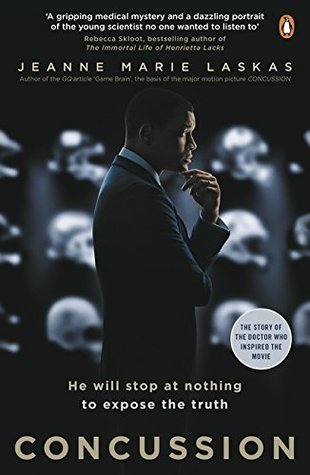
Concussion, by Jeanne Marie Laskas*****

concussionYou don’t have to enjoy football to appreciate Concussion, the riveting new biography of Bennet Omalu, the Nigerian neurological pathologist that discovered CTE, a type of permanent brain damage caused by repetitive concussions, such as that experienced by football players. Not only the content, but the engaging voice with which it is told, make it worth everyone’s while. I was fortunate enough to read it free, courtesy of Net Galley and Random House, but when it comes out Tuesday, November 24, I recommend you get a copy for yourself. It’s information everyone really ought to have, especially those that play American football, or have family members that do.
As for me, several years ago the middle school where I taught was rocked by the news that a young man we had taught had been killed on the football field while playing for the high school next door to us. DeShawn had died in a way the Seattle Times assured its readers was unheard of, a terrible tragedy with little explanation other than that of the coroner, who said he died of a traumatic brain injury. Our in-house football coach, whose frustrated students were stuck playing the “dumb”, safe version known as flag football, opined that maybe DeShawn hadn’t burped his helmet. One of DeShawn’s team members, a friend of my son’s and a frequent guest at our home, considered that DeShawn hadn’t “kept his head down like Coach said”. But the fact is, he was gone, and he wasn’t coming back. Dead at 16.

So I was interested indeed to read about the discovery made by Omalu, the pathologist that by coincidence was in charge of the autopsy of Iron Mike Webster, who played for the Pittsburgh Steelers. But I was equally interested in Omalu’s own story, a man of great enthusiasm and character, a faithful Catholic who used “Gee!” and “Gosh!” with youthful vigor as he uncovered one discovery after another, certain, so very certain that the NFL would want his discovery announced right away so that they could modify the game and make it safer. That poor man.

Omalu left Nigeria, which some Boomers will remember as having once been Biafra, home of genocide and terrible corruption, and he could not wait to live the American dream. The USA was free and open; there were no checkpoints at any of the highways; it was the home of Michael Jackson and Whitney Houston. Oh yes, he could shake the dust of Africa off the soles of his shoes and never look back. He had a full scholarship to the University of Washington, so although he had no idea where Seattle was, he had a ticket through the gates, and he would never live anywhere else.

Laskas uses Omalu’s own narrative in places, a wonderful thing given his buoyancy and eloquence:

Having seen this game [football] played on satellite TV on a few occasions in Africa, all I knew was the players ran into one another a whole lot and banged their heads repeatedly like guinea pigs running around…What an odd and inelegant game…If it hurts so much that you have to bubble-wrap your body, maybe you should play something different.”

But until he examined the brain of Iron Mike, the local hero who had lost his sanity following retirement, tasering himself in the hope he would be able to sleep, trying to fix his rotting teeth back into his own mouth with crazy glue, this was a side issue. His interest was in pathology, in the stories the dead had to tell.

But to Bennet, it seemed obvious enough, when the topic arose, because

“Anybody who knew anything about the anatomy of the head knew…It was a simple matter of physics. The brain floats, is suspended in a kind of thick jelly inside the skull. If you hit the head hard enough, that brain is going to move, no matter what kind of protection you put around the skull. A helmet protects the skull. A helmet can’t keep the brain from sloshing around in that skull. If you hit your head hard enough, the brain goes bashing against the walls of the skull.”

The helmet, it turns out, is more a weapon than protection for the brain.

Huh. No wonder Europe didn’t rush to join us in playing this sport.

Omalu’s story, from beginning to old age, is vividly told, and he is such a fascinating individual that you won’t want to put this story down once you’re into it. I could tell you more, but why ruin it? You really just have to read it. Order it now, or go out next week and buy a copy. You won’t be sorry!

Vietnam, by Mary McCarthy***-****

VietnamVietnam , an impassioned journalistic effort by Mary McCarthy originally published during the US war against Vietnamese freedom fighters, is a once-stirring piece of research that, while worthwhile as a period piece or for specific types of historical research, is in general terms too dated to be of great interest to most readers. Instead, it speaks to the innocence and disbelief Americans with no axe to grind in Southeast Asia felt when they came to grip with the actual facts regarding the war, and how many responded after becoming enlightened.

Thank you once and twice, first to Open Road Integrated Media, and next to Net Galley, for allowing me to read the DRC in exchange for this honest review. The book is now available for purchase.

In many ways, the American mindset can be divided into two contemporary periods: one before the Vietnam War, and one after it. Before the war against working people in Vietnam commenced, Americans by and large trusted their government and believed what its political leaders said was true. As layer upon layer of lies was peeled away from the startling nugget of truth at the core of this conflict, many people—in particular, the youth of the USA and around the world—were outraged at the many ways in which they had been deceived. Most of those smooth-faced but indignant youth are now grandparents now, and most have learned never to believe something is true just because a politician—even the president of the USA—says so.

McCarthy wrote this book during the metamorphosis of the American public from the former condition to the latter.

McCarthy went to Vietnam as a member of the press, and was astonished by both what she saw, and by the things that were told her. In 1967, when this book was written, the military leaders she interviewed told her that roughly ten percent of the population, or 1.5 million people, had become refugees, “casualties of war”, because the bombing had destroyed their homes and defoliated large swaths of jungle. It was unclear to me whether they were speaking about all of Vietnam or only South Vietnam; her time there seems to have been spent entirely, or mostly, inside the city of Saigon, which had become so Americanized that there were more English-speaking Caucasians there than Vietnamese.

At times, her outrage is sufficiently scathing to take this reviewer back to that time. I was just a kid, but the white-hot rage in the streets is hard to forget, even so.

In describing her visit to Saigon, she speaks about the ways in which officers and GIs alike regarded a hospitalized child, a victim of the bombing: because they showered her with candy, dollar bills, had photographs of themselves taken with her, and brought her toys, they considered her to be a very lucky tyke indeed. They made reference to her owning more dolls than Macy’s, and one soldier said fondly, “That girl is so spoiled.”

This type of rationalization, the notion that after wounding and possibly orphaning a child with bombs that destroyed her village and left her full of shrapnel, she had become “so spoiled”, is characterized by McCarthy as “Pharisee virtue”, a phrase I found startlingly eloquent.

There are other moments when she appears a bit confused, and appears to be unconsciously using the terminology of the very military and government forces that she opposes. My own youngest child is half Asian, and when I read an expository sentence in which McCarthy referred to the local children as “slant-eyed”, I almost dropped my reader. What the hell? She refers to the Vietnamese policeman that works for the US army as a “small Vietnamese policeman”, and from context, I got the distinct impression that he was not noticeably smaller than other Vietnamese men, and that in fact his size had nothing to do with anything. If she were still alive today, I would advise the author to check her terminology, and then check her own assumptions about what “normal” looks like. It appears she was carrying around some ingrained racism that came out despite her finest intentions.

One more strange factor here was her reference to the uniforms worn by the National Liberation Front, (otherwise referred to pejoratively as the “Viet Cong”, a term she uses freely), as “black pajamas”. Did McCarthy not understand that this was an expression used by the US military which was intended to demean Vietnamese fighters by suggesting they did not know how to design a uniform? Vietnam is a very warm place, and it’s humid as hell, which is why they used lightweight cloth to make uniforms. The jungles were dark and virtually impenetrable, and this is why black was a really good choice of uniform color. Pajamas are something one sleeps in. The Vietnamese soldier didn’t get a lot of sleep, and he did not fight wearing sleeping apparel.

McCarthy is not always blind regarding the power of terminology however: she points up the fact that napalm, which had been made even more horrific in that it now adhered to things (and flesh) while burning, had been name-changed to “Incinderjell”, making it sound like a children’s dessert. Officials could publicly state that napalm was no longer in use, because now it was called something different. Likewise, defoliants were referred to as “weed killer”.

The only photographs are of the author.

For those that want to travel back to the time when Johnson was president and America’s youth were waking up to the fact that the US government did not always behave in accordance with its stated democratic ideals, this is a good work to drop into your reader. It’s very brief, and you can finish it in a weekend.

I also recommend this work to students and other researchers looking at this volatile and transformational period in American history. Since she personally went to Saigon while the war was being fought, her own experiences constitute a primary document, and in such a case, I would not rate this book a 3 star work, but rather 4 stars.