The Damages, by Shelley Costa****

Shelley Costa, one of my favorite cozy mystery and humor writers, gave us No Mistaking Death, a new series introducing amateur sleuth Marian Warner in 2023. Here she is back with the second in the series, The Damages. My thanks go to the author, NetGalley, and Level Best Books for the review copies. This book is for sale now.

Marian was confused and hurting when last we saw her; that’s what happens when a normal person shoots someone. She blew out of Carthage, Ohio like the devil was on her tail at the end of the first mystery, but now she’s back, answering the call of a kid who wants her to find his missing sister, Beth. Beth is a courier for a medical testing company, ferrying blood samples from point A to point B. She’s well liked, lives a stable existence, and has told nobody of travel plans, but despite the fact that Carthage is a dinky little town, nobody has seen her lately.

It doesn’t look good.

Marian’s investigation dovetails with a big trial that’s taking place. A local obstetrician is being sued for millions by a couple whose baby he delivered. She has Cerebral Palsy, will never walk, talk, or lead a normal life. The medical malpractice suit is a money grab, plain and simple; if it is successful, Dr. Barish won’t be able to practice anymore. His premiums are already killing him. Is he the reason that Courtney Clemm is in such dire condition? Because she certainly is. It’s hard to look away.

This is a complex tale with a lot of twists and turns, but it’s not the mystery that keeps me engaged, it’s the protagonist. Given that this is just book 2 of a series, Marian is unusually well developed and immensely engaging. Add to this Costa’s trademark wordsmithery, her wry observations and quirky figurative language, and the case is almost beside the point. I’m here for Marian. And that’s good, because—for reasons I cannot understand myself—the pacing here is a little slow in places, though it ramps up to an arresting climax and powerful ending.

All told, this is a well-crafted novel, and I look forward immensely to book 3 in the series. Recommended to all that love a good cozy.

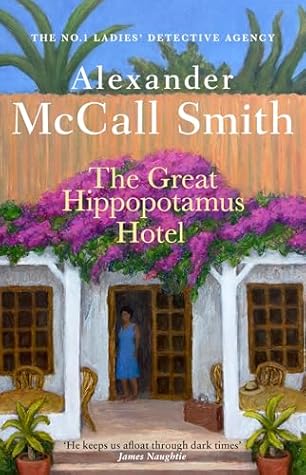
The Great Hippopotamus Hotel, by Alexander McCall Smith*****

The 25th book in the #1 Ladies Detective Agency series is not to be missed. My thanks go to NetGalley and Knopf/Doubleday for the review copy; this book is available to the public now.

When life becomes stressful, what do you do? Some swear by yoga, herbal tea, walking or running, therapy, mindfulness, journaling, or a number of other remedies. Some of us dive into the chocolate; the short-term benefit is mitigated by the long term weight gain, but when we’re upset enough, we don’t care. And for some of us, this series is just what the doctor ordered.

Precious Ramotswe is our detective protagonist, assisted, and occasionally encumbered, by her headstrong but goodhearted colleague, Grace Makutsi, part time apprentice detective, Charlie, and occasionally, by her bestie, Mma Potokwane, who runs the local orphan home.

Our mystery revolves, as the title suggests, around a case of possible sabotage at The Great Hippopotamus Hotel. There’s another thread, too—as there usually is—involving Precious’s husband, Mr. J.L.B Matekoni, owner of the garage and technically, Precious’s landlord.

Those looking for an action packed thriller will always be disappointed here, because that’s not what this series is. Instead, it’s closer to being a Miss Marple-ish cozy mystery. The problem is nearly always solved, not by DNA or murder weapons or questioning baddies until they break, but by an examination of the circumstances and characters of those involved. It is here that Precious is at her finest. In addition, she must tread carefully around the feelings of her staff, primarily that of Grace Makutsi, whose insecurities tend to make her prickly. Grace is a bit threatened by Mma Potokwane, and when Precious explains gently that they will be accompanied by the orphan farm matron on an investigation, Grace says, in a serious case of look-who’s-talking:

“Mma Potokwane—yes, she is observant, but…But Mma, if Mma Potokwane has any faults—and we all have faults Mma, myself included—if she has any faults, one of them is taking over. I am not saying that she is bossy—that is not a word that I would use for Mma Potokwane—I would not say that, Mma, and I am not saying it now. No. But there are some people, I think, who might say that.”

And so, in addition to her detective work, Mma Ramotswe must navigate the small minefields that exist between these two women, both of whom are dear to her.

In some ways, the mystery aspect of these stories is almost superfluous. Every story has to have a problem and a resolution, and so it’s convenient, perhaps, to use a mystery as scaffolding for whatever problem Precious must confront. It’s certainly served Smith well. But the real benefit I see in these series is that the solutions to these problems are always dealt with as gently and as kindly as is possible. Nobody is getting thrown face down on the ground and handcuffed in these stories; every effort is made to turn the problem around while allowing the perpetrator to retain as much dignity as possible. The lyrical prose is so soothing that I love reading these stories at bedtime.

And one more word, for regular readers: the recurring character of Violet, who is the closest we have to a villain, pops up here right away, and I rolled my eyes and said, “Not this again. Smith needs new material.” But the way the character is used this time is different, and if I had a hat, I would tip it in appreciation of the author’s cleverness. He always seems to know when it’s time to break a pattern.

Highly recommended.

Open Season, by Jonathan Kellerman***

3.5 stars, rounded downward.

Open Season is the fortieth (!) in the Alex Delaware series, one that I have read since the very first book. Newbies can read it as a stand alone novel, however. My thanks go to NetGalley and Random House/Ballantine Books for the review copy. It will be available to the public February 4, 2025.

One of the joys of reading a long running series is its familiarity. If the writer is good—and nobody will say Kellerman isn’t—the characters begin to feel like old friends. In addition to our protagonist, kiddy shrink and cop consultant Alex Delaware, we have his wife, Robin, who is mostly a background character; Alex’s best friend, Detective Milo Sturgis; and some lesser recurring characters such as cops Sean and Petra. I could include Milo’s husband Rick, but Rick almost never puts in a personal appearance. In fact, we see a good deal more of Blanche, Alex and Robin’s French bulldog, who, like the other characters, never grows old. When Milo lumbers into the Delaware kitchen and raids practically everything in the fridge, I smile. Ah, there he is, the big guy.

When the series began, Alex, a child psychologist (like Kellerman himself,) worked with seriously troubled children and teens, but when the LAPD had a case involving a child, he would consult on it also. Now he works on the private cases of his choosing, primarily custody cases and the like, and is a de facto cop. This has developed in the context of Milo, a gay cop, being ostracized by the rest of the department, and so once a friendship and working relationship develops between Milo and Alex, Alex rides along and they say he’s a consultant, even when there are no funds in the budget and he is merely a volunteer.

All this may seem improbable today, but please remember that the series began in 1985, when gay men were treated brutally by most of American society, and that is exponential when it’s a cop being hazed by his own department. And even today, gay cops don’t always have an easy road.

Is this realistic, then? Let’s look at it this way. To be completely realistic, Alex would never get into that cop car, and he would work only from his office. To consult with the department, he would be sent information to analyze, and if appropriate, the child or children in question would meet with him in an office to be interviewed. Milo would either be on his own, or with whatever newbie was stuck being his partner for now.

And it would be dull as hell.

So, for me to enjoy this series, I just need the most improbable aspects to be scaled back, and I’m happy. Several books ago, Alex was donning a Kevlar vest and rocketing into action with Milo, and that was straight-up ridiculous. But Alex doesn’t do that anymore. The story is just believable enough for me to buy into it, and so I’m happy.

This particular episode involves a sniper, and although I enjoyed it and found little to object to, it didn’t have quite as much sparkle as most of his other books. On the other hand, it also didn’t have a theme involving kinky sex—ew!—as in multiple past novels, and it didn’t have any of my pet peeves that I dislike wherever they turn up. No kidnapping Alex or his loved ones; no struggle with alcohol. So I was happy for the most part and would have rounded the rating up to four stars, which is what I usually rate Delaware novels, but the multiple snarky remarks about abortion rocked me back. Not all women’s health facilities that feature abortion as an option are “abortion mills.” If a grandmother suggests that a pregnant granddaughter consider abortion, it doesn’t make her a bad grandmother. Am I rounding the score on a novel downward because I don’t like the author’s politics? Yes. Yes I am. But, can I do that? Sure I can. I just did.

I’ve loved this series for a long time, and I look forward to reading the forty-first. I do recommend this book to the series faithful, but if possible, get it at a discount or free, rather than paying full price, unless your pockets are deep ones. If you are new to the series, if possible, read either the most recent one before this—number thirty-nine was excellent—or read the very first, When the Bough Breaks, which ties the subject much more closely to Alex’s original profession.

Veronica Ruiz Breaks the Bank, by Elle Cosimano****

Fans of Cosimano’s Finlay Donovan series will recognize her trusty sidekick and BFF, Vero. Over the course of the series, we’ve had many hints about Vero’s past, and Finlay sometimes wonders why Vero is so tightlipped about her personal history. This short story provides curious readers with some background, as well as some of the entertainment for which Cosimano is fast becoming legendary.

My thanks go to NetGalley and St. Martin’s Press for the review copy. This book is for sale now.

I generally avoid this sort of book, because often as not, the author returns to flesh it out into a full length novel, and as much as I enjoy reading it once, I don’t want to read it twice. But this was low hanging fruit, a shorty by an author I greatly enjoy, at a time when I couldn’t get up and move around much, and so I dove into it.

Vero is an honors student from a struggling family, and her academic career is short circuited when an envelope of money goes missing, and Vero is blamed by her sorority sisters. Vero makes a run for it; desperate for work, she takes a custodial job in a bank, and that’s where the fun begins.

This is an entertaining read, but it’s not up to the level of Cosimano’s novels. For a short story to work, a lot must be packed into it, with every single word pulling its own weight, and possibly that of its friends and family. Here, it feels like a chapter out of a book, one in which the author doesn’t want to give up any truly juicy information about the protagonist because she’s saving it for—you got it—a novel.

Of course, I cannot pretend to know what the author is thinking here; this is just an educated guess. But the product is the product, and whereas it was a fun read as a free galley, I might have felt a bit annoyed if I’d paid money for it.

Those looking for a quick, light read to take to the beach could do worse. Some people don’t have the time or stamina for a full length novel of any type; if that’s you, maybe this is your book. But as for me, I’ll hold out for the real deal in the future.

Spirit Crossing, by William Kent Krueger

Spirit Crossing is the spellbinding new novel in the Cork O’Connor series by William Kent Krueger. The book starts with two missing women, and an accidental discovery of a fresh grave. Readers faithful to the series will recognize the characters; there are enough of them, mostly related to one another, to provide depth and interest, without confusing the reader or making the plot too complex.

Lucky me, I read it free and early. My thanks go to NetGalley and Atria books for the invitation to read and review. This book is for sale now.

The story begins innocently enough, with the series protagonist, Cork, out berry picking with his son, son-in-law, and grandson, who is known by the Ojibwe nickname Waaboo. While searching for blueberries, they come across a fresh grave. Waaboo sees the victim standing before him, as if she is still alive, and he’s distraught because she is so unhappy. Waaboo is not the first one in his family to have this ability; nobody doubts that he sees what he says he sees. And so the men immediately wonder whether this is the grave of Olivia Hamilton, daughter of a wealthy Anglo, who’s been reported missing with massive headlines everywhere; or that of Crystal Two Knives, a missing Native girl whose name barely elicits more than a yawn from law enforcement.

And so right away, we are looking at not only the characters, but the longtime issue of missing Native girls and women, and the way that law enforcement neglects their cases for those whose families have money and connections.

One of the things I admire most about Krueger’s writing is the way that he incorporates urgent issues that especially impact the place where he lives—northern Minnesota—into the plot, blending them in so seamlessly that the reader isn’t distracted, because the issues are part and parcel of the mystery to be solved. He does the same thing with pipeline protests similar to the Dakota pipeline that lit up the headlines in recent years. Other aspects of the story include Ojibwe (Chippewa) culture and history, which is part of every book in the series, since most of the family is Ojibwe, and in this case, a character with a brain tumor. When significant events occur and the woman with cancer is the only one to witness them, did they really happen, or is it the brain tumor talking? This adds a layer of psychological tension not present in most of Krueger’s book; I’m not a fan of that subgenre, and am pleased to see that this doesn’t take over the plotline. It’s dealt with tastefully and without sensationalism.

Those that read my reviews know that I have an interest in seeing how authors develop child characters, particularly in a story such as this one, in which the child plays a major role. It makes me crazy when an otherwise competent author searches for shortcuts, such as a child that’s precocious or gifted, to explain away their own failure to craft the child’s character in a way that is honest developmentally. This is one more reason I enjoy this series. Yes, Waaboo has unusual powers, but he is still a small boy. The notion of going home without blueberries is a major blow. Tears threaten. I love the way Krueger develops this kid, and I can’t wait to see more of him in the future.

My one criticism involves a specific passage between the 88th and 90th percentiles, just as we rise toward the climax. Without going into spoilerish details, I will say that one character does something that everyone in the family agrees they must not do, and without any explanation, everyone in the family is fine with them doing it this time. This, of course, puts the character in danger, which anyone that’s paying attention can predict the very moment the action commences. It’s clumsy in a way that is atypical of this author, and I have no idea why he makes the choice he does, but it affects my enjoyment of the book, because suddenly I am not thinking as much about the characters as I am about the author. Having this occur a split second before the climax is especially grating.

On the other hand, I am picky. Very picky. I suspect that this passage will annoy only a small percentage of readers.

I do recommend this book, and this series, to those that love a good mystery. Although it can be read as a stand-alone, those with the time and inclination might enjoy going back a few titles, or even to the beginning of the series.

Trouble in Queenstown, by Delia Pitt***-****

Delia Pitts has been writing mysteries for quite some time, but she is new to me. In Trouble in Queenstown, she introduces hardboiled sleuth Evander Myrick. Myrick’s friends call her Vandy, and that helps to distinguish her from her elderly father for whom she is named; he’s in a memory care unit.

My thanks go to NetGalley, Macmillan Audio, and St. Martin’s Press for the review copies. This book is for sale now.

At first glance, I thought that this detective fiction was set in New Zealand. Queenstown, right? But in this case, the locale is Queenstown, New Jersey. The story opens with Vandy cleaning up a mess in her office just as Leo Hannah storms in and wants to see Evander Myrick. He assumes Myrick will be a Caucasian male, and that Myrick herself is a member of the cleaning staff.

Oops.

Hannah comes to hire Vandy in the wake of his wife’s murder. He knows exactly who did it, he tells her, and he wants her to prove it, starting with some surveillance. Vandy isn’t sure she should take this job, but she has to pay top dollar to keep her daddy in the best facility, so she reluctantly signs on. As the story progresses, there are numerous twists and turns, and the violence escalates. By the story’s end, three different people have tried to hire her for exactly the same case!

The thing I appreciate here is the way Pitts addresses cop racism. So many detective novels require the reader to suspend belief, to assume that every cop is fearlessly dedicated to finding out the unvarnished truth and arresting the perpetrator of the crime, regardless of race, ethnicity, or sexual orientation. But as Vandy conducts her investigation, Pitts keeps it real. At one point the detective speaks with a salon stylist that worked on Ivy’s hair, and he tells her that Ivy was afraid of someone at home. Vandy asks if he contacted the police.

“’The police?’ He jerked his neck, pursing his lips as if I’d farted. ‘Girl, you think the cops came here?’ He sniffed. ‘You don’t look like a fool. Maybe I read you wrong.’”

Sadly, the second half of the book doesn’t impress me as much as the first half does. I have a short list of tropes that I never want to see again in a mystery novel, and she trips a few, including my most hated one. I won’t go into details because it’s too far into the story, and I don’t want to spoil anything, but when it appears, I sit back, disengage from the text, and roll my eyes. Ohhh buh-ruther. As I continue reading, I can see who the murderer is well in advance, and the climax itself is a bit over the top, though without the tropes, I mightn’t have noticed this last issue.

In addition to the digital review copy, I have the audio. The reader does a fine job.

The more mysteries a person reads, the staler tropes become. I am perhaps more sensitive than most readers, having logged over a thousand novels in this genre. Readers that have not read many mysteries are less likely to be aware of, and therefore bothered by overused elements, and so this book may please you much more than it did me. But for hardened, crochety old readers such as myself, I recommend getting this book free or cheap, if you choose to read it. Newer readers may enjoy it enough to justify the sticker price.

Middletide, by Sarah Crouch*****

Sarah Crouch makes her authorial debut with Middletide, a mystery set in the Pacific Northwest near where she grew up. Atmospheric and tense, it’s a damn fine start to what is sure to be a promising career.

My thanks go to NetGalley and Atria Books for the invitation to read and review. This book is for sale now.

The premise is that Elijah Leith leaves home when he reaches adulthood, eager to flee his violent alcoholic father, and make a name for himself in San Francisco. But his father dies, and when his first novel goes nowhere and he runs out of money, Elijah returns and takes up residence in the cabin where he grew up. He hopes to rekindle a relationship with his teenage sweetheart, but she has moved on, and since he was unreliable the first time around, she is reluctant to trust him anyway.

Then the cops find the body of Dr. Erin Landry hanging from a tree on Elijah’s property.

This whodunit is original and intelligently written. The pacing is perfect, and I never would have guessed the ending, at least not until nearly the end when the author spells it out. Elijah is not the most lovable protagonist, but Crouch develops him so that, although not a prince or a hero, he is nonetheless a decent human being by the end. Some will consider the solution to be over the top, but it’s only far fetched if the author fails to convince us that it’s true, and I am persuaded.

Those looking for a fun read to pack for a vacation, or just to occupy a weekend at home, here you go. Grab your book, your lemonade or your whatever, and head for your happy place. You can thank me later.

House of Glass, by Sarah Pekkanen***-****

3.5 stars, rounded upwards.

Author Sarah Pekkanen is known for writing psychological thrillers, and her newest novel, House of Glass, is a real page turner. My thanks go to NetGalley and St. Martin’s Press for the invitation to read and review. This book will be available to the public August 6, 2024.

Our protagonist is Stella Hudson, and she works as guardian ad litem, which is a professional whose job it is to represent the best interests of a child when he or she is the subject, or an important participant in, a court case. Stella’s father figure and mentor is a judge, and a case has come up that he feels Stella is uniquely qualified for. It’s a divorce case, two wealthy individuals squabbling over a child. The child, Rose Barclay, has experienced a great trauma that has left her mute. She saw her nanny fall (be pushed?) out of the attic window and die, and she hasn’t spoken since. By convenient coincidence, Stella also experienced the same condition after a childhood trauma of her own; this is why Charles, her mentor, has asked her to serve.

I’ll tell you right now, I am not terribly impressed with this book. A protagonist who’s been traumatized in ways related to her task at hand is fast becoming a trope, and I’m ready to be done with it. Rose is a prodigy, brilliant in every way, which is also overused, and very convenient for an author that doesn’t want to deal with developmental stages even though the child is a major character. Also, Stella’s job does not require her to solve the nanny’s murder, that’s the job of the cops. Yet the book leads us to believe that this is part of a guardian ad litem’s work.

But the most annoying facet of this mystery is that I had it solved before the 20% mark. That’s just straight up ridiculous. If I had solved it because I am so darned clever, that would be one thing, but I feel as if my cat could probably have done the same. First, a suspect that’s identified very early in the story is almost never the killer, and then of course, the person least suspected by the other characters is often the one that did it. And so at first I waited hopefully for some new spin or plot twist that would make me change my mind, but it never damn happened.

Consequently, I was prepared to give this book a rating of 3 stars, which is lower than my average, but one thing stopped me. I noticed that, however cranky I felt about this transparently obvious mystery, I didn’t want to stop reading it. I could have quit at the halfway mark, skimmed the ending to be certain I was right, and then written my review, yet even though I knew exactly how it would shake out, I still wanted to see/hear the rest of the story.

I was fortunate in having both the digital review copy and the audiobook, and the narrator, Laura Benanti, does a first rate job. That’s worth something, too.

Because of the fact that Pekkanen’s mysteries are beginning to feel formulaic, I am probably finished with this author, but I also think there are a great many readers that will like it. Nevertheless, my recommendation to you is to get it free or cheap, rather than to pay full cover price.

Instrument of Darkness, by Charlie Parker*****

It’s a funny thing about long running series, how some of them become stale after a time while others just keep building. The Charlie Parker series by John Connolly is one of the latter, and with every addition to it I am more riveted, more amused, and more engaged than I was before. The Instruments of Darkness is the 21st in the series. My thanks go to NetGalley and Atria/Emily Bestler for the review copy; that said, this is one of the rare times that I would have laid out full jacket price if that was the only way I could obtain a copy.

This book is for sale now.

Charlie Parker is a former cop turned private detective with a terrible past. He stepped out to buy a newspaper one morning and returned to find his wife and small daughter savagely butchered; the guilt at not being home to defend them was overwhelming, if irrational. He dedicated himself to finding the person that had done it, and making certain they never did it again. Since then, he’s served as a professional snoop on behalf of other wronged persons. Because he often upsets people with money, power, and twisted morals, he often brings along his own muscle when he works, or in some cases, contracts with them to bodyguard his clients during the process. So it is this time.

The job has to do with a young mother whose baby has been kidnapped from its crib during the night. Colleen woke from the first sound sleep she’d had in forever only to find the nursery window open, and Henry gone from his bed. Later her husband Stephen finds a blanket in the trunk of her car, soaked in blood, which, when analyzed by law enforcement, turns out to be the boy’s blood. Stephen tells the police that he is sure she must have done it, and he leaves her.

But she didn’t. Of course not.

In his last few Charlie Parker novels, Connolly has added touches of horror and magical realism, and it’s only made his stories better. In particular, he is adept at sentient houses or other buildings. Sometimes it really is the structure; at other times there’s some sort of being that lives there, unseen. In this case it’s an old house built from a Sears Roebuck kit over a century ago, and so he names it “Kit No. 174,” and after it appears a time or two in the story, generally as the opening of a new chapter, I get the shivers just seeing the name. The narration tells us, “No one had ever spent long in it—or no one had ever lived in it for long, which is not the same thing. No, not the same thing at all.” There are some minor references to other houses that have appeared in the series, and these will delight the faithful readers that remember them; it did me. However, newbies that are just starting this series will be fine.

The recurring characters shine brightly here. The attorney that often hires Parker, Moxie Castin, opens the book, and we get a resonant character sketch:

“Moxie Castin was easy to underestimate, but only on first impression. He was overweight by the equivalent of a small child, didn’t use one word in public when five others were loitering nearby with nothing better to do, and had a taste for ties reminiscent of the markings of poisonous insects or the nightmares of LSD survivors…He lost cases, but not many, and his friends far outnumbered his enemies.”

Other recurring characters are the Fulci brothers, and when I see their names, I smile. They’re described as “two wrecking balls in human form.” Another is Sabine, a shy, tortured psychic that just wants the dead to go away and leave her alone, and best of all, Angel and Louis, a lawless couple of friends—the word “couple” applies in two different ways here—that Parker hires when things get spicy. If I smile when we are joined by the Fulcis, I beam when I see Angel and Louis. And in a nod to series regulars, there’s a point when Parker simply tells someone, “They’re coming,” and he doesn’t say who, but of course, we know exactly who. (Later he explains them for the uninitiated.) There’s a favorite passage of mine in which Parker is concluding an interview, done in a restaurant, and when he and the other person emerge, she sees them and asks,

“Are they with you?’

“They’re my associates.’

“They don’t look like private detectives. Don’t take this the wrong way, but they look like criminals. If they came into the store, I’d lie down on the floor with my hands behind my head.’

“Sometimes that’s precisely the effect we seek.’”

Oh, there’s so much more, but you need to find these things for yourself. The story is on the gritty side, but not nearly as much so as some of the others in the series. In fact, I generally have a policy of not reading this series at bedtime, lest it enter my dreams. I violated that policy once, and I did indeed have a dreadful night afterward. And so I behaved myself until I hit the last twenty percent, and at that point, I knew I would read it until it was done, regardless of the time or proximity to lights out, because I had to see the resolution. I had guessed, long before, whodunit, but that felt beside the point. So I stayed up and saw it through…and I’m not a bit sorry.

Highly recommended to those that love the genre, and especially to Charlie Parker buffs.