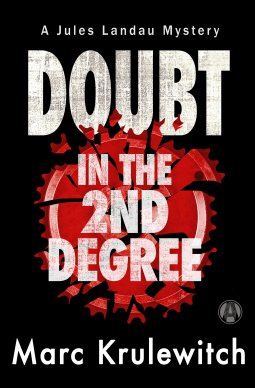
Doubt in the 2nd Degree, by Marc Krulewitch*****

doubtinthesecondThis is the fourth and best installment to date in the Jules Landau series. Thank you Net Galley and Alibi for the DRC, which I scooped on the date of publication in exchange for an honest review. This title is for sale now, and if you like a good whodunit, you should get it too.
The shores of Lake Michigan are inhabited by rich white people, and Jackie Whitney is one of them. Once she is found dead and stuffed on the shelf in her own walk in closet, however, the good times are over.  Kate, Jackie’s girl Friday who hails from Appalachia, is arrested and the public defender asks Jules to look into the case. She doesn’t trust the state’s own people to find reasonable doubt without some outside assistance, but she cautions him that she isn’t going to pay him to find out who did it; all she needs is for him to muddy the waters enough to prevent conviction.

She might as well spit into the wind.

Landau is fired up, and he knows that Kate will be convicted if he can’t find another suspect. Partly this is because cops like to wrap up a case, and once they think they have someone they can convict, they stop looking anywhere else; but there’s another reason, too:

“Corruption and Chicago followed each other like conjoined twins.”

The more rocks Landau turns over, the more suspects he finds. It’s getting to the point where he hardly has time to get home and feed the cat. There are many wry remarks that give this story its kick; it’s a novel that’s part noir, part cozy locked-room-mystery, and whereas the author’s disinclination to settle himself neatly into one area of the genre may cost him in sales, I have to admit that I really like it this way. His clear eye on class divisions and his snarky sense of humor lit me up like Christmas, and I can’t wait to see what he does next.

Although this is the fourth book in the series, I think it works just fine as a stand-alone novel.  Highly recommended!

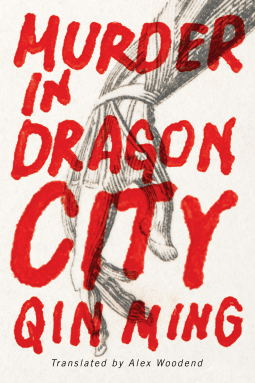
Murder in Dragon City, by Qin Ming**

murderindragonIs there a killer on the loose in Dragon City, one that’s trailing body parts everywhere he goes?  I received my DRC in exchange for this honest review, thanks to Net Galley and Amazon Crossing.  This collection of stories l is written by a Chinese medical examiner, translated to English by Alex Woodend. I’m always up for something new, and so I took my galley and curled up. Unfortunately, this one just never gelled for me. I tried setting it aside, reading other things and coming back to it, hoping that with fresh eyes I would like it more than I had before; finally I had to face the fact that I couldn’t write a happy review and also be honest.

It happens.

Undoubtedly the strongest aspect of this story in my view is, as one might expect, the forensic detail and physical knowledge the author commands. But that can cut two ways, if you’ll pardon the expression. Some of us just love gore, and the more fleshy fingers or toes that land in sizzling oil, the more we eat it up.

On the other hand, some of us are completely grossed out by frequent, grisly findings, and this author put his thumb on my “ick” button and never took it off.

One other thing I like and that’s consistent is that Chinese cops that find corpses or find themselves in strange, scary situations don’t feel compelled to feign indifference. There’s no noir to be found here, just honest cops that yelp when they are scared and that dive when they hear a loud noise near a crime scene. The candor is refreshing and sometimes funny.

Obviously, each story has a different spin to it, but the tone overall is much the same.

I confess that the last time I studied Chinese government and culture was in the post-Mao period, before the largest Stalinist types of government fell apart; I don’t know what life is like for women these days in China. But the author never seems comfortable portraying women as people that are female. Women are featured and discussed as political bigwigs, servants, and technicians, but we never see them acting in concert with men or each other. There’s a clump of men, and then…there’s this woman. Sometimes. The woman is always featured as “other”. The male cops gather and discuss whether any woman would be ruthless enough to commit the crime in question, but by this point I was so green around the gills that I didn’t want to find out whodunit or why. I just wanted to be done, which I am.

The Legacy, by Gary Gusick***

thelegacy Gusick’s hero, Detective Darla Cavanaugh, became an instant favorite of mine when I read the screamingly funny Officer Elvis, and so when I saw that Random House Alibi was about to publish this third book in the series, I scrambled quickly over to Net Galley to snatch up a DRC. Though Gusick is a tremendously courageous writer, one that seeks to stand uncompromisingly on the side of the angels, this time he’s stepped over a line in the sand that was better left uncrossed. I look forward to the next book in the series, but am not sure I can recommend this one.

The book will be available to the public December 6, 2016.

Darla has been planning a leave of absence. She and her husband, a doctor that runs the only remaining abortion clinic in Mississippi, have been unable to have a child of their own, and there’s a baby waiting for them in China. But she has to go quickly, or the adoption won’t go through. It is then that she receives a special request to investigate a murder. She says no; this is one time her family comes first. But the summons is from the governor. His daughter is dead, and he wants Darla to find out who did it.

This reviewer actually has an elderly relative that was tapped to investigate the murder of a governor’s aide in the 1980’s, and he didn’t want to do it either. There was a question of organized crime being involved, and it was dangerous. But as he pointed out at the time, there are some things you can’t say no to. It’s like being invited to tea with the queen; you have to go. And so it is with Darla.

By far the most endearing character here is Darla’s partner, Rita Gibbons:

“Rednecked Rita was…half a licorice stick short in the manners department, a deplorable character flaw in the state of Mississippi.”

When a witness that’s being interviewed coolly inquires as to whether Rita is a “Natchez Gibbons”, Rita tells her that she is actually a “Red Hills Trailer Park Gibbons”, from outside of Louisville.  And oh, how I wanted to engage, because this character is enormously entertaining, but there’s a problem, and it is at the core of the story’s premise.

You see, at the beginning of the story, we learn that Caitlin Barnett, the governor’s adopted daughter, who is African-American, was found hanging from a tree on the campus of Ole Miss. And once we have a lynching—whether it’s racially motivated and a real lynching, or whether there’s an ulterior motive and perhaps the body was posed there to deceive us—we can’t have any fun.

Here’s my litmus test to see if I am overreacting: I imagine giving this novel to one of my African-American family members to read, and I imagine what their reaction to it would be. Would they give Gusick props for pointing out that racism is still alive and flourishing in American society? Would they be glad that he has raised the issue of the Confederate flag? Or would they be slightly queasy, as I was? And immediately I knew that I would never, ever ask any of them to read this book, and if I did, they would probably take my husband aside sometime soon and inquire as to whether I was on any strange new medications.

In other words…no. Once there’s a lynching, or the appearance of one in a story, there can be no giggles, and we can’t rock and roll. It’s a hot stove top kind of issue; it’s not something we can touch, whatever our fine ultimate intentions might be, if we’re going to be partying anytime soon.

I still admire Gusick. Who else would have the rare courage to open oh, so many cans, and release oh, so many worms? But if one has the heart of a lion, one also needs some judgment, and this is where his story comes undone.

Although I cannot recommend this book to you, I look forward to reading this author’s work in the future. He’s done great work before, and he’ll do it again.

The Vanishing Year, by Kate Moretti****

thevanishingyear 3.5 stars, rounded up for this one. I received my copy from Atria Books and Net Galley in exchange for an honest review.  I am impressed most by the first half of the book, and particularly with regard to character, Kate Moretti is a rock star.

Our protagonist is Zoe Whitaker, and we learn that Zoe grew up as Hilary—with one “L”, and no political baggage—and then chose to adopt “Zoe”, the name on her birth certificate prior to her adoption. There’s a lot more mess here than there needs to be, the adopted-child angst, the guilt over having not given her mother Evelyn the funeral she deserved, and fear, fear, fear.

Moretti does a wonderful job of building suspense, and part of this is the vague but real tension, the constant shoulder-checking, wondering if someone has found her. It makes us wonder who, and it makes us wonder why. Bit by bit, she unspools tidbits of the past in the way you might expect someone that needs a friend and is learning to trust a new confidant might do.

Moretti’s main character is beautifully sculpted. Some novelists that withhold information to build tension hang onto so much that we don’t get to know our protagonist, but I was perched right on Zoe’s shoulder, or hanging out with her newly discarded friend Lydia, asking her why the heck Zoe is so passive. Is fear the only language Zoe knows? I felt close to Zoe, and I wanted her to tell me more.

Meanwhile, there’s the marriage. Henry Whitaker, an immensely wealthy man, sees Zoe across a crowd and homes in on her. Those familiar with the patterns common to abusive relationships know that this is a red flag; the guy whose gaze lights on a partner and from then on wants full possession of every move, every thought, and every minute. He makes a snap decision like lightning and then never lets up. And Henry has plenty of other red flags too, but he’s not a stereotypic abuser; Moretti is too cunning to permit any caricatures into her novel.

For the first half of this story, I relished the meaty ambiguity, not only in Zoe’s life but in what it represents. Yes, Henry is too possessive, too bossy, but on the other hand, this young woman that has never been known for her remarkable beauty or extraordinary talent has the Cinderella marriage without the stepsisters.

“I might be under someone’s thumb, but I have money now.”

Zoe has no living relatives to her knowledge, apart from the birth mom she hasn’t located and that may not want her when she does. She doesn’t have a degree, and is working at a florist’s shop in Manhattan when Henry finds her and whisks her away. He is devoted to her, provides her with every small thing her heart desires. She has a car and a driver, she has servants, she has clothes, jewels, and the whole nine yards. Everyone defers to her. There’s no restaurant that won’t make room for her at the front of the queue. Tickets to a sold out event? No problem.

It is easy for us to moralize from afar, we feminists with our principles, but economic want can shorten a woman’s life significantly. As this reviewer heads into retirement, I look at the lives of the women I knew when we were school girls, and no matter how clever or talented, their material well being seems tied, more than anything, to who they married and whether they remained married. Ask any woman over age 50 who’s looking for a job and watching those past-due notices land in her mailboxes, both electronic and physical, and many of those same women would be more than happy to let someone else tell them what to wear in exchange for such a well-padded safety net.

And so as Henry’s behavior escalates, I grow more entranced with the story’s Virginia Woolfish aspect, and I expect Moretti to take us up that mountain. How much is too much? At what point does one relinquish the guarantee, if there is one, of not only the basic requirements but luxuries one may quickly grow accustomed to, in exchange for breathing room, the dignity that comes with independence, self-respect, and with apologies to Woolf, possibly a room of one’s own?

But Moretti doesn’t go in that direction; at the last minute she tosses in a tremendous amount of new information that is original yet seriously far-fetched. Those that want a white-knuckle thriller with a female protagonist may be very happy here, but I was sad, left feeling as if the waiter had decided not to serve me and abandoned me after the hors d’oeuvres.

This title was released on October 4, and so if you are eager to see what all the buzz is about, get a copy, and then let me know what you think.

One way or another, Moretti will be a novelist to watch. The subtlety and nuance that escaped her as this novel progressed are still hers to be had, if she chooses to use them. I know I can’t wait to see what she publishes next.

Combustion, by Martin J Smith*****

combustionPaul Dwyer is dead, a floater that has only been found because his construction business diverted the water from the place where his body is dumped, and it dries up in the Southwestern desert heat, leaving his body exposed to the world.  I was lucky to be able to read this book early, thanks to an invitation from Net Galley and Diversion Publishing, in exchange for this honest review.  I am overjoyed to rate it five stars. I knew nothing at all about either Smith or Diversion, but it turned out to be a risk that worked out in my favor and the author’s.

Our detective is Ron Starke, a single man whose father has Alzheimer’s. The reader cannot help but warm to him as we see him appear in his father’s room, hamburgers in a paper bag, prepared to patiently have the same conversation with his dad that he had with him several times yesterday and most likely will have tomorrow too.

Shelby Dwyer, the victim’s widow, is a very wealthy woman now. She isn’t sorry that he’s gone, and neither is their teenage daughter Chloe. Dwyer was a violent, ugly man in private, regardless of the shine he demonstrated publicly. Naturally, Shelby is the chief suspect, a thing made more difficult by the fact that she was Starke’s girlfriend a decade ago, when they were in high school.  But it’s a small town, a tiny exurb of Los Angeles, and everyone really does know everyone, aside from Starke’s supervisor, Kerrigan, a recent transplant from the big city. To make matters even more awkward, Starke had been considered a shoo-in for the job Kerrigan now occupies, and Kerrigan knows it.

He has a feeling that his new boss is gunning for him.

The story is told from alternate points of view, and Smith creates whiplash tension by shifting between them at key points.  Character development is solid, and it makes me wonder about the possibility of a series emerging from this debut.

Shelby may be rich now, but she is in tremendous personal jeopardy. All of the lonely nights spent holed up in the study, cruising online for connections she can’t find at home, have led her to expose herself in a horrifying way. And as she is forced to confess to Chloe about the unwise things she has said to another visitor in a chat room, a person using the handle LoveSick, and despite the horror of the moment I had to smile, as the traditional tables are turned and 17 year old Chloe has to tell her mother that you should never, never provide a stranger with personal details.

Smith’s debut is hot as the desert sun, a page turner that will live in your head after the last page has turned. Those that know me are aware I finish an average of three titles weekly for review, and so months or even weeks later if I am contacted by the writer’s publicist, I sometimes have to flip back through my records to remind myself…wait, this what which book again? And this is especially true of mysteries, which no matter how unique, tend to share a certain sameness. But in this case, that didn’t happen. The settings are so resonant, the characters so well sculpted that I felt as if I were an unseen guest among them.

It’s for sale today, and I highly recommend that you read it.

A Killer’s Guide to Good Works, by Shelley Costa*****

Happy release day to one of my favorite mystery authors! This book is available today, and if you haven’t ordered it yet, now’s the time to do it.

seattlebookmama's avatarSeattle Book Mama

akillersguidetogoodShelley Costa is a writer to remember. Her dazzlingly dark humor and her ability to spin a tight original story that builds irresistibly caught my eye with her first Val Cameron mystery, Practical Sins for Cold Climates. I began checking in with Henery Press regularly when I logged onto Net Galley, and my stalking paid off big time. Thanks go to Henery and also to Net Galley, from whom I received a DRC in exchange for an honest review.

In this second Val Cameron mystery, our protagonist is back in the big city where she belongs. She is looking forward to lunch with her best friend Adrian, who promises to show her something rare and wonderful, but when she reaches Adrian’s office, her friend has been murdered and the artifact is gone. Val’s loss is our gain, as Costa unfurls another outstanding mystery. This title is available to the…

View original post 166 more words

Small Great Things, by Jodi Picoult*****

smallgreatthings“Is it worth being able to say what you need to say, if it means you land in prison?”

Small Great Things is a courageous novel, one that will excite a fair amount of controversy, and it’s one that needed to be written; it’s the most important novel released this year. Thanks go to Net Galley and Random House Ballantine for the DRC, which I received free of charge in exchange for my honest review. This book will be available to the public October 11, and you should read it.

Picoult’s readers will recognize the familiar format presented here, the alternating points of view of the novel’s main characters. Foremost is Ruth Jefferson, a middle aged labor and delivery nurse at Mercy Hospital in New Haven, Connecticut. Ruth is African-American. She’s making the rounds, doing a fairly perfunctory newborn check when Turk, the father of little Davis Bauer orders her out of the room. He wants to see her supervisor; he wants a note on his son’s chart that no Black person may touch his child. Turk is a white supremacist; he has the Confederate flag tattooed on his arm. The chart is flagged to indicate that no Black medical personnel—which in this hospital and on this ward means Ruth, since she’s the only African-American there—may touch or care for Davis Bauer.

She is told it’s for her own protection too.

But an emergency unfolds, and just as in real life, the hospital is understaffed. There are a limited number of nurses that can take care of emergencies, and when the rotation is full, the only person to keep an eye on Davis following his circumcision is Ruth. The nurse that had been attending him swears she’ll be back in just a few minutes. After all, what could go wrong?

What could go wrong does go wrong, as bad as it gets: Davis dies, and Ruth is blamed. She is suspended not only from the hospital but from nursing, and ultimately, when the hospital hears from the Bauers’ attorney, the administration decides to toss Ruth under the bus. She is arrested and charged with murder.

I have to say here that those that have big ugly reactions to triggers may not be able to read this thing. The language is harsh. There are dead babies in multiple places; if you or someone close to you has lost a baby, decide whether you can go here. There are lots of vicious racist and sexist terms tossed about, not carelessly or as a shortcut to establishing that someone is a bad guy, but because there’s no authentic way to voice a white supremacist character without using them. And I am frankly uncomfortable hearing Turk’s voice, and even more so with the amount of care Picoult uses to develop this character. It makes the book much more powerful, and those that wonder just what in hell makes someone turn out this way can watch it unfold. Is her depiction realistic? I have no clue. However, I can say I believe she has done due diligence with research, and it can’t have been easy.

Until now we have heard alternating voices, those of Ruth and Turk.Once Ruth is in trouble, we add a third character, that of Kennedy McQuarrie, the clueless attorney who sits down with Ruth and explains to her that she doesn’t see race. And ultimately the struggle isn’t about getting Ruth out of jeopardy and back to her job; it’s about how to do that.

Because Ruth, who has been more than tolerant around well intentioned Caucasian people that say offensive things without any idea how terrible they sound, has had enough. She went through Cornell University, but first she had to endure the hallway whispers that she only got in because she was Black. She speaks Standard English, and is fed up to here with being told she is too White. And she was paying close attention when Trayvon’s murderer walked away free; she doesn’t want her son to be the next young man in a hoody sweatshirt shot by cops terrified not of weapons or behavior, but of skin color.

So Ruth wants to go to court and she wants to talk about race. But Kennedy tells her that this is a losing strategy; only by sticking closely to the procedural aspects of the case will Ruth be able to reclaim her life. And Ruth is having none of it.

The people that really need to read this book are those that really think “all lives matter” is an encompassing slogan. I fear many of them will be too afraid of this story to go there. Likely those of us that understand that this slogan is a veiled way to say that only White lives matter are the ones that will be drawn into this story.

The ending felt contrived to me, but the rest of this novel is so well done that I’m not going to split hairs here.

I was somewhat taken aback by the author’s note suggesting that Caucasian readers should take the message back to “other White people”, in our “own” communities. And I do understand that much of the USA is still segregated, but I have been the only Caucasian in my house for a lot of years, and I wasn’t sure quite what to do with her assumption, particularly given that the theme of this story could very well be that nobody has the right to assume things about a person based on that person’s race or ethnicity. But I can live with it, because the story itself is much more powerful than the notes at the end, and I understand that her ultimate message to White folks is that we must not try to be “white knights” that rush in and take over the struggle, but rather allies that follow and support.

I wish it could be required reading for everyone…especially for those that say they don’t see race.

The Tea Planter’s Wife, by Dinah Jeffries****

theteaplanterswifeGwendolyn is 19 years old when she marries Laurence Hooper, the owner of a tea plantation in Ceylon, an island nation south of India now named Sri Lanka. Jeffries provides a compelling, sometimes painful glimpse of the mores and assumptions of the heirs of the UK Empire at the outset of the peasants’ rebellion led by Ghandi. Though a few small glitches occasionally distract, this is a strong piece of fiction that fulfilled the writer’s mission admirably. Thank you to Net Galley and Random House-Crown Publishing for the DRC, which I received free in return for an honest review. The book is on sale today.

The protagonist is not a sympathetic one, and those that need a main character they can love should stop even considering this book right now. But some of literature’s most interesting characters are flawed ones, and the development of this one within the constraints of what Caucasians in the UK expected their lives to resemble at this time, and within the even greater constraints of material self-interest, is fascinating. I found myself wanting to haul this character out to the cheese room and tell her that all other women are not her enemies. She has almost nothing required of her by the easy life into which she has married, and as a local gossip points out, Gwen has “never had to fight for anything”.

Gwen has a passel of problems, however, some real, some imagined. She sees her sister-in-law as a rival not only for her husband’s affections and loyalty, but also for his fortune. She sees his wealthy former girlfriend and business associate, Christina, trying to pull him back into a relationship. What about MacGregor, the surly foreman of the laborers? What about Savi Ravasinghe? By the time the book was halfway done, I found myself alternately scolding her for making enemies everywhere and then, a heartbeat later, screeching at her to beware.

Ultimately I didn’t think I was impressed by this story until I looked back on my notes. I had highlighted nearly every warning bell and red herring and made little notations like, “Noooo!” Obviously this story engaged me all the way through. At times I was frustrated, but that was the author’s intention. At no time was I bored. And given the level of suspense and a certain amount of mystery, I realized that one genre tag had gone missing. I added this title to my “mystery” shelf, because there is so much unknown information that will keep the reader up late as well as any whodunit.

The author makes a few missteps that break the spell of time and place momentarily. At one point there is an argument between two of the characters about Ravasinghe, and one accuses the other of race prejudice, while the other responds that it “has nothing to do with the color of his skin!” This is either ignorance or revisionism. In the 1920s and 1930s racism was at a fever pitch. Colonialists based their system of rule partially on paternalism, which overtly declared that the “lesser” races needed the great white fathers to look after them, employ them, house and feed them. In the USA, Jim Crow and the Klan were at their all time most powerful; African-Americans were afraid to walk on the same sidewalks in the South, and in the North they nevertheless kept to their own neighborhoods to the greatest degree possible. Biracial marriage was an invitation to ostracism or even death, and less than one percent of the Caucasian population in any English speaking nation would even pretend that such ostracism wasn’t about race.

In fact, US President William Howard Taft declared that the day would dawn when the United States flag would fly at “equidistant points” that would include North America, South America, and Central America in fact rather than merely economically, and he told the American people that God had willed this due to the moral and racial superiority of Americans—by which he meant Caucasian Americans. In the East, look what the peasantry went through just to get the vote!  No, no white folks in the British Empire or USA were going to defend themselves against charges of racism; racism was assumed to be the will of God.

There’s another “oopsie” moment when the roof of a large building catches fire and the fire is put out with a garden hose and pots of water. No.

But all of this is mitigated by the expert manner in which the author describes the setting, having had a family member that lived on such a plantation, or a similar one. Part of the reason I wanted to read this DRC is the fact that it was set in Ceylon, and here Jeffries does not disappoint.  I was afraid the ending would either be saccharine or unspeakably brutal, but she deftly avoids both extremes and comes up with a surprising and believable alternative.

So in the end, I recommend this book to you. It’s not always easy for some of us to look in the mirror, or at the mirror of one’s ancestors, but everyone comes from somewhere, and the playing field still isn’t level. Nobody can fix what’s wrong today without knowing where the trouble came from. The Tea Planter’s Wife is a historical treasure in this regard; Jeffries is to be congratulated.

A Long Time Dead–A Mike Hammer Casebook, by Mickey Spillane and Max Allan Collins*****

 alongtimedead  “The evening sky was gray and growling but I had left the trenchcoat behind and my suit coat was unbuttoned. This was the kind of sketchy gin mill where I wanted easy access to the .45 under my arm. The waterfront bouquet greeted me, salt air, grease, oil, sweat and dead fish drifting like a ghost with body odor.

“If you needed to know anything about the harbor facilities stretching from the Battery to Grant’s Tomb, or wanted a line on anybody in the National Maritime Union or the Teamsters, this was your port of call. If you wanted to get laid or make somebody dead, that could be arranged, too. You know the place. They have them in London and Mexico City and Rome and Hong Kong, with smaller variations in smaller locales. But none were meaner or dirtier than the bar run by Benny Joe Grissi.”

Spillane was the prototype for noir fiction, and even though he’d been hiding in plain sight, I never read Spillane because he wrote so many books that I assumed he was cranking out something formulaic, a pot boiler special. I am delighted to find I was mistaken; this set of short stories, an atypical medium for Spillane, was provided to me free courtesy of Net Galley and Open Road Integrated Media in exchange for an honest review. I’ve had a few DRCs that didn’t measure up to my expectations lately, and this particular galley was my bright spot, the reading I considered my dessert after I had dutifully choked down the stuff I was only reading because I’d said I would.

Collins was a close friend of Spillane’s, and at the author’s request, he rounded out some rough drafts that had been left behind when Spillane died. Collins suspects that they had been left dormant because the author’s church would not have approved of the brief—and by today’s standard, very tame—sexual content included. Whatever. We can read them now, and Collins has used Spillane’s style seamlessly. Only one of these stories is more his than Spillane’s, and he tells us which one it is. He did a great job with it.

The author is legendary for the call-and-response style dialogue associated with the genre as a whole now. His use of it and other figurative language is so sweet that I found myself—a retired language arts teacher whose highlighter is the modern day equivalent of the red pen—noting passages where it’s artfully used, and sometimes I got so caught up in watching the language that I had to go back and reread a few pages, because I had lost track of the plot. But it was worth it. Here are a couple of examples:

“’Sure you aren’t seeing ghosts?’

“’Once I’ve killed this guy—really killed him—then maybe I’ll see a ghost.’”

And on the same page, more of the same; Lincoln followed by Lincoln, salesman followed by salesman. Together with the alliteration and the brisk, no nonsense yet curiously intimate prose, I found myself mesmerized. Spillane doesn’t care about preserving evidence, and he usually won’t call cops, at least not until his own business has been concluded. Given today’s social climate and mistrust of urban cops, I suspect this newly issued work by the famous writer will find a wide audience.

Although it’s been decades, I can nearly swear that the Carol Burnett show did some spoofs of this type of narrative during the 1970s, when I was just a kid. If one uses too much of the repetition it becomes ridiculous, and of course Burnett and her colleagues could spot fodder for satire a mile away. But although I kept my antennae up, I never found a weak place in the text that took the lyrical repetition to the point of silliness. It’s carefully meted out so that it reels the reader in rather than appearing ridiculous and distracting. And if you look at my last sentence, I can promise you the alliteration there was unintentional. Good writing stays with us, as any teacher will tell you; this is one reason we have students read something before they write. And thus it is that a tiny nugget of Spillane’s technique has made its way into my review.

Most people don’t want to analyze detective stories; they just want to read them. If so, then you should be good to go here. I was additionally pleased by the lack of racial and ethnic slurs which some writers of the genre would include in the name of authenticity. Likewise, the gorgeous receptionist is actually Spillane’s partner in both senses of the word, and she listens to what people reveal when they believe no one important is listening.

This is the very best of the noir genre. If you enjoy great detective fiction and can stand some graphic violence, this book is for you.

Two Miles of Darkness, by Earl Emerson****

twomilesofdarkness Fans of Emerson’s Thomas Black mysteries will be as pleased as I was to see this, the 14th in the series. Black took a very long nap and seemed to have all but disappeared for awhile, but then he was back with Monica’s Sister, followed by this title. There was no DRC for this one, so I picked it up free using my Amazon Prime digital credits. It was a good way to spend them. The book was released in 2015, so of course you can get it also.

We start out with one of my three most tired devices for a mystery novelist: Black and his sidekick, Snake are hogtied in the trunk of a car. I rolled my eyes in the way that made my second grade teacher caution me might make them stick that way forever—an outstanding science lesson that remained with me long after the legitimate curriculum had drifted away—but because I like this series so much, I kept reading anyway. And it was worth it.

Eventually of course Black stops discussing being stuck inside the trunk, and he remembers back, back, back to how all this came about. And that’s the story that is great fun and also well written.

Black grew up in the working class here in Seattle, but his father did errands and handyman work for a wealthy widow that went by the nickname Doda. Dad is long gone, but Doda is still there, and she hires Black to find Pickles, a dog she gave to Mick and Alex Kraft. The Krafts, by peculiar coincidence, had also tried to hire Black recently in order to find out who was harassing them; Mick had experienced a string of terrible luck that he believed was too sudden to be a coincidence. Black told him that sometimes bad luck really is just bad luck, but the next thing you know, they’re both dead. Police are calling it a murder and suicide; Doda just wants the dog back. She’ll pay a pretty penny if Black can find Pickles and bring him safely home.

In this matter, Black’s friend Snake, usually the irresponsible party where the two friends are involved, is the sensible one that points out the truth, a very good reason to turn the dog job down:

“You hate rich people. Think about these guys. The rest of the world works for a living, but these guys have nothing to do all day but drink Mai Tais and sit around the pool waiting for their dividend checks to arrive in the mail. It burns you up. I know it does.”


Snake is right. Black hates the rich, and I have a sneaking hunch that Emerson does too.  So in this tale, we have a couple of spoiled men—no longer young enough to be called brats—known as Chad and Binky. One is Doda’s son, and the other is the son’s best buddy. Their massive resources coupled with a life of leisure and surfeit of free time give them the capacity to play elaborate pranks, and both show a solipsistic disregard for the effect their games have upon the lives of others. They fit Snake’s description to a tee.

Nevertheless, Black takes the doggy job, and so we have two mysteries, the official dog-finding mystery, and the unofficial mystery Black’s conscience requires him to tackle regarding the Krafts.

One small fact-checking blooper hit my I-don’t-think-so-button, and that was the widely-believed myth that all juvenile records are sealed once the doer of the crime turns 18. In reality, after a number of years, a hefty filing fee, and a ton of complicated paperwork, the person in question can have the particulars of their crime locked away, but if it was a relatively small offense, that may make matters worse, because anyone running the background check will see that the person did something in their youth that they want concealed. Most juvenile offenders never want to see a courtroom again when they are older, and most don’t have the extra money to throw at a court procedure anyway, so the misdeed stays on the record until they grow old and die. It never vanishes from the record, as some folks, sadly some of them juveniles looking for trouble, believe. At least, that’s the truth in Washington State, and that’s where Emerson lives and where his story is set.

Now back to our story. Emerson is a champ when it comes to pacing, and he’s one of the best there is when it comes to bouncing a straight man off a colorful sidekick like Elmer “Snake” Sleazak. The story would be no fun at all without Snake, but with him, it’s immensely entertaining. The sly banter and the unexpected, off-the-chain behaviors will put a smile on your face; if you don’t find him funny, check your pulse to make sure you aren’t dead.  Add another side character, a neighbor kid named Charlie that was friends with Pickles the dog, and there’s charm all over the place. People often underestimate kids, who are often our best observers: “Charlie knew the neighborhood like a cheating husband knew every creaky stair on his front porch.”

This is a page-turner that will make your own troubles seem oh so small, and for those that find themselves with a long weekend at hand, this book will provide the excuse you may need to just chill for awhile. One way or the other, this is a well written story, deftly handle with just the right balance of mirth and suspense. My records tell me I have read over 700 mysteries since 2012, and that doesn’t even take into account most of what I read during the previous decades of adulthood, and so I am picky. I see a device that I’ve grown tired of, and a star falls of my rating. But as for you, if you lean leftward and love a good private eye story, this could well be a five star read.

Recommended to those that lean left and enjoy detective fiction and comic capers.