What Kind of Paradise, by Janelle Brown*****

What if the Unabomber had had a daughter? Thriller writer Janelle Brown spins a fascinating, credible, and memorable story based on this idea. My thanks go to NetGalley and Random House for the invitation to read and review. This book is for sale now.

Jane Williams grows up in a remote mountain cabin with her father; her mother died many years ago, so it is just the two of them. Once in a rare while she is allowed to accompany him into town to visit the bookstore, maybe even get an ice cream cone, but otherwise, she is cut off from society. She has no friends, apart from a casual friendship with the bookstore owner’s daughter; she has no play dates, no television, no computer. She is homeschooled. 

But every now and then, her father will wake her from a sound sleep in the middle of the night. They have to go! She grabs her bugout bag and goes through their established routine, escaping via the tunnels he has built beneath their cabin. Her heart pounds, her chest heaves…but hey, it turns out to be only a drill, after all.

Her father is a writer, composing political tracts that he sells in small, independent bookstores that carry zines. And so, for most of each day, he writes, she reads, and when the weather permits, she watches ants build hills, picks wildflowers, and leads the sort of bucolic life he has planned for her. But then, things change.

The story is told from Jane’s point of view; when Jane longs for even a photograph of her dead mother, anything at all to tell her about the other half of her beginnings, I feel it viscerally. Poor kid. But things are not necessarily as they appear, and as she grows to adulthood, Jane finds clues, small tidbits she’s not meant to find, and each morsel leaves her ravenous for more.

The story unfolds in the 1990s with occasional flashes of Jane’s childhood the decade before, so while it’s not historical fiction, it does have a retro vibe, one that Brown provides with absolute accuracy. We see small snatches of the events that took place in the U.S. during that time, but Brown is too good to rely on pop culture, so these are meted out sparingly, only when needed, never as a crutch.

This is a fun read, and it’s unlike anything I have seen written recently. I highly recommend it to fans of the genre.

May the Wolf Die, by Elizabeth Heider***-****

“Sometimes, killing is necessary.”

Elizabeth Heider is a scientist with a long, impressive track record. Now she has published her first mystery, May the Wolf Die, as well, proving that some of us can wear multiple hats very well indeed. My thanks go to Penguin Random House and NetGalley for the invitation to read and review. This book is for sale now.

Our protagonist is Nikki Serafino, an investigator living in Italy. She’s out in her boat one day when she finds a man’s corpse, and from there we venture into local organized crime.

The mystery itself wasn’t as engaging as I had anticipated, given the buzz, but there are a few laudatory aspects nonetheless. First, Heider is a scientist, and often when someone is a specialist in some other field, they info-dump so much data into their novel that it loses its sheen. Heider’s restraint here is admirable. The unusual characteristic of the corpse, which I won’t disclose, appeared to be a gimmick that would take over the story, but it wasn’t and didn’t. The ending was solid. But the best and most important feature, the thing that elevates this mystery from three stars to four, is the punchy yet tasteful manner in which Heider deals with sexism and violence against women in the military. There are a couple of stand up and cheer moments that made me sit up and take notice.

This is a debut novel, and a promising start for Heider. I wish her well in her new career.

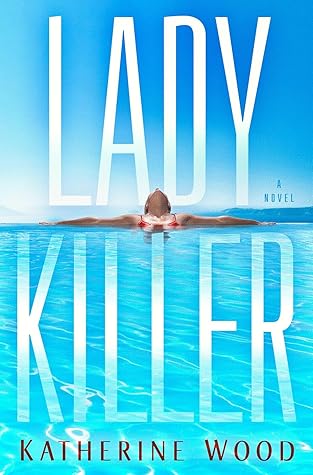
Lady Killer, by Katherine Woods***-****

Lady Killer marks the debut of novelist Katherine Wood. The suspense begins when Abby flies to Greece at the invitation of her best friend, an heiress named Gia, who is planning a birthday party there. Gia has disappeared, and it is her journal that provides clues as to what may have happened. Suspicion falls on her husband because of things that are indicated in the journal, but he’s gone, too.

My thanks go to NetGalley and Random House for the invitation to read and review. This book is for sale now.

It is clear from the get-go that Wood can write. Her word smithery is smooth and original. However, there is so much sexual content that I can’t enjoy the story or bond with the main characters. Partner swapping; threesomes. I finally gave myself permission to skim the rest. Unlike some other reviewers, I have no difficulty with the ending; it’s getting there that makes me queasy.

For some readers, the steamy segments of this novel will make it more pleasurable, but the only perspective from which I can write is my own.

Recommended to those that like a sexy novel of suspense.

The Children of Eve, by John Connolly*****

If Stephen King and James Lee Burke had a baby—an unnatural one, of course—it would probably look a lot like John Connolly. Connolly has a genius for creating tales that take place on Earth, and are in most regards realistic, while adding elements of the supernatural that go well beyond magical realism. There’s the mystery, and there’s the horror, and if we’re reading a Charlie Parker mystery, we cannot have one without the other, nor should we.

My tremendous thanks go to NetGalley and Atria Books for the review copy of The Children of Eve, the 22nd Charlie Parker mystery. This book is for sale now.

The story commences when Charlie is contracted to find and protect a man named Wyatt Riggins, who has disappeared. Riggins has thrown in his lot with some baddies, and may have bitten off more than he can chew. As Charlie—and we—pursue Riggins, we learn of some seriously nasty skullduggery that’s afoot involving international art thieves. Added to the mix are four missing children, believed to have been kidnapped. There’s not a single slow moment as Charlie tracks Riggins, and we see, through the third person omnipotent, the manner in which these thieves have fallen out, and the trail of bodies that are left in their wake. This is grisly business, and not for the squeamish, although I will say that some horror and hardcore detective novels do go places that I can’t, but Parker novels always manage to stay just inside my own boundaries.

Recurring characters Angel and Louis, perennial favorites, return briefly. At one point, Parker has been roughed up and is in the hospital. Angel and Louis have been listed as his next of kin, and they seem unlikely nurturers. While guarding Parker’s room, for instance, Louis amuses himself by making those that pass by him nervous. And when he is discharged on the condition that he not be alone for the next 24 hours, Angel and Louis make the doctor uneasy as well. She asks Parker whether he has “any other friends? Any at all?” I would have loved to see more of these two, but perhaps Connolly is keeping them in the shadows, lest they grow stale. That’s hard to imagine, but no other reason makes sense. I also enjoyed the brief glimpse of the Fulci Brothers, hired (but not brilliant) muscle men that resemble “bears in green leisure suits.”

Perhaps the most disquieting aspect of this novel—scratch that, not “perhaps”—is the development of Connolly’s dead daughter, Jennifer, who has come to him periodically and watches over him. I won’t say anymore about that, but I finished this book 2 days ago, have been reading several other books, and yet I can’t get Jennifer out of my head. For those that love gritty detective novels, and for those that are drawn to things that go bump in the night, this book, and this series is strongly recommended.

One Perfect Couple, by Ruth Ware***

One Perfect Couple is Ruth Ware’s tale of reality television gone horribly wrong. Our protagonist, Lyla, agrees to appear on the show because Nico, her boyfriend, is trying to boost his acting career, and the show won’t accept single applicants; if he’s not there as half of a couple, he can’t even apply, let alone be chosen. So, fine fine fine. Lyla will go, and since she’s not a glamour girl, she figures she’ll get eliminated within the two weeks’ vacation time her job permits, and then Nico will get his show and she’ll get to go home.

It doesn’t work that way.

My thanks go to NetGalley and Gallery Books for the review copy. This book is for sale now.

First, a word: because I was running late with this one, I borrowed the audio version from Seattle Bibliocommons. This proved to be disastrous! The actor voices Nico in such an exaggerated manner that nobody, myself least of all, could imagine someone as smart and savvy as Lyla pairing up with such an egotistical, whiny brat. I drop the audio before the twenty percent mark and from there forward, read it digitally. This is an improvement.

Lyla and Nico are directed to board a ship with the other contestants, and it takes them to a tropical island. Once there, however, they are besieged by a terrible storm. The crew members and producer are asleep on board the ship at the time because the show is a new one, and the crew’s cabins and other facilities are still being constructed. The contestants have been forced to turn in all of their digital devices so that none of the show’s progress will be leaked online before air time, and so when the storm smashes into the island, their communication devices are on the boat; they have become castaways. Worst of all, there is a serious shortage of fresh, potable water. Elements of well loved classics are borrowed; we have tidbits reminiscent of Lord of the Flies, smidgens of—I was going to say Robinson Crusoe, but that’s overstating it, so let’s say Gilligan’s Island instead. One by one, people start dying, and there is no way for the survivors to call for help.

I have read and reviewed almost everything Ware has written. She’s been a reliable source of enjoyable whodunits, usually four stars, sometimes even five. But here I feel as if she has missed the mark. There’s a fair amount of repetition, and whereas the first half is reasonably suspenseful, I found that the longer I read, the less I cared what became of the contestants. One thing I did like, however, was seeing these lovely women that, given the show’s parameters, should have been enemies, supporting, relying upon, and helping each other. That is the one sparkle I found here, and nobody can take it away from me.

The book itself, you can have. Or not. My advice is that if you are going to read it, get it free or cheap; don’t spend your precious dollars buying this one at full cover price, and avoid the audio. As for me, I will hope that Ware is back on track next time around.

Murder in an English Garden, by Carlene O’Connor***-****

Murder in an Irish Garden is the eleventh in the Irish Village mystery series by Carlene O’Connor, but I haven’t read any of the earlier books. My thanks go to Kensington Books, RB Media, and NetGalley for the review copies; this book is for sale now.

I was drawn to this book because it features three of my interests: mysteries, Ireland, and gardening. On the downside, it’s definitely a cozy mystery, and I am generally not a fan of cozies, except for the ones that have a bit of an edge, the sort that make true cozy readers complain. I mention the latter because for me, this felt too sedate; on the other hand, true cozy fans may find it is just about right for them.

The premise is that the annual gardening contest, which features a significant cash prize and a great deal of prestige, is about to take place. The village’s most serious gardeners have spent considerable time, effort, and money preparing their gardens for the event, but then one of the displays turns out to have a corpse inside it; the body is that of an entrant who isn’t from the village, an outsider who’s using the competition as a stepping stone to get her admitted to another contest that has a massive cash prize. Cassidy Ryan, the outsider, has been murdered. Village cops Siobhan and Macdara, who are a married couple, are tasked with solving the crime.

As the story opens, we find the two cops—called garda—in a marital dispute, and our protagonist, Siobhan, has an internal monologue that switches back and forth between murder and her pique at Macdara. I felt the latter was overdone, but I also wonder if I had read some of the earlier books, whether I would be more invested in their romance. Of course, they eventually resolve their dispute, and they crack the case.

I was lucky enough to have access to both the digital and audio versions. This proved to be even more helpful than usual, as I was able to hear the story through the delightful Irish brogue of reader Caroline Lennon, and at the same time, I learned the pronunciation of a few common Irish names that I’d only seen in print until now. Between these things and the fact that the narrative is linear and lends itself to the audio format so beautifully, I recommend that interested readers select either the audio alone, or a combination of both. I read multiple books at a time, and because it is easily followed, it’s the story I have chosen to hear while driving.

The characters felt poorly developed to me, with external qualities—this gardener loves goats, that gardener is formal and rather picky—serving as the only development that I found. I would have liked to see some dynamics, and some agreeable qualities for the deceased included. There was almost nothing about gardening, which would have been fine, had there been character development, but alas.  For this reason, I rate the digital version 3 stars, but for the reasons mentioned earlier, the audio version is elevated to 4 stars.

The Doorman, by Chris Pavone*****

“It’s up to everyone to draw a line, and hold it.”

Chris Pavone writes white-knuckle thrillers, and he’s one of the best in the business. His new novel, The Doorman, is one you won’t want to miss. My thanks go to NetGalley, Macmillan Audio, and Farrar, Strauss and Giroud for the review copies; this book will be available to the public May 20, 2025.

Our story rotates around three main characters, providing the point of view of each in turn; the setting is The Bohemia, an exclusive apartment building in New York City. Julian Sonnenberg, a middle aged art gallerist whose marriage is dying, lives there, as does Emily Longsworth, wife of the ultra-wealthy and ultra-hated Whit Longworth, racist war profiteer; and Chicky Diaz is the doorman, who sees all and hears all. They don’t know it yet, but their fates will soon be linked.

I’ve been reading Pavone’s novels for a long time, and each time he surpasses himself. The common thread that I treasure most, however, is his deep affinity for the working class, and his respect for women. In fact, I don’t know of any male novelist that is better than Pavone when it comes to developing female characters, and that is even more impressive when I consider his genre, because in most true thrillers, the pace is so fast and furious that there’s no time to develop any characters at all. Yet somehow, Pavone does it, and he does it without sacrificing the heart pounding, screaming pace that accelerates until the almost unbearable climax, which in turn is very close to the conclusion.

I was lucky enough to have access to both the digital and audio versions of this story; Edoardo Ballerini does a fine job narrating the latter. You can’t go wrong in either direction.

Highly recommended to those that love the genre and lean to the left.

Murder at Gull’s Nest, by Jess Kidd*****

Nora Breen has sprung the coop, run away from her home of the past thirty years and come to Gull’s Nest, a rooming house near the sea. “Gull’s nest is that sort of place, isn’t it? Where the dreamers and schemers wash up.” And indeed, that’s our Nora. “A washed up nun…An abandoned friend. Flotsam and jetsam.”

Murder at Gull’s Nest is the first mystery in a series by one of my favorite novelists, Jess Kidd. I’m grateful to NetGalley and Atria Books for the review copy. This singular story will be available to buy in the U.S. April 8, 2025.

Nora is indeed a former nun; she’s shed her holy orders along with her tunic and scapular; she’s asked Christ for a divorce. Now she’s middle aged, and dressed in whatever castoffs were available when she departed. She has very little money, and is appalled at what inflation has done to prices between the time that she entered the monastery and the present day. Her first order of business now is clear, regardless: she must find her beloved friend Frieda, who left the order, came to live at Gull’s Nest, corresponded faithfully, then apparently dropped off the surface of the earth. If she’s alive, Nora will find her; if not, Nora will find her anyway.

She settles into the rooming house, and as she gets to know the other boarders, we get to know them along with her. The owner is a stickler for rules, and the cook and housekeeper—one person—is a tyrant. The food is dreadful! Nora resolves to float along beneath the radar for a bit, get the lay of the land before she does any obvious snooping about. However, since this is a murder mystery, someone dies while she’s still getting her bearings. And in time honored tradition, she irritates the very bejesus out of the local law man, Inspector Rideout, who is still deciding whether this death is due to murder at all.

“’I am not yet investigating a murder, Miss Breen.’

“’Are we not?’

“’No, I am not.’”

Don’t ask me to give away anything else about what happens here, because I won’t. I will tell you, however, that it crackles. Jess Kidd writes everything well: internal monologue? Check! Dialogue? Check! Denouement? Check, check, check!

Get this book and read it. You won’t be sorry.

The Maid’s Secret, by Nita Prose****-******

Molly the Maid is back for the third installment of Nita Prose’s excellent and wildly successful series. My thanks go to NetGalley and Random House Ballantine for the review copy. This book will be available to the public April 8, 2025.

As in the first two books, we find Molly employed at The Regency Grand Hotel; she’s been promoted to Head Maid as well as Special Events Manager. She is engaged to chef Juan Manuel, a lovely fellow that helped fill the void in her life when her beloved Gran died. But everything changes when Brown and Beagle, art appraisers famed for their reality television program, come to do a show at The Regency Grand. Along with all of the “polishing to perfection” that is necessary for such a massive event, Molly decides to bring a few of her late grandmother’s trinkets along; you never know, maybe one of them will be worth something.

Oh, it most certainly is!

Once her rare and valuable object becomes public knowledge, Molly’s life changes completely. She no longer has privacy, which she holds dear; strangers are constantly in her face seeking autographs, and the press won’t leave her alone. Meanwhile, we are apprised of the circumstances leading up to this startling discovery. Gran comes to us from beyond the grave—so to speak—in the form of a diary that Molly didn’t know she kept. Chapters in this book alternate between the present day in Molly’s life, and the past, as told in epistolary fashion by Gran.

I wasn’t a big fan of this method, and I’m still a bit ambivalent, which is where the half star off the rating went. It seems like a lazy way to go about telling a story. However, if an author must use this method, it’s hard to imagine it being done better.

Of course things don’t go smoothly following the discovery of the heirloom; if they did, then there would be no novel. But I will leave the conflicts and resolution to the reader to discover.  As for me, I found the series of events, and the ending, believable enough for our purposes, and I enjoyed the story greatly, despite my misgivings about Gran’s storytelling method.

Recommended to those that enjoy the series; this book may be read as a stand-alone, but will be better enjoyed if you can read the first, second, or both earlier books first.

Hang on St. Christopher, by Adrian McKinty*****

Fans of Adrian McKinty’s Sean Duffy mystery series, celebrate! The eighth installment, Hang on St. Christopher, is out, and it’s well worth the wait. My endless thanks go to NetGalley and Blackstone Publishing for the review copy. This book will be available to the American public tomorrow, March 4, 2025.

When we rejoin Duffy, he’s a part-timer with the Royal Ulster Constabulary, driving a desk:

Until a year ago, doing boring paperwork had only been my cover, because I’d really been a case officer in charge of handling an IRA double agent in the police, who we’d turned into a triple agent working for us: feeding the IRA false intelligence and trying to pick up tips. But the stress of playing for us and them had finally taken its toll on Assistant Chief Constable John Strong, who had a coronary event in his back garden, where he’d been pruning his pear tree with a chainsaw. The chainsaw had avoided killing him, but it had laid waste to several of his prized garden gnomes before the cutoff switch kicked in. It had taken him an hour to die out there, gasping for breath in the summer heat among the severed heads of his gnome army, and those of us who knew about his crimes and betrayals had considered that justice.

For the uninitiated, this is typical of McKinty’s writing style, providing essential information in a tightly worded space, but also including, now and then, some unexpectedly hilarious tidbits. It prevents his prose from becoming too dark to be a fun read.

And dark it does become. You see, Detective Sergeant Lawson, who was once Duffy’s underling and whom Duffy still outranks, is on vacation—sorry, holiday—on the Continent, and wouldn’t you know that a particularly interesting and urgent sort of murder takes place while he’s gone? Duffy is on his way out the door, ready to retire to his suburban home in Scotland where his girlfriend and daughter await, when he’s tapped to go to the scene. Of course, he can turn the whole thing over to Lawson once he’s home; it’s only for a couple of days.

As if.

There are two things that as a reader, I rarely do anymore, and one of them is to stay up late to finish a book. Why should I? I’m retired. I can finish it in the morning if I choose, when I’m rested. The other is to feel sorrow when a good book has ended. I always have dozens sitting in my queue, so even a good book that’s finished is a title I can check off my list, right? But just like Duffy’s tranquil—okay, boring—suburban idyll, all that goes out the window for this one. I stayed up long after my light is usually extinguished, and I mourned when I realized there was no more of it to read.

Once the adrenaline had faded, I wondered where my usual cynicism had gone. I’m a tough customer when it comes to mysteries, and in this one, Duffy does about a million things that cops never do in real life, taking all sorts of crazy risks, doing things at his own expense and on his own time. Why do I believe this story? Because I do. I believe every stinking word of it. And then I realize that it’s the character. McKinty has developed Sean Duffy so well that I know that while cops in general don’t do these things, Duffy absolutely does. Part of it is his thirst for justice; part of it is his inner darkness, a slight, or not so slight, death wish.

If I could change one thing, it would be to have the 9th Sean Duffy mystery available now. Right this minute. I have some excellent books in my queue, but there’s not a single one that I wouldn’t drop like a hot coal if I were given another Duffy book.

Can you read it as a stand-alone? You can, but it would be silly, because when you finish, you’ll be online searching for ways to get the first seven in the series. Do what you gotta do, but read this book.