Somewhere Toward Freedom, by Bennett Parten*****

Bennett Parten is a fine historical writer, and here he examines General William Sherman’s renowned march through Georgia during the American Civil War through the lens of the formerly enslaved people that followed him. It’s a job that needed doing, and I’m glad that Parten was the one to do it. My thanks go to Simon and Schuster and NetGalley for the review copy. This book is for sale now.

The Union’s approach to formerly enslaved people evolved considerably over the course of the war. (This is your reviewer talking, not Parten.) In the beginning, when both North and South thought the conflict would be a brief one—ending, of course, in their own victories—anyone that left a plantation without permission to follow the Union army was promptly returned to their owner. But this was problematic from the start, if only logistically, as such practices slowed the army’s pace and drained resources from it, all in service to the enemy. For a while, then, everything was unofficial, as gradually, the formerly enslaved were sometimes folded into the army as support staff, helping cook, set up camps, pave roads, and whatever other noncombat roles needed to be filled. Eventually the practice was codified, not because slaves were declared free—not yet—but as “contrabands” of war. The idea was that by taking the enemy’s property that one runs across, be it livestock, crops, or (wince!) human beings, one’s own forces were strengthened, the enemy’s weakened. And after the Emancipation Proclamation, the formerly enslaved could theoretically go wherever they chose, but since guns and dogs can render such a proclamation from a far away and often unrecognized authority, it seemed like a wise plan for the formerly enslaved to follow the Union army.

Prior to reading this book, I was unaware of the relative size of the crowd of followers as opposed to the army itself. As Sherman’s forces made their way through Georgia waging total war, razing fields and burning cities, the crowd behind it grew from hundreds, to thousands, to tens of thousands!

Sherman’s first obligation, as he saw it, was to win this war. The army had to be his focus. Yet, as enthusiastic followers swarmed, they needed food, shelter, and sometimes other assistance. Initially, the troops were instructed not to give food to anyone other than those followers tapped to serve the army, but it proved difficult to enforce. There were children there, and they might well starve if not fed. The army had, as an intentional strategy, denuded the farms and villages of food and other necessary resources, so telling the followers to go find their own food was disingenuous. The army had nearly all the food there was; unfortunately, it wasn’t enough for thousands of extra mouths. And at times, Sherman and his generals made an effort to prevent, or to at least not help, the followers from remaining with them.

The greatest scandal was the one at Ebenezer Creek. (Sherman himself was not physically present for this, but what happened was consistent with his policies.) Georgia was full of rivers, swamps, creeks, and bogs, and in order to cross them, sometimes the engineers constructed bridges, and then either burned them behind themselves to prevent the enemy from following, or retrieved them for later use. In this instance, the enemy was close at the rear, and the order was given to pull up the bridges just as soon as the last soldier was across. The result was horrifying: with the hounds baying behind them, the desperate followers used every possible means to try to stay with the army. Some drowned; others were captured and either returned to slavery or killed. Women and children perished in those muddy waters, and later, the Federals launched an investigation.

There were other less dramatic, yet still tragic, incidents of the same sort.

In order to solve this conundrum, Sherman ordered a series of abandoned plantations in Port Royal, an island in South Carolina, to be turned over for the use of the freedmen and women. The book goes into a fair amount of detail about how these were run, with a fierce competition between two sides for control. Despite an overly colonial administration, formerly enslaved people were able to farm for themselves, and in some cases were able to buy land with the money they earned. It was a sound, if flawed program that was ultimately destroyed when Lincoln was murdered and Andrew Johnson, a sympathizer of the South, became president and gave the plantations back to their original owners, making no provision whatsoever for the farmers that now worked them.

It is this aspect of which I knew nearly nothing. Part of this is because I am a coward; I have a dozen or more books about Reconstruction that I say I will read, but then I don’t, and that is because I know the ending will be heartbreaking. But there’s also this: conventional histories of the Civil War tend to follow one or another army, general, and so forth, and very few tell the story of what happens after the army marches onward. And so I learned a good deal from this portion of the book; and yes, my heart broke, but not as much as those of the people that were first assisted, and then abandoned by the U.S. government.

Finally, I want to comment on the notes and sources used here. They are beyond reproach, with many primary sources used, multiple sources per endnote in most cases, and well-integrated. I particularly appreciated the quotations of the followers themselves.

I highly recommend this book to all that are interested in the American Civil War, Reconstruction, and the many social and racial problems that have continued to weigh on American society ever since.

Emperor of the Seas, by Jack Weatherford*****

How much do you know about the Mongol empires? If you grew up in the U.S., chances are you answered, “Absolutely nothing.” The world is a big place, and world history has never been much of a priority in American schools; we study various phases of U.S. history, state history, and in a wild flurry of internationalism, some districts now teach a semester of Canadian history. The single year of world history in high school is usually devoted to World War II, which is impossible to teach without including information about Europe, and a smidgen about Japan along with, yes, more American history. There you go. Here’s your diploma.

In my retirement years, I have reveled in the freedom to learn about the history that wasn’t on the syllabus for what I studied, and later, what I was hired to teach. Having marched my way through various other times and places, I realized that I knew nothing about the Mongol khans. I read one novel about Genghis, and I was hooked.

My thanks go to NetGalley and Bloomsbury for the review copy. You can buy this book now.

If you’re going to read a single nonfiction book about the Mongols, this would be a fine choice. Jack Weatherford’s research is outstanding, including works in several non-English languages that most of us couldn’t hope to read on our own. His scholarship is so meticulous that he has been awarded both of Mongolia’s top national awards. Not half bad, for a boy from South Carolina. And while this book is not written as narrative nonfiction, the tone is conversational, the language accessible. I read it daily at lunch time, and it wasn’t long before I was shouting out random, amazing facts to family members that dared venture into the kitchen.

It began with Genghis, a young man whose family was left homeless, left to freeze or starve when his father and protector died. With desperation, talent, and ruthlessness that he learned well, he turned it around, and as he grew up he vanquished his enemies, brought the most talented and trustworthy elements to himself, and let the devil take the rest. His instinct for military strategy was a thing of pure genius. But this book is mostly not about him; it’s about his grandson, Kublai Khan, who expanded the empire Genghis began until his domain stretched from Baghdad to the far shores of China.

Until Kublai arrived, Mongols were an inland people, but it was Kublai who realized that in order to expand and become a world power, he had to have ocean-going vessels and people that knew how to use them. The peoples of Southern China were tough to defeat, but once it was done, he was able to use their technologies in ways that were of immeasurable value.

The progression looked like this (in a very simplified version): Genghis conquered, and took no prisoners, with a few rare exceptions. Kublai conquered, but also used diplomacy, highlighting the potential benefits of becoming a Mongol subject; he didn’t routinely kill everyone he defeated. And under Kublai’s son Temur, the Mongols segued from physical battle to economic dominance, making China’s ports the ideal destination of merchants from all over the world.

One of the most interesting things I learned had to do with the authority that was vested in the women of the highest placed families. When the men rode off to conquer, it was women that looked after the business interests and saw to local governance. It worked out nicely; Europeans should have taken note.

I can’t compare this book to others because I haven’t read any others on this topic cover to cover, but I wouldn’t let that stop you. If the Mongols are persuaded that Weatherford has done the work and done it well, who can argue? I learned a great deal and enjoyed it, and so I highly recommend it to you.

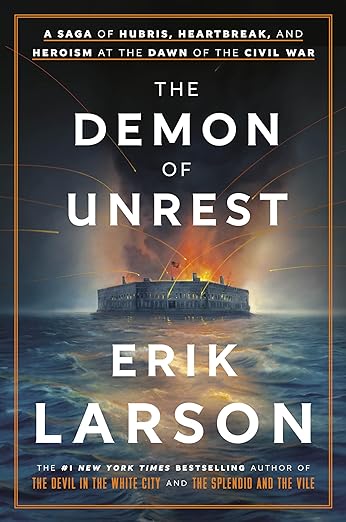
The Demon of Unrest, by Erik Larson*****

When it comes to history, it’s hard to conjure a more capable author than Erik Larson. I’ve thought this for some time, but his Churchill biography, The Splendid and the Vile (2020) cemented this impression.  I am therefore gushingly grateful to NetGalley and Crown Books for the review copy. I would have paid full cover price for this book if that was the only way that I could get it—or the only way that I could get it soon.

This book focuses on Fort Sumter, the Federal fort off the coast of South Carolina that became the catalyst for the opening guns of the American Civil War. The Southern states that seceded from the US, or that attempted to do so, believed themselves entitled to seize the forts, munitions, and indeed, every single ounce of American property located within the borders of their states—and although Fort Sumter and the lesser, partially constructed forts around it were on islands rather than inside the state’s boundaries, they expected to annex those, too.

Meanwhile, as most know, Major Robert Anderson was the fort’s commander, and he desperately wanted orders from Washington. The period following Lincoln’s election, up until he actually took office, was a critical one, but President Buchanan was determined to postpone any official acts until he could hand the responsibility to someone else. He didn’t want his legacy marred by the beginning of a civil war, or indeed, by any sort of noteworthy strife whatsoever, and so he mostly just hid from everyone. Representatives from South Carolina—would-be ambassadors that came to conduct international business—were turned away without official recognition, and that’s about the only worthwhile thing the guy did. And during this fraught period, Anderson and those he commanded waited tensely to learn whether they would be ordered to evacuate, or to defend the fort.

They waited a long damn time; too long.

This is a complex story and an interesting one, and so there are many historical characters discussed, but the primary three that take center stage are Major Anderson; Edmund Ruffin, a South Carolinian firebreather, stoking the fires of secession; and Mary Chesnut, the highly literate wife of a member of the ruling elite. Others of importance are, of course, President Lincoln; Allan Pinkerton, the head of the notorious Pinkerton Agency, which is tasked with keeping Lincoln alive; and a Southern power broker named Hammond, with whom the story begins.

In starting the narrative by discussing Hammond, Ruffin, and Chesnut, Larson gives us a fascinating window into the minds of the South Carolinian ruling elite, known among themselves as “the chivalry.” They style themselves as if they were characters from out of Arthurian legends, placing their own somewhat bizarre code of honor above every other possible principle, and beyond matters of simple practicality. I’ve always been fascinated by the way that leaders of morally bankrupt causes arrange their thoughts and rationales so that they can look at themselves in the mirror every morning and like what they see, and nobody can explain it quite the way Larson can. Everything is crystal clear and meticulously documented. I’m a stickler for documentation, and so although I feel a little silly doing so for someone of his stature, I pull two of his sources, Battle Cry of Freedom, by James McPherson, and Mary Chesnut’s Civil War, which is the diary she wrote leading up to and during the war, from my own shelves, and turn to the pages indicated in a couple of the notes. There they are, just where Larson said they’d be! This may not impress you, but it makes me ridiculously happy.

The story commences with Hammond, a wealthy planter with a highly elastic moral code. There’s a fair amount of trigger worthy material here—though the term had not been coined yet, he was a sexual predator of the highest order, and delighted in writing about the things he did to his nieces. Although this information, drawn from primary sources, does its job by letting us know exactly what kind of person helped shape the rebellion, it’s hard to stomach, and I advise readers that can’t stand it to either skim or skip these passages, because one can easily understand the majority of the text without them.

Once upon a time, this reviewer taught about the American Civil War to teens, and yet I learn a hefty amount of new information. In particular, I find the depiction of Anderson illuminating. I have never seen such a well rendered portrait of him before.

I could discuss this book all day, and very nearly have done so, but the reader will do far better to get the book itself. Highly recommended, this may well be the best nonfiction book of 2024.

Left for Dead, by Eric Jay Dolan***-****

When I saw this book, I was eager to read it. Shipwreck, treachery, and survival? It doesn’t get a lot more exciting than that. I signed myself up for both the digital and audio galleys, and settled in to immerse myself in history.

My thanks go to NetGalley, RB Media, and W.W. Norton and Company for the galleys. This book is available for purchase now.

The book is well paced and well researched, with plenty of quotes from primary sources. The events described take place during the War of 1812, and involves British and American ships and crew members, none of them particularly lovable, but definitely resilient and ingenious at surviving in extremely dangerous conditions. The men on the American ship have been at sea since before war was declared, and are astonished to find themselves prisoners of war when they are rescued by the British at one point. There are a great many twists and turns, and this is one of those stories that would be considered completely unrealistic if written as fiction. What an experience these sailors endured!

Nevertheless, I am not the best audience for this story after all. I came into it thinking of history and survival, but when I applied for the galleys, I didn’t appreciate the word “sealer” in the ship’s description. Sealer, as in clubbing the seals to death. Hundreds! So easy! Filling the hold of the ship and…I will spare you the rest, since I was unable to spare myself. I sternly reminded myself that this was a different time period with different societal expectations. No animal had been declared endangered, and there had been no technologies that would render the need to wear animal skins for warmth obsolete. People need to stay warm and dry; seal skins will do that for them. I vowed to let it slide past and focus on the rest of the book; but it never slid past, because it was mentioned again, and again, and again, not with a tremendous amount of detail, yet far more than I needed or wanted to hear.

Yes, a baby is born on the ship, but that babe gets about three sentences. Yes, there’s a dog on board, and he saves the crew members many times over, but his heroics don’t show up until the last portion of the tale, and although other reviewers have said that the book is worth reading for this alone, I must respectfully disagree.

Clearly there are a number of people that appreciate and enjoy this book, and I agree that it’s important to document historical events, but I finished reading this thing weeks ago, and I still get a sour gut remembering. If you still want to read it, then do so, but it’s important to go in with your eyes wide open.

Rednecks, by Taylor Brown*****

“Law only serves them that’s in power. Ain’t no different than always…’Tis the victor who writes the history—and counts the dead.”

I’ve been an enthusiastic fan of author Taylor Brown since reading Gods of Howl Mountain, which was published in 2018. His new novel, Rednecks, is out now, and as with his earlier work, it is outstanding. My great thanks go to NetGalley and St. Martin’s Press for the invitation to read and review.

Brown tells the story of the Battle of Blair Mountain, a very real large scale battle, complete with machine guns, helicopters, tens of thousands of angry, armed miners, and the U.S. Army, an event which really did take place in the Appalachian Mountains in 1921. Over a million rounds were fired, and then the story was suppressed by the government, bosses, and big business media.

 In his author’s note, Brown tells us that the character of Dr. Muhanna, a heroic individual sympathetic to the cause of the miners, is based on his own great-grandfather. There is a meaty explanation of what parts of the story are based on the actual historical record, and what parts—small ones, to be sure—he has changed.

Apart from his skill as a writer and researcher, the thing that I have always loved best about Brown is his deep respect for the working class. It shines through every page of this novel. Mother Jones, the fiery Socialist labor organizer, is here as well, and she is possibly my favorite figure in American history. Unfortunately, she is not at her best here. Past ninety years of age and in poor health, she attempts to deceive the miners into quitting their struggle early once she learns that Washington, D.C. intends to send troops. It’s a pity that her many years of inspirational organizing and leadership are not on display here, but the facts are the facts, and this story is not, after all, chiefly about Mother, but about the miners, so I suppose that Brown has written it in the only honest way that it could be written. There are indeed passages that demonstrate her eloquence and loyalty to workers of every race and ethnicity.

As I read, I like to highlight passages to include as quotes in my review. This time, I came away with 53 quotes. Reluctantly, I am setting most of them aside; you will have to find them yourself. They’re better within the context of the story, anyway.

As a personal aside, I will mention that my own grandfather—“Papaw”—died of Black Lung disease in 1978 after having worked in a nonunion mine in South Dakota beginning in the eighth grade. He had to leave school and work fulltime, as there was not a social net back then, and he and his family would have starved if he had done otherwise. World War II brought him better fortunes, but coal dust, once lodged in the lungs, never leaves.

This is a gritty tale to be sure, one full of bloodshed and suffering, but also of immense courage and inspirational leadership. I read it in small bites lest it work its way into my dreams, until I reached the climax, at which point I had no choice in the matter, and was unable to put it down. This book is one of the year’s best. I highly recommend it to those that love labor history, historical fiction, or that just love a well-told story.

Codename Nemo, by Charles Lachman****

3.5 stars, rounded upward.

Code Name Nemo is the true story of how U.S. Naval Commander Dan Gallery and his men captured a German U-boat during World War II. My thanks go to NetGalley, Diversion Books, and Dreamscape Media for the review copies. This book will be available to the public June 4, 2024.

German U-boats were brilliantly engineered submarines that were the terror of the seas for Allied forces in the Atlantic theater during World War II. They were extremely difficult to detect, and were responsible for sending not only Allied ships, but also Merchant Marine vessels and other commercial craft to the bottom of the ocean. Until Gallery took the initiative to capture one, the U.S. Navy had been hard pressed just to sink the treacherous subs rather than be sunk by them. To capture one was an intelligence coup of the highest order, providing the Allies with not only the technical details of the U-boats themselves, but also a host of military secrets kept onboard, including the codes that in turn led to the plans and locations of other German subs.

No Naval officer had even attempted such a thing before. Nazis were expected to destroy their subs rather than allow them to be taken; this, even if it meant all or part of the crews had to drown with the vessels. But lately, it was known that there were sailors that were conscripted and who were not Germans, men from conquered European nations. Gallery believed that some of these men would now choose to surrender and live, rather than drown themselves for the Fuhrer. Gallery was right.

Lachman does a presentable job of describing the events leading up to the sub’s capture, and he chooses to tell it from dual perspectives, and so we see it through both American eyes and those of the Germans. I am not a fan of this trend. For starters, I don’t see this as a good time, if such exists, to depict Nazis as warm and fuzzy fellows that just happened to be on the losing side of history. Furthermore—and I’ve said it before, so forgive me if you are my longtime reader and growing sick of my saying this—you never see historical writers take this tack when detailing the events of the Pacific theater. It’s as if there’s an implied requirement, saying, Look here. We are all (Caucasian) human beings, after all.

That aside, I enjoyed this book, particularly the most exciting part when they board the sub and have to prevent its exploding, or sinking fast along with the U.S. sailors that have come on deck. There is a certain amount of information dumping up front that slows things down a bit up front, and that might also confuse a reader or listener trying to remember the many names and personal histories of those involved. I can see the reasoning behind all of it; some of those mentioned in this book will have descendants that swell with pride as they hear of the courage and cleverness of their great-great whatevers, and who may be devastated to see their late relative omitted. However, the narrative would flow better if the details were streamlined.

I primarily use the audio version, with the Kindle version as backup for rechecking facts. Some of the time I used both at once. Qarie Marshall is the reader for the audio, and does an outstanding job of taking me back in time, once the story gets moving.

The research is adequate, but not stellar. Certain sources get the lion’s share of use, primarily Dan Gallery himself, who has written at length about his experience. I found myself wondering, from time to time, if I would have been better served to read his own account rather than this one. But by then I had this one well underway, so I went with it.

Those that enjoy military history might enjoy this story, and for them, I rate this book four stars. As a general read for history buffs, it may be more of a three star read. If you are the latter and considering reading it, you may want to get it free or cheap, rather than investing full cover price.

Longstreet, by Elizabeth Varon*****

Longstreet: The Confederate General Who Defied the South is a biography that focuses on Longstreet’s military service in the American Civil War, and his political life thereafter. It’s meticulously researched, and the documentation is among the best I’ve seen anywhere. Students, Civil War buffs, and other interested readers won’t want to miss it.

My thanks go to NetGalley and Simon and Schuster for the invitation to read and review. This book is for sale now.

James Longstreet was one of the most able and respected generals for the Confederacy, serving as General Robert E. Lee’s right hand officer. Lee called him “my old war horse.” However, a disagreement between them about strategy at Gettysburg has made Longstreet a convenient scapegoat for Lost Cause types that accuse him of treachery, of deliberately sabotaging the deadly three day fight, and thereby causing the rebels to lose a key battle. Varon sets the record straight, and then goes on to explain what he did following Lee’s surrender and the Confederacy’s failure.

When I saw the subscript in the title, I wondered whether Varon might be overstating Longstreet’s postwar behavior in order to draw readers. Having read it, I can say that she has not overstated one single thing. This is a fair and balanced account. In essence, Longstreet recognized that, while the Confederate Army fought long and hard, it had in fact lost, and there was no good to be gained from further destruction at a time when reconciliation was more important. He basically said that having lost the war, the best thing for the South to do is recognize that the war is done, and proceed to obey the laws of the United States and rebuild the ruined Southern states.

I was unaware, before reading this biography, how extensively defeated Caucasian Southerners were inclined to sabotage the U.S. government. Guerilla actions were common, along with the passage of local laws that directly conflicted with Federal ones. Acts of terror against African American former slaves, as well as free Black Southerners, were frequent whenever Federal troops or other peacekeepers were not present to see to their safety and their rights. And though I had not realized it, Longstreet hailed from Louisiana, which seems to have had the ugliest resistance of all, with the White League and the Knights of the White Camelia wreaking havoc against Blacks that occupied governmental posts, became too prosperous for the liking of local Whites, or that in any way displeased any White person of any social standing. Longstreet did his best to shut that down; he failed.

Varon discusses the role played by Longstreet’s personal friendship with U.S. Grant, one which predated the war; he was best man at Grant’s wedding to Julia. She suggests that although the friendship was important, Longstreet was also acting on principle.

Varon doesn’t overstate her case, and is measured and fair in her assessment. She points to the occasions when Longstreet folded and cooperated with the local racists in that well-traveled road of U.S. politicians: I have to do this terrible thing in order to get elected, or I can’t do any good for the former slaves or anything else. This habit, both past and present, sets my teeth on edge, but she doesn’t defend it. She also points out that had the Confederacy won the war, Longstreet would have remained a Dixie racist for the rest of his life, more likely than not.

Those looking at the length of this book—over 500 pages—should be aware that about the last twenty-five percent of it is endnotes, with documentation, bibliography, etc. And while it may be more than a general reader that simply enjoys a good biography might appreciate, those interested in the Civil War should get this book and read it.

What the Taliban Told Me, by Ian Fritz****

Ian Fritz was an Airborne Cryptologic Linguist who served with the U.S. Air Force in Afghanistan for five years. Trained in both Dari and Pashto, he became one of only two people that could understand what was being said by all of the people on the ground before and during battle. Following his service, he became a physician and writer. This is his memoir.

My thanks go to Simon and Schuster Publishing and NetGalley for the invitation to read and review. This book is for sale now.

Fritz was in many ways the perfect recruit; his family didn’t have any money, and he was brilliant, which meant that if he was going to have any opportunities, they would most likely come from the U.S. armed forces. He blew through his public school years, as gifted students that aren’t challenged often do.

This is where I long to stand on a big box and yell through a bullhorn: gifted students are at risk children! We must provide them with challenging, interesting curriculum, or they will stop bothering with school. I’ve been saying so for decades, and I’m saying it again right now. So many times educators and school districts assume these kids will automatically be fine. If the student is bored, they use them as unpaid tutors for their peers, which distorts relationships among the students and does nothing to provide the highly capable student with new, interesting material. These kids need different educations from those in the mainstream. Ian’s story is a powerful example of why this is so.

Ian was sent to an elite language training program, and then he was deployed. Initially, the successful flights in which targets were found, identified, and killed—often partly or solely because of his contribution—were exhilarating, but as time went on, he began to feel conflicted. On the one hand, the Taliban were responsible for the horrific, cowardly attacks on American civilians on 9/11, and were therefore a legitimate target. On the other hand, being able to understand what enemy soldiers were saying to one another made him aware that these were normal people, attempting to live their lives and repel the U.S. invaders. It’s hard to hate someone, or to be indifferent to them, when you overhear them discussing their plans for after the day’s fighting is done, or declaring that it’s just plain “too hot for Jihad today.” Sometimes a threat on the ground would be identified, and the Americans wouldn’t realize that this was an error until after the person they’d targeted was dead. And he knew the names of the dead, sometimes hear the survivors below desperately trying to get their comrade to a medic, but then…oh. Too late.

Then there was this culture among others he served with, those not trained in the language and who were therefore able to demonize the targets, howling with laughter at the way a body on the ground could be made to bounce if you shot it at just the right angle. He realized that “no one else had heard, and no one else ever would hear, the simultaneous screams of the JTAC [U.S. officer on the ground] and the Talibs. Or the sudden quiet when the Talibs died.”

Ultimately, he learned that Afghanistan was actually a lot safer without U.S. forces than with them.

As Fritz began to internalize his despair, he grew suicidal, and he knew he had to get out. It’s at this point that he was charged with malingering and cowardice; he would later learn that it was a trend among the linguists serving in this theater.

Fritz is one hell of a fine writer, and the narrative flows smoothly. I was surprised to find that this was a quick read, despite the intensity of the material. Surely there must be other military memoirs relating to Afghanistan, but as he points out, nobody else is writing about this experience, because almost nobody else has done what he has.

For those with the interest and the courage, this memoir is recommended.

A Fever in the Heartland, by Timothy Egan*****

Timothy Egan, winner of the Pulitzer Prize, is one of my favorite historians to read. His most recent book, A Fever in the Heartland occupied the bestseller lists for months, and rightly so. I took my time with it because it is a very uncomfortable read most of the way through, with the first half being much rougher than the last. I learned a lot from it, and this is clearly a case of truth being stranger than fiction.

The Klan was originally formed by former Confederate officers after the Union’s victory in the American Civil War. However, it was stamped out during Reconstruction, and was gone for fifty years. It was revived on Stone Mountain, Georgia, and the horrifically racist film by D.W. Griffin, The Birth of a Nation, which depicts African-American men as crazed rapists that drink to excess and lose their minds when a Caucasian woman is anywhere nearby, not only aided its reincarnation, but contributed one of its most feared symbols. No crosses were burned until it showed up on movie screens around the United States; the pointy hoods were shaped that way to make the men underneath them appear taller. Later, the women’s organization had robes with cardboard forms in their own pointy hats, because a night of terrorism is no excuse for a woman to let her hair get out of control.

At one point, one Caucasian man in three belonged to the Klan. There was even a children’s organization, with activities similar to boy and girl scouts.

The woman that is at the center of this story, Madge Oberholzer, was the secretary in the office of D.C. Stephenson, the Grand Dragon of the newly revived Klan. Despite the hugely moral speeches he gave around the country extolling traditional values (for the time) including the avoidance of alcohol; women that remain virgins until marriage and then live their lives in service to their husbands and young children; Protestantism, with regular church attendance; Caucasian separation from other races and ethnicities; and unquestioning patriotism, Stephenson himself was a drunk, as well as a serial rapist and sexual sadist, fond of using his teeth to mutilate the women that he savaged. Madge was the one victim that would not crawl into the shadows, and she literally used her last dying breaths to expose him.

I was given a hardcover copy of this book when it was at its height of popularity, but it took me a long time to get through it, because I could only stand to read a few pages at a time. The end was enormously satisfying, however, and even in the worst parts, there are occasional moments that made me want to stand up and cheer. For example: the Klan plot to go the University of Notre Dame—a Catholic university– and burn the golden dome there was foiled by its football team, and the melee that ensued when they physically attacked the Klan is the origin of their nickname, The Fighting Irish. (The dome survived.)

Often when I read nonfiction history, I can’t help imagining how much more interesting it would be if it were written as historical fiction. That was never the case here. Firstly, if this were a fictional account, reviewers everywhere would have been brutal, because nobody would ever believe a story like this one. But the fact is, it’s entirely true, and Egan is second to none when it comes to research. Also, his conversational narrative style is as interesting as the best historical fiction; the pace here is slowed in places, not by any lack of authorial fluency, but by the horrifying nature of this true story.

For those that have the capacity to read something like this without becoming morbidly depressed or coming unstuck, this book is highly recommended. For everyone else, I recommend finding something lighter and more uplifting to alternate with it, and to never read this at bedtime. You won’t want it in your dreams.

Lexington, by Kim Wickens****

Kim Wickens’s book Lexington tells the story, not only of one immensely famous, popular race horse, but of horse racing in general during a bygone era in the U.S. My thanks go to Net Galley and Random House Ballantine for the review copy. This book is for sale now.

From 1780 to 1860, horse racing was the most popular spectator sport in the United States, and almost a religion in the South. Great fortunes rose and fell with the purchase, training, performing, and procreating of prize horses, and Lexington was the greatest of them all. Kim Wickens has done an astounding amount of research. This is probably the best documented work on equestrian history on the market today. If you love horses, and especially if you love horse racing, then this book is for you.

This reviewer knows little about either subject; I read it because it was different from most history books I’ve seen. My particular interest is the American Civil War; the synopsis mentioned General Grant and Abraham Lincoln, and I was all in. One of Lexington’s progenies was gifted to Grant by a supporter during the war, and he prized it greatly. The horse, Cincinnati, carried its new owner into at least three major battles. Grant allowed no one else to ride it, except, on a single occasion, President Abraham Lincoln.

Sadly for me, that’s about all we see of Lincoln, Grant, or the Union Army. It’s done in about four pages, which left me with 412 other pages. There are additional aspects here that are of interest to me, in particular the role of Lexington and his descendants in the crime spree by a bushwhacker named Sue Mundy, a name the man took on in order to throw lawmen off his trail. In fact, I found the second half of this meaty story to be much more interesting than the first half. Of course, although I like horses well enough from a distance, I have never been a rider or had any active interest in them. I am a city dweller, urban to my bones. For horse lovers, perhaps the first half will be as interesting or even more so.

One thing that I must mention has to do with the difficult material. This is nonfiction, and sometimes Lexington and other horses were mistreated by those responsible for their care. Whereas some race horse owners genuinely loved their steeds, ultimately they were investments. What to do with a horse, whether to race it or rest it, keep it or sell it, was governed mostly by the bottom line. Doubtless they would be appalled, were they alive today, to see the vast amount of coddling and spoiling we in the twenty-first century devote to our various fur babies. If you were to make a Venn diagram between us, about the only item that would occupy the shared bubble in the middle would be that we all own animals. That’s it. Whereas there is never any gratuitous description of the violence and other cruelties visited on the horses Wickens discusses, it’s in there, and if you can’t stand it, don’t read it.

I have rated Lexington four stars for a general readership, but for those with a strong, particular interest in horses, racing, and the history of both, this is most likely a five star read. Wickens is off and running!