Teacha! Stories from a Yeshiva, by Gerry Albarelli ****

teacha!I came away from reading this novella-sized (just over 100 pp) nugget somewhat ambivalent. There were aspects of it that I enjoyed, but please note that I read it free, courtesy of Net Galley. If I had paid full hardcover price, I might well have felt cheated. A buck or two for my e-reader? Maybe.

Albarelli spent a year teaching afternoon classes in a yeshiva. I had seen the word used in text without a lot of explanation in other works, and had heard friends and colleagues refer casually to having sent their children to a “small, private Jewish school” when living in New York City. So I came into this—and volunteered the time to read and review it—because I had questions, as well as the slightly voyeuristic curiosity I always seem to experience when examining a culture that is very different from my own.

Several other reviewers on Goodreads.com expressed frustration. They expected Albarelli to come to some sort of conclusion. I felt the same way at first, but after some thought I realized that he had a conclusion. The problem with it is that it’s buried in the middle of what are separate, journal-like chapters, each of which depicts a particularly interesting (to the author, and often to me also) incident or important day at the yeshiva.

Did I get my questions answered? I think so. I did not understand that there are Jewish families living in present-day New York City who speak no English at all, only Yiddish. Chassidic Jews, ultra-conservative, keep themselves apart even by choosing not to learn the language of the dominant culture, but they see value in having their choldren learn it.

Our writer is one-year part time instructor among several who did not blend in culturally due to dress, their lack of facial hair, and the many singular details that demonstrate belonging to a carefully structured in-group. He and the other English language teachers weren’t Jewish, and the kids could tell.

In describing how this yeshiva ran, Albarelli painted a picture that I, as a retired public school teacher, found horrifying. (The rabbi who hired this guy said that public school teachers did not do well in his yeshiva; I can certainly see why.) A large room of 8 year old boys spent the entire morning unsupervised by even a single adult in the room with them. They had a pattern of behaviors that resembled The Lord of the Flies (my comparison, not the author’s), except less organized and more random. Furniture was broken and left in corners; garbage was not always cleaned up, but left on the floor. The students—all boys—disrespected teachers openly when they arrived or during assembly and class time,, spitting on them, throwing things at them, and worse. They did this in full view of other teachers and the head rabbi, none of whom corrected them in any way. If anything, the teacher must be to blame.

Some of the other reviewers took issue with Albarelli’s smug implication, unmistakable, that he was the most favored English teacher, abused least because he was so much better than any other English instructors, and that the other teachers all more or less had it coming. What a joy he must have been to have for a colleague! Don’t let the door hit you on your way out at the end of the school year.

But there were passages suffused with the joy of the teachable moment, when he was able to get some of his students to engage. At times, we are led to believe that every child in his over-sized class was longing to participate during the whole lesson. Given the other things he says, it strains credibility, and yet there can be no doubt that he enjoyed these sessions; they are his main motivation for writing this, at least to my eye.

The conclusion that is buried in the text is that this chaotic, at times bizarre system of education works for this set of children because it is consistent with the way things are done at home. He doesn’t back this theory up with anything factual like home visits; we are to take his word for it.

Because it gave me a glimpse inside a culture that I’d been curious about, I am rounding my 3.5 review up to a 4.0, albeit reluctantly. I would encourage the writer to be more clear about his objectives and organization.

To readers, I advise that if you’re interested, you might check your local library if you believe you’d like to read more, but don’t go out and pay a lot of money for this muddy though occasionally informative and entertaining bit of reminiscence.

I Kiss Your Hands Many Times: Hearts, Souls, and Wars in Hungary, by Marianne Szegedy-Maszak *****

IkissyourhandsPoignant and painful; beautiful and wrenching…Szegedy-Maszak takes us through a time and place in a way nobody else could. If you are a serious historian, please consider this a must-read.

When I applied to receive this story as a Goodreads giveaway, I did so as an historian, conscious of a blind spot in my own education. I knew too little of Hungary and its past, apart from that it had become a part of the Soviet block at some point, and then became independent once more. I wanted to learn more about the country’s political and economic history, and if I had to read a love story to do that, then I would.

When the book arrived, I gasped as I pulled it from its envelope. Beautifully bound in hardcover with folio-cut pages and a pearlescent cover featuring the family about which she writes, I held it in my hands, showed it to my family, and then swore my head would not be turned by the beauty on the cover, and the painstakingly aesthetic manner in which the interior is designed. The family tree at the start of the book actually turns out to be essential, because many people are mentioned many times here, and to keep them straight, I would have to keep flipping back. But I didn’t know that yet. I saw the literary (and as it turns out, highly appropriate) quotes that adorn each chapter’s beginning, along with images from the past, snapshots of what is no more.

So…incredibly good taste, and no expense has been spared. But can she write? Oh yes! And by the time I was done, I had no fewer than fifty sticky-noted pages, and worse, every single one of them marks a passage that seems really important. Now I must pick and choose, which is a dreadful predicament.

Be aware that this is a hyper-literate read, not necessarily accessible to every reader. And to get to the good part, you’ll have to do a lot of work at first, plodding through the dull stuff at the start and trying to remember who everyone is.

Though it tells a good deal of what took place behind the scenes before, during, and after the second world war in Hungary (albeit from the very conservative perspective of considerable material interest and self-involvement), it is also a deeply personal story, told well by an already accomplished writer with a literary pedigree a mile long and granite solid. This is her first book, but Szegedy-Maszak is already a respected writer and journalist. Her love of family and the details that governed their lives in Hungary, Europe, and the USA are what makes this memoir compelling. For many, this will be a more palatable way to learn history as well.

Because of the role of extended family, which is inextricably intertwined with that of her parents, the reader must wade through lengthy genealogy in the beginning. I have read other reviews saying that the reviewer gave up on the book because of the initial level of detail, and indeed, at first it is tempting to wonder why anyone who is not related to the author would have an interest. Though the author has doubtless already hacked away at the introductory chapters and removed portions that it hurt her heart to pull and cut, a little more pruning at the start would make this book more readable. It’s a 4.5 on my very picky scale anyway, though, because what comes after its somewhat tedious beginning is remarkable and well told. It is a very scholarly yet heart-felt telling of how world events have impacted her family, and vice versa, and it is when she describes poignant experiences in a painterly, often painful way that her family’s story becomes most absorbing.

The writer grows up in a multigenerational household in which children are almost irrelevant, seated below the salt at the long formal dinner table. Everything the elders value and discuss has come and gone. Her mother descends from the Weiss and Kornfeld (later to become “de Kornfeld”) families, and her mother’s grandfather was once the most wealthy industrial and agricultural baron in all of Hungary. Now most of the empire is gone, and the family sighs wistfully and speaks about the past, when they were someone, when a mere phone call or visit from Weiss or Kornfeld could cause a policy change, or change someone’s life.

*consider everything after this to be a spoiler alert*

Her parents had been very different people. Her mother had grown up in a vacuum of sorts created by immense wealth and privilege. Even as the Nazis stormed across Europe, Hungary was, by the author’s telling, insulated for a long time, unlike their unlucky neighbors, the Poles. Hungary wanted the land that had been lost to Czechoslovakia in the Treaty of Trianon following the First World War, an immense piece of real estate inhabited primarily by Hungarians, and which had been taken from them. When Nazi tanks rolled into Austria and boundaries were redrawn, the Hungarians held their breath. They understood that with the USSR fighting as an Allied nation, they would see no restitution of land from the Allies. Thus, they became an Axis power, at first tentatively, with the hope that if enough munitions were produced by the Manfred Weiss Works, makers of tanks, munitions, and later in the war, airplanes, the Germans would see no need to invade and supervise Hungary. And this was the Hungarian argument against occupation: we can do so much for you independently, oh Germany. Don’t trouble yourselves coming here. It’s all good.

In the midst of all this, Hanna Kornfeld, the writer’s mother, meets a brooding intellectual and politician, Aladar Szegedy-Maszak. When he signs his letters to her—first formal, then impassioned, but with the restraint decorum required—he concludes with “I kiss your hand”, which is merely the equivalent of the Western “yours truly” (when we aren’t) or “sincerely” (even less so). It was a format, until it was more.

He is an intellectual, a scholar, and a very busy man. He is anti-fascist, and trying to somehow involve the Allied forces, so that Hungary can make its separate peace with Britain and the US, but Britain holds off, regarding Hungary as not of primary importance strategically (and in fact, they are surrounded by fascists, so it would be a stretch by the time Hungary makes its entreaty), and also, Hungary is regarded as opportunist.

Here the author bristles, and I think she doth protest too much.

My sense is that the time to contact the Allies was when Hitler invaded Poland. One doesn’t offer Hitler endless munitions, and then complain to the Allies when he sends his troops in to do exactly what they’ve done everywhere else in Europe.

Aladar, however, is not offering endless munitions; he is trying to persuade anyone who will listen to him that the fascists must be resisted at all costs. He is arrested for his anti-fascist activities and sent to Dachau. He survives , partly because he is treated as a political prisoner, which for some reason is considered a relatively (RELATIVELY!) privileged category, and also because the fascists don’t cast their eye toward Hungary until near the end of the war.

And when they come, they do it in the way only fascists can. The Danube runs red with blood. This is not allegory, but a literal reference. Despite every record that was burned, every photograph that was destroyed, there is still plenty of documentation, and the author provides it all, the child of the scholar become scholar herself. The bibliography at the book’s end, along with the notes for each chapter, is impressive.

Once Aladar is free, his experience leaves him brooding, nearly broken, and overcome with survivor’s guilt. It is with trepidation, then, that he contacts Hanna once more when the war has ended, because as he tells her, he is not the same man he was before the war; he has no money and no job; yet the one thing he knows is that he loves her and wants to marry her if she is still interested. He kisses her hands many, many times.

Interestingly, Hanna is fine. Her family has swung a deal. They will sign over all of the factories, the real estate, in fact the large majority of the family fortune, in exchange for their lives somewhere outside the Nazi realm. Let us go to a neutral country, and you can have it all.

The fascists want to hold a few of the family back as hostages. It is here that the writer’s aunt blanches and almost does not sign. Yet the family understands that there is really nothing to keep the Nazis from taking everything and having every last one of them killed. With the coolness that generally characterizes the ruling class, the family cuts its losses and runs. Who can blame them? Others would surely have done the same, given the chance. They go to Portugal initially; later some will try to rebuild a life in Budapest, others in Switzerland.

But it is Aladar whose political practices and courage open the door to the United States. It is remembered after the war that he has pleaded all along, from the very beginning, for Hungary to become a part of the Allied umbrella. He had met Hitler, and he had heard him speak. He knew the guy wasn’t someone you wanted to rule your people. He did everything he could to take Hungary into Allied hands, but it didn’t happen. He nearly died in the undertaking, and now, the US gazes at him with a bit more focus. He is a friendly face in war-torn Europe, and might make an excellent liaison with the new Hungarian government

When the war is over, is appointed minister to Hungary for the USA. With a moue of distaste at the notion of leaving Europe, and understandable grief at leaving her family at such a wrenching time, Hanna agrees to marry Alastar and move to the USA. Numerous family members will later follow.

But small countries all lose when enormously powerful countries sit down, victorious, to divide the post-war map, as if it were a smallish birthday cake where everyone at the table ought to get a little piece. Hungarians will not determine the fate of Hungarians. The USSR has paid dearly in human flesh and material loss, and now it will build itself a buffer zone to protect its turf against future incursion.

The Allied nations understand the nature of Stalinism (and this is my own historical interpretation; the writer embraces the Cold War era view of “totalitarianism” with regard to the now-moribund USSR). It is ultimately conservative; the USSR was not interested in expanding across the globe, only in holding onto its own power base. Just as France gained back land it had lost, and just as the US experienced unprecedented power and influence over the globe, so would Mother Russia see to it that her own needs were met. Hungary was diced up even finer, since a fair amount of anti-Stalinist sentiment prevailed there. When they were finished, Yugoslavia, Czechoslovakia and other satellite states stood like sentries on the Soviet perimeter.

As for the heroic Aladar, he refuses to recognize the new Hungarian government. He welcomes the wife of the deposed head of state, one who was friendly toward a capitalist system. The Smallholder Party that Aladar favored has gone down, but he is not out of the fight yet. Soon, the newspapers in the Stalinist orbit will display a photograph of the Hungarian minister kissing the hand of this woman as she leaves the US, and he is branded a traitor.

His courage gets him nothing in the US except the opportunity to remain with his family as a US citizen (small potatoes for the writer’s family, yet something that is held dearly and hard to get these days!)
I was chagrined to see that he went to work for the right-wing (my characterization, not the author’s) Radio Free Europe. He had the integrity to resign when he learned this enterprise was CIA-run, but the Voice of America cannot be regarded by a Marxist (of the non-Stalinist variety) such as myself.

The writer is at her strongest when she injects the deeply personal moments into her narrative: a family member explains to her that when she views the photographs of bodies piled high at the death camps, she searches the faces of the corpses to “see if one knows anyone.” Suddenly the Holocaust becomes up close and personal in a way only trumped by Schindler’s List and Night. Family members have died there; this was not as clean an exit for her family as it is made out to be in the press.

Though despondent over the loss of his country’s autonomy; his own survivor’s guilt, including his inability to save the members of his family in Hungary who were killed or hurt by the Stalinists in retaliation against his activities abroad; and finally, the death of his and Hanna’s first-born and namesake, Alastar still travels to Hungary with the writer, his daughter, in the late 70’s, and he is still sharp enough mentally to shush her when she naively inquires about the number of police all over the airport. Marianne Szegedy-Maszak points out that he must have been clinically depressed, but not enough medical advances had been made for him to have anything to help him beyond Valium, a drug that’s great for anxiety, but doesn’t really do much for depression.

Though the writer seems perhaps most deeply attached to the female members of her family, I find myself more taken with her father, who despite his political leanings that are almost opposite to my own, was clearly a man of principle and integrity, and who knew how to roll up his sleeves and do what needed doing. In retirement, he finds that he needs to see things grow; he loses himself in the family garden, and visitors mistake him for the gardener.

There is so much more to see here, and this is clearly a work wrought from love of family and origin rather than something done primarily for fiscal gain. For those interested in the Holocaust; Hungarian history; or for women like Szegedy-Maszak (and me) who find that we understand our mothers so much better only after they grow old and die, this book should not be missed. The first few chapters are slow, but forge on, and you will be rewarded.

Seldom Disappointed: A Memoir, by Tony Hillerman *****

seldomdisappointedHillerman was one of my favorite writers. I am so darned sorry he is gone. I read this partly because I enjoy autobiographies and memoirs (especially at bedtime; they are so linear that I can keep track while I am getting sleepy) and also because I had read all of his mysteries and had none of his novels left to read. But this one is an award-winner in its own right, which I did not know before diving in. It’s a real treasure.

Hillerman grew up in Oklahoma, and he grew up around American Indian kids. He learned a fair amount that way, but once he began writing about them, he felt he had not served them well enough, and so he wrote another novel with the same focus in an effort at getting it right. And so it went. He is the only Caucasian writer ever to have been named a Friend of the Navajo by that tribe, though I found this information on one of the fly-leafs of a novel, not in this book; he is humble and unassuming.

The name of the novel came from a saying of his mother’s: “Blessed are they that expect little, for they shall be seldom disappointed.”

Hillerman talks a lot about his experiences in World War II, and at first, one may think it is just an old man telling war stories. He tells his better than most, of course. But there’s more to it than that. He was badly injured in this war, and he considers himself fortunate to have been an artilleryman, since he says that riflemen got killed fastest; I always had heard that artillerymen got dead quicker than anyone, but that’s not what he says, and who knows whether this is just modesty or whether World War II was different from the general rule (or whether what I read that military historians recorded was wrong information, for that matter).

But Hillerman’s bent isn’t actually military history, it’s his own story, and this was a major part of it. He has a way of coming full circle with various points in his tale. Things that are mentioned at the beginning of the book show up at the end, changed yet the same. (Check the detail with which he describes a game of marbles during his childhood; it’s going to show up again.)

There are two things I really like besides the fact that the guy was really great with the written word. One is his working class trajectory. This comes out in his novels (and instead of mansions with tennis courts, his heroes live in thin-walled aluminum trailers or hogans with no running water), and his dedication to his wife. I have never seen a man wax so effusively over a woman he’s been married to for decades; it says a lot about his character.

I’ve read a lot of this genre, but this is one of the finest of its example I’ve read to date. Highly recommended (and never disappointed).

A Street Cat Named Bob, and How He Saved My Life, by James Bowen *****

AstreetcatnamedbobHow does a young man from a middle income family end up sleeping on the streets in a cardboard box, addicted to heroin?

Answer: it happens all the time. It’s closer than you think.

James Bowen does a really fine job relating, in this lovely little memoir, how it happened to him, and the role Bob, a street cat who adopted him, had in pulling him off of Methodone and toward recovery and a life in mainstream Britain.

Here’s the disclosure: I won this book through the Goodreads.com giveaways. I say this on the fifth day of my new blog with a kind of nostalgia, since this was the first book I got free in exchange for a review; it’s been just over a year since then. The review to follow is the one I originally wrote for him back then.

James Bowen’s memoir smacked me upside the head by showing me a bias I did not know I had. First, I assumed this might be poorly written, and successful in England for the content and novelty of its subject matter rather than any attendant writing skill. When I saw the elegantly simple text, the well-crafted pacing, the deftness with which the writer weaves his life’s narrative in and out of the tale about himself and his cat, I started to look for a co-author or an “as told to”. In short, I did not really believe that someone who had (as he put it) “fallen between the cracks” of society would have the skill to write this book.

Slap my Marxist mouth! I am appalled by the social Darwinist that was lurking in the shadows of my own character, and I thank Bowen for casting that particular demon out by the dumpster, where it belongs.

Bowen has a few really brilliantly descriptive passages here, but he is not a master wordsmith. What works is the continuity of the story without any pauses for maudlin self pity. What amazes and strikes deeply, at least for me, is the way he continues for an astonishingly long period of time to assume that the cat will not want to stay with him. He has taken it in, but assumes that the streets will do better for this critter than he ever could. Time and again, he offers the cat the opportunity to run away and reject him, even after he has spent nearly all of his hard-earned money gained as a street musician on veterinary care, food, and wow, even a microchip (which my own little beagle does not have). Bob has the character to stick around, though, and eventually, in a truly marvelous moment, when a well-to-do woman offers Bowen a thousand pounds for his cat, he in turn asks her the price of her youngest child.

Sometimes people who have seen life’s dark underside commit terrible crimes and take a passive voice in discussing them later. They didn’t do something, but rather, it happened. A recent headline in my home city blared that a killer had apologized for his crimes, but when I read the article, the “apology” turned out to be, “I am so very sorry for the things that happened.” Though Bowen is surely no killer, I was watching for it. I’ve worked with youngsters who have been in and around the juvenile “justice” system here in the States. They get good at distancing themselves from their own wrongdoing, seeing it as tragic but inevitable, and adults do it too. But Bowen does not do that and does not go there. Anything he did, was something he did. If it was wrong, he owns that too. It gives his writing integrity that those who feel terribly sorry for themselves cannot impart.

So here it is. This book is terrific, and you should buy it and read it. When I entered the giveaway, I signed an agreement that this review could be used for marketing purposes by the author and his agents. I wasn’t required to write it, though, and if you’ve read my other reviews, you know I never pull punches. This one was well earned, by the way the man pulled himself out of the abyss, for himself and for his kitty, and for the way he tells the story.

Good job, Bowen.

The Lieutenant Don’t Know: One Marine’s Story of Warfare and Combat Logistics in Afghanistan, by Jeffrey Clement

thelieutenantdontknowClement is a rough-and-ready type of guy. He comes from a military family, and grows up under the assumption that he will join the US Navy after he graduates. It is something of a shock to the family when he joins the Marines instead.

Most of the books I review are ones I receive free in exchange for a review, and my finger surprised me when it tapped the button requesting a copy of this title from Net Galley. See, I am a Marxist. I never support an imperialist war, which means every war the USA has been involved in since the end of the American Civil War, and for me, even the horror of 9/11 didn’t change that. So why did I want to read a soldier’s memoir of Afghanistan?

I hadn’t read far, once I received the book, when I realized that part of the hook for me was the journalistic black-out that has been imposed for many years, ever since the flag-draped coffins hit the front pages of local newspapers and everyone rose up for various reasons; some of them were against the war in general, and some were families of the deceased who felt it was disrespectful for their loved ones to be displayed this way. But one way or another, the Pentagon and those who stand behind it decided that this would not be another open-access war; there would be no more photographs of anything that took place in Iraq or Afghanistan in print from even the most mainstream media. It was a giant blow to the First Amendment. And now, though he was required to change a lot of details for security reasons, a Marine lieutenant has come forward to tell us about his experience there. It was as if the wizard had stepped out from behind the curtain; finally, someone was writing about the war.

Many people, especially those of us on the left, get the false notion that the US military wants to round up all of our young men and send them off to fight. It isn’t quite like that, at least in this man’s experience. From among those who sign up for ROTC, there are those who are culled. Some are tossed for academic reasons; some for physical weakness or unfitness; and others simply aren’t team players. And the amount of absolute obedience and conformity that the training requires leaves no room for the free thinker, that’s for sure. Either you do it, or you’re out!

I had never heard before of someone who genuinely loved every minute of his training experience. I think that part of that mindset has to be a really strong physical constitution; people who get sick easily just can’t do this. But a large part of it is also the culture, the stories that are handed down by the family, and the things he isn’t supposed to ask about. I have had friends from military families also, and I recognize common traits among them: they are reliable, punctual, and they don’t whine. Clements comes across readily as one of them. But he is a natural. He works hard, takes responsibility, and passes with flying colors, though the tale is told with a certain humility in which he owns his mistakes and laughs about some of them, lightening the overall tone.

When he is asked why he prefers to be a military engineer (in charge of logistics, so that he is out in the field with the men rather than driving a desk), he says that his skill set points toward engineering or teaching, and he does not want to teach. As a retired teacher, I could only grimly nod, and think, “So this is what it’s come to. Men would rather go out in the desert and get shot at than deal with the current climate in teaching.”

Long after bin Laden has been found and is dead, US forces continue to serve in the most maddening of conditions. Everything there seems to be in short supply. Nobody has a truck, and if they do, it runs badly; after all, trucks were designed for roads, not sand. Nobody can drive anywhere other than behind a minesweeper, because incendiary devices are planted anywhere and everywhere, or nearly so. Open desert is scary to cross because an attack could come from anywhere anytime, and just what will the convoy hide behind? But hills are worse, because gunners may hide behind them, and they too can conceal horizontal exploding devices. And while traveling in a large convoy, often speeds are limited to 3-5 miles per hour. Twilight is the Taliban’s favorite time to attack, but it is almost impossible to get anywhere at these speeds without having to travel during that time. If someone shoots at you, you aren’t allowed to shoot back unless you can see them; nothing creates an international incident faster than deaths due to friendly fire among allies. All you can do, when shots come out of nowhere, is run, and sometimes, that is at the speed of a walk.

But it has to be done. The village must be secured.

Clement has a gift for story, and the wisdom to let his experience gel to where he could write about what he did and saw with a measure of professional distance. He engages, but does not rant. It’s a good book, well paced and organized, with some (approved) photographs to further enlighten the reader.

What is it that “The Lieutenant Don’t Know”? The phrase is mentioned early in the text, but not fully explained till the end of the book, and it is done with the care and precision of an accomplished writer. You’d better order a copy right now, because not just anyone can explain it the way Clement can.

Kinsey and Me: Stories by Sue Grafton *****

This wonderful collection is quirky, but not only in the manner in which the now-immortal Kinsey Millhone is quirky. I suspect it’s the closest Grafton will ever come to writing an autobiography or memoir, and what little of it is here, is very brave stuff. As we approach the time of life in which Grafton now finds herself, it’s good to do some looking back, figuring out why we did some of what we did, and also coming to terms with some of the less lovely things we went through.

The introduction is expository in nature, and it’s very good. It is the first time I’ve seen it spelled out, what the distinction is between mystery, detective fiction, and crime fiction. In addition, she speaks to the ways in which short stories differ from novels within her genre. She makes it crystal clear and wraps it up with a bow. No droning lecture, but of course, that isn’t Grafton’s style; not ever. She also attempts to differentiate herself from her character. When she says Kinsey is who she might have become had she remained single and childless, I believe her. When she says that mischievous sense of humor is Kinsey’s rather than her own, I don’t believe it for a minute. But it’s a very fun read, one of the most interesting introductions I have ever read.

The first section consists of some Kinsey short stories that were written, some of them published in magazines, prior to the takeoff of the alphabet series. They are every bit as good. I am very fond of collections and anthologies, because they give me permission to put the book down at some point and go do something else…sleep, for instance. Though shorter, they are every bit as good as her longer work.

The last section is one that Grafton says was created largely from her own effort to come to grips with her own past as the child of two alcoholic parents. I think somewhere along the line, every really prolific reader hits a piece of writing that unexpectedly punches them in the solar plexus, leaves them staring disbelieving at the page saying, “Aw, holy shit, I totally did that too!” This was one of those moments for me. I have read thousands of books and had moments like this one maybe three times. It won’t be the same for you, most likely, but if you are a fan of Grafton’s, it is still worth reading. There follow some stories that are not humorous, but strong writing nevertheless.

Because she so effortlessly switches hats so many times in this one volume, first providing us with the most informative, most accessible, best written overview of the genre I have come across; then offering some brief personal notes about herself; then giving us the detective humor that we have come to know and enjoy; then writing briefly and more soberly about her own past; and then breaking out the stark, somber short stories that caught me by surprise, she underscores exactly what a serious, bad-ass writer she is. She is not just a writer of funny detective stories, though I consider those books to be excellent literature, and I love them. She is a scholar, and I can’t help wondering if that wasn’t a good part of the reason she put this volume together in the twilight of her career. We must regard her a serious writer, a woman of great talent. That’s what she is.

Memoirs of General William T. Sherman, by William T. Sherman *****

memoirsofgeneralwmtshermanIt’s important to admit bias up front, and I will tell you that I went into this with a strong sense of near-adulation. Sherman has long been my greatest hero among American generals (and it’s a short list). I have no use for Civil War literature that waxes nostalgic for the “lost cause” of wealthy Southern Caucasians, nor can I stomach the revisionist notion that the war was really just a sad, sad misunderstanding that might have been averted with a little more discussion. I don’t see it that way. I see it as an historic necessity with material roots. Marxist historian George Novak wrote that the opportunity to avoid war and let the Industrial Revolution march forward unfettered by slavery was lost when the slave owners firmly declined all offers to compensate them for “their” slaves and let them go free, so that progress and humanity might take a great leap forward. And so I am a great fan of Sherman’s. His march through Georgia was correct and righteous, and the anger his soldiers unleashed upon the state that began the whole process in a premeditated and aggressive manner, South Carolina, was well placed.

Now that all of that has been dealt with, I can talk about his written record.

Sherman’s memoir is remarkable. He was one of those rare beings, both a soldier and an incredible scholar (in the mold of Lewis and Clark, perhaps). He headed a military academy in Louisiana when the South seceded, and after giving a moving farewell speech to his students–the man gives a sense of being capable of really creating personal bonds, while at the same time knowing that if he has to say goodbye forever, he’ll do it–and went to Washington to seek orders.

Sherman is an outstanding writer, and his voice comes through loud and clear. I confess my affection for him is marred slightly by his horrific perspective (probably not unusual, but this guy never did anything halfway) toward the American Indian. I decided enough was enough, and skipped forward to the Civil War. My husband, whom I will call Mr. Computer, was also reading it, as we had accidentally procured two copies, and he did the same.

The opening years of the war are incredibly frustrating to study. McClellan had been a big-deal general during the war against Mexico, and he was initially placed in charge, while Grant and Sherman lingered in the background out west, each having left the military under a cloud, Grant for his drinking during the Mexican war, and Sherman as having been perceived as crazy. (Today I think a nice bottle of Xanax or Valium would’ve done wonders for the man in peace time years, but I believe he merely suffered from anxiety, and there’s a lot of that out there)!

By reading Sherman, one does not get an account of the whole Civil War; he can’t rightfully provide such a thing, because this is a memoir, so he writes about the places he went and the battles in which he took part. He is lavish in his praise of competent or even excellent officers, and takes pains to mention as many as possible by name, sending them down in history as heroes alongside himself.

His most famous contribution, the 3-campaigns-in-one march of some 425 miles, from the siege of Atlanta, to its invasion, and his willingness to tell the truth and avoid the senseless pussyfooting of his predecessors, who had stupidly believed that by firing over the heads of the Confederates, they could scare them into submission, is an inspiration. He understood that in order to win a war and have it be over, the gloves must come off, and ugly things had to be done. He limited his attacks to Confederate soldiers until the local population began to sabotage his efforts, at which point, without hesitation, he burnt local homes, measure for measure. Inside the city, he endeavored to destroy any and all infrastructure that would aid the enemy, since Confederate weapons, clothing, and food were nearly all warehoused in this city. He personally supervised the destruction of the railroads that would otherwise keep supplies moving between Atlanta and the field, and cut his own supply line, a gutsy move unheard of previously. He soon learned not to trust Cavalry to destroy the railroads, because they’d just tear the tracks off, and someone else would put them back on. Sherman supervised the heating of the rails till they were white-hot and pliable, and created a tool for bending them around the trunks of trees, or into knots when no trees were nearby, so that no one would ever use them again.

Sherman has an unfairly tainted reputation regarding the Black people of the South, perhaps because he discouraged newly-freed families from following his train. The issue was a logistical one; he had enough food for his soldiers, thanks to their resourcefulness in foraging, and he welcomed single Black men to assist in noncombatant ways in order to free up his soldiers. (He was not willing to arm his Black enlistees, and was pleasantly surprised when he found others had successfully done so later). But when someone from Washington came down and privately interviewed former slaves to see who they trusted and who they didn’t, they gave their unilateral trust to Sherman. This is the proof for me, that although he was later unsure they were ready for the ballot before they became literate (with which I disagreed), he treated them with kindness and they revered him, viewing him alongside President Lincoln, as their liberator.

Grant was so eager to have Sherman back to help him fight Lee across the Potomac that he nearly boarded him and all his men onto ships once he reached the sea. Sherman talked him out of it, saying that he must go THROUGH the Carolinas in order for those insulated in die-hard South Carolina to see the might of the American army, and understand that resistance truly was futile. The newspapers (and Sherman’s feelings toward the press were as plain as everything else; on the one hand, I do love a free press, but they were publishing his battle plans, which were supposed to be secret, and so I can understand his hostility toward them!) of the South printed lies, saying that the South was winning its quest for separation, and Sherman felt that personal experience was the only thing that would really convince those who had first seceded, who had fired on Fort Sumter, and perhaps since they started all this, it was appropriate that they not be spared the privations that the people of Georgia, who were much less enthusiastic toward the Confederacy, had experienced.

Grant was smart enough to listen to him, and let him follow what he considered the best course of action. Lincoln was a true friend and leader who knew when to stop delegating. Again and again, lies came to him about Grant, that he was drinking again, etc. and should be removed, and Lincoln, who was well and truly done with the likes of McClellan, Pope, and Burnside, said, “I can’t spare this man. He fights”. I mention this, not as a digression but because Grant and Sherman were hand in glove. This partnership, this blending of mind and purpose, is part of what made victory possible.

Sherman and his men fought their way through woods, swamps, over quicksand, through areas previously considered impenetrable, and unlike many high-ranking officers, he gave himself no perks that he did not share with his men (apart from the rare invitation to dinner with a Union family). At the very end of his memoir, he devotes perhaps 20 or 30 pages to what constitutes effective leadership, and one thing I was struck by is that he believes a commanding officer should ride up front, because the men leading it have pride in the fact that they are leading, and that disorder and bad behaviors are limited to the rear. In short, he is safer with the men in front, and he has to see what is ahead to draw the correct conclusions about what should be done next. He sleeps on the ground, just like his men. At one moving point, he and his men sought refuge from a storm by sleeping in a church, and some of the soldiers found carpets and made him a little bed up by the altar. Sherman told them to give that bed to their division leader, because he was used to sleeping hard. “Then I fell down on a pew and was instantly asleep”.

After Lincoln’s assassination by a Confederate sympathizer, and attempts upon the lives of Seward, Secretary of War, and others, newly-minted President Johnson suddenly knocked Sherman’s legs from beneath him. Without a hint or clue as to why, Sherman was suddenly vilified, and the orders to his subordinates NOT TO OBEY HIM were released to the press. Such lack of appreciation for a man who gave his all to the Union took my breath away. Apparently Secretary of War Stanton, who replaced Steward once he was injured, was filled with paranoia and behaved both irrationally and unfairly. This was primarily his doing, and Sherman knew it. He reported to Grant, and ONLY to Grant.

Upon reaching Washington DC, each leading general paraded with his army before a massive crowd, and Sherman had his rightful place on the review stand once he reached it. He passed down the line, shaking hands along the line of others who’d been seated there…until he reached Secretary Stanton. At this point, he states that he publicly brushed past the outstretched hand offered him, thus returning the public insult that had been dealt him in the press. He snubbed the guy in as public a manner as possible, and I once again wanted to cheer. Well done.

“War is war, and not popularity seeking”, he responded to someone who questioned his destruction of Georgia, and the sieges that left rebel cities on the brink of starvation. And he was right. It can’t be over until someone has the courage to wage real war. His frankness and his affection for his troops, even though he knew some of them would fall, or maybe even more so because of it, was deeply moving, and I came away feeling that I had read one of the best memoirs ever.

One more thing I’d add, for those who get the edition that I read: if you flip to the last page, it says 490. Hmmmm. The book appears to be longer, but then, there’s a lot of small print, where he documents everything meticulously, using primarily the telegrams and letters from himself to his superiors and vice-versa.

But there’s something more. This was originally a two volume set. It’s less expensive to buy just one book, but it remains two volumes under one cover. Once you reach the FIRST page 409, There is a page that says VOLUME II and then you start on page 1 again, so that you are actually reading over 800 pages.

Put together with Southern historian Shelby Foote’s less-apt and rabidly pro-Confederate trilogy, this was a meal, yet I don’t regret reading them together, since it provided two perspectives (and I am finishing Burke Davis’s book on Sherman’s march to the sea, a smaller volume with a third perspective that is closer to Sherman’s own).

But if you ask me who I believe when facts collide: I believe Sherman.

Post script: Shelby Foote’s Civil War trilogy is not reviewed on this blog, because I only give space to work I respect and have rated at four or five stars on a one-through-five star scale.

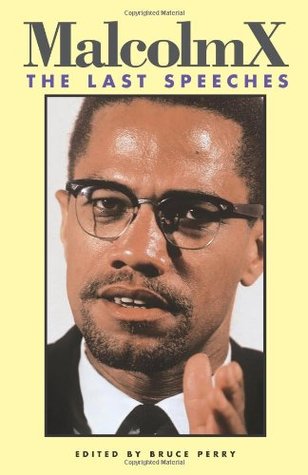
Malcolm X: The Last Speeches by Malcolm X, Bruce Perry (ed.) *****

malcolmxlastspeechesIf you read The Autobiography of Malcolm X, the most widely-read of the books about Malcolm, you will get an idea of the general development of his self-education in prison, and of his attraction to, and eventual prominence in, the Nation of Islam. This volume, in contrast, shows the speeches he made when he broke with the Nation of Islam and decided that the struggle for racial equality was tied to class struggles, and that this meant that people who were not Black could still be part of the fight that he believed was necessary. It shows his attraction to socialist ideas, and these are speeches that were not published until recently, when his widow found them buried amongst a lot of other things in storage, and called the publisher she wanted to distribute these ideas.

For example, for awhile there were posters and tee shirts available for sale showing Malcolm X and Dr. King standing together. The implication inherent in overemphasizing this photograph is that the two were comrades and brothers in struggle. I can’t believe the number of young people I taught believed that Malcolm “wanted peace”. Whereas this is true in the long run, it isn’t what he talked about. When middle class Caucasians were interviewed on TV and they pontificated that it was important for those Black demonstrators walking across the South, being confronted with tear gas, firehoses, police dogs, and arrest, to remain nonviolent, Malcolm responded, “I will be nonviolent when the White man is nonviolent.” In contrast to the ideas of Dr. King, Malcolm was ready to fight for his rights. It was in the last year of his life that he realized that the material interests of the entire working class dovetailed, and he targeted the ruling rich as his oppressors, (correctly so in my view), rather than blaming all members of any ethnicity or race. This was an enormous change from the belief system he had espoused while he was with the Nation of Islam. These speeches serve as the clearest documentation of this change.

These speeches are important, though their context was quite different from today’s, because they break up the myth that mainstream media and US government sources have built up surrounding Malcolm X.  If you can’t stamp out someone’s speeches and memory, what do you do instead? You co-opt them, sanitize them, find a way to make more in tune with what you wish they’d been. And that’s what has been done to Malcolm X’s legacy, by and large.

For those who are seeing a big difference between his earlier speeches and the ones published here, it is not hypocrisy, it is development. It takes a lot of integrity for someone who is famous and controversial to admit he has been in error, and explain what his new viewpoint is, and why he has changed his way of thinking. If you don’t read this book, you will not know the whole evolution of the ideas and political program embraced by Malcolm X over the span of his life.

All of this has more relevance than ever now that we are in the midst of a second, perhaps even more vital civil rights movement. Malcolm’s philosophy and political perspective should be widely read. He’s been gone for a long time, but nothing can kill his ideas, and we need them now.

S Street Rising: Crack, Murder, and Redemption in D.C. by Ruben Castaneda *****

sstreetrisingThis book is remarkable, and I am not the tiniest bit surprised that its writer has won multiple awards. He began life as a journalist, and in part, that’s what this is about. It is a memoir at least four times over. Seamlessly, Castaneda weaves the history of S Street, a formerly down-and-out part of Washington, DC that holds deep personal meaning for him; his own personal story ; the history of local police and in particular, the use of gratuitous violence and what happens to those who try to shut that shit down; and also the memoir of a local street ministry and after school program linked to S Street and the area’s revival. It is braided together evenly and I cannot find a flaw in it (and I am picky). At the end, he ties the whole thing together and puts a bow on it, and my jaw dropped. Did he just do that? Yes, he did!

Many thanks to Net Galley and Bloomsbury USA for the DRC.

My initial thought was that it takes titanium cojones to not only write about the DC crack epidemic while being addicted to it (as well as alcohol), and THEN to come out and write a risky but much lauded magazine article about his own journey doing same, and his subsequent recovery (sixteen years, at the time this was written), and then, after all of that, to write a book about it.

But it’s not just about guts. There are multiple essential messages he wants us to receive, and his strong word-smithery and pacing make it easy to keep turning the pages. The narrative is smooth as glass, transitions so natural they are hard to find. Twice I went back to the opening pages to make sure this was actually nonfiction, because it bears the crafting of a well-paced thriller. And it is highlighted by the journalistic integrity of the writer in what he recognizes is a dying craft: the investigative newspaper reporter.

Looking through the pages of my own city’s less-than-laudable local press as well as TV news coverage, I see two types of journalists, for the greater part. One is the phone-it-in writer. Typically, it is an article about a corporation or organization and the subject of the piece has really done the writing. It shows up as news without anybody double checking the self-aggrandizement done by the firm in question. Easy story.

The other is the heartless story-at-all-costs. Castaneda confesses to being an adrenaline junkie, and the reader must recognize that to keep the hours a journalist keeps for the salary provided, there would have to be a secondary payoff, that of satisfaction. But I do see journalists who go too far, the ones who will approach a mother whose babies have perished in a fire moments before, stick a microphone in her face, and bark, “Tell us how you are feeling at this time, ma’am.” Our author has a couple of sticky ethical decisions he has to make, decisions of integrity versus alpha-journalistic behavior, and he comes down more often than not on the side of the angels, and at least once, he does so at great cost to his career. This is really admirable.

I have read over 200 memoirs, and yet there has never been one like this one. I cannot recommend it highly enough.

The Nanny Diaries, by Emma McLaughlin and Nicola Kraus ****

  This was an awesome vacation read. I got it (as often happens) purely by chance, and I found it hugely entertaining.

This is written by two actual former nannies who have removed all the names and created a sort of amalgam of the typical “Type A” nanny experience. I was fascinated by the coded language that makes the very rich able to look themselves in the mirror every morning and value themselves for doing absolutely nothing, including take care of their own child, at all, ever, despite his or her desperate needs, and their capacity to utterly dominate the lives of their servants, even when clear boundaries have been initially set as to times they are supposed to be working.

It sounds like a nightmarish story, and in some ways it is at its most dreadful peak, but it is put together with such wry, deft storytelling that one feels one is at a slumber party getting the juicy tale rather than being dragged through the muck by the overly entitled wealthy New York jet set. I found myself going to sleep later and later on my trip because frankly, who could put it down?

I can’t give it the fifth star, because I am one of those finicky reviewers who has to limit that category to literature that is amazing, either in its timelessness or occasionally, because it made me laugh sooo hard, or actually changed my world view. But what this is, is a really fun romp.

And for those of you on this site while your nanny is keeping your child from making any noise in the house or touching any furniture outside his or her room…go be a parent!