Kinsey and Me: Stories by Sue Grafton *****

This wonderful collection is quirky, but not only in the manner in which the now-immortal Kinsey Millhone is quirky. I suspect it’s the closest Grafton will ever come to writing an autobiography or memoir, and what little of it is here, is very brave stuff. As we approach the time of life in which Grafton now finds herself, it’s good to do some looking back, figuring out why we did some of what we did, and also coming to terms with some of the less lovely things we went through.

The introduction is expository in nature, and it’s very good. It is the first time I’ve seen it spelled out, what the distinction is between mystery, detective fiction, and crime fiction. In addition, she speaks to the ways in which short stories differ from novels within her genre. She makes it crystal clear and wraps it up with a bow. No droning lecture, but of course, that isn’t Grafton’s style; not ever. She also attempts to differentiate herself from her character. When she says Kinsey is who she might have become had she remained single and childless, I believe her. When she says that mischievous sense of humor is Kinsey’s rather than her own, I don’t believe it for a minute. But it’s a very fun read, one of the most interesting introductions I have ever read.

The first section consists of some Kinsey short stories that were written, some of them published in magazines, prior to the takeoff of the alphabet series. They are every bit as good. I am very fond of collections and anthologies, because they give me permission to put the book down at some point and go do something else…sleep, for instance. Though shorter, they are every bit as good as her longer work.

The last section is one that Grafton says was created largely from her own effort to come to grips with her own past as the child of two alcoholic parents. I think somewhere along the line, every really prolific reader hits a piece of writing that unexpectedly punches them in the solar plexus, leaves them staring disbelieving at the page saying, “Aw, holy shit, I totally did that too!” This was one of those moments for me. I have read thousands of books and had moments like this one maybe three times. It won’t be the same for you, most likely, but if you are a fan of Grafton’s, it is still worth reading. There follow some stories that are not humorous, but strong writing nevertheless.

Because she so effortlessly switches hats so many times in this one volume, first providing us with the most informative, most accessible, best written overview of the genre I have come across; then offering some brief personal notes about herself; then giving us the detective humor that we have come to know and enjoy; then writing briefly and more soberly about her own past; and then breaking out the stark, somber short stories that caught me by surprise, she underscores exactly what a serious, bad-ass writer she is. She is not just a writer of funny detective stories, though I consider those books to be excellent literature, and I love them. She is a scholar, and I can’t help wondering if that wasn’t a good part of the reason she put this volume together in the twilight of her career. We must regard her a serious writer, a woman of great talent. That’s what she is.

Memoirs of General William T. Sherman, by William T. Sherman *****

memoirsofgeneralwmtshermanIt’s important to admit bias up front, and I will tell you that I went into this with a strong sense of near-adulation. Sherman has long been my greatest hero among American generals (and it’s a short list). I have no use for Civil War literature that waxes nostalgic for the “lost cause” of wealthy Southern Caucasians, nor can I stomach the revisionist notion that the war was really just a sad, sad misunderstanding that might have been averted with a little more discussion. I don’t see it that way. I see it as an historic necessity with material roots. Marxist historian George Novak wrote that the opportunity to avoid war and let the Industrial Revolution march forward unfettered by slavery was lost when the slave owners firmly declined all offers to compensate them for “their” slaves and let them go free, so that progress and humanity might take a great leap forward. And so I am a great fan of Sherman’s. His march through Georgia was correct and righteous, and the anger his soldiers unleashed upon the state that began the whole process in a premeditated and aggressive manner, South Carolina, was well placed.

Now that all of that has been dealt with, I can talk about his written record.

Sherman’s memoir is remarkable. He was one of those rare beings, both a soldier and an incredible scholar (in the mold of Lewis and Clark, perhaps). He headed a military academy in Louisiana when the South seceded, and after giving a moving farewell speech to his students–the man gives a sense of being capable of really creating personal bonds, while at the same time knowing that if he has to say goodbye forever, he’ll do it–and went to Washington to seek orders.

Sherman is an outstanding writer, and his voice comes through loud and clear. I confess my affection for him is marred slightly by his horrific perspective (probably not unusual, but this guy never did anything halfway) toward the American Indian. I decided enough was enough, and skipped forward to the Civil War. My husband, whom I will call Mr. Computer, was also reading it, as we had accidentally procured two copies, and he did the same.

The opening years of the war are incredibly frustrating to study. McClellan had been a big-deal general during the war against Mexico, and he was initially placed in charge, while Grant and Sherman lingered in the background out west, each having left the military under a cloud, Grant for his drinking during the Mexican war, and Sherman as having been perceived as crazy. (Today I think a nice bottle of Xanax or Valium would’ve done wonders for the man in peace time years, but I believe he merely suffered from anxiety, and there’s a lot of that out there)!

By reading Sherman, one does not get an account of the whole Civil War; he can’t rightfully provide such a thing, because this is a memoir, so he writes about the places he went and the battles in which he took part. He is lavish in his praise of competent or even excellent officers, and takes pains to mention as many as possible by name, sending them down in history as heroes alongside himself.

His most famous contribution, the 3-campaigns-in-one march of some 425 miles, from the siege of Atlanta, to its invasion, and his willingness to tell the truth and avoid the senseless pussyfooting of his predecessors, who had stupidly believed that by firing over the heads of the Confederates, they could scare them into submission, is an inspiration. He understood that in order to win a war and have it be over, the gloves must come off, and ugly things had to be done. He limited his attacks to Confederate soldiers until the local population began to sabotage his efforts, at which point, without hesitation, he burnt local homes, measure for measure. Inside the city, he endeavored to destroy any and all infrastructure that would aid the enemy, since Confederate weapons, clothing, and food were nearly all warehoused in this city. He personally supervised the destruction of the railroads that would otherwise keep supplies moving between Atlanta and the field, and cut his own supply line, a gutsy move unheard of previously. He soon learned not to trust Cavalry to destroy the railroads, because they’d just tear the tracks off, and someone else would put them back on. Sherman supervised the heating of the rails till they were white-hot and pliable, and created a tool for bending them around the trunks of trees, or into knots when no trees were nearby, so that no one would ever use them again.

Sherman has an unfairly tainted reputation regarding the Black people of the South, perhaps because he discouraged newly-freed families from following his train. The issue was a logistical one; he had enough food for his soldiers, thanks to their resourcefulness in foraging, and he welcomed single Black men to assist in noncombatant ways in order to free up his soldiers. (He was not willing to arm his Black enlistees, and was pleasantly surprised when he found others had successfully done so later). But when someone from Washington came down and privately interviewed former slaves to see who they trusted and who they didn’t, they gave their unilateral trust to Sherman. This is the proof for me, that although he was later unsure they were ready for the ballot before they became literate (with which I disagreed), he treated them with kindness and they revered him, viewing him alongside President Lincoln, as their liberator.

Grant was so eager to have Sherman back to help him fight Lee across the Potomac that he nearly boarded him and all his men onto ships once he reached the sea. Sherman talked him out of it, saying that he must go THROUGH the Carolinas in order for those insulated in die-hard South Carolina to see the might of the American army, and understand that resistance truly was futile. The newspapers (and Sherman’s feelings toward the press were as plain as everything else; on the one hand, I do love a free press, but they were publishing his battle plans, which were supposed to be secret, and so I can understand his hostility toward them!) of the South printed lies, saying that the South was winning its quest for separation, and Sherman felt that personal experience was the only thing that would really convince those who had first seceded, who had fired on Fort Sumter, and perhaps since they started all this, it was appropriate that they not be spared the privations that the people of Georgia, who were much less enthusiastic toward the Confederacy, had experienced.

Grant was smart enough to listen to him, and let him follow what he considered the best course of action. Lincoln was a true friend and leader who knew when to stop delegating. Again and again, lies came to him about Grant, that he was drinking again, etc. and should be removed, and Lincoln, who was well and truly done with the likes of McClellan, Pope, and Burnside, said, “I can’t spare this man. He fights”. I mention this, not as a digression but because Grant and Sherman were hand in glove. This partnership, this blending of mind and purpose, is part of what made victory possible.

Sherman and his men fought their way through woods, swamps, over quicksand, through areas previously considered impenetrable, and unlike many high-ranking officers, he gave himself no perks that he did not share with his men (apart from the rare invitation to dinner with a Union family). At the very end of his memoir, he devotes perhaps 20 or 30 pages to what constitutes effective leadership, and one thing I was struck by is that he believes a commanding officer should ride up front, because the men leading it have pride in the fact that they are leading, and that disorder and bad behaviors are limited to the rear. In short, he is safer with the men in front, and he has to see what is ahead to draw the correct conclusions about what should be done next. He sleeps on the ground, just like his men. At one moving point, he and his men sought refuge from a storm by sleeping in a church, and some of the soldiers found carpets and made him a little bed up by the altar. Sherman told them to give that bed to their division leader, because he was used to sleeping hard. “Then I fell down on a pew and was instantly asleep”.

After Lincoln’s assassination by a Confederate sympathizer, and attempts upon the lives of Seward, Secretary of War, and others, newly-minted President Johnson suddenly knocked Sherman’s legs from beneath him. Without a hint or clue as to why, Sherman was suddenly vilified, and the orders to his subordinates NOT TO OBEY HIM were released to the press. Such lack of appreciation for a man who gave his all to the Union took my breath away. Apparently Secretary of War Stanton, who replaced Steward once he was injured, was filled with paranoia and behaved both irrationally and unfairly. This was primarily his doing, and Sherman knew it. He reported to Grant, and ONLY to Grant.

Upon reaching Washington DC, each leading general paraded with his army before a massive crowd, and Sherman had his rightful place on the review stand once he reached it. He passed down the line, shaking hands along the line of others who’d been seated there…until he reached Secretary Stanton. At this point, he states that he publicly brushed past the outstretched hand offered him, thus returning the public insult that had been dealt him in the press. He snubbed the guy in as public a manner as possible, and I once again wanted to cheer. Well done.

“War is war, and not popularity seeking”, he responded to someone who questioned his destruction of Georgia, and the sieges that left rebel cities on the brink of starvation. And he was right. It can’t be over until someone has the courage to wage real war. His frankness and his affection for his troops, even though he knew some of them would fall, or maybe even more so because of it, was deeply moving, and I came away feeling that I had read one of the best memoirs ever.

One more thing I’d add, for those who get the edition that I read: if you flip to the last page, it says 490. Hmmmm. The book appears to be longer, but then, there’s a lot of small print, where he documents everything meticulously, using primarily the telegrams and letters from himself to his superiors and vice-versa.

But there’s something more. This was originally a two volume set. It’s less expensive to buy just one book, but it remains two volumes under one cover. Once you reach the FIRST page 409, There is a page that says VOLUME II and then you start on page 1 again, so that you are actually reading over 800 pages.

Put together with Southern historian Shelby Foote’s less-apt and rabidly pro-Confederate trilogy, this was a meal, yet I don’t regret reading them together, since it provided two perspectives (and I am finishing Burke Davis’s book on Sherman’s march to the sea, a smaller volume with a third perspective that is closer to Sherman’s own).

But if you ask me who I believe when facts collide: I believe Sherman.

Post script: Shelby Foote’s Civil War trilogy is not reviewed on this blog, because I only give space to work I respect and have rated at four or five stars on a one-through-five star scale.

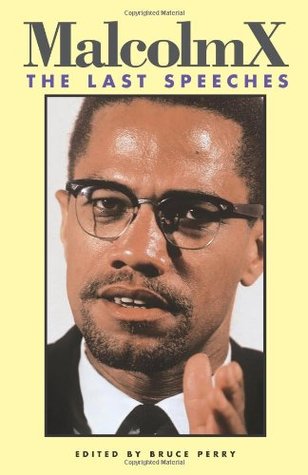
Malcolm X: The Last Speeches by Malcolm X, Bruce Perry (ed.) *****

malcolmxlastspeechesIf you read The Autobiography of Malcolm X, the most widely-read of the books about Malcolm, you will get an idea of the general development of his self-education in prison, and of his attraction to, and eventual prominence in, the Nation of Islam. This volume, in contrast, shows the speeches he made when he broke with the Nation of Islam and decided that the struggle for racial equality was tied to class struggles, and that this meant that people who were not Black could still be part of the fight that he believed was necessary. It shows his attraction to socialist ideas, and these are speeches that were not published until recently, when his widow found them buried amongst a lot of other things in storage, and called the publisher she wanted to distribute these ideas.

For example, for awhile there were posters and tee shirts available for sale showing Malcolm X and Dr. King standing together. The implication inherent in overemphasizing this photograph is that the two were comrades and brothers in struggle. I can’t believe the number of young people I taught believed that Malcolm “wanted peace”. Whereas this is true in the long run, it isn’t what he talked about. When middle class Caucasians were interviewed on TV and they pontificated that it was important for those Black demonstrators walking across the South, being confronted with tear gas, firehoses, police dogs, and arrest, to remain nonviolent, Malcolm responded, “I will be nonviolent when the White man is nonviolent.” In contrast to the ideas of Dr. King, Malcolm was ready to fight for his rights. It was in the last year of his life that he realized that the material interests of the entire working class dovetailed, and he targeted the ruling rich as his oppressors, (correctly so in my view), rather than blaming all members of any ethnicity or race. This was an enormous change from the belief system he had espoused while he was with the Nation of Islam. These speeches serve as the clearest documentation of this change.

These speeches are important, though their context was quite different from today’s, because they break up the myth that mainstream media and US government sources have built up surrounding Malcolm X.  If you can’t stamp out someone’s speeches and memory, what do you do instead? You co-opt them, sanitize them, find a way to make more in tune with what you wish they’d been. And that’s what has been done to Malcolm X’s legacy, by and large.

For those who are seeing a big difference between his earlier speeches and the ones published here, it is not hypocrisy, it is development. It takes a lot of integrity for someone who is famous and controversial to admit he has been in error, and explain what his new viewpoint is, and why he has changed his way of thinking. If you don’t read this book, you will not know the whole evolution of the ideas and political program embraced by Malcolm X over the span of his life.

All of this has more relevance than ever now that we are in the midst of a second, perhaps even more vital civil rights movement. Malcolm’s philosophy and political perspective should be widely read. He’s been gone for a long time, but nothing can kill his ideas, and we need them now.

S Street Rising: Crack, Murder, and Redemption in D.C. by Ruben Castaneda *****

sstreetrisingThis book is remarkable, and I am not the tiniest bit surprised that its writer has won multiple awards. He began life as a journalist, and in part, that’s what this is about. It is a memoir at least four times over. Seamlessly, Castaneda weaves the history of S Street, a formerly down-and-out part of Washington, DC that holds deep personal meaning for him; his own personal story ; the history of local police and in particular, the use of gratuitous violence and what happens to those who try to shut that shit down; and also the memoir of a local street ministry and after school program linked to S Street and the area’s revival. It is braided together evenly and I cannot find a flaw in it (and I am picky). At the end, he ties the whole thing together and puts a bow on it, and my jaw dropped. Did he just do that? Yes, he did!

Many thanks to Net Galley and Bloomsbury USA for the DRC.

My initial thought was that it takes titanium cojones to not only write about the DC crack epidemic while being addicted to it (as well as alcohol), and THEN to come out and write a risky but much lauded magazine article about his own journey doing same, and his subsequent recovery (sixteen years, at the time this was written), and then, after all of that, to write a book about it.

But it’s not just about guts. There are multiple essential messages he wants us to receive, and his strong word-smithery and pacing make it easy to keep turning the pages. The narrative is smooth as glass, transitions so natural they are hard to find. Twice I went back to the opening pages to make sure this was actually nonfiction, because it bears the crafting of a well-paced thriller. And it is highlighted by the journalistic integrity of the writer in what he recognizes is a dying craft: the investigative newspaper reporter.

Looking through the pages of my own city’s less-than-laudable local press as well as TV news coverage, I see two types of journalists, for the greater part. One is the phone-it-in writer. Typically, it is an article about a corporation or organization and the subject of the piece has really done the writing. It shows up as news without anybody double checking the self-aggrandizement done by the firm in question. Easy story.

The other is the heartless story-at-all-costs. Castaneda confesses to being an adrenaline junkie, and the reader must recognize that to keep the hours a journalist keeps for the salary provided, there would have to be a secondary payoff, that of satisfaction. But I do see journalists who go too far, the ones who will approach a mother whose babies have perished in a fire moments before, stick a microphone in her face, and bark, “Tell us how you are feeling at this time, ma’am.” Our author has a couple of sticky ethical decisions he has to make, decisions of integrity versus alpha-journalistic behavior, and he comes down more often than not on the side of the angels, and at least once, he does so at great cost to his career. This is really admirable.

I have read over 200 memoirs, and yet there has never been one like this one. I cannot recommend it highly enough.

The Nanny Diaries, by Emma McLaughlin and Nicola Kraus ****

  This was an awesome vacation read. I got it (as often happens) purely by chance, and I found it hugely entertaining.

This is written by two actual former nannies who have removed all the names and created a sort of amalgam of the typical “Type A” nanny experience. I was fascinated by the coded language that makes the very rich able to look themselves in the mirror every morning and value themselves for doing absolutely nothing, including take care of their own child, at all, ever, despite his or her desperate needs, and their capacity to utterly dominate the lives of their servants, even when clear boundaries have been initially set as to times they are supposed to be working.

It sounds like a nightmarish story, and in some ways it is at its most dreadful peak, but it is put together with such wry, deft storytelling that one feels one is at a slumber party getting the juicy tale rather than being dragged through the muck by the overly entitled wealthy New York jet set. I found myself going to sleep later and later on my trip because frankly, who could put it down?

I can’t give it the fifth star, because I am one of those finicky reviewers who has to limit that category to literature that is amazing, either in its timelessness or occasionally, because it made me laugh sooo hard, or actually changed my world view. But what this is, is a really fun romp.

And for those of you on this site while your nanny is keeping your child from making any noise in the house or touching any furniture outside his or her room…go be a parent!

The Splendid Things We Planned: A Family Portrait, by Blake Bailey *****

Blake Bailey is one hell of a writer. In this memoir of a family that is first twisted and then broken, he has given of himself in a way that is impossible to measure. It is a powerhouse of a memoir, a beacon that starts out distant and becomes gradually more focused and immediate in a way only a master of the genre can do. I feel fortunate for having been lucky enough to catch a glimpse free and in advance, courtesy of his publisher and the Goodreads.com first reads program. If you are drawn to haunting, searingly evocative memoirs, I recommend you go out and get a copy for yourself. You won’t forget this one.

In the beginning, he is so droll that I mistakenly dropped this story onto my “humor” shelf. It begins light, as childhood tends to be in spite of everything, and gradually, not unlike the “Clouds” he uses to end his story, it darkens, at first almost imperceptibly, then in a way that builds until the reader sits up, sits back (perhaps like me) to say, “Oh HELL no!” or, “Did that just happen?”

It did. And when you think about it, how could it be otherwise?

It is not just a good read, but also a damning indictment of the so-called justice system in the USA. How much human potential has been wasted in funding and resorting to incarceration when mental health care is so badly needed for so many?

I have a couple of quotations I had considered using, but why should I do that when I recommend that you read it yourself? It would ruin part of the discovery for you.

The silence when he finishes is thunderous and deafening.


I Love a Man in Uniform: A Memoir of Love, War, and Other Battles by Lily Burana ****

  This was one of the most unlikely things I’d ever have guessed I would read. I found it in my favorite home-town used book store, and I read the blurb on the back. Huh. Might actually be interesting.

Though I myself come from a family with lots of military folk, I have opposed every modern war in which the US involved itself, and I consider the American Civil War the last truly righteous US war. But I could see that this memoir had an outsider’s point of view, and from my (strangely many) friends who do come from military backgrounds, I had figured out that the military is a culture unto itself. So…how would a former stripper accommodate herself to a military lifestyle? And just how does a former exotic dancer end up marrying into the military…to an officer, no less?

See what I mean? It really does leave a swirl of question marks dancing in the air around it.

I can’t quote from the book, because I bought it, read it, and gave it to (who else?) a friend whose family was military, before I began writing reviews. But I will tell you this: it is a story like no other. And if, like me, you want to avoid smut in your reading material, relax. This story is not about sex. It’s about the fear many of us have of what would happen if someone important to us finds out who we really are, or at least, used to be.

In the author’s case, the problem is exponential. Not only is her marriage on the line (because she kept this nugget to herself until after they’d both said “I do”), but all of the new friendships she has found on the base may fold up around her and exclude her, talk about her if this thing becomes known.

It’s enough to drive a woman to a nervous breakdown.

Whether you are military, a peacenik, or just a person who loves an absorbing memoir, this is unique and very readable. Recommended for all, except children.

Life in Motion: An Unlikely Ballerina, by Misty Copeland ****-*****

lifeinmotionI rate this four stars for general audiences, five for those interested in the ballet.Misty Copeland, star ballerina with the American Ballet Theatre, wants us to know that when she enters a stage, she thinks, “This is for all the little brown girls.” And rightfully so. She is the first Black ballerina to rise to this level of prominence in twenty years, and the first ever to star in The Firebird.

I read this book free courtesy of Net Galley. I approached it not as a fan of ballet, but as an avid reader of autobiographies and memoirs. When I rate this book a five-star read, I do so not for a niche audience, but for anyone who enjoys reading stories of personal struggle, triumph, and success.

Copeland, who is racially mixed but identifies primarily as African-American, is famed for her work on the stage, but she can really write, too. I kept half an eye open to see if a byline or as-told-to would crop up somewhere. Copeland’s education was often disrupted by a chaotic childhood; her mother, a loving but apparently capricious individual who seems to have had terrible taste in men, had trouble staying in one place. Dramatic departures that took all of Misty’s “tribe” (her loving term for her siblings) in as co-conspirators, became a pattern, but they never seemed to leave the first “daddy” until Mama had a second one already waiting for them. How does a young woman whose life—and education—are tossed up and thrown down into increasingly tenuous situations , become this literate?

I can only conclude that the label of “prodigy”, one she heard from an early age, did not apply solely to her dancing talent, but also to her intellect and capacity to pick up information quickly.

Copeland begins her ballet training in California, in a working class neighborhood at the local Boys and Girls Club. Her ability is breathtaking, and a mentor arranges for her to receive further, more advanced training.

At one critical juncture, Copeland’s mother pulls another rip-up-our-roots-and-leave number, and the family, now nearly destitute, lands in a motel room in a seedy area. There are six children and their parent (and boyfriend, at first) living in a single room, and Misty survives emotionally by compartmentalizing her life, fronting at school as if her home is the same as everyone else’s, avoiding prurient details, and doing the same, more or less, at her beloved ballet lessons. (Her mentor is covering some expenses for her, but she does not know this at the time; she thinks it is all free.) Misty ‘s sisters and brothers are increasingly finding other places to spend the night; the integrity of the family is unraveling. Misty survives those nights in the grungy motel by looking forward to school and above all, ballet, the following day. That is, until her mother tells her to quit.

The mentor is having none of it. She confronts Misty’s mother and asks to bring Misty home with her instead. And with a poignant note of pain, Misty tells us, “She let me go.”

Turns out, it isn’t so bad that way. Life in the middle class opens up new possibilities for her, once she is in Cindy’s condo with her husband and toddler. She learns which fork to use, how to set a good table, and watches ballet on video. She has nice clothes and a full belly. Her confidence increases.

But visits back to the motel room to see the family are tense. She is perceived by her siblings and mother as arrogant. She has a new hairdo, and this sets off all sorts of bells and whistles. (Those of us who have been through foster parent training were told: never mess with the kid’s hair without checking with bio-mom first; for some reason, it is a button-pusher.)

After years in the bosom of a new and loving family, in which she is included to the extent of having studio portraits of a family of four framed on the walls, herself, the two new (Caucasian, Jewish) parents, and the little brother, her mother decides to take her back.

This reviewer has been there, and nearly wept at this juncture, though the author puts a professionally polished distance between the feelings she had then; those she had subsequently; and those she has now. Social workers will tell you that a parent who is more than ready to see a child go, a kid who is one more mouth to feed at least, and at times, maybe creates extra work or trouble, often sees their newly-acclimated offspring when they are successful and happy, and they suddenly want them back, as if they can pull a little piece of that success back to themselves. Maybe that’s what occurred here.

Perhaps other, less subjective reviewers may feel differently, but I was surprised to see Cindy wiped out of the story, more or less, once Misty went back to live in the motel, and then not brought back except peripherally at the end. I get it; this is a ballet memoir, but it’s also an autobiography, and when she tells us that she had “been seeing” Cindy and her family off and on, I wondered what kind of interactions took place, and whether she felt turmoil at such times.

One thing was sure, though: just as she took to ballet with remarkable speed and talent, she also took to Manhattan in a New York minute. Though it was expensive and hard to afford an apartment with any natural light or air, she hooked into the city, once invited to study, then perform there, and claimed it as her own.

But culturally and economically, she felt the disparity between herself and other dancers:

“Ballet has long been the province of the white and the wealthy. Our daily, toe-crushing exercises made pointe shoes as disposable as tissues, and they can cost as much as eighty dollars a pair. I came from a family that didn’t always have enough food to eat…[her peers] summered in Europe…their families had weekend homes.”

At one point in her development as a ballerina, when a bigoted reviewer indicates that she doesn’t fit in with the white dancers, members of the Harlem cultural community ask her why she doesn’t come there to dance instead. Why does she put herself through it, they wonder. And in time, she is formally invited to jump ship and come on board the Harlem dance organization.

But she has learned the negative lessons of her mother’s tendency to cut and run when adversity strikes, and she decides she will fight to maintain her position in the USA’s premier ballet company.

International fame follows, along with the opportunity to work with the musician Prince. And there is more, but I should leave a thing or two for the reader to discover.

I appreciated the author’s deft juggling of her personal story and her professional one, although of course they mesh in many places. There is never a point where the story drags or too much information (old grudges or love life details) make me want to skim.

Like the ballet, the story is lean, trim, and full of joy, despite hardship. You should read it.

The Trials of Lenny Bruce ***** by Ronald K.L. Collins, David Skover

 thetrialsoflennybruce I cannot remember the last time I felt so strongly about a book I had bought. I have never, ever felt this strongly about a CD! I found, by a rare bit of luck, this hardcover book in brand new condition, in a used book store. The CD inside the cover was still sealed. It is not just an actor on the CD; it is actual footage of Bruce’s voice performing (along with narration by someone else). It cost me all of five bucks. Unbelievable!

If you are a champion of free speech, you have to know that this amazing (though oh yes, profane) comedian broke new ground. It could be (and has been) argued that he paid with his life, that performing in a nightclub LINED with cops all up and down ultimately broke him, but he did not go gently.

The first time I heard the material was in the movie “Lenny”, starring actor Dustin Hoffman in the title role. I knew it was good, but I was also young, had very tender ears, and I think there were times when the one-two punch of some of the words that I hadn’t heard much, caused me to miss some of the point. Even then, I understood that this was a powerful thing, though.

This book and ESPECIALLY the CD, which provides not only the words, but the all-important inflections (transcribed, for those who miss some of what goes by in the snappy nightclub patter, in the book), is one of the most important pieces of primary evidence I have ever been privileged to hear, see, and own. I cannot believe the clarity of the sound! For those, like me, to whom the early sixties are not within the realm of memory, the book is essential for context. There are people who were well known at the time whose names go by like gunshots in his routine; two who come to mind were a cardinal and a bishop. The context that the CD does not provide is in the book.

The text itself is 442 pp. in length; the rest is meticulous documentation. Pictures of everyone…this is a treasure!

Run, Don’t Walk: The Curious and Chaotic Life of a Physical Therapist Inside Walter Reed Army Medical Center, by Adele Levine *****

I loved this memoir. It came out in May, and you should get a copy. You don’t have to be even slightly interested in reading about physical therapy to enjoy this book. It is a stellar memoir, entertaining and informational in a way that everyone can access and enjoy.

I got my copy through the First Reads program on Goodreads.com. All that means these days is that I screened it before applying for a copy. I have a steady stream of free books coming in the mail, the wonderful symbiosis of retired-teacher-who-likes-free-books-and-writing versus publishing-houses-that-don’t-want-to-pay-for-a-review. I have become fairly persnickety about what I’m willing to read and review–because to my way of thinking, it is not fair to accept the free book and not finish or review it, and I don’t want to poison the well by asking for something I already suspect is not well written or that I may not be entertained or fulfilled by reading. So the publisher chose me, but first, I chose Levine’s book.

I’ve been through physical therapy for things like whiplash from car accidents (yes, some folks really do get whiplash), but nothing like the scale experienced by the veterans and soldiers that Levine treats. And so the first sign of expertise is in the title (where she wisely excluded any reference to amputations), and the fact that it was dropped into the “humor” section of the Goodreads.com giveaways.

Ask yourself: is there a tasteful way to laugh about amputations and amputees, as well as the people who work with and/or visit them?

Amazingly, there is. She’s found it. And at first I could not accept that this was Levine’s first book, because the amount of synthesis and development of characters is not in any way rookie work, and I don’t care how brilliant the writer might be. The book says “experienced writer”. Everything clicked into place when I read that she had been writing a weekly humor column (though what kind of over-achiever can work the hours she works, maintain a relationship, indulge in extreme sorts of physical exercise, write a column, and eventually even become a parent, is beyond me).

Sometimes people write a first book and they get insecure. They pass out free copies to friends and relatives and beg them to get on various readers’ sites and post glowing reviews. So I will prove to you (assuming you are not someone who has read any of my other 500+ reviews) that I am not one of them. I FOUND A FLAW in the book! I did! Here it is:

Levine claims to own only two pieces of furniture during the time frame about which she writes. She has a futon sofa and a lamp. BUT!!! She rushes home to watch her favorite television program. AHA! If a lamp is furniture, then so is a television set.

I rest my case. I am entirely unbiased in my book reviews.

I didn’t set out to learn anything here–it’s not as if I am considering becoming a PT. And as stated, this should not be viewed as a niche book just for medical folk or military types, but for the general book-loving public. It would even make a good beach read.

But I learned some things, nevertheless. I didn’t know that anyone who loses both legs ever has a shot at walking on two prostheses, for example (and indeed, some don’t, but the possibility is strong). I didn’t know some prostheses have computers. And I groaned at the obstacles put in place by the fishbowl atmosphere: deliberately limited computer access so that anyone, celebrities, congressional staff, or John Q. Public, will see the therapists ONLY working with patients, and then they have to stay after their paycheck ends in order to enter notes about progress registered, because people who come to see the circus don’t want to see more than two people using a computer at a time. The banning of coffee for the same reason; nobody wants to see your cup! And I loved reading about the guerilla response to said ban.

There are a number of places I’d like to quote, but I read a galley, so I am not supposed to do that in case they make changes, and this review gets posted TODAY. Characters Cosmo and Major Dumont were favorites (and I will let you find out for yourself how they were developed). And I loved the Jim-quote and how it is used at a party full of insufferable assholes who think that they are really something because they went to Walter Reed and WATCHED the patients and therapists for awhile. (The punch line is awesome. Again: get the book.)

And I really loved the Miracle reference.

I was on my third day with this book (I generally read 4-6 at a time, so it was getting rotated with the others) when someone in my family died. It was a total fluke, someone younger than me whose time should not have been up yet, and it hit all of us in the solar plexus. The writer’s chapter on the bone marrow transplant proved really cathartic. It wasn’t written for that purpose; I just had the right book at the right time, and so I sat with the book in my hand and cried awhile. Thanks; I needed that.

Are you still reading my review? You have another window open too, right? Because you should buy this book, and if you get the chance to pre-order it, then you should do that so you won’t accidentally let it go by once it’s available. May is Mother’s Day; what a great gift for the mother who likes to read!

To sum up: order the book for yourself. Order another copy for at least one of the mothers in your life. I promise you won’t be sorry.