My Name is Emilia del Valle, by Isabel Allende****

“Aren’t you afraid, Angelita?’ I asked her. ‘All the time, but I don’t think about it. I want to die with my boots on my feet,’ she answered…

“I did not know who I truly was until circumstances put me to the test.”

My Name is Emilia del Valle is the newest novel published by feminist icon and author Isabel Allende. The story is a fictionalized account of a journalist that travels from California to Chile, where war has broken out. Because she is a woman, her editor resists sending her, and then, under pressure, agrees that she may go, but only to cover human interest stories in the city. Those that have read any book ever by Allende will know instantly that this is not what our journalist does.

My thanks go to NetGalley and Random House Ballantine for the invitation to read and review. This book is available for sale now.

Like all of Allende’s protagonists, Emilia is a woman that refuses to be constrained by the expectations of the time regarding gender. She is possessed of feverish curiosity, and once she finds herself in the thick of the conflict, she has no interest whatsoever in finding and maintaining a safe, distant place from which to report. She assists the “canteen girls,” who provide water to fallen soldiers, along with minor first aid. Emilia learns first hand about the horrors of war, and she is forever changed by it.

This conflict is one that isn’t widely reported, and Allende writes about it so that it may not be forgotten. Ten thousand died here, mostly men from poor families, killed for no good reason. Emilia’s experiences highlight the disparity in treatment according to social class and wealth, as well as gender.

The writing is first rate as always. However, in most of her earlier novels, the author found a way to intersperse shocking or horrific passages with some that were uplifting, and often very funny. I would bark with sudden laughter at some witticism that I had not seen coming. I wish she had done that here. When there’s too much horror and bloodshed, it is tempting, natural even, for readers to tune out, let the words wash over us. And while there is romance here that provides some relief, I would have liked more.

Nevertheless, those that love historical fiction, social justice, feminism, and especially those that love Allende’s writing will want to read this book.

I’ll Be Right Here, by Amy Bloom***

I’ve been a reader of Amy Bloom’s novels for decades, and so when I see a new one is coming out, I leap, usually without even checking out the synopsis. Just the author’s name is enough to get me moving. This time was a little different. I began reading, but had trouble engaging, and my mind wandered. I decided to get the audio from the library, once the publication date had come and gone, and that was how I eventually finished it.

My thanks go to NetGalley and Random House for the invitation to read and review. This book is for sale now.

We start out in Europe during World War II. Gazala emigrates from Paris to New York, and becomes friends with a pair of sisters; later Samir, Gazala’s brother, joins her. Now here’s where it gets icky, (to use a highly literary term.) Gazala and Samir become a couple. They don’t tell people they meet that they are related, so they are accepted. Their friends also become involved in—to be charitable—unconventional relationships. In looking back at the synopsis, it’s all right there: “the lawlessness of love.” Hoo boy. It definitely is.

So, after forcing myself to finish listening to this thing, I nearly give it two stars, but the nugget that saves it for me is the concept that occurs when they are grieving a loved one, the notion of a “dead people’s party.” I love thinking about this! I have already started imagining my own such party, having lost too many people I cherished, when my sister dies. Her death is not altogether unexpected, as she was a great deal older than I am and has been in ill health for many years, but it still packs a punch. The thought of my sister’s dead people’s party—complete fantasy, as far as I am concerned, but who cares? Is what has helped me through a dark time.

So Bloom gets an extra star.

Nevertheless, I don’t recommend this thing unless the reader has carefully read the synopsis and is still interested. Yikes! I’ll probably read Bloom again, but this time I’ll be more careful before I commit.

The Fisherman’s Gift, by Julia R. Kelly*****

“Why is it, she asks herself, that we only ever remember the things we did wrong?”

Julia R. Kelly’s novel The Fisherman’s Gift tells a luminous tale of long ago, and it is one of the year’s best. My thanks go to NetGalley and Simon and Schuster for the invitation to read and review. This book is for sale now.

Dorothy lives alone in Skerry, a tiny Scottish fishing village, in the year 1900. She is an outsider, having moved here to teach the children; she marries and has a child, but when the child is tragically drowned, her husband leaves her, and now her life is one of solitude and regret.  Then a little boy washes up, a shipwreck victim, and Joseph, a fisherman that shares a past with Dorothy, brings him to the village; it is Dorothy that takes care of him, and every day, he seems more like her own lost boy. She wonders from time to time whether God has sent him back to her.

This is a beautifully written novel, glorious not only for what is said, but for what isn’t. Kelly crafts every character in the story with nuance, and so there are no bad people, and also no perfect ones. The entire book is written in third person omniscient, so we get a peek into one character’s thoughts, and then another’s. Sometimes this can be frustrating, because I want to climb onto the page and explain to one of them or another that what they’re thinking is wrong, and can’t they see that they have misunderstood a person, or an event? But when I yearn to do this, it’s because I believe every single word about every single character.

It’s a bittersweet tale to be sure, but readers can rest assured that Kelly won’t burn everything to the ground.

To those that love historical fiction, and to those that enjoy a good love story, I highly recommend this sweet story.

Cat’s People, by Tanya Guerrero****

Cat’s People marks author Tanya Guerrero’s debut in writing a novel for adults, and she does it beautifully. This heartwarming feel-good story tells the story of five people in Brooklyn that are brought together by a stray cat in the neighborhood. My thanks go to NetGalley and Random House Ballantine for the invitation to read and review. This book is for sale now.

When I first received the call to read this book, I was leery. That pink cover with a cat on it; I thought it might be cloyingly sweet. I let the widget sit in my file for a while. However, Goodreads friends—people that are not dimwits—really liked it, and it occurred to me that my own selections were a little on the dark and heavy side, so I went back and retrieved it. It was a good choice. Because I was running a little late with it, I checked out the audio version from Seattle Bibliocommons, and it made a delightful travel companion when I found myself driving across the state line for a semi-emergency within my family. Even Ox, my oversized beagle, seemed to find it soothing. Reader Elena Ray does a wonderful job.

I’m not entirely sure whether the protagonist here is Nuria, the woman that volunteers for a local group that feeds stray cats in the neighborhood, or Cat himself; this would make a nice book club discussion question. Nuria is single and a bit at sea in New York, the city where her mother told her not to move. However, she begins finding post it notes in the area where she feeds Cat; they are from a secret admirer.

The admirer in question is Collin, a successful author who’s also single, lonesome, and very shy. Collin sees Cat outside in the cold, so he builds him a small house with a bed, and he puts it in his courtyard. Others in Cat’s orbit are Omar, the mailman who’s going through a crisis of his own; Bong, the owner of Nuria’s favorite Bodega, who’s grieving the loss of his wife; and Lily, the sprightly newcomer who’s come to the city to find Nuria. All of them are brought together when Cat becomes ill.

I have never said this about a novel for adults before, but this book is adorable! The tone is perfect, balancing the cares and anxieties of the humans with acts of kindness by each that remind us that humankind is inherently good.

Recommended to those that need something a little bit warm, light, and fluffy–even dog people.

Broken Country, by Clare Leslie Hall*****

I am late to the party, but it would be a crime not to review Broken Country, the stirring love story by Clare Leslie Hall that can make even the hardest cynic weepy-eyed. My thanks go to NetGalley and Simon and Schuster for the review copy. This book is for sale now.

The story is set in a small village in Britain during the mid-1900s. The setting bounces back and forth between the present day and the past; it’s easy to keep track of, partly because the author takes care to delineate which chapter is which, and partly because there are few characters to keep track of. Our protagonist is Beth, and she and her husband, Frank, are farmers, have lived in the same community for their whole lives. A farm accident claimed the life of their only child, Bobby, a few years before, but they are both still fragile, ragged in their grief.

Then, oh my my, who comes back to town but Beth’s old flame, Gabriel, a man that came from money and went on to make a name for himself as a novelist. Gabriel has inherited the family house and land, and in the wake of his divorce, has brought his son Leo to live here. Here. Right next door to Beth and Frank.  And to complicate old feelings all the more, his son Leo is about the same age as Bobby was when he died.

Is it possible to be in love with two men at the same time? Beth would tell you that it is. Frank can see what is unfolding, and he tries to reason with Beth, but she assures him that everyone is grown up now, the past is the past, and there’s no reason that they and their new old neighbor cannot be friends.

Well.

I seldom reach for novels like this one, wary as I am of schmalz and schlock, but reader, I see none of either one in this story. The writing is disciplined and restrained, yet oh, so intimate. When a formula or trope comes into view, Hall goes the other way instead. And though I may have thought I knew where we would all end up, I was mistaken; the ending is beautifully planned and executed.

Because I had fallen a bit behind, I checked out the audio version from Seattle Bibliocommons; reader Hattie Morahan does a stellar job with the narration.

Highly recommended.

The Family Recipe, by Carolyn Huynh*****

“We all need to feel needed. Otherwise, what’s the point of living?”

Carolyn Huynh made her authorial debut in 2022 with The Fortunes of Jaded Women. It was one of my favorite novels not only of that year, but of all the thousand-plus galleys I have read since I began reviewing. She’s back again with The Family Recipe, and it’s every bit as good as the first. My thanks go to NetGalley and Atria Books for the invitation to read and review, but make no mistake: I would have hunted this thing down and bought it with my Social Security check if it came down to it. I wouldn’t have been sorry, either.

This book is available to the public now.

Once again, our protagonists are Vietnamese and Vietnamese-Americans, mostly women, and once again, they are siblings and other family members that must come together; it isn’t a voluntary reunion. And that’s where the similarities between the first book and this one end.

Duc Tran, the patriarch, has laid out the terms by which his children may inherit his fortune. Once upon a time, he was the Vietnamese sandwich king, and in order to become his heir, each of his four daughters must relocate to a city she doesn’t want to live in, and revive a down-at-the-heels restaurant in a now undesirable end of town. It’s a contest; that is, unless Duc’s one son, Jude, succeeds in getting married within the one year’s time limit of the contest. If he can do that, he wins. (His sisters aren’t worried; who would marry Jude?)

The story is told from several points of view; these include the siblings, their uncle—a shady lawyer, and Duc’s best friend; their mother, who abandoned them when they were small, when her mental health collapsed, and never went back; Duc’s second wife; and briefly, Duc himself, who mostly serves as a mysterious figure that doesn’t even return to the States to lay out his children’s requirements, sending their uncle as his proxy.  As the story unfolds, we learn more about each sibling, and about the traumas they have experienced, as well as their successes.

The thing that makes it work so well is Huynh’s unerring sense of timing. It’s a dramatic tale, but it’s shot full of humor, as we see at the outset, when we learn the sisters’ names. Their father was a huge fan of the Beatles, and so the girls are named Jane, Paulina, Georgia, and (wait for it…) Bingo!

There are plenty of twists and turns, and the dialogue crackles. The internal monologues are mesmerizing. This book would make a fantastic movie.

Since I was reading this galley digitally, I highlighted quotes that I thought I’d like to use in this review, but there are 28 of them. Obviously, I cannot share them all here, but let that inform you, if nothing else here has, how much I love this book.

Highly recommended to anyone that has a beating heart, at least a passing interest in Vietnamese-American culture and/or family stories, and can use a few good laughs.

The Ballad of Jacquotte Delahaye**-***

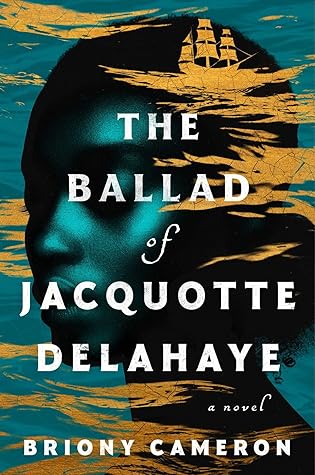
The Ballad of Jacquotte Delahaye marks Briony Cameron’s authorial debut. She is a talented wordsmith, and my thanks go to Atria Books and NetGalley for the invitation to read and review. While I enjoyed several exciting passages—I do adore a good pirate tale—in the end there were issues with credibility that got in my way.

 This story of a pirate woman’s derring do is for sale now.

When I read that Jacquotte Delahaye was a real person and that the book is based on true events, I was all in. However, there are passages that made me raise an eyebrow, and since there didn’t seem to be any notes that would indicate what is true and what is the author’s invention, I took to Google to find out more. This is where I learned that actually, she may have been a real person, or she may be only legend. The stories surrounding her life and exploits are also legend. There’s virtually no verified historical information on this character.

I love good historical fiction, which is where actual, documented facts are given warmth and life by an author that adds dialogue and perhaps fleshes out a few areas where the record is sketchy. Then, if the author is sharp and professional, there will be end notes that explain what is a matter of historical record, and what has been invented. That’s my happy place. Even better is when sources are provided for interested readers. Of course, a writer of any kind of fiction isn’t required to provide footnotes or other documentation, but when they do, it’s the cherry on the sundae, and it makes me love them all the more.

Because this story is not nearly as closely aligned to historical record as the promotional materials would have me believe, I nearly dropped my rating to two stars. I felt, and still feel, that the synopsis provided is misleading. I don’t like feeling as if I’ve been played. However, I realize that the author probably is not in charge of her own promotional blurb, and I can’t see penalizing her for what the publicist has chosen to do.

Do I recommend this story? Not so much. Had it been written in such a skillful way that I felt no need to do research of my own, I might not know that this is pure fiction based on little more than speculation. That’s not the case, though. It doesn’t ring true in a number of places, and that’s partly because it isn’t. However, should the reader decide to pursue it, I would advise that you get this book free or cheap, unless your resources are endless ones. Don’t pay full cover price.

The Love Elixir of Augusta Stern*****

Augusta Stern is about to turn eighty, and she’s being forced into retirement, darn it. Her beloved niece persuades her to leave New York and spend what remain of her golden years in a Florida seniors’ community. From there, a wave of surprising events unfolds, changing Augusta’s life.

My thanks go to NetGalley and St. Martin’s Press for the invitation to read and review. This book is for sale now.

Loigman’s debut novel came in 2016, and as of now, she’s published three more. Every single one is golden. This author writes with warmth and intentionality, and although the first was wonderful, each subsequent one has been better than the last. And so, although I have gone on to read other novels by other authors since I finished this one, this is the one I’m still thinking about.

You see, in 1922, Augusta’s mother became gravely ill. Try though they might, neither the doctors nor her pharmacist father were able to help her, and she died. Augusta, her sister, and her father were all plunged into a dark and terrible place without her.  Great Aunt Esther showed up to run the household, and she brought with her a case full of herbs and tinctures; Esther was an apothecary. Her methods, which were sometimes unconventional, put her at odds with her nephew, but they got results, sometimes where conventional medicine had failed. Soon Augusta was spending her hours after school helping her father in the pharmacy, and sneaking out of bed in the middle of the night to observe Esther devising natural concoctions of her own. Esther declared Augusta to be her heir; she had a loving heart and a healer’s instincts.

Her social life was very limited, absorbed as she was with the family business, but the brightest spot in her day was when Irving Ripken, her father’s delivery boy, came to work. Often, they would talk as they worked; in time, they fell in love. Imagine her horror, then, when he abruptly married someone else and moved to Chicago! Augusta never recovered from the blow, and so she has never married.

Now, imagine her astonishment when sixty years later in Rallentando Springs, Irving shows up at the pool!

Much of what follows is what a reader might expect, but the details and character development take the story to a higher plane, and as we follow it, we also see the events of 1922, and these enable us to understand these characters and what drives them. There’s an unusually clever twist at the end, and it’s one that I absolutely do not see coming.

Ordinarily I would include ways in which the novel fell short or could be improved, but that’s impossible in this case. Loigman has spun magic for us from start to finish, and all I can do is bow in appreciation, and recommend this novel to you.

The Wedding People, by Alison Espach*****

It’s a good sign when I finish reading a book, and I’m smiling. Alison Espach’s new novel, The Wedding People, not only left me smiling at the end; it made me laugh out loud almost from the get-go, and it will do the same for you.

My thanks go to NetGalley, Henry Holt, and Macmillan Audio for the review copies. This book is for sale now.

I’m not usually fond of romances, but a friend mentioned the premise of this one, and I couldn’t resist. In a nutshell:  Phoebe, the protagonist, worn down by the pandemic and devastated when her husband leaves her, heads off to the posh hotel where they’d intended to spend their vacation. She takes no luggage or even her phone, because she plans to kill herself once she’s inside that lovely place.

Upon arrival, it’s clear that a mistake has been made. The entire hotel has been reserved for a wedding. But Phoebe’s room hasn’t been double booked, and so she is allowed, with apologies, to proceed to her room. However, the bride—wealthy, entitled, Bridezilla—learns of Phoebe’s presence, goes to her room, and orders her to leave. As they argue, Phoebe discloses her reason for coming, and assures her that she’ll be gone—so to speak—by the time the wedding takes place. But Lila, our bride, is having none of it. How dare Phoebe spoil her wedding! Absolutely not. She isn’t going to have guests gathering just as a corpse is being wheeled out to the morgue, right through the lobby! Phoebe must change her plans.

I won’t share any further developments, but I will tell you this: Espach can write.

Long ago, I decided that five star reviews should not be reserved for the rare gem bound to become a timeless classic. I give five stars to any novel that makes me unusually happy, and that represents the best being published within its genre. This book is one of those.

Helen Laser is the voice actor narrating the audio version, and she makes it even funnier. If you are strictly a visual reader, that’s fine, but if you like both formats, go with the audio this time, or use the audio and print versions together, which is what I did.

Highly recommended to those that enjoy a good romance, a good laugh, or both.

The Hazelbourne Ladies Motorcycle and Flying Club, by Helen Simonson*****

Helen Simonson is the author of the bestselling novel, Major Pettigrew’s Last Stand. With her new release, The Hazelbourne Ladies Motorcycle and Flying Club, she is once more in her element, creating believable characters and using them to skewer the pervasive racism and class snobbery of Britain, and also, in a smaller way, that of the U.S.  With outstanding word smithery and an unflagging pace, this historical novel should be number one on your summer reading list.

My thanks go to NetGalley and Random House for the review copy. This book is for sale now.

The year is 1919; the place is England. Constance Haverhill has been ousted from her job running an estate; the Great War has ended, and now the women that have been gainfully employed and done a fine job are unceremoniously ejected so that their jobs may go to the men that have returned from the conflict. For the time being, she has a position as a traveling companion to a family friend who’s recuperating at the seashore; once this situation ends, she has no idea where she’ll go or what she’ll do.

Out of nowhere comes Poppy, a daring young woman from a wealthy family. Poppy wears trousers and drives a motorcycle; she befriends Constance and sweeps her into her motorcycle club. Things become even more interesting when Poppy purchases a used biplane to bring home to her brother Harris, a handsome but severely depressed young man who’s lost a leg in the war. At one point he laments, “They look at me as if my brain has gone missing along with the leg. Or rather they refuse to look at me at all.”

Poppy is utterly fearless, challenging local authority and promoting women’s rights. She doesn’t care about the opinions of others; her eye is set on the horizon. And she can do that, because she has a soft nest in which to land. At the same time, Constance is always aware of the stark class division that prevents her from behaving as Poppy does.

“Respectability was the currency in which Constance knew she just trade for the foreseeable future. She…did not have Poppy’s wealth and position from which to defend herself against notoriety.”

There are a number of amusing side characters whose less progressive attitudes contrast with Poppy’s. The two women—also very wealthy—on the adjoining estate sniff at her exploits and declare them to be unladylike. The class division is also highlighted when Constance is offered a position with the hotel where she and Mrs. Fox, the family friend she accompanies, are staying. However, she is told that once she accepts the offer, she can no longer be a guest at the hotel, nor may she use the restaurant, which is a frequent gathering place of Constance’s new friends. No hobnobbing with the clientele will be tolerated; she must use the back door. Constance reflects to herself that wherever she goes, her friend Poppy will use the front door.

Britain’s racist attitudes toward people of color is also featured here, but in a way that does not hijack the plot. There’s an Indian guest of the hotel that is snubbed left and right; at one point, an American visitor attempts to have him excluded from the social events to which he’s been invited. This is resolved in a deeply satisfying manner, as is the issue of taboo friendships formed by Mrs. Fox.

If I could change one thing, it would be to add a bit more nuance. The bad characters are oh so bad; and while the good characters make the occasional mistake, we never doubt their complete goodness. However, this is a minor bone to pick, and overall this is a delightful book.

Highly recommended.