Let Us Descend, by Jesmyn Ward*****

Reading Jesmyn Ward always hurts so good. In Let Us Descend, she conveys the heartbreak and sense of betrayal a young girl, Annis, faces when she and her mother are sold separately by their owner—who is also her father–and the ways that she copes, and also the ways she is helped by the spirits of her ancestors.

My thanks go to Scribner and Net Galley for the invitation to read and review. I’m sorry to be so late here, and am grateful that the literary world has recognized this book for the masterpiece that it is.

You may have seen other reviews in which I complain and gnash my teeth over historical inaccuracies; sometimes I rant over an author’s failure to portray a child in a way that is developmentally inaccurate. There will be none of that here. Ward has taken the time and done the research, and so her well crafted characters aren’t compromised by sloppy background details. I had to take this story in small bites because it is excruciatingly sorrowful.  For part of it I listened to the audio version; this is a treat in itself, as Ward reads her own novel.

Some reviewers have taken issue with the amount of magical realism Ward employs. I disagree with them. How can any novelist portray such a story and such a character as Annis with any glimmer of hope, unless they employ these literary devices? Does anyone really want to read a book that is miserable at the outset, miserable in the middle, and miserable even at its bitter, wretched conclusion? Without hope, there’s not much incentive to keep reading, nor would it have been satisfying to write; but Ward will not and does not revise history simply to make her readers more comfortable. There was only one way to tell this story and be true to history and her characters, and Ward found it.

Yes, it’s a rough read, but it’s so well written that many readers must have smiled through their tears. Know that, of necessity, this story is absolutely loaded with triggers; assuming that you can navigate them without coming undone, I highly recommend this story to you.

Margo’s Got Money Troubles, by Rufi Thorpe****

Margo’s Got Money Troubles, by Rufi Thorpe, is a bold, inventive, and very funny novel about a young woman cut adrift in a difficult, expensive world. My thanks go to NetGalley and William Morrow for the invitation to read and review. This book is for sale now.

Margo is the daughter of a Hooters waitress and a former pro wrestler, an absentee father with a family of his own; her mother had been his woman on the side. Consequently, Margo has always understood that she would have to hit the ground running when she grew up, and so she’s enrolled in a junior college. When the brief affair with her English professor leaves her pregnant, she has nobody reliable to advise her. The women she confides in urge her to terminate the pregnancy, and of course, the professor does, too; yet Margo likes the idea of becoming a mother, and it’s her fetus. Nobody can make her do anything. She decides to keep it.

Her mother is about to marry a man with money and conservative values, and she sees Margo as a loose cannon that just might upset the whole ship, so she tells her to terminate or be cut off.

Wow, Mom. Really?

Margo’s roommates hadn’t agreed to share an apartment with a baby. They need to sleep! They have to get up early!

Early on, I’m rolling my eyes. Part of me is thinking that Margo is about as dumb as they come; part of me is wondering why no author in this entire world is writing—or, more likely, why no major publishing house is publishing—novels in which a young woman chooses to have an abortion and take back her body and her life. But I’m overthinking, because soon, Margo—who after all, is just young, naïve, and rudderless—admits her error. She loves her little boy, but she had no idea he would be so expensive, or that motherhood would be so difficult. She tells her father, who re-enters her life as her mother steps away,

 “’I shouldn’t have had him,’ as though some rip cord had been pulled inside her. ‘I know that, okay? Everyone told me it would ruin my life and it did. They were right, and I was stupid, and I didn’t get it. Okay? But now I’m here.’ And her father, who strangely enough becomes the most reliable adult in her life, says, ‘Yes. Now we’re here.’”

Later, Margo will comment that nothing can make a person pro-choice like having a baby.

Margo has been waiting tables, but she can’t find child care, and when she brings the baby to work, she’s fired. And the truth is, she doesn’t like leaving her baby. Then one day, while looking at her naked self in a full length mirror, she observes that she has huge boobs for the first time in her life. Men would pay to see this. She opens an account on OnlyFans.

And so this controversial choice becomes the crux of the story. Some friends reject her, and her mother has really had it with her now. But there are a lot of meaty conversations that are thought provoking, and so, even though this old lady schoolteacher reviewer is mighty uncomfortable reading about an online sex worker’s film process, there are related questions that cannot be ignored. For example, Jinx—her father—advises her against it, saying that she shouldn’t get mixed up with these kinds of girls, and she asks him, “What are ‘those kinds of girls’?” And it’s true. A man can send his dick pix out into the world any number of times and places, and whereas many will consider these gross, or obscene, which they are, how many people will condemn the guy’s entire character, his moral fiber, for having done it? So the double standard is screaming to be recognized.

Margo goes through a lot of grief, defending custody of her son when the skeevy professor resurfaces, as well as having to deal with housing crises and other problems. But the central issue lurking in the shadows is that of a young mother choosing sex work as a career.

I have to tell you quite frankly that I was way out of my comfort zone through much of this book. I am probably not part of its target audience, despite the fact that I was approached to cover it. Partway in, I considered not finishing it, but the quality of the writing is so strong that I kept going, and I’m glad I did.

The story is told from a third person omnipotent perspective, but it shifts in a surprising and funny way, and that’s all I will say about that, lest I ruin it. I wonder from time to time if we have an unreliable narrator, but this is more than that. This unusual point of view a brave choice, and I think she carries it off well.

There are a lot of worthwhile discussions that can spring from this novel; it’s fertile territory, if you’ll pardon the expression, for book clubs. It’s also being adapted for Apple TV. I recommend this book for any feminist that likes to laugh, and isn’t afraid to think outside the box.

Like the Appearance of Horses, by Andrew Krivak****

I first read Andrew Krivak in 2017, when The Signal Flame was published. His glorious prose is something few authors can match. Here we have another novel involving many of the same characters and to an extent, the same setting. I am happy to get back to it.

My thanks go to NetGalley, Highbridge Audio, and Bellevue Literary Press for the review copies. This book is for sale now.

One of the things that initially drew me to Krivak’s writing is that he occupies a sparsely populated niche with his historical fiction. Who else writes about the Romani Resistance of World War II? Who writes about Romani refugees? Most authors are as susceptible as anyone else to trend following and bandwagonism. Krivak is not. He sets his own course, and he does it with spellbinding prose and sterling self-discipline.  

Here we see three generations of men that go to war, starting with World War II, then to a P.O.W. camp during the Vietnam War, and finally, to Iraq. This is a rough read, friends. There’s just about every possible trigger, so if you’re protecting the more tender parts of your mind, you may need to pass on this one. On the other hand, if you are looking for a catharsis to bring about a good ugly cry, rush out and get this book right this minute.

Krivak doesn’t write page turners; instead, he draws me in and makes me forget where I am and what I was doing a minute ago. His work is deeply absorbing and at times, moving.

Narrator Jamie Renell gives a flawless performance here. The book is tightly plotted enough, however, that the listener needs to pay careful attention. I had both the audio and ebook formats, and I still got confused once in awhile and had to backtrack.

If I could add one more thing to ice Krivak’s literary cake, it would be a well developed female character. The women that appear here seem to have been planted for the purpose of developing the male characters. That’s not necessarily a bad thing, and Krivak has crafted this story around a set of actual people and events, though he says it’s a loose representation, and so I can see why he chooses to focus on the men that go to war; yet, since he is taking a few liberties anyway, would it hurt so very much to send off a soldier girl?

This complaint is a minor one. Krivak is a badass, and I do recommend this book to you.

The Morningside, by Tea Obreht****

In 2019, Tea Obreht blew me away with Inland, a work of historical fiction—alternative history actually—so creative that I haven’t stopped thinking about it to this day. Her new book The Morningside is a dystopian novel that, while not as remarkable as the previous effort, is both intriguing and memorable.

My thanks go to NetGalley and Random House for the invitation to read and review. This book is for sale now.

Our protagonist is Silvia, and she and her mother are refugees from a homeland made dangerous by violent political turmoil. They were invited to live in The Morningside, a once grand old building fallen into disrepair by the flooding that comes with climate change. Silvia’s aunt, who arrives first, and her mother are to be caretakers and participate in the resettlement program.

At eleven, Silvia is full of questions. Her mother never talks about her father or about the past. Her aunt has photographs and stories; her mother is like the librarian that just wants everyone to stop talking. She is consumed by her fears. We readers have to wonder which of them is more realistic. Should the aunt stop blabbing, or should Sil’s mother get a grip? Silvia clearly prefers her aunt’s approach, but then, Sil is just a kid.

There’s a considerable wait list to get into school, so in the meanwhile, Silvia is bored, and bored kids have a tendency to get into trouble. Silvia becomes obsessed with the reclusive artist that lives in the penthouse. Nobody talks to her, because nobody is supposed to bother her. The one obvious thing about this neighbor is that she leaves home at the same time each day with her three dogs.

Silvia becomes convinced that the woman is a sorcerer whose dogs transform into humans—her three sons—for a portion of each day. My initial reaction is the same as her mother’s: don’t be ridiculous, Sil. Leave that poor woman alone. But then it dawns on me that this is fiction, after all, and this is Obreht, so…could the woman have supernatural powers?

Silvia is assisted twice in her spying mission, first by a neighbor that goes by Lam, and that is willing to exchange a pass key to enter the artist’s home for mail that was sent to him after he moved out.  I wonder about this; an eleven year old is approached by an adult man for secret purposes. What could possibly go wrong?

Her other confederate is a girl her own age whose family moves into The Morningside.  How starved Silvia has been for a peer!  Yet this girl is even gutsier than Silvia, and she leads her into dangerous waters more than once.

That’s all I’m going to tell you, except that the story is fresh and original, and although I tend to be skeptical when it comes to this genre, there is never a moment when I find myself stepping back and saying, no way.

With a young protagonist, one might be tempted to say this is for young adults, and that’s possible; yet the vocabulary is advanced enough that the younger reader had better have extraordinary skills in reading and comprehension, not to mention stamina.

I recommend this novel to those that love the genre.

Piglet, by Lottie Hazell****

“Such a special day.”

Piglet is an offbeat novel that marks the debut of author Lottie Hazell. The protagonist is a young woman named Pippa, but everyone calls her Piglet. This author has me before I open the book, because with a nickname like this, I have to see what’s behind it, and where it’s going. My thanks go to NetGalley and Henry Holt for the review copy; this book is available to the public now.

Piglet lives in London, far from the working class area where she was raised, and where the rest of her family still resides. She’s a cookbook editor for a publishing company, is engaged to marry Kit, who is handsome and comes from a well to do family, and they have recently purchased a gorgeous home. Her star is clearly rising.

It’s a tightrope walk, to be certain. People with money have expectations, and so it’s not easy for Piglet to advocate for herself in the presence of his family. But she genuinely likes them, and so she works with them—which generally means that they get their way. Her own family mildly embarrass her when the two families meet, but her folks won’t often cross paths with these people once she and Kit are wed.

Then, two weeks before the wedding, Kit confesses a terrible, terrible betrayal, and Piglet has to decide whether she is in or out. As she unravels, I watch in horror. Piglet, you see, is an emotional eater.

In many ways, Piglet is the protagonist I have been wanting to read all my life. So often female main characters respond to stress by not eating. The lesser characters around them cluck over how pale, how thin they’ve become, and I sit back on my ample behind and say, “Yeah, right.”

But Piglet’s stress eating is epic in scope, and I also worry that the resolution will involve therapy, a new diet and a wedding gown in a size smaller than anything she’s ever owned. And since this much comes from my own imaginings rather than the book, I’ll go ahead and tell you, no. That doesn’t happen, and I am so grateful.

For most of this novel, I feel an intimacy with the protagonist that is rare. I can’t wait to find out what happens next, but I also can’t tolerate interruptions, and so I choose my reading sessions carefully. I am fortunate enough to receive both the digital review copy and the audio galley, and at the outset, I do what is my usual routine in such circumstances, listening to it while I am doing something else, but with the DRC nearby so that I can make notes or highlight likely passages for quotes. But by the time I am about thirty percent in, that’s over, and instead I am listening while reading also, because how can I think of anything else?

There are two things that I am dying to know. First, does she stay with Kit? And more importantly, what terrible thing did he do? Piglet keeps this information close to her vest, but the few people she tells are uniformly horrified, and so I know it’s bad. But what is it? Just what the hell did he do?

The ending feels incomplete to me. There are so many things that Hazell could have done and didn’t that I am disappointed by what feels like a slightly bland resolution. This is a good book, but it could have been a great one.

Hazell’s word smithery skills are stellar, and when I was done, I found I’d highlighted over 150 passages. Obviously, I won’t use them all here. Most of the novel’s tone is quite serious, but there are a few moments of dark humor that leave me shaking my head in admiration. In particular, there’s a wedding photographer that makes me howl!

The narrator is outstanding.

One way or another, Lottie Hazell is an author to watch. I look forward to seeing what she produces next.

After Annie, by Anna Quindlen*****

After Annie tells the story of a family that is changed by the sudden death of the mother, a woman still in her thirties. My thanks go to NetGalley and Random House for the invitation to read and review. This book will be available to the public Tuesday, February 27, 2024.

I’ve read a number of books by this author, and I have come to notice a pattern. I read the synopsis, like the sentence I used to begin this review. I see what it’s about and shrug. Doesn’t sound like it would be all that special, but hey, it’s Quindlen, and I have liked her work before, so let’s give it a shot. After all, in past novels, the topics also didn’t seem engaging at the outset. One novel is about a family being forced to relocate due to eminent domain; another has to do with parking spaces in New York City. There’s a memoir about grandparenting, and another about—I kid you not—her dog. Nothing here seems all that appealing.

Yet in some ways, it is the very ordinariness of her subjects that draws us in. So many of us have had to move when we didn’t want to, and so we fought it; or we became so angry with a neighbor’s thoughtlessness that we fantasized about terrible revenge; or we dealt with a death that came out of the blue, striking down someone that was perfectly healthy, or that seemed to be. If we haven’t done any of these things, chances are excellent that someone else we care about has. By tapping into every day experiences and crises of various sizes, Quindlen finds commonalities.

But perhaps the most important feature of her books, particularly her novels, is the way that she crafts characters that are so visceral we would know them if we saw them on the street. Young Ali, the daughter who’s just beginning middle school, yet suddenly finds herself burdened by all of the things her mother did for the family, from child care to meals to housework, is so real to me that I nearly climb inside of her skin, and when Annie’s best buddy tries to tell Bill, Annie’s husband, Ali’s dad, that this isn’t okay and he blows her off, I want to cry out. We can see that he’s behaving selfishly, whether he knows it or not, because he is so poleaxed with grief. It’s hard to prepare a meal when you can’t stop crying. Hell, Bill can hardly go into the kitchen, because that’s where she died.

Grief was like spring, maybe. You thought you were getting out from under it, and then it came roaring back. And getting out from under it felt like forgetting, and forgetting felt like treason.

I began reading this story because I like the author, but it also serves as a grief book. I found this out when my sister died about halfway through. Unlike Annie, my sister was not in the prime of her life, nor was her death unexpected. She’d been horribly ill and in great pain for years on end. Her death was a relief, ending her pain, and ending the anguish of others that had been constantly seeing her that way, helpless to improve her life in any way. So I am not poleaxed like poor Bill. She didn’t leave behind a houseful of small children and a middle schooler trying to pick up all of the pieces. She didn’t have a six year old who would explain to everyone that his mommy wouldn’t be dead anymore once she came home from the hospital. But what I am saying is that I find this book more soothing than I would have guessed. If you or someone near to you is dealing with loss, After Annie may help you too.

Highly recommended.

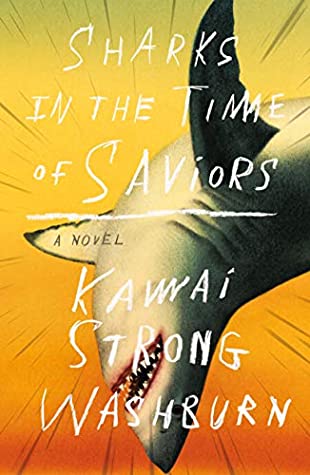
Sharks In the Time of Saviors, by Kawai Strong Washburn*****

A story like this one only comes along once in a rare while, luminous, intimate, and deeply affecting. My great thanks go to NetGalley and also Farrar, Strauss and Giroux for the review copy. This book is available to the public, and you should get it and read it.

Initially I was drawn to this book for several fairly superficial reasons. The cover is certainly arresting; the title is perplexing. But the biggest draw for me was that it was set in Hawaii, and all of the characters are native Hawaiians. In my corner of the world, the Pacific Northwest, there are a lot of Pacific Islanders. Why anyone would leave such an idyllic climate for the dark, soggy winters we see here used to be a mystery to me, but ultimately, people follow the jobs, and so many Seattle residents come from there.

As a history teacher, I’ve always felt that my students deserve to be included in the curriculum, and so in addition to teaching about Caucasians during whatever time period we’re examining, I work in African-Americans, Latinx, Native peoples, and a variety of Asian ethnicities, but time and again I hit a wall when I tried to find something for my Islander students. And when I’ve taught literature, it’s been the same struggle. Islander kids get shut out every time.  And so now I am retired, and here’s my appeal to other educators out there. Put this book in your classroom.

For the rest of you: apologies. Let’s get on with it.

As we open, the setting is Hawaii in 1995, and the protagonists are two parents and three children, all members of the Flores family. They’re on vacation when seven year old Noa falls into the ocean where sharks are circulating. But instead of devouring the boy, one of the sharks delivers him back to his family, carrying him gently in its jaws, “Like you were made of glass, like you were its child.” The first chapter is told in the second person, with Malia, the mother, recalling the event, speaking to Noa. She tells him, “The gods were hungry for change, and you were that change.” It’s obviously a miracle, and others see it happen also. Their lives will never be the same.

As the story continues, we hear from all of the family members. At first, Noa appears to be gifted with a magical healing ability, but he is still a child, and the demands on him are grueling, exhausting. But this is not the only change his magical abilities produce. Noa is the youngest child in the family, but now the siblings’ hierarchy is completely flipped, and the resentment felt by his brother and sister is dreadful. At one point Kaui, who is academically talented, fumes that she is “just his shadow, shaped like a sister.”  And his brother Dean, who is an athlete, explains:

You’re out at breakfast without him, eating cereal and joking with Mom and Dad, Kaui coming in, and you get them all laughing and smiling, just because of you. But then Noa shows up right, and suddenly it’s all questions about what’s happening with his day and did he sleep okay and here’s some thoughts about which extracurricular program he should enroll in…Hard not for get angry at that. I felt it like a fist flexing inside my own chest.

To make matters even more fraught, there’s an economic downturn that makes it impossible for the parents to support the family. They begin charging people that come to be healed by Noa, and so the youngest child is not only the golden favorite because of his miraculous ability; he’s also the family breadwinner. And again: it’s an awful lot to put on the shoulders of one small child.

The dialect combines with the authorial voice to create characters that I swear I would know if I ran into them, and in many ways, they remind me of the adolescents that I taught. Because I was so unconscionably late here, I checked out the audio version at Seattle Bibliocommons, and I have never heard an audiobook I loved more. The voice actors are so convincing that I can hear them now, more than a month and several other audiobooks, after I finished it.

For me, that would be enough. Create visceral enough characters and I don’t even care much about the plot. But the plot is also gobsmackingly brilliant! I believed I could track where it was headed up until perhaps the 60% mark, and then there’s one surprise turn, and another, and another, till at the end I was simply sitting with my mouth open and my eyes on the text as the audio gave way to the afterword and credits. I had to remind myself to breathe.

This is one of those rare galleys that I could see reading again just for the love of it. This review is my 923rd for NetGalley, and I have chosen to reread fewer than 10 of them, so let that indicate the measure of esteem in which I hold this novel.

The Book of Fire, by Christy Lefteri****

My thanks go to NetGalley and Random House Ballantine for the invitation to read and review. I found myself drawn to this novel because it’s different from everything else I have read. I’m fairly sure that I have never read a book set entirely in Greece; then there’s the fire, and the way that the forest interacts with the rural community living in and around it; many people have relied upon it, in one way or another, to make a living.  The Book of Fire is an interesting read, and it’s available to the public now.

Having said this, my first 25% or so of the story finds me with buyer’s remorse (or, reader’s remorse?) The thing is sorrow, grief, and more sorrow. I begin to think maybe I’ll abandon it, because eventually one disengages when there’s no hope of any kind for a brighter outcome. But just as these thoughts begin to crystalize, there is a subtle shift, and then the whole thing becomes more toothsome.

The story is told in alternating timeframes, with the current day being told to us in the first person, while the past is told as if it is a fairytale, and so in it, our protagonist, Irini, is referred to most of the time as “the mother,” her spouse is “the husband,” and their child is “the girl.” It took me a long time to figure out the protagonist’s name, but then there is dialogue, and that helps.

Initially, the protagonist confides to us what she has done. She found the arsonist in the burnt forest; he was on the ground beneath a tree with a rope around his neck. The branch above him is broken, so it’s either a botched lynching or a botched suicide, but not entirely botched, because he’s in bad shape. She begins to try to help him, but then she remembers what he has done, and she walks away from him. When she returns the next day, full of remorse, he’s dead. And so already we have this fact thrown in there along with the man’s own crime. We don’t know whether he did this or it was done to him until nearly the end.

In time more details emerge to muddy the waters of responsibility, so then she has a hundred little ethical questions to examine, and these are joined with a powerful environmental message. Because of this, I think this novel would be terrific for book clubs, and also for the high school classroom. There’s no sex in it, and the vocabulary is accessible. And despite my early fears, the entire book is not a portrait of grief and misery.

Recommended to those that enjoy literary fiction.

Martyr! by Kaveh Akbar

“’Do you worry about becoming a cliché? ‘

“’How do you mean?’

“’Another death-obsessed Iranian man?’”

My thanks go to Doubleday and NetGalley for the invitation to read and review this singular debut novel. This book is for sale now.

Our protagonist is Cyrus, an Iranian immigrant who comes to live in the U.S. as an infant. He is raised by his father, Ali; his mother’s plane was shot down shortly after Cyrus was born, an accident on the part of the U.S. military. His father dies suddenly while he is away at college, leaving him rootless. He spends a lot of time anguishing over death, wondering what is worth dying for. He doesn’t want to waste his “one good death.” Later, he points out that “If I died trying to kill a genocidal dictator tomorrow, the news wouldn’t say a leftist American made a measured and principled sacrifice for the good of his species. The news would say an Iranian terrorist attempted a state assassination. “

And you know that he’s right.

The thing that attracted me to this story is its difference from everything else that I have read. Persians almost never show up in American novels, and when they do, the Persian is the other, the bad or weird person, pretty much like the quote above suggests. So I was all in.

However, I have to say that the amount of angsty inner dialogue makes this a slooow read in places. There is also dialogue between Cyrus and friends, but most of it basically the same thing with a different format. I was primed for humor, since that’s how the book is being promoted, but didn’t find much of it.

The story wakes up a bit when Cyrus leaves Indiana for New York, but the writing remains inconsistent, and the transitions are sometimes a bit ragged.

The revelation about his mother, which occurs toward the end of the story, is startling, and I didn’t see it coming, but it also presents a credibility issue; I won’t go into details here, because it would be a spoiler. Still, apart from this one reservation, the ending is nicely rendered.

Akbar is an interesting writer, and I look forward to seeing what he writes next.

North Woods, by Daniel Mason*****

By now the word is out about this genre-bending novel. North Woods, by Daniel Mason, is nothing short of brilliant. My thanks go to NetGalley and Random House for the invitation to read and review; this book is available to the public now.

This book is all about the setting; there are some terrific characters, but don’t get too attached to any of them, because for the most part, they come and then leave. Rather, our story is about a cabin in the woods of upstate New York, and the acreage surrounding it, and how its use changes over the years.

We commence before the American Revolution, and so in the beginning, the narrative has the style of a very old diary, with antiquated spelling and language. This section is the reason I am so dreadfully late reading and reviewing this book. Honestly, the first fifteen percent or so is as dull as watching paint dry. I would begin reading it, but then my eyes would glaze over and I knew I had some other things to read by authors I knew and loved, and so I would switch books. But my Goodreads friends were raving about this book in unusually large numbers. Nobody didn’t like it. And so I summoned my self-discipline and went to it in a determined fashion, fortified by the audio version, which I received from Seattle Bibliocommons. This was very helpful. And once I got past that dry beginning, I began to understand why other readers were raving about it.

The first characters that are noteworthy are twin daughters named Alice and Mary, who are left to run the apple orchards on their own when their father goes off to war. He is a Loyalist, determined to save New England for his king. He doesn’t survive the war, which is just as well, because the locals hate him; he chose the wrong side to fight for. Neither daughter marries, and the property eventually goes to someone else.

The chain of owners is varied and, in many regards, absolutely hilarious. We see one new owner after another explore the house and the grounds, and of course, none of them has a full picture of the previous owner. I love the fact that I know more about this place than its most recent purchaser, and the assumptions that they make range from the merely incorrect to the disastrous. I cannot say too much more, although I particularly enjoy the character of George, whose phlegmatic, unattractive qualities are rendered uproarious in the audio version, and also the medium, a complete charlatan who’s horrified when she inadvertently awakens some actual supernatural beings. I would love to say more, but that would ruin it for you, and that would be a crime because surprise is an important part of the book’s success.

There is a formidable cast of actors that take on the reading for the audio book, and for those readers that are on the fence between audio and print, I recommend the audio version; better still, use both together.

After reading this one clever, memorable book, I will be watching to see what Daniel Mason writes next, because whatever it is, you know it will be good.

Highly recommended to those that enjoy historical fiction, literary fiction, humor, and horror.