
“There’s nothing ‘not political’ in Palestine, habibi.”
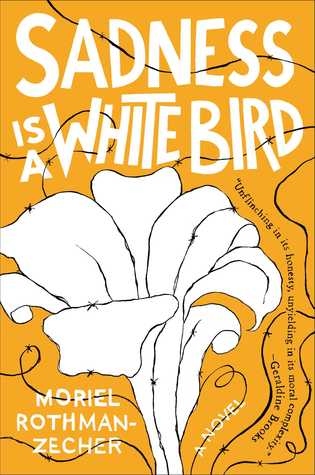 Jonathan grew up in the United States, but now his family is in Israel, the land of his mother’s birth. He’s visited Auschwitz where much of his family died, and he can’t wait to turn eighteen so that he can train to be an Israeli paratrooper. Enough with being ‘people of word’, he figures; he wants to be a Jewish warrior, the ‘people of the sword,’ and exact some payback. A friendship with two Palestinian teenagers complicates his life in ways he didn’t expect. I received an advance review copy of this exquisitely rendered story free, courtesy of Net Galley and Atria Books in exchange for this honest review.
Twin siblings Laith and Nimreen are Palestinians, but long days at the beach and twilit evenings spent with Jonathan, getting high and telling ridiculous jokes, blur the social boundaries observed by most Jews, and by most Palestinians. With the absurd idealism peculiar to young people that haven’t run up hard against life’s limitations, Jonathan thinks that he can have both, that he can become an Israeli soldier and keep his friendships separate from his new career. His friends know better, but still they love him.
There’s only one way to tell a story like this one, and that’s as a tragedy; that’s exactly what Rothman-Zecher does, but he does it better than anyone else I can imagine. This doomed friendship becomes more deeply intimate the closer the day comes when Jonathan must report for duty. Ultimately it becomes a bizarre love triangle in which our young protagonist has a sexual relationship with both of them—though fortunately not simultaneously. For a good long while this lodges in my craw, and as the story continues, I am too revolted to focus. As brilliantly written as this story is, I was headed in the direction of a four star review in protest; that was true, anyway, until I recognized the allegory. Then I was over it.
Nimreen is a teenager too, but she lives with the partitioned state every damn day of her life. She knows that Jonathan can’t have it both ways, but she hopes against hope that he’ll change his mind, that he won’t go into the service. And as Jonathan and his friends try to do anything, go anywhere where there are other people, we see exactly how polarized this place has become. They can’t hitchhike together; there are so many places where either Jonathan isn’t safe, or Laith and Nimreen are not permitted. He goes through a checkpoint where, without his suspicious-looking friends, he would simply have been waved through, and he finds out what it’s like to have one’s homeland invaded.
Rothman-Zecher does a splendid job of depicting exactly how difficult this question is. If I ask myself, have Jews been systematically robbed of their possessions, their homes, and sometimes their lives across not just hundreds of years, but across centuries? I know the answer is yes. I knew it before, but this story drives it home in a way that is visceral. And do Jews deserve to have a home that nobody can ever, ever take from them again? Again, the answer is absolutely yes.
But then we look at the Palestinians, indigenous people living in the Third World at a bare subsistence level. Their homes are almost all they possess, and does anyone have the right to march in, evict them from this place and chase them away from their homes, their families, their livelihoods? Oh hell no, of course not.
In this epic story, Rothman-Zecher bridges the scholarly with the deeply personal, fulfilling a task that can only be achieved by excellent fiction. This searing debut has put this writer on the map definitively and marked him as a new voice in literature.
Highly recommended.
 Ward is a force to be reckoned with, a literary power house whose books everyone should read. I read the third book in this trilogy, the National Book Award winning Sing, Unburied, Sing last summer, and then I knew I had to read everything else she had ever written. When I saw that this title, the first in the same trilogy, was being released again and that review copies were available, it seemed like Christmas. Many thanks to Net Galley and Scribner. This book was released again last week and is now for sale.
 Nerds, geeks, and bibliophiles be ready. Marvin Dietz, who in an earlier life was the executioner of Joan of Arc, is leaving Portland, and he’s collected some unlikely traveling companions. Why not join him? I read this story free and early thanks to Meerkat Press, but it’s worth your nickel to seek it out, because there is nothing else like it. This book is available to the public Tuesday, January 23, 2018.
 Four adolescent siblings growing up in New York City learn that a traveling psychic has hit town, a woman that can tell each person the date that he or she will die. Against the wishes of their parents, they sneak out to find her. I received my copy free and early in exchange for this honest review, thanks to Net Galley and G.P. Putnam’s Sons. This book is now available to the public.
 “You ever hear of the Bobbsey Twins from homicide?”
 Anna Quinn is a brave writer. This wrenching debut novel occupies a place in literature that has lain dormant for decades; kudos to Quinn for bringing dark business out into the light of day for a good airing. I received my review copy free and early thanks to Net Galley and Blackstone Publishers. It will be available to the public January 30, 2018.
 Oh hey now…do you hear bells?
 The Story of Arthur Truluv is a gently philosophical story centered on an elderly widower. Arthur visits the cemetery every day and has lunch at his late wife’s grave so that he can talk to her. Those interred there make pieces of their stories known to him at times; it’s a bit like crossing Fannie Flagg’s The Whole Town’s Talking with the work of Fredrik Backman. I read it free and early thanks to Random House and Net Galley in exchange for this honest review. I rate this book as 3.5 stars and round upward.
 Unless you’ve been hiding under a rock somewhere, you already know that Allende is a luminary that owns the literary lane of magical realism, and is renowned for her fictional immigration stories. But it’s her accessibility, the way she spins her tale as though speaking to a good friend, along with her sparkling great humor and feminist spirit that keep me coming back for more. My bookshelves may be crowded, but when I have to clear old books away to make room for new, my Allende shelf is never up for grabs. These are books I will read again, and that’s a thing I don’t do much. In the Midst of Winter is one I read digitally and free, thanks to Net Galley and Atria Books in exchange for this honest review, but sooner or later I will have to find a hard copy to complete my shelf. You will want to read it too.
