Category Archives: fiction
A Line Made By Walking, by Sara Baume***
I was gob-smacked by this author’s last book, Spill Simmer Falter Wither, and when I saw she had another book out—one set in Ireland, one of my favorite settings—I immediately requested a DRC. Thank you to Net Galley and Houghton Mifflin Harcourt for letting me read it free in exchange for this honest review. The book is for sale now.
Had I no obligation to the publisher, I might be tempted to write a rare one-word review: bleak. Our protagonist is grieving the death of her beloved grandmother, and the dog died too. She’s stuck in a place she can’t get out of mentally, but since she is an artist, she takes her ennui and lets it guide her through art, and the narrative follows a pattern in which each grim thought leads her to a different art theme mentally. The story is told in the first person, and so we follow her miserable wandering thoughts from one grim topic to another, and then at some point each train of thought ends with “Works about [ fill in noun here: beds, rabbits…whatever].”
“The world is wrong, and I am too small to fix it, too self-absorbed.”
Yup.
I continued reading because it seemed to me that her earlier book started out depressing and it took some time to warm up, but then once it took off I was in love with it. I waited for this to happen here. And waited. At the 16% mark, she notes that getting drunk provides her with a “heightened sense of despair” the next day, and my notes my notes say “Fuck me.”
The protagonist tells us of an instance when she follows her very elderly landlady down a set of steps and pretends this is her usual pace also, and my notes say, “What the hell else you gonna do? Tell her to move her butt? Give her a shove to help her along?”
Each time I have one of these magic moments, I know it’s time to read something else for a while and come back to this story with fresh eyes. This is why it took me so long to read and review. Had I not bailed at 68% and peeked at the end for some sign of redemption, it would have gone even more slowly. Our protagonist has family members that want to help, but she is not interested. Instead, we notice dead animals; we notice garbage. We notice mold and other ugly things, but we can’t get up and deal with them because we are depressed and going to continue sitting here, lying here, not seeking change and wallowing.
In fairness, the word smithery here is strong in places, and I like the figurative language. However, for me the double-whammy of perpetually depressed prose followed, every now and then, by reflections about art and art history, a subject that makes my eyes glaze over, is a powerful repellent, and I am never able to engage; perhaps by now, you suspected as much.
So the third star is here because I know there are readers that have a great love of art, and if you are one of them, your experience with this novel may be completely different from mine. I wanted to tell the protagonist to take her meds and shut up, but there may be some truly redemptive aspect of the art discussion that makes the rest of it flow beautifully for art lovers.
For most readers, I can’t recommend this novel, and if you take it up anyway, put the sharps in another room and lock up your pills and firearms. Seriously. But for those with an affinity for art and art history, this book should be considered.
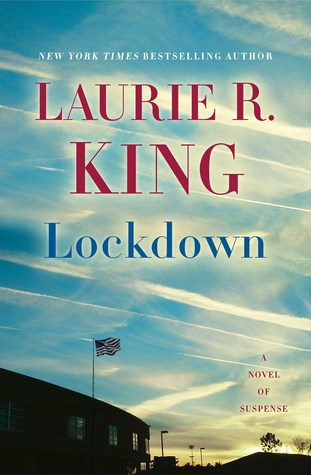
Lockdown, by Laurie R. King*****
I am a big fan of Laurie R. King’s contemporary thrillers, and this one is no exception. Thank you to Net Galley and Random House Ballantine for the DRC, which I read free and early in exchange for this honest review. It’s for sale today, so now everyone can read it.
King’s feminist fiction is made more delicious by her careful attention to detail. There is NEVER a single moment in which the setting—which is primarily at Guadalupe Middle School—slips and shows the reader that the Great and Powerful Oz is really just a human behind a curtain. Her magic never falters. Every fine detail regarding school schedules, culture, and protocol is true to life. This reviewer spent a couple of decades teaching in a middle school not much different from King’s fictional one, and I have never seen any novelist get everything so completely right in using school as the main setting.
As the cover suggests, this story is centered around a school shooting in California that takes place on career day. This is ticklish business to say the very least, one that authors dared not approach for a long time. Now, with Columbine significantly in our rear-view mirror but with school shootings an increasing, ever-present concern, King works it like a pro. A large measure of her success has to do with the way she builds her characters. We have a complex blend, from the school administrator, Linda McDonald; to her spouse Gordon, who has secrets that must not be revealed; to Tio, the custodian, another man that holds his cards closely; to the kids, the kids, the kids. We have Mina, the perfect student who has worries all her own, to Chaco—my personal favorite—to a host of others. By the time we reach the climax, we feel as if we know each one of these people, and so it isn’t a story of violence in the broad sense, but the fates of real people that collide.
This white-knuckle read treats issues of class, ethnicity and gender with the sensitivity one might expect from a master of the genre. When I finish, it is replete with the satisfaction I receive at the end of Thanksgiving dinner—but this feast is one I don’t have to cook up myself, which makes it all the better. I’ve read 11 other books, mostly galleys, since I read Lockdown, and yet in my memory this one stands out as exceptionally strong fiction, the kind of book one wants to read a second time. And I know that when I do, some things will leap out from the pages brand new, because such a layered, intricate story is full of delightful niches and crannies that aren’t necessarily seen the first time through.
I wholeheartedly recommend this story to good people that love novels of suspense. If it means you have to pay full freight—do it anyway. I would have.
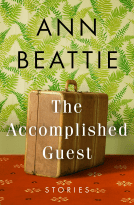
The Accomplished Guest, by Ann Beattie*****
Ann Beattie is a seasoned writer with a list of accolades as long as your arm, and this is why I requested a DRC of her soon-to-be-published short story collection, whose theme is visitors and travel. I was not disappointed. Thank you Net Galley and Scribner for letting me read it free and early in exchange for this honest review. This book will be available to the public Tuesday, June 13.
The first selection is droll; our protagonist is going to see an older man, and so we wonder…is this a boyfriend? Is it an ex? And as we move down the checklist, I love what she does with it. The next couple of selections are good but not as striking, but then the wind catches in Beattie’s sails and she is unstoppable. Other favorites here are “Other People’s Birthdays”, “The Debt”, and “The Cloud”. I found myself highlighting most of the text, which is wasted effort, since I can’t quote most of the book to you, but it’s something that happens to me when I read top-drawer fiction. The story I loved best is “The Caterer”, which made me laugh out loud and woke Mr. Computer, who was slumbering next to me and had to get up the next day for work.
Short stories are wonderful bedtime material, because there isn’t the wrenching sensation in tearing oneself loose from the book. When the story is over, it’s time to bookmark one’s place and turn out the light. I’ve read over a hundred short story collections, and this one is among the best.
Highly recommended to those that love excellent prose, and in particular to Boomers.
Amish Guys Don’t Call, by Debby Dodds****
Amish Guys Don’t Call is funny, absorbing, and ultimately lifting. Dodds has a great heart for teenagers, and this title is one that should grace every high school and middle school library, and will also attract parents and teachers of adolescents. I read it free and early thanks to Net Galley and Blue Moon Publishers. This book will be available to everyone June 13, 2017.
Samantha is still smarting from her parents’ divorce and her father’s inattention when her mother moves them to Lancaster, Pennsylvania, which is the heart of Amish country. Samantha has been in trouble for shoplifting, and the urge increases when she is in stressful situations. To her surprise and delight, she strikes up a friendship with Madison, who in turn pulls her into the most popular circle at school. The one thing that gets in Sam’s way is her wholesomeness. She doesn’t drink, smoke, or use street drugs; not only is she still a virgin, but she’s never had a boyfriend. Madison tells Sam that all of this can end, with some careful time and grooming. Thus is “Project P” launched.
Despite the name of the boyfriend project, this book is free of explicit sexual situations. We see drug use, and sexual situations arise, so those considering whether this title is right for your teen or group of teens should bear this in mind. If in doubt, buy a copy for yourself and read it first.
At a big party held at night in a cornfield by Amish boys during their Rumspringa, a period in which some Amish groups permit their adolescents a taste of what the outside world is like and tolerate sometimes-extreme behaviors as a rite of passage, Samantha meets a young man named Zach. He’s handsome, and he’s drawn to her. We can tell from his behaviors (as well as the book’s title) that he is Amish, but it takes quite awhile for Sam to catch on. She is obsessed with his failure to provide her with his cell number. Is there another girl in the picture?
This story was a fun read, but I don’t recommend it to general audiences apart from those that really enjoy a wide variety of YA novels. Every nuance is explained thoroughly, and so whereas the text is accessible to students—with vocabulary at about the 9th grade level—most adults will want something more nuanced. That said, if I were still in the classroom, I would purchase this title. Because the subject matter might provoke conservative parents, I would not use it as assigned reading or use it as a classroom read-aloud, but I know that a lot of students will want to read it.
Recommended for teens that are not from highly conservative backgrounds.
Grief Cottage, by Gail Godwin*****
Happy release day! This deeply moving story takes awhile to warm up, but once it gets moving, you’re pretty much in it for keeps. Those that love literary fiction will have to look far and wide to find better.
“We know so very little about the people we are closest to. We know so little about ourselves.”
Gail Godwin has been lauded and honored many times over, and has five New York Times Bestsellers to her credit. I read Grief Cottage free and early, thanks to Net Galley and Bloomsbury USA. Now I have to find her earlier work and read it, because her extraordinary prose is worth seeking out. Those that love achingly brilliant literary fiction will want to read this book, which will be available to the public June 6, 2017.
Marcus and his mother live alone and are very close; when she dies, it is as if the bottom has fallen out of his world. He is taken in by a relative he has never met; his Great-Aunt Charlotte lives on a tiny island off the coast of South Carolina. Haunted by his grief, Marcus is…
View original post 389 more words
Before We Were Yours, by Lisa Wingate**
Lisa Wingate is an established author, but she is new to me. I received this DRC free and early, thanks to Net Galley and Random House Ballantine; it is available to the public Tuesday, June 6, 2017. And although I would love to tell you to run out and buy it right now, in all honesty I have never felt quite so ambivalent about a novel, at least not in recent years. There’s so much that’s good here, but there’s also some terrible material—albeit brief—that any sensible editor would have to question, and that every reviewer that’s paying attention has to notice.
We have two protagonists, both female. Our first is Rill Foss, the member of a large, poor family that lives on a riverboat. She and her siblings are scooped up by the authorities when they are left without an adult present while their mother is rushed to the hospital after complications in childbirth. After a harrowing sojourn at the Tennessee Children’s Home, she and a sister are adopted into a well-to-do, politically connected family, and she becomes May Weathers; yet Rill is still determined to return home to the Arcadia, the boat on which she was raised, where she knows her true parents will be waiting.
Our second protagonist is Avery Stafford, the beloved daughter of a senator that is grooming her to succeed him. All of her life, Avery has known she must consider every decision she makes with the assumption that the public will learn of it. But when she learns of a mystery that might affect the final years of her beloved Grandma Judy, who is in the early stages of dementia and living in assisted care, she follows the threads—carefully, discreetly—in order to learn more about her grandmother and in the process, about herself.
“Am I my father’s daughter, or am I just me?”
The prose is woven in a way that is fresh and delightful in most regards, and I admire the organization of the story as a whole, which is masterfully done. Ultimately, we see where May’s story and Avery’s meet, and although we are given a glimpse of how some aspects of the story will resolve, others are a wonderful surprise. The dialogue between Avery and Trent, a man that assists her in her inquiries, absolutely crackles. The characterization of Trent’s three-year-old son, Jonah, gets my vote as the most adorable tot to ever grace fiction.
There are two areas that hold this story back from a five-star rave here. The first and smaller concern is the depiction of the orphanage to which Rill and her siblings are taken. Wingate tells us in her end notes—which I read first, and you should, too—that the Tennessee Children’s Home Society was real, and that poor children were in fact routinely kidnapped and adopted, for high fees, to affluent families almost as if they were livestock; “Christmas babies” were publicly advertised, especially blond ones. The point is well taken, and Riggs is a well-drawn villain. However, the passages set in this place are so horrible and so harsh that in some ways, it’s almost a caricature. I found myself skimming passages here because I just couldn’t stand it. If I had my way, there would either be a wee bit more ambiguity here, or the section would be shorter. Sometimes less is more.
The other, larger concern here is the cultural deafness in the terms used. Even if racist terms were common among Caucasians of the time in question, finding them gratuitously tossed into this novel, not because they are key to the plot but merely as set dressing, is like finding a rattlesnake in my lunchbox. Why would anyone do this? I refer to the slur on a Chinese man that appears briefly and is not important to the plot; the mammy-like dialect written in for the African-American servant, which appears numerous times; the reference to American Indians of the north as ‘Eskimos’, the offhand references to slave cabins and ‘Confederate’ roses, and most particularly the place in which one of the children threatens a Black woman they think may steal from them by telling her:
“They’ll hang you up in a tree, they will.”
My god. A threat of lynching, just tossed in for flavor!
By the end of the galley, I was in love with the story and its main characters, and I initially rated this book four stars, but in going back over my notes, I realized that as long as the lynching reference remains in the text, I can’t go there, and I can’t do that. And I wonder—why in the world is it used at all? All it does is demonstrate how tough the children are, that they can chase away an adult that might mean them harm. Wingate could have done this dozens of other ways, and yet she chose this one.
So there you have it; it’s a brilliantly crafted story with significant social miscues that threaten to derail all that is done well here. Take your pick; read it or don’t. My own advice is that if you want to go there, get it free or at a discount. I cannot see rewarding a work that contains overt racism that is tossed in to no good purpose, and it’s a crying shame, because otherwise it’s a compelling tale by a master word-smith.
Watching the Detectives, by Julie Mulhern*****
“’There’s been an incident…Mrs. White in the study with a revolver.”

Mulhern is on a roll. This is the fifth book in the Country Club Murders series, but I plunged in without having seen the first four, and it was still a treat. Thank you, thank you to Net Galley and Henery Press for the DRC, which I snagged free and in advance in exchange for this honest review. It is now available to everyone.
The story is set among the Caucasian upper middle class of the 1970s, and Mulhern renders the period—when this reviewer was a mere, blushing wisp of a girl—so well that I checked twice to see whether it was an older title being re-released.
Ellison Russell is our protagonist, and people keep dying at her domicile. It’s become a nuisance, and there’s a cop that thinks it’s too great a coincidence. Ellison’s in a jam, and her thirteen-year-old daughter Grace isn’t helping. She sulks when they are told they must leave the house for a few days because it’s a crime scene, exclaiming that people have died at their house before and they didn’t have to leave. It’s just not fair!
Ellison is a widow, and a merry one at that; she has a flirtation going with a local cop whose name is Anarchy—a guy who believes in rules– but her main man is Mr. Coffee. He’s always there for her.
I moan when Ellison’s mother is introduced—yet one more overbearing mother, I thought, and authors always blame everything on mothers, just like everyone else does—but then I am surprised by where she takes it. I won’t say more lest I ruin it for you. But I will say this: every overused or overworked plot element is here for a reason, either to take it apart, or to make fun of it. Mulhern considers every word in this dandy novel carefully, and the result is splendid.
As the story unfolds there are other witty tidbits tucked in here and there, such as a character named Margaret Hamilton who is such a witch. But the frippery and snarky humor aren’t the whole package; while the mystery is a romp, serving up the snobbery of the petit bourgeoisie with a sharp skewer, this excellent novel is also a nicely turned feminist manifesto. While the mystery is a fine 4-star beach read, the author’s purpose is a strong one that’s delivered well. It is for this aspect that the fifth star is given.
Highly recommended for strong women and those that love them.
The Half-Life of Remorse, by Grant Jarrett*****
Here is a story for our time. It’s fresh, moving, fall-down-laughing funny in places, and has the best character development I’ve seen lately. I was growing cranky from having to pan other people’s bad books, and I requested this DRC from Net Galley and Sparkpress almost as an afterthought; then it nearly knocked me off my feet with its voice and sheer creative power. It was published last week, and you should get it, read it, and then make other people do the same thing. It’s that strong.
The format is a simple one, and because there’s not a lot of plot or setting, everything boils down to the inner monologues of the three characters here. We start and conclude with a brief narrative in the third person omniscient, and in between we have the staggered monologues of two homeless men and a professional single woman confined to a wheelchair. Sam has blocked out a traumatic past, likely suffering from PTSD and who knows what else. His monologue is a literary sounding one, and indeed, he was once an academic. Now he calls himself a wizard, and at times, we nearly believe him.
The other homeless man calls himself Chick. He is not a young man either, and is running from his own misdeeds, and Sam tells us that Chick “…is a testament to life’s unrelenting desperation to continue.” Chick is not literate, but he manages to communicate brilliantly in his own tumbledown, roughshod, clumsy manner. Every now and then he tries to use a slightly larger vocabulary than he possesses, and ends up referring to “the persecuting attorney” and not wanting to “cast inspersions” upon the characters of others. Though he is thoroughly profane and limited grammatically, in his own way Chick is as eloquent as Sam.
The third character, a less developed but still important one, is Claire. Claire lost the use of her legs when her family was invaded by criminals during her childhood. Both Sam and Chick were there, but at the time, they did not know each other.
Jarrett writes in a way that is wholly original, and the juxtaposition of Sam’s monologue with Chick’s is startling and very funny. Somehow this author manages to slam tragedy and humor right up against one another without diminishing either. Most importantly, he is able to portray both Sam and Chick as men that still have purpose and a personal code of honor despite the horrors they have experienced and the bad choices they have made. Jarrett’s prose is the sort that grabs me by the hair and doesn’t release me until the story is finished. At one point, I found myself lightheaded because I had forgotten to breathe.
This novel is highly recommended to everyone that loves strong fiction.
The Frozen Hours, by Jeff Shaara****
“’All right. They’re on our left. They’re on our right. They’re in front of us, they’re behind us. They can’t get away this time’.”
Fans of Jeff Shaara’s military historical fiction won’t have to wait much longer; with the ambitious rendering of the Chosin Reservoir battle during the Korean War, he’s taken a great leap forward. I received a DRC from Net Galley and Random House Ballantine in exchange for this honest review. The book will be available to the public tomorrow, May 23, 2017.
Shaara makes military history accessible by breaking it down into small bites, and by choosing a reasonably representative group of historical figures to feature. One thing that has made him controversial, but which I admire and appreciate, is his decision to add at least one completely fictional character to each book in order to have the humble foot soldier, the ordinary joe that never gained fame or glory, represented. If Shaara chose to use the more traditional method, including only those actual servicemen that left a trail of records behind them, he would be telling us about the war solely from the point of view of officers. I am glad he has stuck to his guns—so to speak—because the rank and file make an enormous impact on the outcome of every battle in every war.
Approaching this story, it is key not to skip the preface or the afterword. This reviewer taught American history and government, and yet I learn something new every time I read one of Shaara’s books. One of the things I appreciate most is that it’s reasonably clear what is fact and what is fiction.
The war is basically a struggle over who will rule the Korean peninsula. Over the centuries, Japan, China, and various Western powers have had their eye on it; it is located in a way that gives its would-be colonizer wonderful access to a great many other places. Who wouldn’t want a military base there? And so as we commence, the Chinese, accompanied, at the outset, by the Soviet Union (now Russia), are determined to repel American incursion into the region. Shaara shows Koreans themselves as merely wishing everyone else would just leave, and although others would differ, this point of view serves well enough for the purpose of telling about this battle.
The US military troops here are commanded from afar; General MacArthur provides unreachable deadlines for the capture of hotly contested areas. At the outset of our story, he orders Marines and US Army shipped to North Korea and selects a inland line of march that he tells the press is a “pincer movement” but which in fact leaves vast amounts of unguarded areas between isolated groups of soldiers. They are high in treacherously cold mountains, where many men on both sides of the conflict will freeze to death or lose body parts to frostbite. They are surrounded and forced to fight their way out, then fight again to rescue their comrades.
There are two things I would change here if I could. The first is the maps. I blew them up on my tablet and still wasn’t able to read most of the print. They were better than nothing, but just barely. There isn’t even a compass provided to show where north is located.
The second is actually a pretty sore spot, and that is the constant use of nasty racist terms for every Asian mentioned ever. The Japanese, the Koreans, the Chinese all get called more ugly names than I ever want to see again in my life! I understand that part of his point in doing so is to show how badly the American command underrated Mao’s forces. I also understand that Caucasian US troops did use racist language casually, and that dehumanizing the enemy is one more way to unify one’s own force and go out and kill people.
However, an author gets to choose his points of emphasis. In his many excellent Civil War novels, Shaara goes lightly around the N word, because he understands that it is painful and divisive, and that for many people, it will destroy the joy they might otherwise experience reading his work. It’s a tender place in our national consciousness. Yet the perception doesn’t hold when the people of color are Asian. It’s hard to take. Why add more nastiness than one must? Occasionally there is a lull where Chinese are called Chinese and Koreans are called Koreans, and I sink into the narrative as one does with strong fiction, only to have another epithet tossed in my face like cold water.
Perhaps it is because Asians are quieter, most times, about racism and stereotyping, that writers—Shaara is by no means alone in this, which is why only one star comes off—seem to think nothing of repeatedly slamming these horrifying terms at us again and again from within their pages. The references to the Japanese are obviously only there as—what do I call this, ambience? The Japanese are now allies of the US, but the J word gets sprinkled in anyway, and it’s a rotten thing to do.
There are nearly 7 million Asians of either Japanese, Korean, or Chinese ancestry living in the USA, and I have news: they read. And whereas I am undoubtedly more sensitive than some readers, given that we’re talking about my husband and my youngest child, I am not actually Asian myself. And there were moments here when I really felt that if I hadn’t committed to reading for the purpose of a review, I would prefer to leave the book unfinished, to slide it in the back somewhere and not really look at it anymore.
Shaara is an excellent writer, and his characters are almost tangible at times. With a little more sensitivity toward people of color, his work could be even better. This book is recommended to those that love historical military fiction, with the caveat just mentioned.
“We know so very little about the people we are closest to. We know so little about ourselves.”
“’All right. They’re on our left. They’re on our right. They’re in front of us, they’re behind us. They can’t get away this time’.”