Good Dirt, by Charmaine Wilkerson*****

Charmaine Wilkerson is the author of the massively successful Black Cake. Her sophomore effort, Good Dirt, carries some of the same components—an impending marriage, a family heirloom, secrets and betrayals—but is nevertheless a very different story, and it’s an even better one. My thanks go to Random House Ballantine and NetGalley for the invitation to read and review. This book will be available to the public on January 28, 2025.

Our protagonist is Ebby Freeman, which is short for Ebony. She lives with her parents in an affluent neighborhood in New England, but there was a fourth family member, her brother Baz, who was murdered during a home invasion; Ebby witnessed all of it, and has long carried the guilt of survivors. Could her ten year old self have done something to save Baz?

Now Ebby is grown, and plans to be married, but things don’t go as anticipated.

As in her previous novel, Wilkerson packs so many points of view into the story that I eventually stop counting, and although I am skeptical about this choice through much of the book, by the end I have to admit that she has carried it off nicely. Some points of view are urgently necessary to carry the plot forward; others, like that of the intended groom, Henry, are straight-up hilarious in places. Once again, we move not only between points of view, but time periods as well, reaching back into an earlier century, when some of her ancestors were enslaved. These passages aren’t entertaining, but they are necessary to provide clarity and urgency.

Ordinarily, I don’t read stories with wealthy protagonists, and make no mistake, Ebby’s family has a great deal of money; but having the family be African-American, and self-made rather than heirs to massive, often ill gained fortunes helped a great deal. Ultimately it was easy to bond with Ebby. When she experienced pain and rejection, I felt it, too. I carried her around in my head in a way that I usually don’t; over 1,000 reviews are in my rearview mirror, and only the truly special ones take hold of me as this one has.

Highly recommended.

The Slate, by Matthew FitzSimmons*****

Author Matthew FitzSimmons is a veteran novelist, but he is new to me. I picked up on the buzz generated by his most recent book, a political thriller titled The Slate. What a ride! This is a true thriller, one that gripped me at the outset and didn’t let me go till it was done with me. I’d had surgery and was dealing with a lot of drowsiness from the various medications and anesthesia, but this book didn’t care about any of that. This book—aided and abetted by narrator Mia Barron– made me read it anyway, and I’m glad.

My thanks go to Net Galley and Brilliance Publishing for the review copies. This book is available to the public now.

Agatha Cardiff is retired. She used to be a political mover and shaker, but many years ago, she was roped into doing something she didn’t want to do, and should not have done. Since then, she’s been hiding. A neighbor offers her some bedding plants, and she takes his damn head off in a single bite, because she does not want to get to know him. She doesn’t want to get to know anyone.

To make ends meet, Agatha rents out her basement flat to young Shelby. Shelby is late with her rent, and has done something regrettable in order to rectify the problem. Now, Agatha learns, Shelby is in deep trouble, being held captive on board a ship.  Well, there’s no choice, not really. Agatha has to save the kid, even though it means stepping out of seclusion. And sure enough, all hell breaks loose.

As Agatha emerges from her self-protective exile, we begin to see exactly what she’s capable of. It’s a revelation! Our point of view changes occasionally, but make no mistake, this is Agatha’s story. FitzSimmons is such a badass writer that he even manages to develop this character, something I rarely see in a thriller, because it’s hard to maintain rapid pacing while dealing with backstory and internal monologue. He makes it look effortless, but you try doing that. Go on, give it your best shot.

See?

I often shy away from political thrillers because so many of them have a hugely conservative bent that sets my teeth on edge. The Slate, in contrast, plays it right down the middle, and shouldn’t offend red hats, the woke, or anyone anywhere else on the political spectrum.

Because of the narrator’s skill, I lean toward recommending this as an audio book foremost, but if you are a visual reader, don’t let that stop you, as the print version is also excellent. Highly recommended.

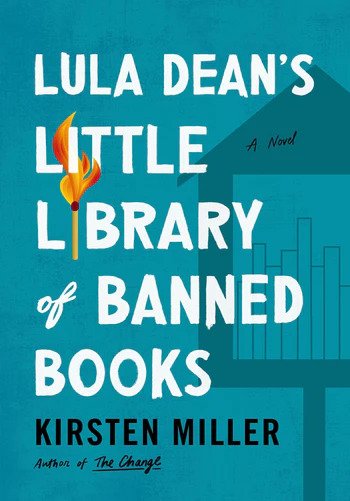
Lula Dean’s Little Library of Banned Books, by Kirsten Miller

Lula Dean is a deeply unhappy woman. Neglected by her children, alone and unappreciated, she strikes on a way to gain the attention she knows that she deserves. She embarks on a crusade to remove books she deems objectionable from local libraries, and she sets a sterling example for her town by erecting a little library on her lawn, a collection of the wholesome material she thinks is most appropriate. Little does she know that one of the town’s youths has snuck out in the dead of night and inserted banned books inside the dust jackets of the books she originally placed there. Her library becomes wildly popular, and Lula hasn’t a clue why.

My thanks go to NetGalley and William Morrow for the review copy. This book is for sale now.

The moment I saw the synopsis for this novel, I knew I had to read it. The First Amendment is a hot button for many people in the U.S., and as a language arts teacher, it’s been at forefront of my mind for most of my adult life. And I think I can safely say that Lula Dean is a soft sell; readers are generally a receptive audience, and so any novel containing the word “book” or “library” in its title should, I would argue, be held to a slightly higher standard. It’s not that hard to preach to the choir.

I love the premise of this story, and I laugh out loud more than once at the beginning. After that, though, things flatten out a bit. There are a lot of characters here, and whereas I have no difficulty keeping them straight, their numbers may have prevented author Kirsten Miller from fully developing them. I feel as if I am reading, for the most part, about cartoon cutouts rather than real people;  had I felt as if the characters were real, I would have been more deeply invested in their outcomes. However, everyone in this thing is either a fine, enlightened character or a despicable, ignorant blowhard. It accurately represents the way many Americans regard those around them, blue versus red, and that is not helpful. Two characters that stand out better than others are side character Beverly Underwood, and the young Elijah. However, even these are not dynamic characters. Nearly everyone here is the same going out as they were coming in.

Those looking for a short, funny novel to toss in their suitcase over the holidays could do worse; they could also do better. The sad thing is that had this been written in a more intentional way, with the literary standards one would hope to see in any novel, it could have been impressive, might even have changed a few hearts. This book isn’t going to do that, and so I see it as an opportunity squandered.

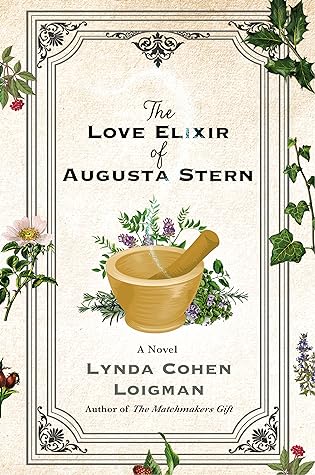
The Love Elixir of Augusta Stern*****

Augusta Stern is about to turn eighty, and she’s being forced into retirement, darn it. Her beloved niece persuades her to leave New York and spend what remain of her golden years in a Florida seniors’ community. From there, a wave of surprising events unfolds, changing Augusta’s life.

My thanks go to NetGalley and St. Martin’s Press for the invitation to read and review. This book is for sale now.

Loigman’s debut novel came in 2016, and as of now, she’s published three more. Every single one is golden. This author writes with warmth and intentionality, and although the first was wonderful, each subsequent one has been better than the last. And so, although I have gone on to read other novels by other authors since I finished this one, this is the one I’m still thinking about.

You see, in 1922, Augusta’s mother became gravely ill. Try though they might, neither the doctors nor her pharmacist father were able to help her, and she died. Augusta, her sister, and her father were all plunged into a dark and terrible place without her.  Great Aunt Esther showed up to run the household, and she brought with her a case full of herbs and tinctures; Esther was an apothecary. Her methods, which were sometimes unconventional, put her at odds with her nephew, but they got results, sometimes where conventional medicine had failed. Soon Augusta was spending her hours after school helping her father in the pharmacy, and sneaking out of bed in the middle of the night to observe Esther devising natural concoctions of her own. Esther declared Augusta to be her heir; she had a loving heart and a healer’s instincts.

Her social life was very limited, absorbed as she was with the family business, but the brightest spot in her day was when Irving Ripken, her father’s delivery boy, came to work. Often, they would talk as they worked; in time, they fell in love. Imagine her horror, then, when he abruptly married someone else and moved to Chicago! Augusta never recovered from the blow, and so she has never married.

Now, imagine her astonishment when sixty years later in Rallentando Springs, Irving shows up at the pool!

Much of what follows is what a reader might expect, but the details and character development take the story to a higher plane, and as we follow it, we also see the events of 1922, and these enable us to understand these characters and what drives them. There’s an unusually clever twist at the end, and it’s one that I absolutely do not see coming.

Ordinarily I would include ways in which the novel fell short or could be improved, but that’s impossible in this case. Loigman has spun magic for us from start to finish, and all I can do is bow in appreciation, and recommend this novel to you.

Identity Unknown, by Patricia Cornwell*****

Patricia Cornwell’s Scarpetta series is among my favorites. Identity Unknown, the 28th in the series, is every bit as riveting as her earlier ones, and I am thrilled to have received a review copy. My thanks go to Grand Central Publishing, NetGalley, and Hachette Audio. This book is for sale now.

First, I have to offer a shout out to January LaVoy, who reads the audio version. I was unsure how I would feel about this one, because I read the first 27 installments with my own eyes, and so I had developed the voices for each character in my head. Would I be thrown by the way they were voiced by a professional? As it happens, no. The protagonist and her ever present sidekick, Pete Marino, who is now her brother-in-law, sound exactly as I had thought they would. Of course, much of this comes down to excellent writing. The voices of her niece, Lucy, who now occupies the top echelons of governmental spookdom, is softer and slightly higher pitched than I had expected, but it fits, and I made the mental transition easily. Kay’s husband, Benton, doesn’t have as deep a voice as I would have thought, but to make his voice that deep would require a second, male reader. All told, LaVoy does a fine job, and I didn’t feel distracted from the story.

I have begun reading the DRC when I am provided the audio, and so from there forward, I switch to the audio, referring occasionally to the DRC to make notes or highlight possible quotations. Once the climax comes, however, the tension gets the better of me, and because I know I can read faster than LaVoy can talk, I switch back to the text.

The premise is that there have been two deaths. The first is an old boyfriend of Kay’s, a man named Sal Giordano. They have remained friends over the years, and she saw him recently when she dropped off a basket of goodies for his birthday. He has been the victim of a death flight, which is new to me but apparently, according to Wiki, is a thing. It involves killing someone by dropping them from a plane.

Holy crap!

Now we get into aspects of the case that make it an even better October read, as well as darkly funny. The prose itself doesn’t appear to be intentionally humorous, and yet I cannot, for the life of me, imagine that Cornwell didn’t snicker a bit as she wrote it. The area where Sal is dropped is inside an abandoned amusement park with a Wizard of Oz theme. It’s been vandalized, and is seriously creepy. The higher ups within the U.S. military are in on the investigation, and so:

“’Let me make sure this is clear,’ General Gunner says to me. ‘He landed on the Yellow Brick Road in the middle of an apple orchard.’

“’Inside the Haunted Forest. Yes.’”

I couldn’t help myself. I squawked out loud!

Soon another corpse is identified, a child belonging to a pair of wealthy, powerful people that are also terrible human beings, and as it happens, horrible parents. The two deaths are connected. The parents throw their weight around and try to manipulate the investigation, but of course, they don’t succeed.

Ultimately it seems that one of the guilty parties is Kay’s nemesis, Carrie Grethen. Carrie was once Lucy’s true love; later, her evil nature became apparent, but nobody can seem to keep her locked up, and she has become Kay’s Moriarty. I mention this here because it is raised early in the story, so I don’t think it can be called a spoiler, but I won’t say more about that.

To the faithful readership, I will also say this. As the book opens, two of Cornwell’s old standbys, ones that I’d be happy to see her retire, appear. First, she has to be driven to the scene in a helicopter, but oh no, there’s a storm coming. I was irritated. Can Kay not go anywhere without there being a storm? Just once? Please? And then something has to be retrieved by diving, which harks back to an earlier book in which she’s attacked with a spear gun. But friends, neither of these turns out to be key to the story, and we’re done with them in a heartbeat, so be patient.

I like to read a few books at a time for variety, but once this one began, it edged out the others—except at bedtime, because when I go to bed, I need to sleep! It’s among her finest work, and I recommend it wholeheartedly to you.

My Name is Barbra, by Barbra Streisand*****

As I came of age in the late 1970s, Barbra Streisand was a tremendous star, and when it came to movies in which she sang, she was peerless. She still is. I was starstruck by her brilliance, her charisma, and her astounding voice, and even so, I didn’t know the half of it. She wouldn’t accept glass ceilings, and when she encountered one, she kicked it in, and she did it with style.

Once her place in the industry was established, Barbra tried to erect a few boundaries around her private life, but it wasn’t easy; when she declined interviews whose focus was her relationships with men, some members of the press chose instead to portray her in an unfriendly light. And some people were threatened by her. A woman director? A woman producer? Who did she think she was, anyway? And she showed them who, sometimes wearing multiple hats in a given film, directing and acting, or…well, you get the idea. And thanks to the resistance she encountered, she grew to be a fierce feminist activist as well.

The autobiography is done in linear form, which I appreciate. I chose not to request the galley, because the book exceeds 1000 pages, and I’d have had only a month till it was published. Instead, I put it on my Christmas list, and Santa delivered it both in print and audio. Both are wonderful, but the audio is read by the author, which makes it my favorite. One more thing I greatly appreciate: when she discusses her music, we get to hear a brief, seconds-long excerpt. A pet peeve of mine is when song lyrics are spoken on audio books, and it is triply aggravating when the book in question is written by and read by the musician that made it famous. I’m sure there are hoops that must be jumped through to be allowed to include these snatches of song, but I know it can be done, because Barbra did it.

We begin with her childhood, the loss of her father, the unavailability of her mother, and I marvel that she grew up to be a good person, and that she nevertheless found the inner strength and confidence to pursue a career as a performer.

A good person? How would I know? We’ve never met. Surely authors do their damnedest to shine the light on their better qualities when they scribe their memoirs. But ultimately, it’s the way that Barbra’s own character makes its way into her productions that convinces me. She has no use for pretension, for one thing, even after the millions she’s made (and given away a lot of.) And she’s spent decades as an activist, using her talents to raise funds for AIDS research, to combat climate change, and to promote women’s equal treatment.

One word about that: there are long passages, at least one whole chapter and parts of others, where she discusses her causes and the politicians she admires, and I must confess that her adoration of various Democratic politicians is my least favorite part of the book. I actually lean further left than she does, and as she gushes over the Clintons, I find myself arguing a bit with her in my head. Sure, Bill Clinton did A and B as president, but he also did C and D, which are dreadful. And so on. Ultimately, I skipped to the end of one such chapter, and I was able to enjoy the rest of the book just fine.

I was fascinated by her explanation of why The Way We Were, one of her massively successful movies, is curiously devoid of politics, even though that is the point of the movie. She tells us that there was a lot of excellent content that landed on the cutting room floor. Nixon’s people had leaned hard on the studio not to disparage the McCarthy witch hunt, for example, and they folded. Happily, Streisand thought to ask if she might keep the portions that were cut, and a new version is being published for its 50th anniversary, so that we can see what it was supposed to look like. And it was this travesty, the way the original film was butchered without her input or consent, that made her determined to direct, and not to make any more movies unless she could have the final cut in her contract.

In her old age—she is in her eighties now—she is willing to talk about her private life in ways she would not do earlier, and she finds just the right level of intimacy to describe it. She speaks well of most of her past loves and many, many fellow performers, and has met and spent time with just about every public figure you can imagine. At one point I challenge myself to think of someone famous that isn’t in her book. Ha, I’ve got it! Nelson Mandela. Then I flip through the vast trove of photographs at the end of the book, and there she is with him.

Her harsh words are very few, and even so, she can often find some positive words to round out her discussion. Sidney Chaplin, son of Charlie, was monstrous, and he terrorized her just as her career was taking wing. Her longtime boyfriend, the hairdresser-turned-producer, Jon Peters, is the other major entrant on her unhappy list, but she recognizes the good things that he did, too, and the fact that he—and every one of her exes—sends her flowers on her birthday says it all.

I could go on even longer about this book, but it won’t be as fun for you as if you get the book for yourself, and I want to go back and re-watch her movies, especially Yentl. As for you, this audio book could make your daily commute much more enjoyable. Highly recommended.  

Margo’s Got Money Troubles, by Rufi Thorpe****

Margo’s Got Money Troubles, by Rufi Thorpe, is a bold, inventive, and very funny novel about a young woman cut adrift in a difficult, expensive world. My thanks go to NetGalley and William Morrow for the invitation to read and review. This book is for sale now.

Margo is the daughter of a Hooters waitress and a former pro wrestler, an absentee father with a family of his own; her mother had been his woman on the side. Consequently, Margo has always understood that she would have to hit the ground running when she grew up, and so she’s enrolled in a junior college. When the brief affair with her English professor leaves her pregnant, she has nobody reliable to advise her. The women she confides in urge her to terminate the pregnancy, and of course, the professor does, too; yet Margo likes the idea of becoming a mother, and it’s her fetus. Nobody can make her do anything. She decides to keep it.

Her mother is about to marry a man with money and conservative values, and she sees Margo as a loose cannon that just might upset the whole ship, so she tells her to terminate or be cut off.

Wow, Mom. Really?

Margo’s roommates hadn’t agreed to share an apartment with a baby. They need to sleep! They have to get up early!

Early on, I’m rolling my eyes. Part of me is thinking that Margo is about as dumb as they come; part of me is wondering why no author in this entire world is writing—or, more likely, why no major publishing house is publishing—novels in which a young woman chooses to have an abortion and take back her body and her life. But I’m overthinking, because soon, Margo—who after all, is just young, naïve, and rudderless—admits her error. She loves her little boy, but she had no idea he would be so expensive, or that motherhood would be so difficult. She tells her father, who re-enters her life as her mother steps away,

 “’I shouldn’t have had him,’ as though some rip cord had been pulled inside her. ‘I know that, okay? Everyone told me it would ruin my life and it did. They were right, and I was stupid, and I didn’t get it. Okay? But now I’m here.’ And her father, who strangely enough becomes the most reliable adult in her life, says, ‘Yes. Now we’re here.’”

Later, Margo will comment that nothing can make a person pro-choice like having a baby.

Margo has been waiting tables, but she can’t find child care, and when she brings the baby to work, she’s fired. And the truth is, she doesn’t like leaving her baby. Then one day, while looking at her naked self in a full length mirror, she observes that she has huge boobs for the first time in her life. Men would pay to see this. She opens an account on OnlyFans.

And so this controversial choice becomes the crux of the story. Some friends reject her, and her mother has really had it with her now. But there are a lot of meaty conversations that are thought provoking, and so, even though this old lady schoolteacher reviewer is mighty uncomfortable reading about an online sex worker’s film process, there are related questions that cannot be ignored. For example, Jinx—her father—advises her against it, saying that she shouldn’t get mixed up with these kinds of girls, and she asks him, “What are ‘those kinds of girls’?” And it’s true. A man can send his dick pix out into the world any number of times and places, and whereas many will consider these gross, or obscene, which they are, how many people will condemn the guy’s entire character, his moral fiber, for having done it? So the double standard is screaming to be recognized.

Margo goes through a lot of grief, defending custody of her son when the skeevy professor resurfaces, as well as having to deal with housing crises and other problems. But the central issue lurking in the shadows is that of a young mother choosing sex work as a career.

I have to tell you quite frankly that I was way out of my comfort zone through much of this book. I am probably not part of its target audience, despite the fact that I was approached to cover it. Partway in, I considered not finishing it, but the quality of the writing is so strong that I kept going, and I’m glad I did.

The story is told from a third person omnipotent perspective, but it shifts in a surprising and funny way, and that’s all I will say about that, lest I ruin it. I wonder from time to time if we have an unreliable narrator, but this is more than that. This unusual point of view a brave choice, and I think she carries it off well.

There are a lot of worthwhile discussions that can spring from this novel; it’s fertile territory, if you’ll pardon the expression, for book clubs. It’s also being adapted for Apple TV. I recommend this book for any feminist that likes to laugh, and isn’t afraid to think outside the box.

The Stepford Wives, by Ira Levin*****

Ira Levin, legendary novelist and playwright, published The Stepford Wives in 1972, a time when feminist ideas were at a fever pitch for many, and a frightening development for others. Women’s rights were at the forefront in a way that they had not been since the suffragists had won the right for women to vote over 50 years earlier. Now the book is re-released in audio format, at a time when the advances won during that time have been rolled back in some places, and appear to be under attack everywhere. So although I was already familiar with this book, I jumped at the chance to listen to it and promote it; I wish Levin was still alive today, because we can use men like him.

Version 1.0.0

My thanks go to NetGalley and Blackstone Audio for the review copy. This book is for sale now.

Stepford, Connecticut appears to be idyllic; beautiful homes; rolling lawns; good schools. There’s no crime to speak of in Stepford, and Joanna and Walter jump at the chance to move their young family away from the city and into a lovely new home. The children make friends almost immediately, but for Joanna, it’s a little harder. All the women are stay home mothers—not unusual in 1972—but they are insular, preferring housework and beauty regimens over any outside interests, including other women. She finds two women that are friendly, and that have moved here fairly recently themselves, and she turns to them for solidarity. But then one of them begins to change, and Joanna has become suspicious. Is it something in the water? Why are Stepford women such docile, ornamental drudges?

This is a brief book, more of a novella than a novel, and that’s part of what makes it so effective. Levin uses spare prose and doesn’t let anything clutter his central message. In doing so, he creates a more spine chilling effect than a more description laden, dialogue rich novel could have done. And once you read it, you’ll never forget it.

I highly recommend this classic work of horror for women and those that care about them.