Let Us Descend, by Jesmyn Ward*****

Reading Jesmyn Ward always hurts so good. In Let Us Descend, she conveys the heartbreak and sense of betrayal a young girl, Annis, faces when she and her mother are sold separately by their owner—who is also her father–and the ways that she copes, and also the ways she is helped by the spirits of her ancestors.

My thanks go to Scribner and Net Galley for the invitation to read and review. I’m sorry to be so late here, and am grateful that the literary world has recognized this book for the masterpiece that it is.

You may have seen other reviews in which I complain and gnash my teeth over historical inaccuracies; sometimes I rant over an author’s failure to portray a child in a way that is developmentally inaccurate. There will be none of that here. Ward has taken the time and done the research, and so her well crafted characters aren’t compromised by sloppy background details. I had to take this story in small bites because it is excruciatingly sorrowful.  For part of it I listened to the audio version; this is a treat in itself, as Ward reads her own novel.

Some reviewers have taken issue with the amount of magical realism Ward employs. I disagree with them. How can any novelist portray such a story and such a character as Annis with any glimmer of hope, unless they employ these literary devices? Does anyone really want to read a book that is miserable at the outset, miserable in the middle, and miserable even at its bitter, wretched conclusion? Without hope, there’s not much incentive to keep reading, nor would it have been satisfying to write; but Ward will not and does not revise history simply to make her readers more comfortable. There was only one way to tell this story and be true to history and her characters, and Ward found it.

Yes, it’s a rough read, but it’s so well written that many readers must have smiled through their tears. Know that, of necessity, this story is absolutely loaded with triggers; assuming that you can navigate them without coming undone, I highly recommend this story to you.

Margo’s Got Money Troubles, by Rufi Thorpe****

Margo’s Got Money Troubles, by Rufi Thorpe, is a bold, inventive, and very funny novel about a young woman cut adrift in a difficult, expensive world. My thanks go to NetGalley and William Morrow for the invitation to read and review. This book is for sale now.

Margo is the daughter of a Hooters waitress and a former pro wrestler, an absentee father with a family of his own; her mother had been his woman on the side. Consequently, Margo has always understood that she would have to hit the ground running when she grew up, and so she’s enrolled in a junior college. When the brief affair with her English professor leaves her pregnant, she has nobody reliable to advise her. The women she confides in urge her to terminate the pregnancy, and of course, the professor does, too; yet Margo likes the idea of becoming a mother, and it’s her fetus. Nobody can make her do anything. She decides to keep it.

Her mother is about to marry a man with money and conservative values, and she sees Margo as a loose cannon that just might upset the whole ship, so she tells her to terminate or be cut off.

Wow, Mom. Really?

Margo’s roommates hadn’t agreed to share an apartment with a baby. They need to sleep! They have to get up early!

Early on, I’m rolling my eyes. Part of me is thinking that Margo is about as dumb as they come; part of me is wondering why no author in this entire world is writing—or, more likely, why no major publishing house is publishing—novels in which a young woman chooses to have an abortion and take back her body and her life. But I’m overthinking, because soon, Margo—who after all, is just young, naïve, and rudderless—admits her error. She loves her little boy, but she had no idea he would be so expensive, or that motherhood would be so difficult. She tells her father, who re-enters her life as her mother steps away,

 “’I shouldn’t have had him,’ as though some rip cord had been pulled inside her. ‘I know that, okay? Everyone told me it would ruin my life and it did. They were right, and I was stupid, and I didn’t get it. Okay? But now I’m here.’ And her father, who strangely enough becomes the most reliable adult in her life, says, ‘Yes. Now we’re here.’”

Later, Margo will comment that nothing can make a person pro-choice like having a baby.

Margo has been waiting tables, but she can’t find child care, and when she brings the baby to work, she’s fired. And the truth is, she doesn’t like leaving her baby. Then one day, while looking at her naked self in a full length mirror, she observes that she has huge boobs for the first time in her life. Men would pay to see this. She opens an account on OnlyFans.

And so this controversial choice becomes the crux of the story. Some friends reject her, and her mother has really had it with her now. But there are a lot of meaty conversations that are thought provoking, and so, even though this old lady schoolteacher reviewer is mighty uncomfortable reading about an online sex worker’s film process, there are related questions that cannot be ignored. For example, Jinx—her father—advises her against it, saying that she shouldn’t get mixed up with these kinds of girls, and she asks him, “What are ‘those kinds of girls’?” And it’s true. A man can send his dick pix out into the world any number of times and places, and whereas many will consider these gross, or obscene, which they are, how many people will condemn the guy’s entire character, his moral fiber, for having done it? So the double standard is screaming to be recognized.

Margo goes through a lot of grief, defending custody of her son when the skeevy professor resurfaces, as well as having to deal with housing crises and other problems. But the central issue lurking in the shadows is that of a young mother choosing sex work as a career.

I have to tell you quite frankly that I was way out of my comfort zone through much of this book. I am probably not part of its target audience, despite the fact that I was approached to cover it. Partway in, I considered not finishing it, but the quality of the writing is so strong that I kept going, and I’m glad I did.

The story is told from a third person omnipotent perspective, but it shifts in a surprising and funny way, and that’s all I will say about that, lest I ruin it. I wonder from time to time if we have an unreliable narrator, but this is more than that. This unusual point of view a brave choice, and I think she carries it off well.

There are a lot of worthwhile discussions that can spring from this novel; it’s fertile territory, if you’ll pardon the expression, for book clubs. It’s also being adapted for Apple TV. I recommend this book for any feminist that likes to laugh, and isn’t afraid to think outside the box.

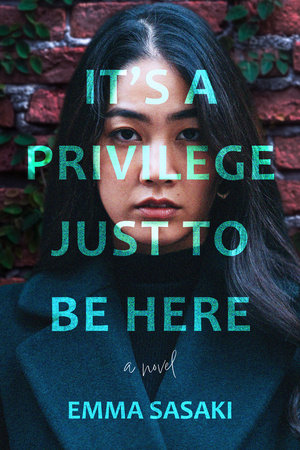
It’s a Privilege Just to Be Here, by Emma Sasaki****

Emma Sasaki makes her fictional debut with the darkly amusing story of a mother and daughter caught up in a scandal at a prestigious private school. My thanks go to NetGalley and Dreamscape Media for the audio galley. This book is for sale now.

Wesley Friends School is the prep school to which presidents and other high placed politicos send their teens, a place where they are nurtured as completely as any hot house flower, and then sent onward, hopefully to an ivy league college. Aki Hiyashi-Brown abandons her PhD and accepts a teaching job there in order for her daughter, Meg, to be able to attend; otherwise the tuition would be impossibly expensive. The school is overwhelmingly Caucasian, and so perhaps it’s unsurprising that Aki finds her face prominently displayed on all of the promotional materials the school disseminates, along with those of the few other teachers of color.

That’s all fine and good until the day when the fence outside is vandalized by spray paint reading, “Make Wesley white again.” Aki is ready to do what she’s been taught from the cradle: keep her head down, do her job, and not say anything. But Meg and her classmates have no intention of remaining silent. Before she knows it, Aki finds she has been assigned to be the head of the Racial Equity Task Force, a token job on a token committee that has more to do with appearances than with any actual desire for change.

She is given a script to follow and told not to offer up any of her own observations or opinions.

Soon, things spiral beyond the control of Wesley’s administration, and Aki is caught between doing what her bosses want her to do, and supporting her daughter and students in their quest for genuine change.

This book, which the author notes is based on her own experience, has me at hello. Though I am not a wealthy or connected individual, I did send my child to a private school for a few years, one which was very white, and which used my half-Japanese daughter’s face on its pamphlets a lot. I can’t not read this book, and whenever I have earbuds in, this is what I listen to. I find it well paced and engaging, setting just the right tone without over-moralizing or becoming strident. There are some great side characters as well; I like Aki’s husband and mother particularly, and appreciate the bond between Aki’s half-Japanese daughter and her Issei (first generation) grandmother.

However, my own husband is also Issei, and I asked him to listen to the reader during one of the many passages in which the grandma speaks to Aki in Japanese. “Is this reader’s Japanese as good as I suspect?” I asked, somewhat proud of my first year Japanese skills. He listened to two lines, laughed, and shook his head.

For this, I really do have to knock one star off my original five star rating. Perhaps if I had a digital review copy I could have rated that version higher, but I have what I have, and it’s problematic. Nevertheless, I appreciate this novel and the message it delivers, and I greatly look forward to reading whatever Sasaki publishes next.

Like the Appearance of Horses, by Andrew Krivak****

I first read Andrew Krivak in 2017, when The Signal Flame was published. His glorious prose is something few authors can match. Here we have another novel involving many of the same characters and to an extent, the same setting. I am happy to get back to it.

My thanks go to NetGalley, Highbridge Audio, and Bellevue Literary Press for the review copies. This book is for sale now.

One of the things that initially drew me to Krivak’s writing is that he occupies a sparsely populated niche with his historical fiction. Who else writes about the Romani Resistance of World War II? Who writes about Romani refugees? Most authors are as susceptible as anyone else to trend following and bandwagonism. Krivak is not. He sets his own course, and he does it with spellbinding prose and sterling self-discipline.  

Here we see three generations of men that go to war, starting with World War II, then to a P.O.W. camp during the Vietnam War, and finally, to Iraq. This is a rough read, friends. There’s just about every possible trigger, so if you’re protecting the more tender parts of your mind, you may need to pass on this one. On the other hand, if you are looking for a catharsis to bring about a good ugly cry, rush out and get this book right this minute.

Krivak doesn’t write page turners; instead, he draws me in and makes me forget where I am and what I was doing a minute ago. His work is deeply absorbing and at times, moving.

Narrator Jamie Renell gives a flawless performance here. The book is tightly plotted enough, however, that the listener needs to pay careful attention. I had both the audio and ebook formats, and I still got confused once in awhile and had to backtrack.

If I could add one more thing to ice Krivak’s literary cake, it would be a well developed female character. The women that appear here seem to have been planted for the purpose of developing the male characters. That’s not necessarily a bad thing, and Krivak has crafted this story around a set of actual people and events, though he says it’s a loose representation, and so I can see why he chooses to focus on the men that go to war; yet, since he is taking a few liberties anyway, would it hurt so very much to send off a soldier girl?

This complaint is a minor one. Krivak is a badass, and I do recommend this book to you.

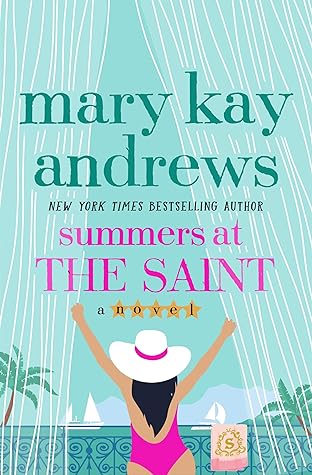
Summers at the Saint, by Mary Kay Andrews****

Summers at the Saint is the latest novel by veteran author Mary Kay Andrews. I am not usually a fan of what I think of as light and fluffy books, but over the last couple of years, I’ve developed an appreciation for this author’s work. This story centers on a fashionable beach resort hotel and those that run it, with the focus primarily on the women. It’s a good summer read—not a bad choice to take to the beach, actually. My thanks go to NetGalley, Macmillan Audio, and St. Martin’s Press for the invitation to read and review. This book will be available to the public May 7, 2024.

Our protagonist is Traci Eddings, the young widow of Hoke Eddings, heir to the Saint Cecilia resort. Traci has inherited part of the business from her late husband, but there is a power struggle in play as the book opens. The old man is dying, and the surviving heirs are scheming. The business seems to be on the rocks, or near to it, and Traci can’t figure out why. She makes several smart changes, hires good people, and yet…

We have interesting side characters. Parrish is Traci’s niece, whom she persuades to postpone her studies for one more summer as Traci implements the changes that are needed. We have the new cook, Felice, as well as Livvy, a capable young woman that Traci hires away from the diner where she is waiting tables; and we have Livvy’s mother Shannon, who used to be Traci’s best friend. Shannon completely dumped Traci many years ago, leaving Traci bewildered and hurt; she still feels that way. Lastly we have Whelan, who is working at the Saint as a pretext while he tries to unravel the circumstances that led to the death of his younger brother at the resort’s pool many years ago.

The book’s strongest aspect is the side characters, particularly Felice, Shannon and Livvy. Other characters are one dimensional, either entirely good or entirely awful. Rather, this is a plot based book. There are a great many moving parts, with a blend of genres that include romance, mystery, beach reads, women’s fiction, and contemporary family drama. It is in weaving the many pieces of this story that Andrews’s experience shines through. If there is a plot element that conflicts with another, or that is simply illogical, I didn’t spot it. At the end, everything and everyone is accounted for; in fact, I might have preferred not to have every single aspect resolved, and every positive character quite so perfectly happy. I seldom argue in favor of ambiguity, but in this case, it wouldn’t hurt.

I was fortunate enough to receive both the Kindle and audio versions, and once more, Kathleen McInerney does a fine job of narration with all of the women characters and the internal monologue. Her voice isn’t deep enough to voice the men’s characters well, and I suggest adding a second, male narrator next time around.

The story held my attention quite nicely as I did my morning bike ride, and I recommend it to Andrews’s loyal readers, and to those that enjoy a good beach read.

The Morningside, by Tea Obreht****

In 2019, Tea Obreht blew me away with Inland, a work of historical fiction—alternative history actually—so creative that I haven’t stopped thinking about it to this day. Her new book The Morningside is a dystopian novel that, while not as remarkable as the previous effort, is both intriguing and memorable.

My thanks go to NetGalley and Random House for the invitation to read and review. This book is for sale now.

Our protagonist is Silvia, and she and her mother are refugees from a homeland made dangerous by violent political turmoil. They were invited to live in The Morningside, a once grand old building fallen into disrepair by the flooding that comes with climate change. Silvia’s aunt, who arrives first, and her mother are to be caretakers and participate in the resettlement program.

At eleven, Silvia is full of questions. Her mother never talks about her father or about the past. Her aunt has photographs and stories; her mother is like the librarian that just wants everyone to stop talking. She is consumed by her fears. We readers have to wonder which of them is more realistic. Should the aunt stop blabbing, or should Sil’s mother get a grip? Silvia clearly prefers her aunt’s approach, but then, Sil is just a kid.

There’s a considerable wait list to get into school, so in the meanwhile, Silvia is bored, and bored kids have a tendency to get into trouble. Silvia becomes obsessed with the reclusive artist that lives in the penthouse. Nobody talks to her, because nobody is supposed to bother her. The one obvious thing about this neighbor is that she leaves home at the same time each day with her three dogs.

Silvia becomes convinced that the woman is a sorcerer whose dogs transform into humans—her three sons—for a portion of each day. My initial reaction is the same as her mother’s: don’t be ridiculous, Sil. Leave that poor woman alone. But then it dawns on me that this is fiction, after all, and this is Obreht, so…could the woman have supernatural powers?

Silvia is assisted twice in her spying mission, first by a neighbor that goes by Lam, and that is willing to exchange a pass key to enter the artist’s home for mail that was sent to him after he moved out.  I wonder about this; an eleven year old is approached by an adult man for secret purposes. What could possibly go wrong?

Her other confederate is a girl her own age whose family moves into The Morningside.  How starved Silvia has been for a peer!  Yet this girl is even gutsier than Silvia, and she leads her into dangerous waters more than once.

That’s all I’m going to tell you, except that the story is fresh and original, and although I tend to be skeptical when it comes to this genre, there is never a moment when I find myself stepping back and saying, no way.

With a young protagonist, one might be tempted to say this is for young adults, and that’s possible; yet the vocabulary is advanced enough that the younger reader had better have extraordinary skills in reading and comprehension, not to mention stamina.

I recommend this novel to those that love the genre.

Darling Girls, by Sally Hepworth****

Sally Hepworth writes creepy, spooky stories involving families, and I have friends that swear by her, but this is the first of her books that I’ve read. My thanks go to Macmillan Audio, St. Martin’s Press, and NetGalley for the invitation to read and review. This book will be available to the public April 23, 2024.

Jessica, Norah and Alicia are closer than most sisters, even though they are not biologically related. All three spent most of their formative years at an Australian foster home called Wild Meadows, under the gimlet eye of Miss Fairchild, an abusive foster parent. Miss Fairchild was adept at keeping up appearances, but once a visitor—an infrequent occurrence—was gone, the place got dark. The woman was cruel and unpredictable, dreaming up horrifying punishments for even slight perceived infractions. Open rebellion was unthinkable. But it was when she began accepting babies that they resolved to turn her in.

Now all are grown, but they remain tightly bonded, and the call comes in: bones have been found under the foundation of the razed house. They must all report to the local police, which in turn means returning to the vicinity of Wild Meadows.

I can see why this author has such a loyal following. The way the narrative flows is flawless, and although we transition often from the past to the present as well as between the three girls’ stories, there’s never even momentary confusion. The list of characters is kept manageable, and all of them are believable. I begin reading via audiobook because that’s the version that was offered me, but once I began, I asked for and received the digital galley also. Usually this is a necessity in order to keep up with what I am hearing, but I scarcely needed it. Narrator Jessica Clarke provides the perfect listening experience.

For me, the joy of this well written novel is somewhat dampened by the horrors of the girls’ experiences. The child abuse is so cruel, and so specific that I sometimes stopped listening early and went away with a ball of lead in my gut. I suspect that this is something most likely to be experienced either by those that were themselves abused as children, or—like me—those that have worked with such children. Although part of me still wanted to know what came next, another part of my thought that if I wanted this kind of nightmare, I should just go back to work!

Reader, you probably know what you can read and what you should stay away from. If this sort of novel is unlikely to haunt you, go for it. I doubt there are many that can do this thing better. With that caveat, this book is recommended to those that enjoy the genre.

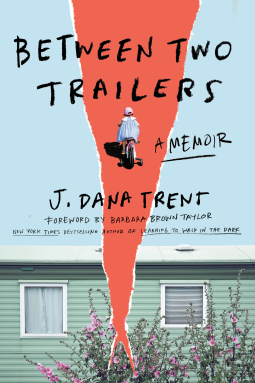
Between Two Trailers, by J. Dana Trent*****

And you thought your childhood was difficult.

Dana Trent is the child of two drug addicted schizophrenics who met and fell in love on the psych ward. The fact that she lived to adulthood is astonishing. Her story is captivating; my thanks go to NetGalley and Random House for the invitation to read and review. This memoir will be available to the public April 16, 2024.

“’Kids make the best hustlers,’ King told me the week after I was expelled from preschool. He lifted me onto the counter and coated his arms with palmfuls of petroleum jelly from the biggest Vaseline tubs Walmart sold. Then he greased up mine. ‘No one expects a runt in a Looney Tunes T-shirt to shank you,’ he explained. ‘Budgie!’ he said and pointed to my chest, then sealed my street name with a Vaseline cross to my forehead. ‘Budgie,’ I parroted, finger to my own chest…‘Guns are for idiots,’ he added. ‘Here.’ He handed me my first pocketknife, a foldout two-inch blade with a horse and buggy painted on the handle. Knives teach you to accept the inevitable. ‘You’ll get stabbed,’ he said, ‘but you’ll survive. No big deal.’”

The nickname “Budgie” was chosen because she was his lookout on drug deals. She would ride along with him, his trunk stuffed full of drugs, and when he got out, she was stationed on the highest available vantage point. If she saw someone—an ambush, the cops, anyone—she was supposed to sing like a bird. (Even other drug dealers and manufacturers questioned the wisdom of hauling a three year old on such expeditions, but King, as her father was known, was not easily influenced.)

At such moments, one might wonder where her mother was. Usually her mother was either unconscious in bed, or on the way into or out of that state. Because her father was awake and slightly more predictable, Dana considered him the more reliable parent. Before she was old enough for kindergarten, she understood that it was up to her to take care of The Lady.

My initial response to this scenario was to be bitterly angry at whoever decided to expel this child from preschool. Boom, there went that tiny girl’s one tie to the safer, saner world. How could anyone look at her behavior, her clothing, her hair and not call Children’s Services? I’m still fuming.

Miraculously enough, Trent made it to adulthood, and after years and years of therapy, she is able to lead a normal life. She’s achieved a remarkable amount, with a Ph.D. to her credit along with a solid career in academia.

And she can write! There is never a slow moment in this memoir, a hair raising read that I brought out at lunchtime, but never at bedtime. There is very little by way of dialogue, and that makes the swift, steady pacing even more remarkable.

Between Two Trailers is one of the year’s best reads. Highly recommended.

The Great Divide, by Cristina Henriquez*****

I found The Great Divide, by Cristina Henriquez, on a short list of most anticipated novels of 2024. I don’t like to get shut out when a book gets this much buzz; then there’s the added draw of an unusual setting. The U.S. doesn’t see a lot of fiction published that’s set primarily in Panama during the early 1900s, and so that sealed it. My thanks go to NetGalley and Harper Collins for the review copies, both audio and digital. This story lives up to the hype, and I recommend it to you.

I am not so sure about it at the outset. There is a robust quantity of characters that are important to the story, and each of them is given a brief chapter all to themselves. I wonder whether they will ever intersect, or if this will turn out to be a collection of short stories, but before much longer, characters are meeting other characters. They don’t all end up together in the end, but we can see the ties that have formed. There are a lot of people to keep track of, and for me, having both the print version and the audio is tremendously helpful. Robin Miles narrates in a way that is natural and fluid, and I don’t notice much of what is around me when I listen to her. But once in awhile a character is mentioned and I draw a blank; here is where the Kindle version is essential, because I highlight the names of each of the characters, and this enables me to instantly flip back to where they were introduced to us without having to stop listening. Eventually, of course, I no longer need to do so, but knowing that I can makes for stress-free reading.

I am engaged with these characters, each of whom feels real to me, and I groan when I see them get into trouble, and sigh with relief once they are in the clear again. The ones that I care about most are a father and son that are estranged from each other, neither wanting to stay that way, yet both of them incorrectly interpreting the silence of the other. As we reach the climax, I can tell there are three ways for this situation to resolve: they can reconcile; one of them can die; or the son can decide to follow another character back to the U.S.A. without reconnecting with his dad.  It only now occurs to me that there was a fourth possibility, which was to leave them still estranged at the end; but by this time, Henriquez had shown herself to be a better writer than that, and while I won’t tell you how they wound up, I will say that she didn’t leave her readers dangling.

Because this is an intricately woven tale with a lot of equally important characters, I’m not including any quotes, but I will say that Henriquez is a talented writer, and anyone that loves good historical fiction should get this book and read it. This applies even more so to those interested in Latin American history and the building of the canal. I hadn’t read her work before, but she’s on my radar now, and I look forward to seeing what she writes next.

The Hunter, by Tana French*****

In 2020, Tana French gave us The Searcher, the first in the Cal Hooper detective series. By that time I was already an established fan, but I loved that book particularly well, for reasons I’ll revisit in a moment. Now we have the second in the series, The Hunter, and if anything can reduce this crusty old English teacher to a blushing fan girl, this is it. Two books in, this is already on my short list of favorite series. My thanks go to NetGalley and the Penguin Group for the review copy. This book will be available to the public Tuesday, March 5, 2024.

The series debut introduced the characters, with the protagonist being a retired Chicago cop that found this tiny Irish village on vacation and, needing a new home far from his ex-wife, yet affordable, discovered a bargain fixer of a home and decided to stay. The story’s main problem revolved around a nearly feral tween that kept popping up at Cal’s place. The scrappy little stinker that was relieving Cal of food, occasionally, and doing other unsettling things turned out to be a girl; her name is Teresa, but she’s known as Trey. Her family was in dire straights following the departure of Trey’s father; her brother had left, intending to return, but never had. The mystery was where Trey’s brother had gone, what had become of him, and why. In the interim, she became greatly attached to Cal, who enjoyed her company and taught her some woodworking skills, but also kept a careful distance, lest rumors start and grow.

Now Trey is a bit older, and she is more civilized. She is close to both Cal and Lena, the local woman that Cal has been seeing. But as life settles into a civilized hum, one that would be comfortable had climate change not created a drought that has local farmers at the near end of their wits and their bank accounts, the unexpected happens once again: Johnny Reddy, Trey’s no-account father, has returned. Cal is prepared to step back, if need be, in case Trey wishes to bond with her actual dad rather than himself. Meanwhile, Johnny vows to visit Cal with some local moonshine, and “make a night of it.”

“Trey says nothing. If he does that, she’ll get Cal’s rifle and blow his fucking foot off, and see can he make his way down the mountain to Cal’s after that.”

Johnny never succeeds in bonding with Cal, who doesn’t like the look of him. “Johnny gives him the urge to pat him down and ask him where he’s headed. There are guys like that, who flunk the sniff test just going to the store; it’s a good cop’s job to work out whether they’re actually doing something hinky, or whether it’s just that they will be sooner or later, probably sooner.”

The village is a tiny one, and outsiders are few. Everyone in the vicinity knows that Johnny’s back; everyone wonders what he’s up to. They haven’t long to wait; he’s brought a man with him, one whose family once lived here, or so he says; and the man is interested in seeing if there’s gold on some of the local properties. “He has a rich man’s smile, easy and understated, the smile of a man who isn’t required to put in effort.”  Now the question is whether this “plastic Paddy” is a shyster trying to rip off the locals, or if he is someone that Johnny is seeking to fleece. Meanwhile, Trey has a different agenda, a private one.

The thing that makes this story so much better than your standard mystery is the characterization. If you are in search of a thriller that is all page-turning action, this isn’t your book. However, if you love a layered story with complex, convincing characters, this is for you. I said in my previous review of the first in the series that Trey is what makes an otherwise solid story a golden one, and that’s even truer here. One could even argue that it’s really her series, with Cal existing as scaffolding. Time will tell.

In particular, though, anyone that works with, or has worked with at risk youth cannot, must not miss this story. French has taken hold of my heartstrings hard, and I don’t want her to let go. Highly recommended.