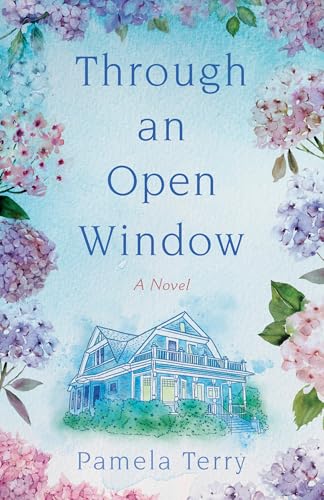
Through an Open Window, by Pamela Terry*****

“When you’re the last one with memories it’s like trying to hold on to hot sand.”

Author Pamela Terry never misses. Her debut, The Sweet Taste of Muscadines, forged such an emotional connection in me that if someone had told me they didn’t like it, I might not have cared for them as much as before. The same held true for her next work, When the Moon Turns Blue, which was every bit as good if not better. And now, with her new novel, Through an Open Window, I know that I will follow this author anywhere.

My thanks go to NetGalley and Ballantine Books for the invitation to read and review. This book will be for sale August 19, 2025. If you are female and have a beating heart, you should get it and read it.

We open with a scene from 1956. The local sheriff rescues two small children from a scene of horrific carnage; the baby girl is surrendered to the social worker before they find the little boy. The sheriff and his wife have been unable to have children, and want them so badly that instead of reporting the boy also, he takes him home and they keep him.

Cut forward now to the fictional town of Wesleyan, Georgia. A family is grieving the loss of its patriarch, Lawrence Elliot. His widow, Margaret is the first to receive a visitation—not from Lawrence, but from Great-Aunt Edith, who has been dead for years. Aunt Edith wants her to know something. And in fact, other family members will also see her at various times, in various places, but it’s not the sort of thing one shares with others. But Edith isn’t leaving until her message is received and understood.

As we see Margaret and her three adult children cope in different ways, we also see the interplay of their relationships to each other. This story is loaded with character development, and I believe each and every one, even Jubal, the rescued Clumber Spaniel that comes to live with Margaret. (I had never heard of this breed before, and now I kind of want one. Someone stop me!)

Events roll forward, and slowly we learn what it is that Edith is trying to convey, as the family does, and we find the tie-in to the prelude. It’s done brilliantly! Along the way, the author’s voice comes through in undeniable word smithery that forces me to highlight way, way too many passages to quote here. I experience the entire gamut of emotion, and when I near the ending, I am torn, wanting to read more slowly so that the book won’t end, but also needing desperately to know what is coming next.

The only possible improvement would be if Terry could write, and write up to the standard she has established, as fast as I can read, because I cannot wait for her next novel! She has become a favorite author, one I’d pay to read if I couldn’t do it free of charge. Highly recommended.

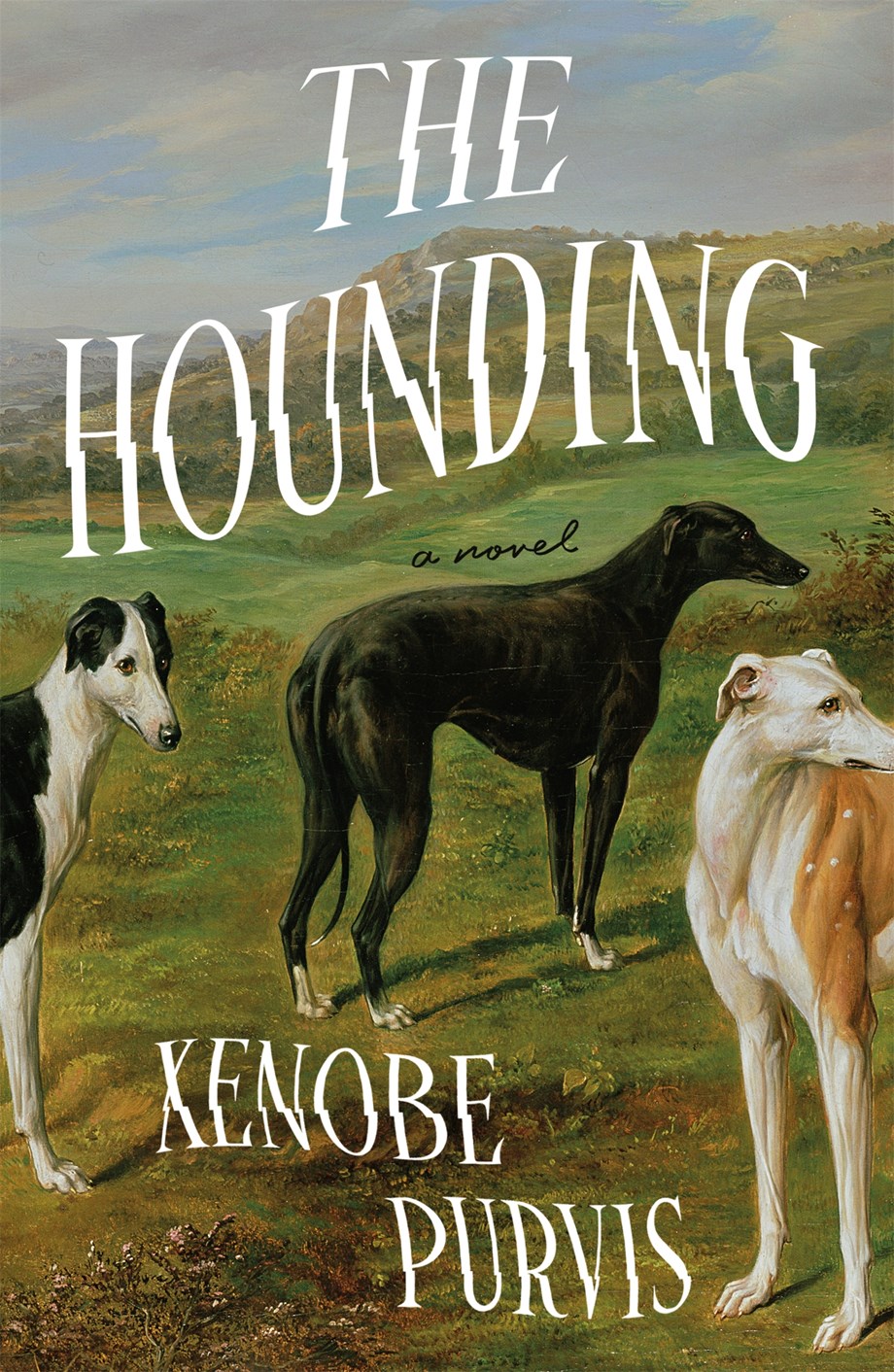
The Hounding, by Xenobe Purvis***-****

Who could walk away from this book cover? The Hounding, the arresting debut by Xenobe Purvis, is a story set during summer in eighteenth century England, in a tiny hamlet. Five motherless girls are given more freedom than is customary, and a rumor takes hold that the girls turn into dogs and wreak havoc on the village of Little Nettlebed.

My thanks go to NetGalley and Henry Holt for the invitation to read and review. This book will be available to the public August 5, 2025.

The Mansfield girls are being raised by their grandparents; their parents are long dead. But now, their beloved grandmother has died as well, leaving them in the care of their elderly grandfather, who is almost blind. It’s not a great summer for anyone else, either; there’s a dreadful drought that affects agriculture, and the riverbed is nearly dry. Then one day, Pete, the ferryman, tells the local gossip that he has seen the Mansfield sisters transform into dogs! Soon the rumor has spread, and others report that they’ve seen it happen, too; everyone wants to get in on the excitement.

The story tells a cautionary tale, not a new one, but a worthwhile one about the way society sometimes victimizes people that are a little different from most. There’s not much by way of character development, but this book is not about character or setting, it is purely plot-based. Purvis is a fine wordsmith, and since I was lucky enough to have both the digital and audio galleys, I found myself drawn into the narrative, first by the text, and then by the audio. Reader Olivia Vinall does a splendid job, and I recommend the audio version for those that enjoy the medium.

My only sorrow is that although this book is engaging, it could have been so much more. There are opportunities here that are left unfulfilled, and the plot twist at the end destroys the message that has been so carefully crafted up to that point. I find it frustrating. This is a good read, but it could have been a great one.

With that caveat, I recommend this book to you.

What Kind of Paradise, by Janelle Brown*****

What if the Unabomber had had a daughter? Thriller writer Janelle Brown spins a fascinating, credible, and memorable story based on this idea. My thanks go to NetGalley and Random House for the invitation to read and review. This book is for sale now.

Jane Williams grows up in a remote mountain cabin with her father; her mother died many years ago, so it is just the two of them. Once in a rare while she is allowed to accompany him into town to visit the bookstore, maybe even get an ice cream cone, but otherwise, she is cut off from society. She has no friends, apart from a casual friendship with the bookstore owner’s daughter; she has no play dates, no television, no computer. She is homeschooled. 

But every now and then, her father will wake her from a sound sleep in the middle of the night. They have to go! She grabs her bugout bag and goes through their established routine, escaping via the tunnels he has built beneath their cabin. Her heart pounds, her chest heaves…but hey, it turns out to be only a drill, after all.

Her father is a writer, composing political tracts that he sells in small, independent bookstores that carry zines. And so, for most of each day, he writes, she reads, and when the weather permits, she watches ants build hills, picks wildflowers, and leads the sort of bucolic life he has planned for her. But then, things change.

The story is told from Jane’s point of view; when Jane longs for even a photograph of her dead mother, anything at all to tell her about the other half of her beginnings, I feel it viscerally. Poor kid. But things are not necessarily as they appear, and as she grows to adulthood, Jane finds clues, small tidbits she’s not meant to find, and each morsel leaves her ravenous for more.

The story unfolds in the 1990s with occasional flashes of Jane’s childhood the decade before, so while it’s not historical fiction, it does have a retro vibe, one that Brown provides with absolute accuracy. We see small snatches of the events that took place in the U.S. during that time, but Brown is too good to rely on pop culture, so these are meted out sparingly, only when needed, never as a crutch.

This is a fun read, and it’s unlike anything I have seen written recently. I highly recommend it to fans of the genre.

Far and Away, by Amy Poeppel****-*****

Amy Poeppel is the queen of intelligent feel-good novels. Her newest work, Far and Away, is about two women that have never met, one in Dallas, one in Berlin, who exchange houses for several months. The deal is done fast, as both of them have a short time to line something up, and soon they will both regret their hasty decisions.

My thanks go to NetGalley and Emily Bestler Books for the invitation to read and review. This book is for sale now.

One of the things I love best about Poeppel’s writing is her ability to create a complex plot with a lot of moving pieces, along with believable, sympathetic characters; yet somehow, the whole thing is easily understood, never confusing. Our story starts with Lucy and her family in Dallas, Texas. Her eldest child, Jack, is about to graduate from a private high school, then attend M.I.T. At the last minute, however, he is expelled unceremoniously. He’s done something dumb, and it’s been interpreted as something more sinister. He isn’t even offered a chance to explain or to defend himself. And though there is a lot of other business involving other characters, I enjoy this part most for the message it sends us at a time it’s desperately needed. Before you judge someone, take a moment to listen. Ask some questions before you hurl accusations and seek vengeance. If the behavior is as deplorable as you think it is, there’s still plenty of time to accuse and avenge afterward.  We in the U.S. and also Europeans can benefit from this one tasty nugget. Plenty of others can, too.

On the other side of the world in Berlin, Greta’s husband Otto has been invited to teach for a term at a college in Texas. He’s accepted without even discussing it with Greta; he has to go right away! Where will they even live? Otto suggests a hotel; Greta is having none of it. In her desperate search for last minute housing, she is connected with someone that knows that Lucy has decided, quite suddenly, to relocate for the summer. The accusations against Jack have turned to harassment and vandalism, and she’s ready to get out of Dodge. Her husband is incommunicado, performing a simulation for NASA, a part of which is to be cut off from everyone else. Mason still thinks that Jack graduated, and that M.I.T. is Jack’s next step.

And so it is that Lucy and her brood relocate to Greta’s apartment in Berlin, and Greta and Otto take up residence in the massive experimental home in Dallas owned by Lucy and Mason. Not a lot of details have been exchanged about either place; there hasn’t been time. So, they get on the plane, and everybody gets what they get, to their sometimes consternation.

There are many hilarious moments here; I especially enjoy the foreign language errors made, both English to German, and German to English.

If there were one thing I could change, I’d rework the epilogue. There’s a considerable jump in time, but the chapter heading doesn’t tell us, and so I am taking in details while doing some mental calculations. That’s not so bad when it’s at the start of a book, but at the end, it’s disorienting and breaks the flow. I also feel as if there were too many things tied up with too many bows. A kindergarten teacher told me once that the key to having a kindergartner paint, was to know when to stop them. It may also apply to adults and their writing.

Nevertheless, I loved this book! Part of the magic is due to Poeppel’s understanding of human nature, which is inherently good, and part of it is her hilariously quirky humor that often drops in, seemingly out of nowhere. Highly recommended.

This American Woman, by Zarna Garg*****

Zarna Garg is an immigrant, born and raised in India. She was rich, except for when she was poor; more on that in a minute. Ultimately, she came here for the same reason many people do: she had to make a break for it.

My thanks go to Random House and NetGalley for the invitation to read and review. This book is available to the public now.

Garg works now as a stand up comic, but she has done many things, and worn many hats. First, of course, she was a runaway bride, more or less, bailing from India before her very wealthy father could marry her off as part of a business arrangement.

“If I hadn’t done that, right now I would be a Mumbai grandma in an arranged marriage to a much older, boring industrialist. I would be draped in brocade silk saris, but I would have a giant padlock on my big mouth.”

Garg’s immigration—fast and sneaky, which was the only possible way–was made easier by her older sister, who was already living in Ohio. Since then, Garg has finished law school and passed the bar, married another Indian immigrant, had three children, and done a number of other impressive things, but it was her own daughter that asked her mother whether she’d ever considered a career in comedy. It takes someone that’s mentally tough to succeed in that realm, but the streets of Mumbai, where she’d lived hand-to-mouth for two years as a runaway teen following her mother’s death, prepared her well, so she was ready for the gritty world she was entering. She explains,   

            “…I had played a show at a club on the Upper East Side and a cockroach fell on my head. The night before that, as I walked to the stage I had to step over a communal puddle of throw up from a bachelorette part who refused to leave. They just kept throwing up and laughing. So far my comedy career had been physically revolting—but it was still my dream! Now here I was in my very first New York City green room that smelled like air…I walked out on stage. Two thousand white ladies politely applauded. Oh my god. What was I doing? Would this audience even understand my humor? For them India is incense and chanting. Were they ready for a foul-mouthed real-life Indian auntie who hated meditation? “

I wondered, after watching some of Garg’s stand up work online, whether the book would be a duplication of her routine, more or less; it’s happened with other comic authors. But although there’s a small smattering of shared content, the memoir is mostly unique, and I never had the sense that I’d already seen this before.

Garg is funny enough that I’ve let her speak for herself here. Anyone that needs to laugh hard, and that enjoys reading about the disorientation and culture shock experienced by those new to America should read this book. Highly recommended!  

Broken Country, by Clare Leslie Hall*****

I am late to the party, but it would be a crime not to review Broken Country, the stirring love story by Clare Leslie Hall that can make even the hardest cynic weepy-eyed. My thanks go to NetGalley and Simon and Schuster for the review copy. This book is for sale now.

The story is set in a small village in Britain during the mid-1900s. The setting bounces back and forth between the present day and the past; it’s easy to keep track of, partly because the author takes care to delineate which chapter is which, and partly because there are few characters to keep track of. Our protagonist is Beth, and she and her husband, Frank, are farmers, have lived in the same community for their whole lives. A farm accident claimed the life of their only child, Bobby, a few years before, but they are both still fragile, ragged in their grief.

Then, oh my my, who comes back to town but Beth’s old flame, Gabriel, a man that came from money and went on to make a name for himself as a novelist. Gabriel has inherited the family house and land, and in the wake of his divorce, has brought his son Leo to live here. Here. Right next door to Beth and Frank.  And to complicate old feelings all the more, his son Leo is about the same age as Bobby was when he died.

Is it possible to be in love with two men at the same time? Beth would tell you that it is. Frank can see what is unfolding, and he tries to reason with Beth, but she assures him that everyone is grown up now, the past is the past, and there’s no reason that they and their new old neighbor cannot be friends.

Well.

I seldom reach for novels like this one, wary as I am of schmalz and schlock, but reader, I see none of either one in this story. The writing is disciplined and restrained, yet oh, so intimate. When a formula or trope comes into view, Hall goes the other way instead. And though I may have thought I knew where we would all end up, I was mistaken; the ending is beautifully planned and executed.

Because I had fallen a bit behind, I checked out the audio version from Seattle Bibliocommons; reader Hattie Morahan does a stellar job with the narration.

Highly recommended.

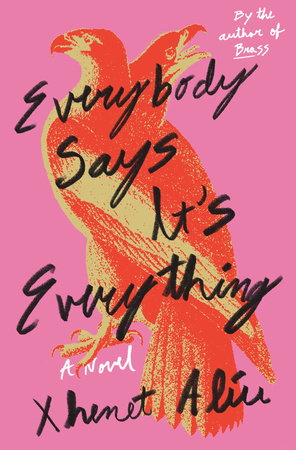
Everybody Says It’s Everything, by Xhenet Aliu**-***

2.5 stars, rounded upwards.

Xhenet (pronounced similar to “Jeanette”) Aliu is the author of Brass, the award-winning debut novel that was one of my favorites of 2018. When I saw that she had a new book, Everybody Says It’s Everything, I was so excited that I bounced up and down in my desk chair. My thanks go to Random House and NetGalley for the invitation to read and review; sadly, I found this book disappointing. The sophomore slump is real, friends.

Our story centers—to the extent that it has a center—on adopted twins, Drita and Pete, who’ve been leading quintessential American lives. Drita was a star student, and is in the midst of graduate studies when she is called home to care for her mother; Pete—actually Petrit—has been in various sorts of trouble, and now his girlfriend and son have landed with Drita looking for help, since they aren’t getting any from Pete. The story takes us through their native Albanian roots and heritage, through the war in Kosovo, and through Pete’s discouragement, hardship, and addiction.

I have a hard time connecting with any of these characters. The dialogue drags, and the poignant qualities that I found in Brass are nowhere to be found. Both are sad stories, but the protagonist in Brass had my whole heart and my full attention, whereas these characters left me feeling as if I was eavesdropping on one more group of depressed, underserved people, but also edging towards the door. I was just straight up bored, a word I rarely use in reviews. I continued all the way through because I was sure that it would turn brilliant any minute; it never did.

I look forward to seeing what this author writes next, because she has proven that she has the ability to connect with readers in general and me in particular, but I can’t recommend this book to you.

The Family Recipe, by Carolyn Huynh*****

“We all need to feel needed. Otherwise, what’s the point of living?”

Carolyn Huynh made her authorial debut in 2022 with The Fortunes of Jaded Women. It was one of my favorite novels not only of that year, but of all the thousand-plus galleys I have read since I began reviewing. She’s back again with The Family Recipe, and it’s every bit as good as the first. My thanks go to NetGalley and Atria Books for the invitation to read and review, but make no mistake: I would have hunted this thing down and bought it with my Social Security check if it came down to it. I wouldn’t have been sorry, either.

This book is available to the public now.

Once again, our protagonists are Vietnamese and Vietnamese-Americans, mostly women, and once again, they are siblings and other family members that must come together; it isn’t a voluntary reunion. And that’s where the similarities between the first book and this one end.

Duc Tran, the patriarch, has laid out the terms by which his children may inherit his fortune. Once upon a time, he was the Vietnamese sandwich king, and in order to become his heir, each of his four daughters must relocate to a city she doesn’t want to live in, and revive a down-at-the-heels restaurant in a now undesirable end of town. It’s a contest; that is, unless Duc’s one son, Jude, succeeds in getting married within the one year’s time limit of the contest. If he can do that, he wins. (His sisters aren’t worried; who would marry Jude?)

The story is told from several points of view; these include the siblings, their uncle—a shady lawyer, and Duc’s best friend; their mother, who abandoned them when they were small, when her mental health collapsed, and never went back; Duc’s second wife; and briefly, Duc himself, who mostly serves as a mysterious figure that doesn’t even return to the States to lay out his children’s requirements, sending their uncle as his proxy.  As the story unfolds, we learn more about each sibling, and about the traumas they have experienced, as well as their successes.

The thing that makes it work so well is Huynh’s unerring sense of timing. It’s a dramatic tale, but it’s shot full of humor, as we see at the outset, when we learn the sisters’ names. Their father was a huge fan of the Beatles, and so the girls are named Jane, Paulina, Georgia, and (wait for it…) Bingo!

There are plenty of twists and turns, and the dialogue crackles. The internal monologues are mesmerizing. This book would make a fantastic movie.

Since I was reading this galley digitally, I highlighted quotes that I thought I’d like to use in this review, but there are 28 of them. Obviously, I cannot share them all here, but let that inform you, if nothing else here has, how much I love this book.

Highly recommended to anyone that has a beating heart, at least a passing interest in Vietnamese-American culture and/or family stories, and can use a few good laughs.

The Road to Tender Hearts, by Annie Hartnett*****

The Road to Tender Hearts is aptly named, possibly the most big-hearted novel of 2025. Author Annie Hartnett first came on my radar in 2022 when she published Unlikely Animals, which turned out to be one of my favorites that year. When I saw that she had a new one out, I tried to temper my expectations; not many authors can write more than one novel so hugely imaginative, genre defying, darkly funny, and yet heartwarming. And it’s true; not many can. As it happens, however, Hartnett can, and she has.

My thanks go to NetGalley and Random House Ballantine for the review copy; however, this is one of those rare instances where I would have paid full cover price if that was the only way for me to read it. It will be available to the public Tuesday, April 29, 2025.

Like Hartnett’s previous novel, The Road to Tender Hearts has quirky characters and at least one sentient animal with an internal monologue, but the structure of the plot is not as complex—a thing I am grateful for, near bedtime—and there are fewer characters and settings. Both are magical, and the distinctions show that Hartnett is not one to write the same book, more or less, over and over. She has more imagination than that; she may have more imagination than ten or twelve ordinary people.

Our protagonist, to the extent we can identify just one, is PJ Halliday. PJ was living the good life, a happy family, steady work, and the esteem of his neighbors in Pondville, Massachusetts, but then his elder daughter, Kate, died when she was eighteen, and PJ, and his marriage, came apart. Since then, he’s been doing two things: drinking, and giving away chunks of his huge lottery prize to every sad sack and every player that comes with an outstretched palm. But all that is about to change.

The son of PJ’s late brother, from whom he was estranged, dies, along with his wife, leaving two elementary aged children without a home or family. It seems that PJ is the only relative these little tikes have. Luna and Ollie aren’t sure that PJ can be trusted, since their own parents and skeezy grandpa never could be, but he actually has some strong if rusty parenting skills, and he is determined to clean up his act for them. There’s just one other thing he needs to do: his old high school flame, Michelle Cobb, has recently become a widow. He never forgot her, and now he intends to drive to her retirement community, Tender Hearts, in Arizona and see if he can try again with her. Two little kids in the car? No problem. And now, add his (still living) daughter Sophie, who figures she’d better keep an eye on him and the tots, and Pancakes, the cat that has adopted him.

Pancakes has a unique talent: he can tell who is about to die, and he goes to them, so that oftentimes, their last breaths are taken as they stroke a purring kitty. And so, Pancakes goes on the trip too, but every now and then, he disappears and is found on the lap of some elderly individual in poor health. (Or, not elderly. Hey, Pancakes just knows.) It’s no coincidence that the story begins and ends with Pancakes.

PJ is not always the best decision maker, and there are several times when I wince at the choices he makes. Sometimes, someone else swoops in and fixes his blunders, and at other times, they’re left hanging in the wind, and we have to wait to see how they will affect the story’s outcome.

Every single aspect of this book is golden. The dialogue flows naturally, and the internal monologues, all told in the third person omniscient, are authentic and full of character. In short—and I rarely say this—there’s not one single thing about this glorious redemption tale that I would change.

Highly recommended to everyone that loves fiction, and that has a beating heart.

The Second Coming, by Garth Risk Hallberg***-****

Garth Risk Hallberg is the author of the epic, memorable novel City on Fire, which was among my short list of favorites the year it was published. My thanks go to NetGalley and Alfred A. Knopf for the invitation to read and review his new novel, The Second Coming. This book is for sale now.

The story begins in New York City when Jolie, who is thirteen years old, is nearly struck by a train. Her parents are divorced, and she hasn’t seen her father in quite a while. Ethan is addicted, and his cravings make him unreliable. He makes promises he won’t keep, and Jolie has more or less given up on him, but her brush with death convinces him that she is in a darker place than her mother realizes, and that only he can save her.

Heaven help the girl!

The episode is the beginning of a twisted, bizarre odyssey. Jolie’s mother is distracted, not paying a lot of attention to her daughter, and Jolie becomes involved with a complete stranger, young man much older than herself. As a reader, I became frustrated and wanted to shake Jolie’s mama and tell her to wake up and take care of her kid. Just because they look grown at 13, doesn’t mean they are grown.

On glorious display here is Hallberg’s remarkable word smithery. The man has a gift, and he’s not afraid to use it. Portions of this book were a joy to read, simply because his prose is matchless.

For me, however, the plot and characterization of Ethan got in my way. Addicts and alcoholics in literature are becoming a trope, and I had vowed to myself to steer clear of them. I read the synopsis of this one and knew what I was walking into when I accepted the galley; I had hoped the author’s talent and skill would take a tired old plot point and make it seem new. He partially succeeded; I didn’t throw my reader across the room as soon as the addiction material appeared. But I didn’t love it the way that I loved City on Fire. Also, large portions of this are in epistolary form, from letters that Ethan writes to his daughter, and although they have been edited down considerably between the galley I read and the polished, finished result, they still got in my way.

So, this is a competent effort, but not a magical one. If you enjoy fiction with addicted characters, or if you like books about fathers and daughters, this book may be a happier experience for you than for me. However, I was expecting great things, and I came away feeling somewhat disappointed.