I’ll Be Right Here, by Amy Bloom***

I’ve been a reader of Amy Bloom’s novels for decades, and so when I see a new one is coming out, I leap, usually without even checking out the synopsis. Just the author’s name is enough to get me moving. This time was a little different. I began reading, but had trouble engaging, and my mind wandered. I decided to get the audio from the library, once the publication date had come and gone, and that was how I eventually finished it.

My thanks go to NetGalley and Random House for the invitation to read and review. This book is for sale now.

We start out in Europe during World War II. Gazala emigrates from Paris to New York, and becomes friends with a pair of sisters; later Samir, Gazala’s brother, joins her. Now here’s where it gets icky, (to use a highly literary term.) Gazala and Samir become a couple. They don’t tell people they meet that they are related, so they are accepted. Their friends also become involved in—to be charitable—unconventional relationships. In looking back at the synopsis, it’s all right there: “the lawlessness of love.” Hoo boy. It definitely is.

So, after forcing myself to finish listening to this thing, I nearly give it two stars, but the nugget that saves it for me is the concept that occurs when they are grieving a loved one, the notion of a “dead people’s party.” I love thinking about this! I have already started imagining my own such party, having lost too many people I cherished, when my sister dies. Her death is not altogether unexpected, as she was a great deal older than I am and has been in ill health for many years, but it still packs a punch. The thought of my sister’s dead people’s party—complete fantasy, as far as I am concerned, but who cares? Is what has helped me through a dark time.

So Bloom gets an extra star.

Nevertheless, I don’t recommend this thing unless the reader has carefully read the synopsis and is still interested. Yikes! I’ll probably read Bloom again, but this time I’ll be more careful before I commit.

Coffin Moon, by Keith Rosson*****

“One thing you can be certain of, boy. Things change. Even for those such as us.”

In 2018, I read a book by a promising local author titled Smoke City. It was complex and kept me on my toes, and all told, it was a good novel. Since I enjoyed it, the small publisher he was working with sent me another of his books, The Mercy of the Tide. I liked it, too.

Fast forward. I received a galley this year by the same author, but he was no longer working with the itty-bitty press. No, he was published by Random House. This made me sit up and take notice! My thanks go to NetGalley and Random House for the invitation to read and review Coffin Moon, the scariest straight-up horror novel you’re likely to find on the shelves this year. It will be available to the public September 9, 2025.

The premise is this: our protagonist, Duane Minor, is back from Vietnam. The year is 1975; the place, Portland, Oregon. His wife Heidi is living in an apartment over the bar her parents own, and Duane goes to work for them. Heidi’s 13-year-old niece, Julia, comes to join them as well after her mother is sent to prison. Duane is a bit shaky, following his tour of duty, but he’s sober, has pulled himself together, and things are going pretty well. That is, until the vampire takes over the bar.

That’s all you need to know of the plot to get started. In fact, I don’t even recommend reading the promotional blurb, because it’s better if you come to it on your own. What I will say is that this is not just any horror novel. There is more depth to it than you typically see, philosophical questions inextricably wound into the decisions that Duane and his niece must make. There’s also far more character development than I generally see in this genre. Finally, the word smithery Rosson brings to it makes this book grittier, more heart-rending, and far more thought provoking than other books of its ilk. Mr. Rosson was a good author before, but the brilliance of his prose has surged since his early work.

As I get older, I find I only have enough fortitude to read one or two horror novels each year; the rest of the time, I reach for other genres. If you are also an infrequent reader of horror, I strongly urge you to make this story a priority. It’s the sort of novel that stays with you long after the last page is turned.

But the sun is coming up; I must leave you.

My Friends, by Fredrik Backman***-****

“Being human is to grieve, constantly.”

Well now. Fredrik Backman’s many fans ought to brace themselves for his latest novel. The feel-good stories he’s written, and written brilliantly, in years gone by are nowhere in evidence here; those of us that look to this author to bolster our sense of optimism and to remember that human beings are innately good are not going to find it. This book is far darker than anything he’s written to date, and I have no idea what is behind this sorrow and misery sandwich, but I am sorry it’s come to this.

My thanks go to NetGalley and Atria Books for the review copy. This book is for sale now.

Our premise is that a homeless teen artist, grieving the death of her best friend, befriends an older, dying street artist who turns out to be someone famous and revered in the art world. The artist senses in her a kindred spirit, and so his last act is to have his friend and business agent sell everything that the artist owns in order to purchase back one of his most iconic paintings and give it to her after he dies, because “She’s one of us.”

Okay. It’s a stretch, but it’s fiction, and after all, Backman generally delivers, so I’ll suspend disbelief and roll with it.

Nearly the entire remainder of the book consists of the friend, whose name is Ted, spilling his and the artist’s past to the girl, whose name is Louisa. He’s traveling by train, and so he takes her with him. We hear all about their childhoods together, along with the two other friends that made up their tightly knit friend group. At one point she runs off, and at another, they lose the painting and the artist’s ashes, but these constitute minor breaks in the otherwise unending conversation, which is nearly a monologue.

It didn’t take me long to be heartily sorry I had ever taken the galley; I finally bonded with the narrative at about the 60% mark, and from that point until just past the 80% mark, I was reading because I wanted to know what would happen next, or be said next, rather than from a sense of duty. For most of the final 20%, I was watching the page numbers and wondering if this thing was going to end, ever.

It’s hard to rate a book like this, because so much of my disappointment stems from my earlier admiration of Backman’s works. If this was written by someone with whom I was unfamiliar, would I rate it a little higher? But then, if the author wasn’t known to me, I likely wouldn’t have picked it up in the first place. The stark shift in the author’s world view is shocking, and I am still not entirely over it. I can only recommend this book to you if you need a grief book, because anyone in need of a good ugly-cry will surely find it here.

The Road to Tender Hearts, by Annie Hartnett*****

The Road to Tender Hearts is aptly named, possibly the most big-hearted novel of 2025. Author Annie Hartnett first came on my radar in 2022 when she published Unlikely Animals, which turned out to be one of my favorites that year. When I saw that she had a new one out, I tried to temper my expectations; not many authors can write more than one novel so hugely imaginative, genre defying, darkly funny, and yet heartwarming. And it’s true; not many can. As it happens, however, Hartnett can, and she has.

My thanks go to NetGalley and Random House Ballantine for the review copy; however, this is one of those rare instances where I would have paid full cover price if that was the only way for me to read it. It will be available to the public Tuesday, April 29, 2025.

Like Hartnett’s previous novel, The Road to Tender Hearts has quirky characters and at least one sentient animal with an internal monologue, but the structure of the plot is not as complex—a thing I am grateful for, near bedtime—and there are fewer characters and settings. Both are magical, and the distinctions show that Hartnett is not one to write the same book, more or less, over and over. She has more imagination than that; she may have more imagination than ten or twelve ordinary people.

Our protagonist, to the extent we can identify just one, is PJ Halliday. PJ was living the good life, a happy family, steady work, and the esteem of his neighbors in Pondville, Massachusetts, but then his elder daughter, Kate, died when she was eighteen, and PJ, and his marriage, came apart. Since then, he’s been doing two things: drinking, and giving away chunks of his huge lottery prize to every sad sack and every player that comes with an outstretched palm. But all that is about to change.

The son of PJ’s late brother, from whom he was estranged, dies, along with his wife, leaving two elementary aged children without a home or family. It seems that PJ is the only relative these little tikes have. Luna and Ollie aren’t sure that PJ can be trusted, since their own parents and skeezy grandpa never could be, but he actually has some strong if rusty parenting skills, and he is determined to clean up his act for them. There’s just one other thing he needs to do: his old high school flame, Michelle Cobb, has recently become a widow. He never forgot her, and now he intends to drive to her retirement community, Tender Hearts, in Arizona and see if he can try again with her. Two little kids in the car? No problem. And now, add his (still living) daughter Sophie, who figures she’d better keep an eye on him and the tots, and Pancakes, the cat that has adopted him.

Pancakes has a unique talent: he can tell who is about to die, and he goes to them, so that oftentimes, their last breaths are taken as they stroke a purring kitty. And so, Pancakes goes on the trip too, but every now and then, he disappears and is found on the lap of some elderly individual in poor health. (Or, not elderly. Hey, Pancakes just knows.) It’s no coincidence that the story begins and ends with Pancakes.

PJ is not always the best decision maker, and there are several times when I wince at the choices he makes. Sometimes, someone else swoops in and fixes his blunders, and at other times, they’re left hanging in the wind, and we have to wait to see how they will affect the story’s outcome.

Every single aspect of this book is golden. The dialogue flows naturally, and the internal monologues, all told in the third person omniscient, are authentic and full of character. In short—and I rarely say this—there’s not one single thing about this glorious redemption tale that I would change.

Highly recommended to everyone that loves fiction, and that has a beating heart.

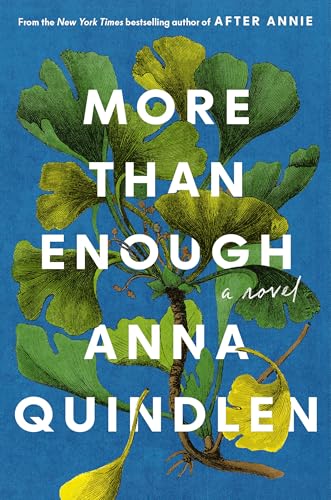
After Annie, by Anna Quindlen*****

After Annie tells the story of a family that is changed by the sudden death of the mother, a woman still in her thirties. My thanks go to NetGalley and Random House for the invitation to read and review. This book will be available to the public Tuesday, February 27, 2024.

I’ve read a number of books by this author, and I have come to notice a pattern. I read the synopsis, like the sentence I used to begin this review. I see what it’s about and shrug. Doesn’t sound like it would be all that special, but hey, it’s Quindlen, and I have liked her work before, so let’s give it a shot. After all, in past novels, the topics also didn’t seem engaging at the outset. One novel is about a family being forced to relocate due to eminent domain; another has to do with parking spaces in New York City. There’s a memoir about grandparenting, and another about—I kid you not—her dog. Nothing here seems all that appealing.

Yet in some ways, it is the very ordinariness of her subjects that draws us in. So many of us have had to move when we didn’t want to, and so we fought it; or we became so angry with a neighbor’s thoughtlessness that we fantasized about terrible revenge; or we dealt with a death that came out of the blue, striking down someone that was perfectly healthy, or that seemed to be. If we haven’t done any of these things, chances are excellent that someone else we care about has. By tapping into every day experiences and crises of various sizes, Quindlen finds commonalities.

But perhaps the most important feature of her books, particularly her novels, is the way that she crafts characters that are so visceral we would know them if we saw them on the street. Young Ali, the daughter who’s just beginning middle school, yet suddenly finds herself burdened by all of the things her mother did for the family, from child care to meals to housework, is so real to me that I nearly climb inside of her skin, and when Annie’s best buddy tries to tell Bill, Annie’s husband, Ali’s dad, that this isn’t okay and he blows her off, I want to cry out. We can see that he’s behaving selfishly, whether he knows it or not, because he is so poleaxed with grief. It’s hard to prepare a meal when you can’t stop crying. Hell, Bill can hardly go into the kitchen, because that’s where she died.

Grief was like spring, maybe. You thought you were getting out from under it, and then it came roaring back. And getting out from under it felt like forgetting, and forgetting felt like treason.

I began reading this story because I like the author, but it also serves as a grief book. I found this out when my sister died about halfway through. Unlike Annie, my sister was not in the prime of her life, nor was her death unexpected. She’d been horribly ill and in great pain for years on end. Her death was a relief, ending her pain, and ending the anguish of others that had been constantly seeing her that way, helpless to improve her life in any way. So I am not poleaxed like poor Bill. She didn’t leave behind a houseful of small children and a middle schooler trying to pick up all of the pieces. She didn’t have a six year old who would explain to everyone that his mommy wouldn’t be dead anymore once she came home from the hospital. But what I am saying is that I find this book more soothing than I would have guessed. If you or someone near to you is dealing with loss, After Annie may help you too.

Highly recommended.

Martyr! by Kaveh Akbar

“’Do you worry about becoming a cliché? ‘

“’How do you mean?’

“’Another death-obsessed Iranian man?’”

My thanks go to Doubleday and NetGalley for the invitation to read and review this singular debut novel. This book is for sale now.

Our protagonist is Cyrus, an Iranian immigrant who comes to live in the U.S. as an infant. He is raised by his father, Ali; his mother’s plane was shot down shortly after Cyrus was born, an accident on the part of the U.S. military. His father dies suddenly while he is away at college, leaving him rootless. He spends a lot of time anguishing over death, wondering what is worth dying for. He doesn’t want to waste his “one good death.” Later, he points out that “If I died trying to kill a genocidal dictator tomorrow, the news wouldn’t say a leftist American made a measured and principled sacrifice for the good of his species. The news would say an Iranian terrorist attempted a state assassination. “

And you know that he’s right.

The thing that attracted me to this story is its difference from everything else that I have read. Persians almost never show up in American novels, and when they do, the Persian is the other, the bad or weird person, pretty much like the quote above suggests. So I was all in.

However, I have to say that the amount of angsty inner dialogue makes this a slooow read in places. There is also dialogue between Cyrus and friends, but most of it basically the same thing with a different format. I was primed for humor, since that’s how the book is being promoted, but didn’t find much of it.

The story wakes up a bit when Cyrus leaves Indiana for New York, but the writing remains inconsistent, and the transitions are sometimes a bit ragged.

The revelation about his mother, which occurs toward the end of the story, is startling, and I didn’t see it coming, but it also presents a credibility issue; I won’t go into details here, because it would be a spoiler. Still, apart from this one reservation, the ending is nicely rendered.

Akbar is an interesting writer, and I look forward to seeing what he writes next.

I Did It for You, by Amy Engel****

Amy Engel is the author of The Roanoke Girls and The Familiar Dark, both of which were unrelentingly creepy, and I loved them. When I saw that she had written another, I had to read it. My thanks go to Net Galley and Random House Dutton for the review copy of I Did It for You. This book is for sale now.

Greer Dunning’s sister, Eliza and her boyfriend, Travis, were murdered when they were teenagers. One minute they were making out in his car, and the next, boom. Someone shot them dead, right through the window. The guilty party was eventually caught and charged, and eventually admitted what he’d done, but it never made sense, especially not to Greer. She had a hunch that the killer, an intellectually disabled fellow with little imagination, had not acted alone. But he has said nothing about it, refused to provide a motive, and what he knew, he took with him to the electric chair.

Greer moved on. She finished school, moved from her hometown of Ludlow, Kansas to Chicago, where she works as a middle school counselor. But now a similar crime has occurred back in Ludlow, and Greer feels the pull, the urge to turn toward home and find out for real just what is going on.

This is a solid mystery, though not one with the sort of page turning urgency as the other two. It’s deeply atmospheric, and there’s a melancholy, brooding mood that’s thick and rich, and this is becoming Engel’s signature quality. The internal monologue is an absorbing one.

The choices that she makes while she is home make sense in a strange way, and parallels form in the most unexpected of places.

The solution itself doesn’t work for me. What? No. But the journey we take to get there makes this novel worth reading.

The only problem with writing a big-deal debut novel is that you’ve set the bar high, and readers develop stratospheric expectations for each subsequent book. So it is here. I Did It for You is a decent read, but it isn’t The Roanoke Girls, and it isn’t The Familiar Dark. Instead, it is simply a good book.

For mystery lovers that have never read anything by this author, this book is recommended. For those that have, you may want to get this one free or cheap, rather than paying full cover price.

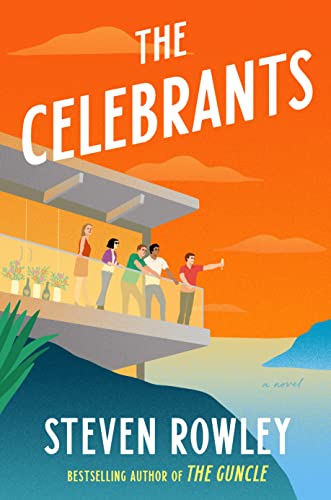
The Celebrants, by Stephen Rowley***

I enjoyed Rowley’s novel, The Guncle, which came out in 2019. When I was invited to read and review The Celebrants, I jumped at the chance. Unfortunately, it didn’t do a thing for me. Nonetheless, my thanks go to Net Galley and Putnam Books for the review copy. This book is for sale now.

As a child, we once had a bird bludgeon itself to death on our sliding glass door, unable to accept that the invisible barrier was really there. Reading this book made me feel just a bit like that bird. I’d liked Rowley’s last book. Other Rowley fans liked this book. So why…(BAM!)…why…(BAM!)…why could I not get into it?

I think it all boils down to privilege.

Had I read the premise more carefully, I might have avoided this trap. A group of seven college friends, grief-stricken after losing the eighth friend, agree to meet every few years and give each other mock funerals to celebrate the lives that still exist among them.

What rarefied conditions must exist to make such a thing possible? Imagine having the resources to be able to drop everything and fly off to wherever the meeting is held. Air fare. Childcare. Housing. But as I read the abundant dialogue in this thing, such trivialities are seldom mentioned. These are people that for the most part came from money, and they have money now, and they assume they will have as much, if not more, in the future.

Of course, the story is not about money and privilege. It’s about taking stock of their current lives and comparing them to their youthful expectations. There are secrets. There is baggage. And now, in their middle aged years, they are older, wiser, and in many ways, sadder.

Oh honey. They think they’re old now? My ass!  My children are middle aged. Get a fucking grip.

So okay, I am probably not the ideal audience; and yet, I will remind you that I didn’t volunteer for this. I was selected. Someone clearly believed that I am within the target audience.

I initially felt some of this when I began reading The Guncle. The protagonist there was a successful actor with a pile of money; and yet, the challenges he faced, first with the death of his partner, and then with the homophobic relative that tried to keep him from taking the children that had been entrusted to him, won out. The presence of well-written children helped a good deal, and the humor was completely on point. I cannot fail to appreciate an author that can make me laugh out loud.

I didn’t laugh out loud this time.  It’s grim, but it’s wealthy-people grim, not working class grim. If you don’t know the difference, then we all know which one you are.  I rolled my eyes a great deal, but it’s even harder to read when you do that, so I borrowed the audio from Seattle Bibliocommons. It didn’t help a bit, apart from making it possible to take in the book and roll my eyes at the same time.

I see that this title has been nominated for the Goodreads Choice awards, so clearly, a lot of people have loved this book. But I am not one of them.

Recommended to rich people that believe their lives to be harder than they actually are.

Unlikely Animals, by Annie Hartnett*****

There are indifferent writers; good writers; outstanding writers; and then there are writers like Hartnett, that leave me with my jaw dropped down to my knees, thinking that I like to write, and you probably do, too, but friend, neither one of us will ever write like this. Not ever.

My thanks go to Net Galley and Random House Ballantine for the review copy.

Emma Starling is our protagonist, and she was born with healing powers in her hands. She went away to medical school, but was expelled for reasons that we don’t understand until later, and her healing touch is gone. She has quietly left school without telling a soul back home. She hasn’t even returned for a visit, but now she has been summoned unequivocally; her father is dying, and her mama wants her to come home. NOW.

There are enough points of view in this story to make your head spin. We have the graveyard crowd, for example, and since Everton, New Hampshire is such a tiny town, everybody knows everybody, dead or alive. When I first see that the dead are discussing the affairs of the living, I am dismayed, because the legendary Fannie Farmer has already done this in The Whole Town’s Talking. But soon it becomes obvious that this story isn’t derivative in the least; Hartnett takes this device and uses it in a different way, and it doesn’t dominate the story as Flagg’s does; these characters are there to provide a slightly more objective perspective than those that still live.

There are several points of view from among the living, too. And there are references throughout to the writings of Harold Baines, a naturalist instrumental in shaping the town and in particular, the iconic yet bizarre Corbin Park, which is open only to a chosen few. There are points of view offered from the critters as well; not all of the critters are real, however. And at the EXACT moment when I begin to think that the author should have pared this thing down, for heaven’s sake, because the organization appears to be all over the place, the narrative explains that “A good story doesn’t always follow an arrow, sometimes it meanders a little instead, so we hope you’ll excuse this tangent…It might seem unrelated, but sometimes a minor character doesn’t become important until later…The lives of the living often get tangled up in unexpected ways, especially in a town as small as ours, even when a ten-foot electrified fence splits it up.”

I howled, because it felt as if the author had read my mind!

An important plot point is the disappearance of Crystal Nash. Crystal was Emma’s best friend, and had lived with the Starling family as sort of an informal foster child. Crystal developed an addiction and disappeared; Emma and Crystal had had a falling out, and Emma tries not to think about her too much now. Clive, Emma’s father, seldom thinks about anybody else. He’s turned over every rock; slapped a poster on every telephone pole.

To say the least, it’s an interesting homecoming for Emma.

As if the many points of view don’t make for a complex enough story, Hartnett takes us back in time—sometimes just a few years, at other times, way back in the past—and I am awestruck at the way she pulls all of it together at the end, with no loose ends hanging. At the outset I had been sure that this story should have been streamlined, but at the end, when I look back to see what, if anything, could be cut without detracting from the story, there is nothing that’s superfluous. Not one thing. All of these odd bits and pieces are essential to the story she is telling; “meandering,” indeed.

Because I had fallen behind in my reading, I checked out the audio version from Seattle Bibliocommons, and it is brilliantly performed. Usually a story this complicated doesn’t work for me as an audiobook, but this one is outstanding and not hard to follow (although I did go back over the DRC for some quotes.)  Mark Bramhall and Kirby Heyborne do an exceptional job as narrators.

This is undoubtedly one of the finest novels we’ll see in 2022. Highly recommended in whatever format makes your heart happy.

Damn Lucky, by Kevin Maurer****

John “Lucky” Luckadoo was a bomber pilot in World War II in the most dangerous period of the European theater, and he survived twenty-five bombing runs, which was unusual. This is his story, told to us by the skilled wordsmith Kevin Maurer, and narrated by Holter Graham and Luckadoo himself. My thanks go to Net Galley, St. Martin’s Press, and Macmillan audio for the invitation to read and review.

The first portion of the narrative tells about Lucky’s early years, as well as his yearning to learn to fly. I feel a bit impatient as I read this segment, because I’m dying, like Lucky, to go to war. However, some of what I think is extraneous material proves to be important later on, so I’m glad not to have skipped anything.

A quarter of the way into the story, and we’re off. I am impressed by the descriptions, which are brief and unmistakably clear, written for general audiences of today. An example is when he tells us that a Quonset hut looks like a tin can that has been split lengthwise, then put on the ground, cut side down. Everything, from the planes, to the target, to the flying conditions is easily understood without talking down to the reader. The chapters are a good length, and the dialogue crackles. But now, we have to talk about that.

When anyone writes military history, whether it’s a biography, a memoir, a reference book, or any other nonfiction work, there must be citations for the facts and especially for quotations and dialogue. (I am proud of myself for not using twelve exclamation marks here; if there were an audio version of this review, I would be shrieking, so it’s just as well that we’ve stuck to print.) The author provides a bibliography at the end, and it. Is. Not. Enough. No, no, no! This is why so many writers in this field use historical fiction as a vehicle; the very best historical fiction communicates the same material, but is not bound to document facts. A bibliography alone would be just dandy for a work of historical fiction…which this is not. In fact, (said the American history and government teacher,) the four star rating is evidence of my appreciation for the clarity, organization, and pacing of this story; ordinarily I would go no higher than three stars for anyone in violation of this clear requirement. (Where was the editor?)

Moving on. The pace in the middle segment is brisk, but I have no problem putting it down and walking away when I am interrupted in my reading. That all changes at the sixty-sixth percentile, when the B-17 pilots and crews are sent on a mission to bomb Bremen. This is a huge mission, and a very dangerous one, as they are trying to bomb the canal where German U-boats are housed in broad daylight. At the same time, Goering is done watching his pilots get pounded, and he orders them to fight to the last man, and those that will not will be transferred to the infantry (note here that the German infantry is starving and freezing; pilots are much better fed.) Consequently, their aggression in the air is unprecedented, with kamikaze-like maneuvers that none of the Allies have seen from Germany up till now. During the portion of the book, I would not have left this story unless my house was on fire.

The callous decisions by higher-ups as to what an acceptable attrition level looks like, with about sixteen percent of active American airmen making it home alive after their service is done, is horrifying.

I have read a number of biographies and other historical works regarding this topic, but nevertheless, I learned some new information. I recommend this book to readers that are interested, but not to researchers or students.

Although the narrators do a perfectly fine job, I realize early that I cannot keep up with this level of detail without seeing the words, so I jettison the audio version and stick to the digital review copy. I recommend the audio version for those quirky souls that understand and retain spoken information better than print.