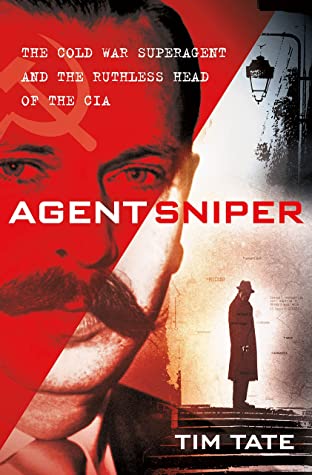
Phantom Orbit, by David Ignatius****

“When we know a secret that could have devastating consequences, what should we do?”

David Ignatius writes spy thrillers, and is one of the most reliable authors I’ve read within that genre. I can always count on an absorbing read. Phantom Orbit centers on Ivan Volkov, a young man from Russia that goes to Beijing to study science, and an American CIA officer named Edith Ryan. They come together and then part, because while their interests and personalities draw them together, their obligations to the lands of their births pull them apart.

My thanks go to NetGalley and W.W. Norton and Company for the review copy. This book is for sale now.

Our chief protagonist, Ivan, is courted by the Chinese, who want to recruit him and his brilliant mind to their space program, but he is summoned home when his mother becomes ill, and once he is there, he comes under intense pressure to remain in Russia. Later, once he has lost almost everything, he finds a chance for redemption.

Edith, on the other hand, is faced with every possible glass ceiling and endless sexism in her work, and nobody will take her ideas seriously. Eventually she gives up on the Agency and returns to civilian life in the States.

This story grabbed my attention from the get go and held it all the way through. I wasn’t able to guess what the resolution would be.

That said, this also isn’t the best he’s written. For those new to this author, I recommend The Quantum Spy. For Ignatius’s faithful readers, and for those fond enough of espionage thrillers to want more than one such novel, this book is recommended.

The Bitter Past, by Bruce Borgos***

2.5 stars, generously rounded upward.

The Bitter Past is the first in the Porter Beck series by Bruce Borgos, and if I liked it, I’d be thrilled to read more. On balance, though, I don’t. Nevertheless, my thanks go to Net Galley and St. Martin’s Press for the invitation to read and review. This book is for sale now.

The setting is the hinterlands of Nevada; part of the story takes place in the 1950s, and part of it is in the present. I rate the historical threads as 3.5 stars, and the contemporary part as 1. The premise is that Porter Beck is the local sheriff who is called when a grisly murder is discovered; in addition, a sister-wife goes missing. Sana Locke is the woman that the Feds send in, uninvited. The premise for the other thread is that a Russian operative named Georgiy Dudko lands in Nevada, tasked with entering the nuclear test site and stealing a nuclear warhead. Toward the book’s conclusion, we see how the two stories are joined.

Before I am even twenty percent of the way into this story, my hackles are up. I haven’t seen an author write with such brazen disrespect for women in a very long time, and I hope not to see it again. You see, Beck is God’s gift to women, and it’s a good thing, too, because none of them prove smart enough to find their butts with both hands until he sails in and fixes everything. From the instant Agent Sana enters the narrative, introducing herself as FBI, Beck is the guy in charge, and Sana is his li’l buddy, his sidekick. Good thing he is here to educate her. It is Beck that finds a hidden room in a house they’re searching; it is Sana whose eyes “go big.” He has to dive quickly to save her from the bad guy with the gun. He tells her what to do, and she does it. Here are some quotes that set my teeth on edge:

“Before [Sana] can speak, I place a finger over her lips.”

“Sana appears confused.”
“I bring my finger under her chin. ‘Look up.’”

And no collection of sexist bilge is complete without the old saw about how women are unable to get along with other women: “[Sana’s] still miffed about Brinley, [Beck’s sister] and it’s clouding her judgment…I glare at Brin, a warning to her to retract her claws.”

Beck feels completely free to comment on Sana’s physical features, particularly her “exquisite ass,” but of course, Sana likes that in a guy. She’s in the sack with his middle-aged, um, butt in no time flat.

For a long time I hold out hope that things will turn around, and the author will prove to us that actually, Beck is about to get his just desserts, and Sana had been sent to take him down for some reason, but the only comeuppance she deals him at any point is when she pulls a jujitsu move on him, and that’s only once.

What else? Ah yes, the sister-wife. The girl’s husband is a good FLDS neighbor, Beck tells Sana. They don’t force anyone to marry. She’s seventeen years old, so it’s fine.

What the fuck. Seriously? Excuse me while I grab my blood pressure medication.

In addition to all of this, there is the constant use of the word “illegal” to describe a person that is in the U.S. without documentation. They don’t even call them illegal immigrants, or illegal residents. They don’t merit a full grammatical description.

The thread that takes place in the past is more palatable. Georgiy needs into the nuclear test site, and so he befriends a scientist that works there, and is introduced to Kitty, the scientist’s daughter, whom he courts and accidentally falls in love with. Kitty is not developed as a character any more than Sana is, but at the same time, during the 1950s in the U.S., marriage and motherhood were very nearly the only acceptable path for women, so within the context of time and place, this is believable. I like Georgiy much better than Beck, that’s for sure!

There’s a twist of sorts at the end, but it’s not all that impressive, and it mitigates nothing.

I was provided with the digital review copy and the audio as well, and so I listened and read at the same time. Narrator James Babson does a fine job portraying the characters as they are written, and he isn’t to blame for the way I feel as I read.

That’s it in a nutshell. If all of this sounds just fine to you, then go ahead and get this thing, and stay away from me. Does anyone have any matches I can use?

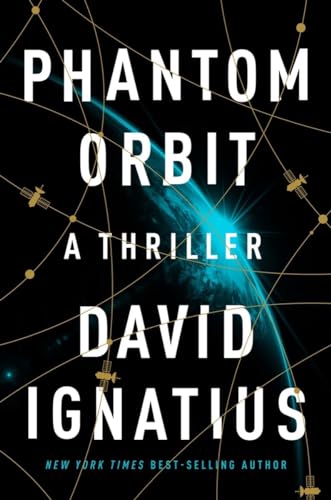
Agent Sniper, by Tim Tate***

I was invited to read and review this book by Net Galley and St. Martin’s Press. I accepted because I do love a good spy story, and there aren’t many of them being published at this time. Tim Tate has had a long, illustrious career as a documentary filmmaker and as an author, but is new to me.

So, when I began reading and found my attention wandering, I thought it was a personal problem. Too many distractions. I tried again, and when that didn’t go well, I procured the audio version and listened to it while I prepared dinners during the week. Eventually, I threw in the towel and admitted that this is simply not an engaging book. The topic sounds fascinating, but just as a gifted, dedicated author can spin dull material to gold, so can an indifferent one tell an electrifying spy story in a way that leaves the reader checking the page numbers and the clock—is this thing over yet?

It’s not all bad news: the research here is top drawer. For the researcher, this book has use, although I would caution the uninitiated into reading carefully, because history is always politically charged. Every fact that is included, and every fact that is not; the interpretation; the language used, all give a biased account, even when a researcher and writer is endeavoring to be as balanced as possible. I don’t care for this writer’s interpretation, which makes him sound like a hardened right winger, but I have no doubt that the facts that he uses are accurate ones.

Then we come to the audio, and I must wonder why, if we’re primarily dealing with the CIA and its agents, we have a narrator with a clipped English accent (and a few pronunciations that sounded very odd to me,) telling the story. I found it disorienting, but if this had been a more engaging story, I would have overlooked it.

Ultimately it comes down to wordsmithery, and I didn’t find much of it. Those interested in dabbling in this genre would do better to read Ben McIntyre and Tim Weiner.

This book is for sale now.

Paris Never Leaves You, by Ellen Feldman**-***

2.5 stars rounded upward. I was invited to read and review this novel by Net Galley and St. Martin’s Press.

World War II fiction is a crowded place, and I have left it, for the most part, having had more than my fill. I am initially interested in this story because it takes place in 1950s New York, and that’s a setting I haven’t seen much. However, this setting alternates with the protagonist’s memories of Paris during the war, and so there I am again, back in Europe during the war.

Charlotte is a young widow, working in a bookstore to make ends meet. Her infant daughter, Vivi, is often with her. A German soldier is drawn to her, and she snubs him repeatedly, but when he brings food and milk for her starving child, she caves. When Vivi becomes sick, he smuggles in medication. Yes, this is one of those I-hate-you-but-I-love-you stories. This isn’t new; I’ve seen plenty of forbidden love stories, especially with regard to German soldiers. I’ve also seen plenty of love-hate romances.

But what strength I see in this one is in the grey areas. Is it all right to fraternize with the soldiers that are responsible for the deaths of loved ones, if those you’re befriended by can save other loved ones, particularly children? Is it all right to let someone think you’re Jewish, once the war is over, if that means they will save you? Is it acceptable to be Jewish, whether inobservant or otherwise, but pretend you are not, if it increases your odds of survival? What if that means taking other Jews prisoner, serving your enemy?

I’ve said this before in other reviews, and I’ll say it again here. It irritates the bejesus out of me, this World War II forbidden-romance storyline that is always, always, always between a Caucasian European, or Euro-American, and a German. Maybe someone has been wildly creative and included an Italian, but I haven’t seen it if they have. What do we never, never see? Ever? Never? (I could go on all night like this, and don’t provoke me or I’ll do it!) We never, ever see a WWII relationship between a Caucasian civilian from an Allied nation and a Japanese soldier. Or civilian. Or anything. It’s almost as if there’s a whispered subtext that insists, “It’s okay. After all, we’re both white, and that’s what really matters.” And authors that are far too progressive, too modern, too civilized to use any of the zillion ugly epithets that were common usage at the time by Allied service people and citizens toward Germans and Italians, nevertheless decide it’s somehow acceptably authentic to use the J word for Japanese. You know the one I mean. And Feldman is a serious offender here.

Because I was having trouble plodding through this story’s text, I visited Seattle Bibliocommons and borrowed the audio version. (Laurie Catherine Winkel does a fine job as the reader.)  I had listened to about seventy percent of this story when Charlotte has a conversation with her landlord, sponsor, etcetera about his own war experience, and boy does he pour it on. I think I must have found the J word on damn near every page, sometimes more than once. I nearly stopped reading, and I nearly gave this book a single star. I fast-forwarded a bit, and when the passage involving this veteran’s way-too-long speech ends, I don’t hear the word again, so I take a deep breath and forge onward to see how it ends.

The ending is bittersweet, and it’s not formulaic.

So there it is. This book is for sale now, but my advice is to either give it a miss, or read it for free or cheap. And if another forbidden WWII white-on-white romance turns up in my inbox, it’s going straight to my round file. Stick a fork in me, cause I am done.

Best Biography of 2019: Madame Fourcade’s Secret War

The Day Fidel Died, by Patrick Symmes*

thedayfidelThose that admire and stand in solidarity with the Cuban Revolution will not find any measure of satisfaction here.  When I read the promotional blurb, I noticed that this account was written by a Rolling Stone Magazine journalist, and that it was written soon after President Obama opened relations between the US and Cuba. I thank Net Galley for permitting me to read a review copy free of charge, but that cannot diminish my disappointment and irritation (thus one star) at the patronizing, reactionary vantage from which Symmes writes.
Has no one noticed that even the United Nations has recognized that Cuba is the only nation in Latin America and the Caribbean to eradicate malnutrition? And has nobody noticed that when Fidel died, the revolution didn’t die with him?

Most nations do not offer visiting heads of state a forum and opportunity to locate and meet with the disgruntled fringe citizens that might be open to overthrowing the government of the host nation. Symmes’ punch line here seemed to be that by Obama cutting his trip short, he was somehow making the Cuban Revolution ‘irrelevant’.

Do the other nations of Latin America and the Caribbean see it thus? Has Africa adopted this stance? I didn’t think so. It is only possible to see the Cuba in that light if one filters world news through the view of international business conglomerates and the U.S. government.  Happily, there are independent thinkers here that can appreciate the contributions made by Cuba in ending hunger and oppression in that country and making medical advances from which the whole world benefits.

This book is a waste of ink, and a waste of space in one’s digital library.

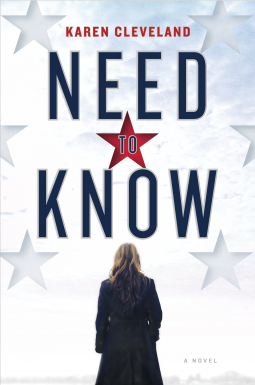
Need to Know, by Karen Cleveland***

NeedtoKnow

“My God, Vivian, what’s it going to take for you to trust me?”

 Need to Know is an espionage thriller written by a former CIA analyst. I read it free and early thanks to Random House and Net Galley. This book will be available to the public on Tuesday, January 23, 2018.

Our story is told in the first person by Vivian Miller, a CIA analyst with a mortgage to meet and four small children. In the course of her research she comes across the identity of someone she knows and then the whole house starts to tumble, as she makes one bad decision after another, punctuated with the occasional wise choice to heighten suspense.  Around the sixty percentile I found myself reading it for giggles as it becomes increasingly clear that our protagonist is as dumb as a box of rocks.

With this in mind, I have devised a drinking game for rowdy book clubs that meet in real life. Here are some ideas:

  • Take a drink every time Vivian refers to Matt as her “rock”.
  • Take two drinks every time she refers to Matt as their children’s “rock”.
  • Take a drink every time you run across the word “ringleader”.
  • Spin around three times and take a drink for every rhetorical question you find in the narrative.
  • Take a drink for every stereotype you see.


Spoiler alert (*snerk*): you may want to clear your calendar the day after your book club meets, because it’s going to be a rough one.

Now I understand that there may be abstainers in your drinking book club, patient souls that either really like the people in your club, or that can’t find a book club made up of tea-totters. For those people I have special instructions:

  • Take a drink when you find a well developed character.
  • Take a drink when you find a positive female role model .


Another spoiler alert: provide this second group of people with water, because otherwise they are going home thirsty.

I can also recommend this title to women that are newly divorced, mad as hell, and looking for something to throw. For these ladies, I recommend obtaining a hard copy, because you won’t want to ruin your expensive electronic devices. Before commencing with this title, remove pictures, monitors, and china from the wall where you’ll be reading. Broken glass is nobody’s idea of a fun Tuesday night.

“They’re good, the Russians.”

Newly divorced, mad-as-hell, book-throwing women that have recently divorced a Russian man may even want to pre-order a copy. I’d do that right now if I were you.

Купить книгу.

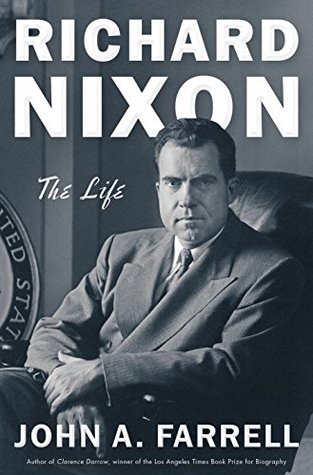
Nixon: the Life, by John A. Farrell*****

richardnixonfarrellHistory buffs rejoice; the definitive Nixon biography is here.  John A. Farrell is the renowned biographer of Clarence Darrow. Now he gives us a comprehensive, compelling look at the only US president ever to resign from office under the cloud of imminent impeachment. This is the only Nixon biography that answers the many questions that left Americans—and those around the world that were watching—scratching our heads. Why, why, and why would he do these things? Farrell tells us. I read this book free and in advance, thanks to Net Galley and Doubleday, but it would have been worth paying the full retail price if I’d had to. It’s available to the public now.
Anytime I read nonfiction, I start with the sources. If the author hasn’t verified his information using primary sources, I go no further. Nonfiction is only fact if the author can prove that what he says is true—and I have never seen more meticulous, more thorough source work than what I see here. Every tape in the Nixon library; every memoir, from Nixon’s own, to those of the men that advised him as president, to those written by his family members, to those that opposed him are referenced, and that’s not all. Every set of presidential papers from Eisenhower on forward; the memoirs of LBJ, the president that served before Nixon took office; reminiscences of Brezhnev, leader of Russia ( which at the time was part of the USSR); reminiscences of Chinese leaders that hosted him; every single relevant source has been scoured and referenced in methodical, careful, painstaking detail. Farrell backs up every single fact in his book with multiple, sometimes a dozen excellent sources.

Because he has been so diligent, he’s also been able to take down some myths that were starting to gain a foothold in our national narrative. An example is the assertion that before the Kennedys unleashed their bag of dirty tricks on Nixon’s campaign in 1960, Nixon was a man of sound principle and strong ethics. A good hard look at his political campaigns in California knocks the legs out from under that fledgling bit of lore and knock it outs it out of the nest, and out of the atmosphere. Gone!

Lest I lend the impression that this is a biography useful only to the most careful students of history, folks willing to slog endlessly through excruciating detail, let me make myself perfectly clear: the man writes in a way that is hugely engaging and at times funny enough to leave me gasping for air. Although I taught American history and government for a long time, I also learned a great deal, not just about Nixon and those around him, but bits and pieces of American history that are relevant to the story but that don’t pop up anywhere else.

For those that have wondered why such a clearly intelligent politician, one that would win by a landslide, would hoist his own petard by authoring and authorizing plans to break into the offices of opponents—and their physicians—this is your book. For those that want to know what Nixon knew and when he knew it, this is for you, too.

I find myself mesmerized by the mental snapshots Farrell evokes: a tormented Nixon, still determined not to yield, pounding on the piano late into the night. I hear the clink of ice cubes in the background as Nixon, talking about Prime Minister Indira Gandhi of India, suggests that “The Indians need—what they really need—is a mass famine.”

I can see Kissinger and the Pentagon making last minute arrangements to deal with a possible 11th hour military coup before Nixon leaves office. Don’t leave him with the button during those last 24 hours, they figure.

And I picture poor Pat, his long-suffering wife to whom he told nothing, nothing, nothing, packing all through the night before they are to leave the White House…because of course he didn’t tell her they were going home in time to let her pack during normal hours.

The most damning and enlightening facts have to do with Vietnam and particularly, Cambodia. Farrell makes a case that the entire horrific Holocaust there with the Khmer Rouge and Pol Pot could have been avoided had Nixon not contacted the Vietnamese ambassador and suggested that he not make a deal with Johnson to end the war.

Whether you are like I am, a person that reads every Watergate memoir that you can obtain free or cheaply, or whether you are a younger person that has never gone into that dark tunnel, this is the book to read. It’s thorough and it’s fair, and what’s more, it’s entertaining.

Get it. Read it. You won’t be sorry!

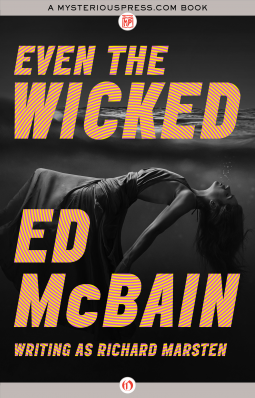
Even the Wicked, by Ed McBain**

eventhewickedBest known by the pseudonym Ed McBain, Richard Marsten, the name under which this book was originally scribed in 1958, was born as Salvatore Lombino.  I was a huge fan of McBain’s, and every time I see some small thing he wrote that I haven’t had a chance to read yet, I snap it up. And so it was with this DRC, which I received compliments of Net Galley and Open Road Media. But once I reached the halfway mark, I felt sort of queasy and couldn’t continue. I suspect that much of what he wrote as Marsten might as well be left in whatever obscure attic corner it’s perched in, because society has moved forward since the 1950s, and this book is still there.
The re-publication date for this book is October 25, 2016.

The premise is this. Our protagonist, Zach, is returning to the beach house where he and his now-deceased wife stayed on their wedding night. He brings their little girl Penny along with him. Before he can commence to do any sleuthing, however, the real estate concern that rented the place to him tells him it’s been taken by someone else. Zach isn’t going down easily for two reasons: first, he wants to see if his suspicion regarding the possible murder of his wife is true, and second, he’s already paid in full for the entire stay. The story starts with the excellent, tense build up that would become Lombino-Marsten-McBain-Hunter’s hallmark. I rolled up my sleeves and snuggled in.

And then bit by bit it all went to hell.

First of all, why would a man on a deadly mission bring his little girl with him? Leave the tot somewhere safe or stay home. And then there’s the stereotypic, racist crap about the local Indian. (He’s ‘chiseled’, of course, but he’s also just plain creepy looking.) Next, Daddy Zach tells Penny that he’s pretty sure her mommy was murdered.

The fuck?

And as he sets up his date with destiny, he finally realizes he has to have a sitter for Penny after all—in the contested house, of course, where surely nothing bad will happen to her while he’s away—and so he asks a complete stranger for the name of a babysitter, and the person refers him to someone that’s also a complete stranger. He sets it all up, arranging to leave his little girl, all he has left in this world, with someone he’s never heard of till today and doesn’t even plan to interview, and hits the road to solve the crime.

I got halfway through this thing and finally threw up my hands. Had I read the rest, I might have thrown up, period.

I know that in bygone times, people in the US were much more relaxed about child care arrangements than we are today. Many Caucasian people were also really racist, and men and sometimes even women were sexist, too. But that doesn’t mean I care to see it in my escapist fiction.

If you haven’t read Ed McBain, find something he wrote after 1980 and you’ll be in for a treat. But this one is a thumbs-down.

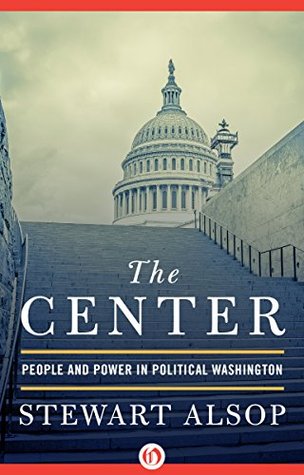
The Center, by Stewart Alsop**

thecenterAlsop’s book is a collection of essays describing Washington, DC as it was in the 1960’s. Everything here was written then, so it’s a chance to jump back in time and see what the media—and this reporter in particular– thought was appropriate for mainstream Americans reading the news of the day.  I was invited to read and review this book thanks to Open Road Integrated Media and Net Galley in exchange for this honest review. I always hate to pan a book when I’ve been invited; it sounds as if I am insulting the host after eating at his table. However, the truth is the truth, and I see this title as fitting a narrow niche audience, but not so much the general public.

Alsop takes us back to the time that the USSR was a country and looked as if it was going to stay that way. He refers to Latvia and Estonia as former countries. Journalists that are female are referred to as “lady reporters”, and sodomy was still a crime on which the journalist frowned and assumed we would, also. He refers to justices of the Supreme Court and elsewhere as men, and with the assumption that this also is according to nature and will never change.

Perhaps the most chilling aspect of this collection is the chummy way he refers to the Miranda case, in which it was determined that those about to be charged with a crime had to be told that they had the right not to speak against themselves and to have an attorney. He explains that most of the court’s decision making was done in restaurants and over the phone long before they ever met, and so this case was “almost certainly” decided before the justices ever met in chambers.

This reviewer’s father-in-law is a retired judge that served many ethical decades for the State of Oregon, ending his career on the State Court of Appeals. Talk like Alsop’s would make his blood run cold—or maybe extra hot, actually. His ethics were so firm and fair that he would not tell his own family, when we dined in the privacy of our home or his, who he planned to vote for in the upcoming election…because judges are supposed to be above partisan politics. He did not discuss his cases with family, and I would stake the deed to my house on his not having entered into any chummy agreements over the phone when serving at any level on the bench.

So for those interested in the journalism of the 1960s, here’s a trip down the rabbit hole that will take you there, or at least to one version of it. Those interested in the sociology of that time period might also find this useful.

Those interested in building a better world may be encouraged to see how far society has come since this dark time. If you think things are bad now, check out what they were like 50 years ago. But don’t pay full jacket price unless it’s important to you.

You can have this book now if you want it.