
Blanche On the Lam, by Barbara Neely*****

BlancheontheLamI was already a Barbara Neely fan when I received this DRC, courtesy of the Brash Priority Reviewers Circle, in exchange for an honest review. I’ve been reviewing books for Brash Books and others for the past couple of years, and had read three other Blanche White mysteries out of order, so when I saw that the first in the series—which I think was the only one I hadn’t read yet—was up for grabs, I nailed it right away. It’s available for purchase now.

The amazing thing to me is that although these novels were originally published in the ‘90s, they are extremely relevant right now. For those new to this Anthony, Macavity, and Agatha Award winning book and series, Blanche White is author Barbara Neely’s foil for a number of social issues that are best approached with humor, yet also with absolute, stark clarity. Those that have supported the #BlackLivesMatter movement should order this fantastic book right away. It’s a double win, treating those of us that favor social justice and also enjoy strong fiction. On the other hand, those that don’t understand the current of Black anger that pumps through the small towns, fields and cities of the United States may want to read this book and catch a clue.

She makes everything crystal clear.

Here’s the premise: Blanche, who does domestic work and also has custody of her late sister’s children, is in trouble with the law. She has written some checks she can’t cover, and the fact that they’ve all been paid in full by the time she stands before the court doesn’t make much difference to the judge. She is given two months in the slammer, but a much greater disturbance distracts the officer who’s supposed to lock her up, and without a moment’s hesitation, Blanche slips out a side door to freedom. She knows she has to get gone and figures on leaving the state as soon as she has the money for travel, but in the meantime she escapes by using the greatest camouflage possible…because nobody looks a domestic worker in the face.

The family that has hired her has problems of its own, and Blanche can’t leave once the shit hits the fan, because if a domestic worker suddenly disappears when a crime has been committed, the thing will automatically be blamed on them. Instead, she is pinned like a butterfly, stuck in the kitchen of a horribly dysfunctional—and criminal—family. But Blanche is a born survivor, and the cynical things she does in order to keep herself from harm’s way, and ultimately to avenge the death of a nice man that didn’t deserve his fate are both amusing and riveting.

It is here that we meet Mumsfield, an engaging character who will turn up later in the series.

Blanche’s attitude toward the sheriff and the situations that feature him made me want to stand up and cheer!

I took the opportunity to read Blanche White mysteries as they became available, and I am glad I did. Reader, you have the chance, if you haven’t begun the series yet, to read them in order. Neely’s writing is both politically on-point and also seriously funny. What more could you ask for? Once you read this one, you’ll want to continue the series.

Highly recommended!
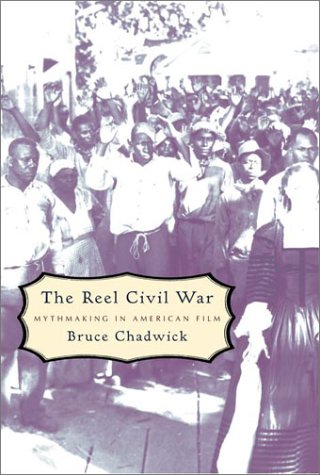
The Reel Civil War: Mythmaking in American Film, by Bruce Chadwick****

thereelcivilwarI found this gem at my favorite used bookstore in Seattle, Magus Books, which is just a block from the University of Washington. Its strength, as the title suggests, is in tracing the story of the American Civil War as told by the cinema. Those interested in the way in which movie impacts both culture and education in the USA would do well to find this book and read it.
Chadwick spends a considerable amount of time and space carefully documenting the myth produced by Gone with the Wind, a completely unrealistic, idealized portrait of the ruling planter class of the deep South. Many of us would, in years gone by, have been inclined to dismiss this concern by saying that after all, the book and movie were primarily intended as a love story, but Chadwick demonstrates that this is not so. He ferrets out actual interviews with Margaret Mitchell herself in which she insists that this is exactly the way it was. Her sources? Former plantation owners, of course.

To this day, if an avid reader goes to Goodreads.com and under the caption “explore”, goes to “listopia” and from there selects a list of readers’ favorite Civil War titles, GWTW will place within the top ten, and sometimes be the foremost title, selected over nonfiction as well as more accurate fiction. I find this horrifying.

The research regarding the Civil War itself is nothing I haven’t seen before, but Chadwick makes excellent use of strong secondary sources to document the fact that Black folks in the pre-war South were neither happy nor well treated. He takes apart the myth Mitchell constructed in a meticulous manner, one damn brick at a time. Hell yes. About ten percent of the way into the book, Chadwick’s removed, scholarly tone changes to one of articulate outrage, and I found this tremendously satisfying.

Chadwick follows Civil War films forward, after first also examining Birth of a Nation, a painfully racist film which was famous at the time because of its length; its original claim to fame was not content, but technology. For those that have not seen the film, this will be interesting reading also, and those that have seen it may pick up some new information as well.

A couple of generations later, the more realistic and highly acclaimed Roots television miniseries told the story of Black America in a way that hadn’t been represented on film before. Chadwick is again careful in his documentation and clear in his explanation.

The book’s final film treatment is of the most positive and accurate film depiction of African-Americans is the film Glory. This reviewer used this film in the classroom. It depicts the Black Massachusetts infantry that tried to take Fort Wagner and in doing so, inspired President Lincoln to order more Black troops to be armed and trained for combat in the American Civil War.

For those interested in the connection between film and American history, and of the American Civil War in particular, this book is recommended.

MJ: The Genius of Michael Jackson, by Steve Knopper****

MJthegeniusofmichaeljacksonJackson was a musical prodigy whose talent was almost limitless. His brilliant career was derailed by scandal, and his final 50 city tour was aborted by his death the night before it was to commence. Knopper does the best job of objectively recounting Jackson’s life and death that I have seen so far. His portrait is intimate without being prurient. Thanks go to Net Galley and Scribner for the DRC, which I received in exchange for this honest review.

Jackson was born in the 1950’s, a time when the race barrier kept Black performers from being seen by a general audience, with only the rarest exceptions. Black folks could play music for Black folks, and nobody else. The family was terribly poor, with eight or nine people crowded into a house better suited to three or four. They lived in Gary, a steel town in which Black poverty was more the rule than the exception. His father was a struggling musician until it became obvious that his sons had inherited his talent plus some. By the time Michael was five years old, he was the charismatic center of the Jackson Five, who soon were contracted to Motown, the center of African-American music in the USA.

Knopper explains how the family’s progression from a Motown act, where they were not allowed to actually play their own instruments on stage and could not use music they wrote themselves; to an independent family act, apart from one son who chose to remain with Motown; to the final day when Michael got himself an agent and a lawyer and set out on his own, divorcing his family so that he could have full control over a solo act. Until he was independent, iconic creations such as Thriller and Smooth Criminal would most likely never have been launched. And he recounts the family drama that ensued, with bodyguards pulling guns to discourage Michael’s angry brothers when they tried to force their way past the gates of his estate, shouting that he owed them money.

As a fan of excellent music and performance, I was sucked into the maelstrom produced by the press both during his life and afterward. It’s embarrassing to admit how completely I was played. For years I would not permit Jackson’s music to be played in my home because I thought he was a sick creep who used his fame to gain private, inappropriate contact with smooth-faced young boys. Somehow it escaped me that he had never been proved guilty in a court of law; on the one hand, it made sense to pay one family off in order to take the heat off his career, and Knopper documents the advice experienced, famous musicians gave Jackson to do whatever he had to do to shut that shit down so he could go back to focusing on music. But the press was merciless, and the payoff, which came too late to do damage control effectively, was portrayed as a tacit admission of guilt. And I bought it.

A few months after Jackson’s death, I was in a hotel room on vacation with my family, and my youngest son, who is Black, turned on the television, and there was the second round that Knopper documents, the round of memorial tributes that brought a lump to one’s throat as we saw Jackson’s miraculous career unspooled. He pioneered music videos in so many ways I had failed to appreciate, and he employed so many Black musicians that might never have had a steady job, while at the same time reaching out to Caucasian performers as well, creating a bridge between Black music and Caucasian sounds, transitioning from disco-like R and B to the “King of Pop”. I was horrified at the way I had misjudged him.

About a year ago, I read Michael Jackson’s memoir, Moonwalk, and while I took parts of it with a grain of salt, I also came to believe that the guy just didn’t know what was socially appropriate at times because he had never had a normal childhood. I was sold. Poor Michael.

Knopper has a more realistic take on all this. He certainly should; he used over 450 sources, and he wasn’t anybody’s mouthpiece. And so the truth turns out to be more complicated.

What left me somewhat stunned, in the end, was not the sex scandal, and it wasn’t the postmortem resurrection of Jackson as some sort of musical saint. Instead, I was absolutely floored at the number of people that worked for the guy, some of them for a lot of years, who he left without paychecks for weeks, then months on end. Jackson had a tremendous load of debt, was on the verge of bankruptcy and was saved only by his investment in song publishing, a piece of advice given him by friend Paul McCartney that he had followed through on. Yet he continued to buy one extreme luxury estate after another, holding residences he would likely never use again, shopping extravagantly (the example of taking a new friend shopping and telling him to do it “like this”, as he swept entire shelves of merchandise into his cart, astounded me) while leaving his employees, regular working folk with bills to pay for the most part, with no paychecks. There was money for shopping, but not for them, and some of them took him to court for it. It made me a bit sick. This man knew what it was like to be poor, and he knew what hunger was like, but as long as he didn’t have to see the people that he had betrayed, he could continue to play out the Peter Pan thread, irresponsibly trashing the lives of those he had told they could count on him, then leaving them with empty wallets and eviction notices.

Maybe you think I have over-shared. I have news; this is only the tip of the iceberg. If you have followed this review all the way to its conclusion, you will like this book. It is available for purchase October 20.

The Warmth of Other Suns: The Epic Story of America’s Great Migration, by Isabel Wilkerson *****

thewarmthofothersunsIf you have any interest whatsoever in African-American history; American history in general; or Black Studies, this book should already be on your shelf. It is one of the most important volumes to have been written in decades, a comprehensive yet readable and enjoyable look at a migration that dwarfs the smaller California Gold Rush and Dust Bowl migrations in size and scope. Black folks started to leave the south as Jim Crow became entrenched. They did so often at their peril; Caucasians who wanted that cheap and servile day labor were so violently opposed that Blacks planned their departure, in many cases, with the utmost secrecy, buying the train ticket from their own backwater hamlet to a nearby town so no one would suspect they really meant to go to Chicago, Milwaukee, Washington DC, New York City, or any of a number of places in the north and west where there was no official Jim Crow.

Though they still faced a disappointing amount of racism, from segregated neighborhoods to hotels that magically became “full” just long enough for the Black traveler to get back into the car, things were much less tense in their newly found homes. Like immigrants who come to the US from Third World countries, they found that although they did not yet possess the things the White man had, regardless of their own professional qualifications, they did enjoy a better standard of living and lived under less fear than they had back in Mississippi, Texas, or any other part of the Jim Crow south. Some grew homesick and went back where they’d come from, but most did not.

Wilkerson received a Guggenheim fellowship to help support the vast amount of research-related travel and time it took to compile this masterly piece of research, for which she used over 1,200 interviews. Her scholarship is meticulous. Every speck of information provided by a primary source is backed up. She won the Pulitzer for this book, and that is not surprising.

In my own reading of this work, in which she follows the stories of three individuals, interlacing their stories with her more journalistic reporting of the facts on the ground, I found it helpful to skip to the section in which she explains her methodology, before I read further. Thus, I read the introduction, then skipped to the methodology (since I had initially wondered what good 1,200 interviews did if we were going to just follow three, but she cleared that up quite nicely), then the main body of writing, start to finish.

It’s a large tome, and I usually restrict my reading of physically large works to a small portion of each day due to my own issues with arthritis and pain. That went out the window while I read this. It is anything but dry; I could not put it aside. It was as riveting as the most unforgettable biography or memoir, and I kept reaching for sticky notes to mark passages I found particularly compelling.

Sometimes I end my reviews by suggesting a particular book is worth reading, but only if you can get it free or cheaply. Not this time. This is a book the serious reader will want on his or her bookshelves. It is one to refer back to again and again after having read it. If you don’t own it yet, go out and buy it. I hope that in the near future, it will become one of those books that every scholar will be expected to have read in order to be taken seriously. It’s that important…and how lucky we are that it is also fun to read!