
The Unquiet Grave, by Sharyn McCrumb*****

theunquietgraveVoice, voice, voice; nobody writes like Sharyn McCrumb. Here her dry, dark humor combines with her expertise in Appalachian culture and above all, her deep respect for the working poor, and the result is a masterpiece of an historical mystery. Thanks to Net galley for the DRC, and to Atria for sending a hard copy galley and a finished copy of this excellent novel. However, had I paid full freight, I’d have come away happy. This book will be available to the public September 12, 2017.

Based upon the legend of the Greenbrier Ghost, our story is set in West Virginia in 1897. Zola Heaster is swept away by the handsome young blacksmith that comes to her tiny Appalachian farming community. Her story is told to us primarily in a first person narrative by her mother, Mary Jane. Magnetic physical attraction overwhelms any common sense Zona may possess—which isn’t much—so when the handsome stranger comes along, Zona tumbles:

“Zona was well nigh smirking at him—cat-in-the-cream-jug smug, she was. Well, Mr. Shue—the name fits the trade, I see—I am Miss Zona Heaster, a visitor to my cousin’s house, here. How do…Well before Edward ‘Call me Trout’ Shue came ambling along, with his possum grin and his storybook profile, we’d had trouble with Zona.”

Before we can draw breath, Zona is pregnant. It isn’t the first time, either, though the first was kept quiet, settled out of the area. As her mother wonders whether Trout will want to marry her, Zona brags,

“’He’d be lucky to have me.’ 
“’Well, Zona, it seems that he already has.’”

Mary Jane doesn’t like her daughter’s suitor, and a number of small but troubling things make her reluctant to see this wedding take place, even given the shotgun-wedding circumstances. We are disquieted, not by huge monstrous overt acts by Shue, but by the small hints that provide a deeper suspicion, a sense of foreboding. Part of McCrumb’s genius is in knowing when less is more.

Ultimately, Zona marries and moves away, and is little heard from. Too little. And here is the mother’s dilemma that most of us will recognize: how much should a mother pry? Will it make things better to follow our nose to the source of trouble; can we help? Or will our efforts only antagonize one or both of the newlyweds? And I love Zona’s father, the laconic Jacob who tells his wife that Zona has made the choice to marry, and she’s made the choice to stay there, so “Let her go, Mary Jane.”

But it’s a terrible mistake.

A secondary thread alternates with this one. The year is 1930; attorney James P.D. Gardner is consigned to a segregated insane asylum following a suicide attempt. His doctor is the young James Boozer, who has decided to try the new technique that involves talking to one’s patients. This device works wonderfully here because it provides Gardner the opportunity to discuss a particularly interesting case he tried many years prior, one that involved defending a white man accused of murdering his wife. The conversation flows organically, rather than as a monologue shoehorned into the prose. I am surprised at first to see McCrumb write dialogue for African-American men; I don’t think she has done this before, although I can’t swear to this.( I have been reading her work since the 90s and may have forgotten a few things along the way.) The dialogue between Gardner and Boozer is dignified and natural, and this is a relief; those that have read my reviews know that there have been others that failed in this regard. And just as the discussion starts to drone—intentional, since one of the two men yawns just at the moment I do—everything wakes up, and we learn about the trial of Trout Shue from a different vantage point.

Every aspect of this novel is done with the authority and mastery of Appalachian fiction for which McCrumb is legendary. The dialect is so resonant that I find myself using it in writing, speech, and even thought—just tiny snippets here and there—and then laughing at myself. And I cannot help wondering how much of it stewed its way into McCrumb’s own conversations while she was writing. You may find it in yours.

The result here is spellbinding, and the use of Appalachian legend, herbal medicine, and folklore makes it all the more mesmerizing. Again, skill and experience tell here. How many novels have I read in which an author’s research is shoehorned in to such a degree that it hijacks the plot? Not so here. The cultural tidbits are an integral part of Mary Jane’s personality, and there’s no teasing them apart. Instead of distracting as it might in less capable hands, the folklore develops character and setting, and ultimately contributes to the plot, when Zona’s ghost returns to let Mary Jane know that she has been murdered.

This is no-can-miss fiction, strongly recommended to those with a solid command of the English language and a love of great literature.

What I’m Reading

I’ve been experimenting with ways to share what is coming up next. Usually I put this on a different page, but then it also tends not to get seen, likely due to the absence of share buttons. Let me know what you think. Is it better to post it separately, or do you like it here?


Here are books I’ve finished reading, and as soon as a sane moment presents itself in my uncharacteristically busy domicile, you will see them reviewed here:

 This is what I am reading now; all are good, but some are outstanding. [Imaginary drum roll goes here.]

Southern Fried, by Tonya Kappes***

southernfriedThis fetching little cozy mystery is the second in a series, but I didn’t read the first one, and I was able to keep up with it finer than frog hair. You might could, too. I am grateful to Net Galley and Henery Press for the DRC, which I received absolutely free of charge in exchange for this review. But don’t you worry none, cause you can buy it now.

Our protagonist is Sheriff Kendrick Lowry, and she tells us the whole story in the first person. The problem starts when Myrna finds Owen in the greenhouse on top of her prize tomatoes. Why did he have to go and die there? She says it took her months to get them that plump, and if you’ve ever grown great tomatoes—an impossible feat in Seattle, I am sorry to admit—you know it’s true.

Sheriff Kendrick, locally known as “Kenni”, is assisted in her law enforcement activities by Poppa. Poppa was the sheriff around these parts, but he’s dead now, and his ghost can only appear when she has a case to crack, so in a strange sort of way, this murder is a blessing in disguise. The local stigma against a woman as sheriff in this small Kentucky town is offset by the venerable family tradition Poppa cultivated before he departed.

I believe my favorite part is the day following the discovery of the body, when Lowry arrives to find the crime scene tape destroyed and Myrna moseying around the greenhouse like nothing ever happened. You know this happens in real life, but you never see it in fiction, except here. I also love the part when someone suggests the sheriff call for backup, and she notes that her deputy is out of town, and so exactly who is she supposed to call? Again, fictional cops always seem to have unlimited resources in even the most unlikely situations, and Kappes leaned hard on my funny bone. What a hoot.

A lot of this book doesn’t make much sense, but then it doesn’t have to. It’s a romp. However, if a couple of inconsistencies had been cleared up and a hot-stove issue hadn’t been grazed, it would be better still.

Would anyone kill for an okra recipe, for example?  (I was told as a child that okra tastes like a bowl of warm snot.) Because there’s so much camp in this very funny story, I can’t tell whether I should be suspicious of this as motive or not; in the real world I don’t see it, but in this story, I feel as if anything goes.  And while I love the feminist spirit in the sheriff’s assertion that she doesn’t cook anything, period, later she goes to try out the secret recipe and I find myself wondering how she knows how to glaze a cast iron pan. This woman doesn’t even know how to boil water, and yet a fairly obvious cooking skill that nobody puts into a recipe seems to present no problem at all.

But these are just li’l thangs.

Despite the occasional feminist overtones, there are some tired devices and stereotypes that are harder to disregard. Why does half the story obsess with her crush on her deputy? It’s kept light, but the notion that a woman is nothing without a man, while not openly asserted, seems to float in the air. I would have liked to see more women, especially older women, depicted in a positive light. It seems as if every story that features a heroic young woman has to also feature an impossible mother, and so I moaned when she introduced her momma. And there’s the “cat fight”, which while there’s no denying that the narrative is straight-up hilarious, is also a stereotype that suggests women can’t get along once you put us in a room together.

The thing that knocked a star off what would have been a four star review is the place where her Poppa’s ghost notes that when he saw Deputy Finn carry Kenni’s drunken, unconscious body to her bedroom and put her in her bed, he had feared the deputy was about to “take advantage” of her.  The word is rape, and it’s never funny. The deputy didn’t, but the suggestion, accompanied by the euphemism, left an after-taste in my mouth that I couldn’t quite get rid of.

If you can get past these brief but clear obstacles, you will get a lot of laughs out of the main thread here. Kappes has a raucous sense of humor, and I had immersed myself in too many dark stories. I was ready for a good laugh, and this title provided several.  But unless your pockets are deep or your interest great, I recommend you get this one cheaply when you can, or at your local library if available.

Where All Light Tends to Go, by David Joy*****

WhereAllLightTends“Dead men tell no tales, Jacob. The ones left to living are the ones who write the history.”
I received my DRC courtesy of Net Galley and Putnam Penguin publishers in exchange for an honest review. This title is available for purchase.

Jacob McNeely is a teenager in Cashier, North Carolina, a tiny  town deep in the crags and hollows of the Appalachian Mountains. His mother is a crank user recently released against his father’s wishes from a psychiatric hospital. Jacob has always wished she might turn into a real mother, but it isn’t going to happen.

His father is the local drug czar, with cops on his payroll and a wide variety of other employees as well. He uses McNeely’s Auto Garage to launder his drug money. If any clueless tourist should come by, he gives them a quote so outrageous they take their business elsewhere. Locals foolish enough to cross him or get in his way find themselves and their vehicles in a deep, watery grave yard. That’s if the abused, underfed Walker coonhounds that are tied up at intervals throughout his property don’t kill them first.

Jacob walks a careful tight rope just in order to stay alive. He doesn’t like the life he leads, but he doesn’t see a way out. That is, unless he can run away with Maggie, the girl he has loved since childhood. Maggie is cut out for greater things; Maggie should go to college and escape the danger and poverty of Cashier.

If only Jake could go with her.

Joy is a gifted writer. His stark prose is chilling yet poignant, and so arresting that the reader will be hard pressed to set it down once it’s begun. But you may think twice about reading it at bedtime.

Where does all light tend to go? The allegory is heavy but sophisticated. Perhaps all light goes toward heaven, the candle that reminds us of the existence of God.

Or it’s possible that all light just goes out.

Searing, wrenching, and deeply affecting, this is a book to remember long after you’ve forgotten everything else you’ve read. Highly recommended to adults. Definitely not for children or adolescents.

Simply brilliant!


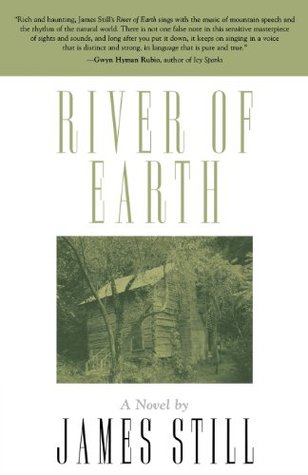
River of Earth, by James Still *****

riverofearthRiver of Earth, originally published in 1940, is a classic tale of Appalachian coal miners, dirt-poor, ever-proud people living deep in the mountains, crags and hollers, trying to scratch out a living, sometimes from pretty much nothing. How does one grow a crop if one has eaten the seeds to avoid starvation the winter before? And how does one survive as a miner when the days of available work shrink from five, to four, to two, to “Mine’s Closed”?

Initially, I was drawn to this book for two reasons. One is an interest in the early United Mine Workers, a stark, brutal organizing effort that is actually nowhere in this story. I got the book for Christmas upon my own request, and one might expect I’d be disappointed that no union shows up at all here.

And yet I wasn’t. Note that five star rating. My other reason for wanting to read it, is that one of my favorite authors mentions it in the text of one of his novels, and I wrote it down. And as I read this bittersweet tale of rural Caucasian poverty, I found something unexpected. I’ve been finding it more than one might think lately. I found ghosts and echoes of my own ancestors.

My grandfather was a miner; he died of black lung. But when a relative embarked on a genealogical expedition, I found that three of my four grandparents had roots in that same hardscrabble region, the part of Eastern Tennessee, Kentucky and Virginia where a body had to more or less guess, back in the 1700’s, which side of the state line he was on.

By 1940, when this book was published, my folks had cleared out of there, but I still heard little speech mannerisms, which cultural geographers call “cultural artifacts”, that had embedded themselves and dropped into the speech of my elders back in the day.

Alpha, usually referred to in the first-person narrative as “Mother”, has married down. She fell in love with Brack many years ago, and although there was at least one wealthy man that set his cap for her, she chose Brack instead. And she doesn’t complain about the family’s state of poverty, not even when there is so little food that she pretends to eat while the children have their supper so that they won’t realize she is making a single mouthful last an entire meal. No, Brack is the one she wanted, and he is what she’s got. She’d do it again, she says.

But oh, how she wants to settle on a little spot of land! At one point they have rented a farm that is humble, yet provides enough food that they can winter over without fear of starvation. It’s on a hilltop with a view, and it has access to woods nearby where in spring, wild salad greens can be picked. It’s all she wants. That, and for Baby Green to survive. He’s been feeling poorly, crying from hunger. Finally, one ugly winter when the food has nearly run out, she apologetically takes a little more food at table. She is ashamed to do it, but she knows the baby needs milk, and it’s the only way she’ll be able to feed him.

She loves that baby so.

Just a plot of land where she can grow things and settle into the house without constantly being required to pick up and move to the next coal town, a mining town which might or might not be hiring, and where the air will clog the children’s lungs and coat the inside of the house with fine black grit, no matter how many used tobacco plugs are stuffed into its cracks. She is sure that if her little family takes care of the earth, it will take care of them. It worked for her mother, and it will work for her family too…if only she can persuade Brack.

And she can’t. Brack is a miner. He believes he was destined to mine coal. And wouldn’t it be nice if his many hanger-on relations, those that come to visit and never leave, felt inclined to do the same? Or to help turn the ground, when they have some to turn? Or to do something other than eat more than anybody else and complain that the food isn’t good enough?

The reader has to admit that this is a wicked-hard dilemma. If one’s relatives are likely to starve if turned out of the house midwinter with nowhere to go, can one send them? But if one’s children are going hungry because the relatives are eating a lot of the food that was supposed to be theirs, can one continue to feed them? It’s a point of contention between Mother and Father. Father says he won’t turn his kin out; Mother says the children are too thin and hungry, and couldn’t his kin do a lick of work for once?

At one point Grandma needs help, but Mother can’t go to her, because the baby is ill. The food supply problem and the Grandma problem are partially solved by sending our narrator and protagonist, still elementary school aged, off to live with her and help her run her farm. Grandma is the embodiment of a work ethic. Rheumatic and 78 years old, she crawls down the rows of crops in order to harvest a few puny potatoes. She reflects on her married life, before her husband died, and her pride in having none of them shot to death, so common in these nail-tough hills:

 “Eight me and Boone brought into this world, and every one a wanted child. Four died    young, and natural. Three boys and one girl we raised. My boys were a mite stubheaded, as growing ones air. But nary a son I had pleasured himself with shooting off guns, a-rim-recking at Hardin Town and in the camps, a-playing at cards and mixing in knife scrapes, traipsing thar and yon, weaving drunk. Nor they never drew blood for doing’s sake, as I’ve got knowing of. Feisty though, and ready to fight fair fist if the other feller wanted it that a way. I allus said, times come when a feller’s got to fight. Come that time let him strike hard where it’ll do most good, a-measuring stick with stone, best battler win. The devil can’t be fit lessen you use fire.”

It occurred to me as I read it, although I could hear Grandma speak in that dialect in my head clear as day, that the dialect would wreck havoc upon the eyes and mind of someone with a mother tongue other than English. I handed it to my husband and pointed to a paragraph. He’s been in the USA for decades and speaks several languages, but he reluctantly told me that although he could understand it if I read it aloud with inflections where they belonged, it was really too much on the printed page.

With that sole caveat, I recommend this slim but magnificent story. The setting is nearly a character unto itself (although I had to get online to figure out what a paw-paw fruit was). The dialogue and its point and counterpoint, Mother advocating for the Earth, and Father advocating for dynamite and despoilment, is bound to resonate in this fragile ecological time.

But you could just read it because it is amazing literary fiction.