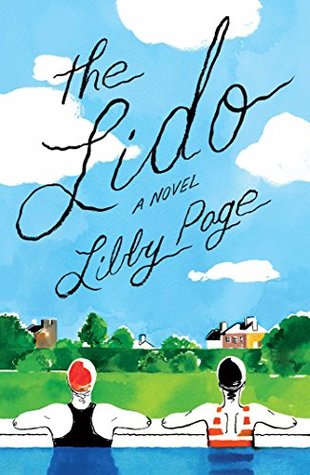
The Lido, by Libby Page***-****

thelido3.5 stars rounded up. My thanks go to Simon and Schuster and Net Galley for inviting me to read and review this charming debut. This book is for sale now.

Kate is a journalist, painfully shy, anxious, and lonely. Rosemary is an elderly widow. When the Lido—which I learned is an open air swimming pool—in Brixton is slated to close, Rosemary is up in arms. She isn’t usually an activist, but she has swum in this pool her entire life, and many of the most memorable events she has experienced took place there. She loves it still, and she cannot abide the fact that the lido is being sold to private developers who want to put up “swish new high rises.” Rumor has it that it won’t even remain a swimming pool; they may pave it over and put in tennis courts. Rich folks love tennis.

Kate smells a story, and she wants to interview Rosemary. Rosemary makes a counteroffer: she’ll do the interview only after Kate has swum at the Lido.

For Kate, this is traumatic. She isn’t crazy about her own body, and the thought of disrobing in front of others in a locker room nearly undoes her. But she swims, and she gets her interview. Over the course of the fight to save the lido, which Kate joins, she and Rosemary become good friends, and Kate’s own life blossoms. At the same time, there’s a bit of history here as we wander back in time with Rosemary to the war years when she met her husband, George.

The text has a soothing quality that you don’t see much of anymore. It’s not a page turner, and gets a bit slow in places, but sometimes a more sedate pace is what’s needed. I found it good bedtime reading, because it helped me unwind. My feminist heart is cheered by a story in which both main characters are female, and neither of them fits the tiny-but-fierce model that so many writers seem to favor. Kate is awkward. Rosemary is a fat old granny. Oh hell yes. Both are white women; there is a side character named Ahmed, but those looking for a truly diverse bit of fiction will have to look elsewhere.

Some readers are disturbed by blue language and sex scenes. Though the story isn’t entirely devoid of these, there’s very little of it.  The text is accessible to anyone with a high school education.

There are moments where the sweetness goes over the top. I gagged when the Brownie troop joined the protest to save the pool, and I wondered how Rosemary could have dozens of sweet memories of George and not even a single resentful or ambiguous one. But these are relatively small concerns.

For those looking for a feel good story, this book is recommended.

The Line That Held Us, by David Joy****

thelinethatheldusDarl Moody and Calvin Hooper have been best friends forever, and so when Darl has the worst kind of accident, he knows who to turn to. You know what they say real friends will help you bury. The body in question is Carol Brewer; Darl was hunting out of season, and when he glimpsed something moving through the woods he thought it was a wild pig. Turned out he was wrong; turned out to be Carol, poaching ginseng on Coon Coward’s land. But you can’t bring the dead back to life, and you sure can’t call the cops for something like this. Carol is Dwayne’s brother, after all. Dwayne is a huge man, half- crazy and rattlesnake mean. There are no bygones in Dwayne Brewer’s world. There is only revenge.

My thanks go to G.P. Putnam and Net Galley for the galley, which I received free in exchange for this honest review.

“I’d be lucky if all he did was come after me,” Darl said, “But knowing him, knowing everything he’s done, you and me both know it wouldn’t end there. I bet he’d come after my mama and my little sister and my niece and nephews and anybody else he could get his hands on. That son of a bitch is crazy enough to dig up my daddy’s bones just to set him on fire.”

“[Calvin tells him] “You’re talking crazy, Darl.

“Am I?”

So Carol disappears…for awhile. But Dwayne won’t be satisfied till he knows what has happened to his brother, who is all the family he has left. Once he finds out, of course all hell breaks loose.
Joy is a champion at building visceral characters and using setting to develop them further. I know of no living writer better at describing hard core rural poverty to rival anything the Third World can offer:

“The house had been built a room at a time from scrap wood salvaged and stolen. Nothing here was permanent and as each addition rotted away, a new one was hammered together from plywood and bent nails off another side so that slowly through the decades, the five-room shanty shifted around the property like a droplet of water following the path of least resistance. Red Brewer was no carpenter. Chicken coops were built better. So were doghouses. But this place had been the roof over their heads and had kept the rain off the Brewer clan’s backs all Dwayne’s miserable life.”

The murderous rage of Dwayne Brewer contrasts with the tender, poignant love that exists between Calvin and his girlfriend Angie, who has just learned she is pregnant. Calvin understands throughout all of this that he has a lot to lose, and this makes the conflict between Dwayne and Calvin a more unequal one.

I would have liked to see Angie better developed, and I blanched a bit at the line where she thinks that the only important thing is what’s growing in her uterus. But the story isn’t really about Angie, and I have seen Joy develop a strong female character in one of his earlier books. I hope to see more of that in his future work.

Meanwhile, the passage where Dwayne visits Coon Coward—some four or five pages long—just about knocks me over. This is what great writing looks like.

I struggled a bit with the ending, and this is where the fifth star comes off. The first 96 percent of this tale is flat-out brilliant, but I feel as if Joy pulls the ending a bit, and I can’t see why. None of the rest of the book points us toward this conclusion.

Last, the reader should know that there is a great deal of truly grisly material here. We have a torture scene; we have numerous encounters with a decaying corpse. If you are a person that does most of your reading during mealtime, this might not be the best choice.

For those that love excellent literary fiction or Southern fiction, this story is recommended. It will be released August 14, 2018, but you can pre-order it now.

Paper Ghosts, by Julia Heaberlin***

PaperGhostsGrace is convinced that Carl Feldman killed her sister Rachel. The once celebrated photographer was tried for the murder of a young woman and acquitted; now he is very elderly, and residing in assisted living due to dementia. Grace poses as his daughter, and she wants to take him on a road trip.

My thanks go to Ballantine Books and Net Galley for the invitation to read and review. This book is now for sale.

The outset feels delightfully creepy, as in small bits and pieces Grace tells us what she knows and what she wonders about. We don’t know where she plans to take him, or what she intends to do with him, only that she isn’t who she claims to be and her intentions aren’t what she says they are.

The story is uneven in its quality. The first half is superior to the second half; at first I can buy the premise, which is full of holes—why would they release him to her? How could someone her age have enough money to do this, even with saving every penny she’s earned? How is she so careless with his meds, and how can he suddenly behave as if he is much younger and more vigorous than he has been for years? –but as the story continues, I find myself stopping now and then and rolling my eyes. I put it down, then come back to it, and the same thing happens. By the time I reach the ending, which feels cobbled together and not authentic at all, I am ready to be done.

Fans of Heaberlin’s may enjoy this book, but my advice is to wait till you can get it free or cheaply.

Soul Survivor, by G.M. Ford*****

SoulSurvivorLeo Waterman is one of my favorite fictional detectives. Lucky me, I scored this eleventh in the series free courtesy of Net Galley and Thomas and Mercer in exchange for this honest review.

Leo has changed, and yet he hasn’t. He came into his old man’s ill-gotten fortune awhile back, so he doesn’t have to work anymore, and since his knees are going, it’s just as well. But an old family friend comes calling on behalf of a grieving parent who wants to know how her boy, Matthew, turned into a mass shooter. Matthew died too, so nobody can ask him. Waterman goes to the funeral, where hysterical gun law advocates start a ruckus, and somehow Leo finds himself in the middle of it. From there, it’s all downhill.

Waterman runs afoul of some serious thugs, and they nearly kill him. He wakes up in the hospital and learns that his assailants have carved a symbol into his chest, one associated with white supremacy.

At first the plot seemed, once we were past the hospital portion, a little too familiar. Waterman always seems to find himself opposing right-wing nut jobs, and in chasing a resolution, he always ends up leaving Seattle in pursuit of reactionary criminals in some hinterland headquarters or bunker. But upon reflection, I decided I’m good with that, since it matches my own worldview. There are some bad apples in every city, every town, but the most progressive parts of society gravitate toward major population centers. Even an elitist place like Seattle contains more laudable elements than the teeny rightwing enclaves that are established in various rural outposts.

It doesn’t hurt that the Waterman series makes me laugh out loud at least once every single time.

I have read too many mysteries in which the sleuth is shot, stabbed, or whatevered, and when they wake up in the hospital, the first thing they do is rip out their IV, hobble into their clothes, and scoot out the door against doctor’s orders, material reality be damned. This inclination is inching its way onto my hot-button list of stupid plot points I never want to see again, and so I am greatly cheered by the way Ford writes this portion of the book. Leo’s in the hospital for a good long while, because he’s hurt. He’s really hurt. At the outset, he’s in a wheelchair, and then he needs additional surgeries and physical therapy. He leaves when he’s discharged. I’m pretty sure I hollered my thanks at least once here.

Ford’s corrupt cop characters are among the best written anywhere. I also love the intrepid desk clerk named Dylan who uses what little power he possesses for the forces of good.

This story is a page turner, and it’s hilarious in places. Last I looked, the Kindle version was only six bucks. If you love the genre and lean left, you should get it and read it. Your weekend will thank you for it.


Dusty Zebra and Other Stories, by Clifford D. Simak***

Dusty ZebraClifford Simak was a prolific writer of short stories, mostly science fiction starting in the 1930s when the genre was new, and initially the stories were sold individually to magazines. They have been curated and released digitally by his friend, David W. Wixon, who provides a forward and brief, interesting notes before each one. My thanks go to Open Road Media and Net Galley for the DRC, which I received in 2016 in exchange for this very tardy but honest review.

Open Road offers the entire Simak collection in a series, and as a fan of old school science fiction–the sort that doesn’t make inside jokes for programmers and code writers–I have been snapping them up. I read #1, #4, and #7-10 and loved them all, and so I settled happily down to read this one. The introduction by Wixon is perhaps the best of the notes I have seen so far, and the first story, Dusty Zebra, is uproarious. I loved it. After that, not so much.

In addition to having written a ton of science fiction and a few westerns, which were hugely popular in the 1950s and early 1960s, Simak also wrote a few World War II stories, primarily during and shortly after the war. These are not stories that have aged well. There are a whole raft of ugly racist terms used in them that were horrifyingly common among Caucasian Americans during that time period. We are better people now, most of us, and so reading this sort of thing puts my teeth on edge. I skipped around in the collection some, but even those that contained none of this crap somehow failed to hold my attention. I moved to the last story, since short stories are often bookended with the strongest selections, and I didn’t care for it either; it wasn’t offensive, but it also wasn’t interesting. Simak sometimes struggled with dialogue, and so dialogue-heavy selections are usually not his best work.

Open Road doesn’t post on Net Galley anymore, but I still have one more of their Simak collections, #12, and I intend to read it and review it. With 6 excellent collections and 1 mostly lousy one, I like my odds. But for fans of wonderful science fiction, I recommend turning to one of the others noted above, all of which I have reviewed. Simak’s work is great more often than not, and I still encourage you to read it; in fact, since it’s selling cheaply, you could even buy this one for the title story if you have a mind to. But you’ll get more bang for your buck by turning to the others first.

Ohio, by Stephen Markley*****

OhioMarkley’s thunderous debut is not to be missed. My thanks go to Simon and Schuster and Net Galley for the review copy, which I read free and early, but this is one of the rare times I can say that if I’d paid full hardcover price, it would have been worth it. This is the summer’s best fiction, and it’s available to the public August 21, 2018.

Our story is broken into a prelude and four additional parts, each assigned to a different protagonist, all of whom knew one another, traveling separately from four different directions; they were born during the great recession of the 1980s and graduated from New Canaan High in 2002, the first class to graduate after 9/11. We open with the funeral parade held for Rick Brinklan, the former football star killed in Iraq. His coffin is rented from Walmart and he isn’t in it; wind tears the flag off it and sends it out of reach to snag in the trees. The mood is set: each has returned to their tiny, depressed home town, New Canaan, Ohio, for a different purpose. The town and its population has been devastated economically by the failure of the auto industry:

“New Canaan had this look, like a magazine after it’s tossed on the fire, the way the pages blacken and curl as they begin to burn, but just before the flames take over.”

At the mention of football, I groan inwardly, fearing stereotypes of jocks and cheerleaders, but that’s not what happens here. Every character is developed so completely that I feel I would know them on the street; despite the similarity in age and ethnicity among nearly all of them, there is never a moment when I mix them up. And the characters that are remembered by all but are not present are as central to the story as those that are. As in life, there is no character that is completely lovable or benign; yet almost everyone is capable of some goodness and has worthwhile goals.

Families recall the closure of an industrial plant with the same gravity with which one would remember the death of a beloved family member; the loss has been life changing. Residents are reduced to jobs in retail sales and fast food, welfare, the drug trade, and military service due not to legal compulsion, but economic necessity. Everyone has suffered; Walmart alone has grown fatter and richer.

This is an epic story that has it all. We see the slide experienced by many of New Canaan’s own since their idealistic, spirited teenaged selves emerged from high school to a world less welcoming than they anticipated. One of the most poignant moments is an understated one in which Kaylyn dreams of going away to school in Toledo. This reviewer lived in Toledo during the time when these youngsters would have been born, and I am nearly undone by the notion that this place is the focus of one girl’s hopes and dreams, the goal she longs for so achingly that she is almost afraid to think of it lest it be snatched away.

Because much of each character’s internal monologue reaches back to adolescence, we revisit their high school years, but some of one person’s fondest recollections are later brought back in another character’s reminiscence as disappointing, even nightmarish. The tale is haunting in places, hilarious in others, but there is never a moment where the teen angst of the past is permitted to become a soap opera.

Side characters add to the book’s appeal. I love the way academics and teachers are depicted here. There’s also a bizarre yet strangely satisfying bar scene unlike any other.

Those in search of feel-good stories are out of luck here, but those that treasure sterling literary fiction need look no further. Markley has created a masterpiece, and I look forward to seeing what else he has in store for us.

Catfish Dream, by Julian Rankin****

CatfishDreamEd Scott Junior was one of the first Black catfish growers in the USA, a “Delta titan,” and he was the very first to own a catfish processing plant.  My thanks go to Net Galley and the University of Georgia Press for the review copy. It’s inspirational, well written, and well sourced. The book will be available to the public tomorrow, July 10, 2018.

To say that this story is out of my usual wheelhouse is an understatement. I’m a city woman, Caucasian, living in the Pacific Northwest. The two slender ties that drew me to this biography are my interest in civil rights, and my love of a good plate of catfish; yet I enjoyed it a lot, and I think you will too.

Scott was the son of a successful Black farmer, a former sharecropper that bought land incrementally until he owned hundreds of acres in the Mississippi Delta. The first third of the book explains how he did that, and the experiences that Scott Senior and Junior had with the Civil Rights Movement and the local power elite. It’s a little slow at the outset, but the narrative wakes up in a big way around the 35% mark.

As Scott’s farm grows, he encounters one obstacle after another, and the racism is naked and blatant. Local white agribusiness runs him out of the rice growing business—and he has the nerve to drive a better truck than some of the white farmers in the area, which is an affront they can’t let pass. Left with hundreds of acres and no seeds to plant, Scott decides to dig ponds. Rankin is clear: by ponds, he means bodies of water the size of 15 football fields. Big damn ponds.

Caucasian farmers are able to get subsidies and FMHA bank loans, but Scott is declined, not on the basis of his credit score, but because he is African-American. Bank officers and local government officials are so certain of their positions of power that they put their refusals on the basis of race in writing, and up the road, that is what Scott will use to bring them down.

Prior to the 1980s, catfish was not sold in supermarkets. It was considered a lowly bottom-dwelling fish by many, and so its consumption was limited to the families of sport fishermen and poor Southerners . When it made its debut and was purchased by “Midwestern homemakers”, this reviewer was among them, puttering in the back of a Kroger in Toledo, Ohio. “Huh,” I said, “Catfish. Now we’ve never tried that.”  I missed the cheap, readily available salmon I’d grown up with in the Pacific Northwest, and was jonesing hard for fish. I had no clue that an immense power struggle lay behind the little foam tray of fish in my shopping cart, but once I’d dipped it in a cornmeal mixture and fried it up, there was no turning back. Yummers.

I read multiple books at a time now that I’m retired, and some of the thrillers I favor make poor companions at bedtime.  This biography was perfect then. It’s linear for the most part, focused, and although I was angered by the way Scott was treated, I could tell he was going to emerge victorious, so it didn’t keep me awake after the light was out.

Rankin wants to be clear that there’s a whole lot that needs to change before we will be able to say that every race is treated equally in the Delta, or elsewhere the US. One might hope this would be obvious. But everyone needs to read victory stories to boost their morale and remind them of what is possible. If you need a story where the good guys win, then you should get this book and read it.

So Close to Being the Sh*t Y’all Don’t Even Know, by Retta**

SoClosetobeingtheshHuh. Go figure.

Although I don’t watch Parks and Recreation, the television show for which this comedic actor has become famous, I thought I would enjoy her memoir. For one thing, she’s a big woman, and I love it when well-padded women have the courage to go on stage for a purpose other than disparaging themselves. At least one reviewer on Goodreads hadn’t watched her program, yet loved this book. Thanks go to Net Galley and St. Martin’s Press for the DRC; I want to like this book too, but I don’t.

Retta is the child of Liberian immigrants who sacrificed a great deal so that she could receive a stellar education. They had no clue that life would lead her to show business instead of medical school. She began her career by doing stand-up routines, and so I went to YouTube and watched a clip from Comedy Central, and I thought it was pretty good. But much of the humor she uses is in the delivery. Without the pauses, without the facial expressions and other body language, things that cannot be conveyed in writing, that routine comes out flat. I watched her perform her signature line, and whereas I didn’t feel the magic, I suspect context would improve it.

If the memoir were simply a little dull, I could likely go with a third star here, but there are aspects that I found abrasive. I don’t need to know all about the many thousands of dollars apiece that go into her handbag collection, and I wonder why anyone would find that kind of self-indulgence amusing. How many good causes could use that money? I don’t need all the details of what she does on the toilet; ew. And why insert a chapter complaining about the gifts she has received from others? Was she raised to be so ungracious? So much of the collection includes her great love for booze that I found myself wanting to hire a skywriter to fly over Southern California to say, GET HELP.

On the other hand, I’m a member of the Boomer generation. I suspect that a lot of Retta’s fan base is younger than I am. So if you already a big fan, you may like this book, but unless your pockets are deep—not deep enough for fifteen thousand dollar purses, but deep—I suggest waiting until you can get It free or cheap. Others may want to read something else. 

Find You in the Dark, by Nathan Ripley*****

Findyouinthedark4.5 rounded up. What a way to make a debut!  Ripley’s creepy new thriller will have you locking your windows and looking under the bed at night. Thanks go to Atria Books for the review copy, which I received free of charge. I didn’t ask for it, didn’t expect it, but once I flipped it open and began reading, there was no question that I would finish it. You’ll feel the same.

The story is told in the first person by Martin Reese, a wealthy entrepreneur who took early retirement. He explains to us that he is on the way home from one of his digs, and he has to get back in time to pick up his daughter, Kylie from swim practice. Martin regards himself as a family centered man, and so at first I assume this is true. Is the guy an archaeologist?  Is he a cop? He isn’t either of these. So the digs are…?

Alternately we read a second narrative, told in the third person, about Detective Sandra Whittal.  She’s nobody’s fool, and the anonymous calls she receives that lead her to the graves of women long presumed dead at the hands of serial killer Jason Shurn set off all sorts of bells and whistles. Whittal doesn’t think this caller is the clever public servant he claims to be. She regards him as a murderer in the making, a man building toward a killing spree of his own.

The pacing here is strong, building toward the can’t-stop-now climax, but it’s the tone, the phrasing of Martin’s narrative that is disquieting.  His conversational tone tells us that he genuinely considers himself to be one of the good guys, but there are little cues here and there that that make me lean in, because something is wrong, very wrong here. Martin tells us that his wife and daughter are his whole world, but he spends very little time in their company. He tells us that he is searching for Ellen’s missing sister, a presumed victim of the serial killer whose remains haven’t been found, but a dozen small signals tell us that he’s never going to stop doing this. As the story unfolds, the dread and tension increase without ever letting up.

Contributing to my foreboding is the way Martin talks about and to his wife. Ellen suffers from anxiety and depression related to her sister’s death, but she functions in the real world, holding down a position of responsibility at a credit union. Though Martin tells us that everything he does is for her and Kylie, there are little cracks in the surface that show anger and resentment toward her. He doesn’t treat her as his equal; he is patronizing toward her, treating her and Kylie as if they are one another’s peers. Conversely, he confides an unusual amount to his fourteen-year-old daughter, and is the final arbiter of disagreements between his wife and daughter. I expect this sick dynamic to factor into the story’s denouement, but although his inattentiveness is a factor in some of the surprising results, the bizarre relationship isn’t fully addressed or resolved, and it is here that half of a star comes off.

This story is a page-turner. I read it quickly and if it hadn’t been quite so sinister, I would’ve torn through it in a weekend, but I gave myself an evening curfew where this book is concerned. I didn’t want it in my dreams. I didn’t even want it in my bedroom. As a younger woman, I am sure it wouldn’t have impacted me this way, so it may not disturb you quite as completely as it did me.

If you enjoy a book that conveys the emotional impact of Thomas Harris or Truman Capote, here you go. But plan to sleep with the light on while you’re reading it.