Codename Nemo, by Charles Lachman****

3.5 stars, rounded upward.

Code Name Nemo is the true story of how U.S. Naval Commander Dan Gallery and his men captured a German U-boat during World War II. My thanks go to NetGalley, Diversion Books, and Dreamscape Media for the review copies. This book will be available to the public June 4, 2024.

German U-boats were brilliantly engineered submarines that were the terror of the seas for Allied forces in the Atlantic theater during World War II. They were extremely difficult to detect, and were responsible for sending not only Allied ships, but also Merchant Marine vessels and other commercial craft to the bottom of the ocean. Until Gallery took the initiative to capture one, the U.S. Navy had been hard pressed just to sink the treacherous subs rather than be sunk by them. To capture one was an intelligence coup of the highest order, providing the Allies with not only the technical details of the U-boats themselves, but also a host of military secrets kept onboard, including the codes that in turn led to the plans and locations of other German subs.

No Naval officer had even attempted such a thing before. Nazis were expected to destroy their subs rather than allow them to be taken; this, even if it meant all or part of the crews had to drown with the vessels. But lately, it was known that there were sailors that were conscripted and who were not Germans, men from conquered European nations. Gallery believed that some of these men would now choose to surrender and live, rather than drown themselves for the Fuhrer. Gallery was right.

Lachman does a presentable job of describing the events leading up to the sub’s capture, and he chooses to tell it from dual perspectives, and so we see it through both American eyes and those of the Germans. I am not a fan of this trend. For starters, I don’t see this as a good time, if such exists, to depict Nazis as warm and fuzzy fellows that just happened to be on the losing side of history. Furthermore—and I’ve said it before, so forgive me if you are my longtime reader and growing sick of my saying this—you never see historical writers take this tack when detailing the events of the Pacific theater. It’s as if there’s an implied requirement, saying, Look here. We are all (Caucasian) human beings, after all.

That aside, I enjoyed this book, particularly the most exciting part when they board the sub and have to prevent its exploding, or sinking fast along with the U.S. sailors that have come on deck. There is a certain amount of information dumping up front that slows things down a bit up front, and that might also confuse a reader or listener trying to remember the many names and personal histories of those involved. I can see the reasoning behind all of it; some of those mentioned in this book will have descendants that swell with pride as they hear of the courage and cleverness of their great-great whatevers, and who may be devastated to see their late relative omitted. However, the narrative would flow better if the details were streamlined.

I primarily use the audio version, with the Kindle version as backup for rechecking facts. Some of the time I used both at once. Qarie Marshall is the reader for the audio, and does an outstanding job of taking me back in time, once the story gets moving.

The research is adequate, but not stellar. Certain sources get the lion’s share of use, primarily Dan Gallery himself, who has written at length about his experience. I found myself wondering, from time to time, if I would have been better served to read his own account rather than this one. But by then I had this one well underway, so I went with it.

Those that enjoy military history might enjoy this story, and for them, I rate this book four stars. As a general read for history buffs, it may be more of a three star read. If you are the latter and considering reading it, you may want to get it free or cheap, rather than investing full cover price.

Charlie Chaplin vs. America, by Scott Eyman*****

Charlie Chaplin rose to fame over 100 years ago, but his fame hasn’t faded over the years. One of the most visionary movie makers in modern history, he rose from desperate poverty and homelessness during his childhood to become one of the wealthiest and most respected men in his chosen profession. And yet, for some odd reason, the U.S. government relentlessly pursued him as if he were an enemy agent, eventually forcing him to retire abroad. It’s a bizarre episode in U.S. history, and a fascinating one.

When I saw that Scott Eyman, an author whose biographies of actors I have previously enjoyed—John Wayne, Jimmy Stewart, Henry Fonda—had written about this case, I had to read it. My thanks go to NetGalley and Simon and Schuster for the invitation to read and review. This book is for sale now.

Charlie was born in 1889 in London. His mother Hannah was an actress, a loving mother whose health was dreadful. In addition to more conventional illnesses, she was sent repeatedly, and for longer stretches each time, to mental hospitals; it has been speculated that she suffered from syphilis, which eventually had devastating effects on her brain. Charlie’s father was a businessman who left the family and refused to pay a single shilling of child support because one of Charlie’s brothers was conceived with another man. And as an aside, if there is an afterlife, I sincerely hope that Charles Chaplin, Senior is roasting eternally in the flames of hell.

For a while, Hannah’s relatives cared for Charlie and his older brother, Syd, but eventually the boys found themselves in a workhouse, beaten, abused, sickened, and barely fed. It was his brother Syd who first discovered that acting could keep him out of the workhouse and put food on the table, and once he was so employed, Syd took his pale, sickly little brother to the theater and persuaded his boss to use Charlie, too. Thus was a star born.

His tremendous suffering during his childhood gave Charlie a lifelong sympathy with the working class, the impoverished, and the down and out. Early in his career, a director gave Charlie a costume and told him to come up with a character, and this was when he invented The Little Tramp.

I’ve known for most of my life about Charlie’s expulsion from the U.S., but I’ve never been sure whether he was a Communist. I’ve known people brought up in Communist households in America, and for many years, they existed strictly underground, so I wondered, did Chaplin deny his affiliation because he wasn’t a Communist, or because he was? Eyman’s meticulous research demonstrates once and for all that Charlie was not political. He told the truth about himself: “I am not a Communist. I am a peace monger.”

Nevertheless, once he gained prominence in the American movie industry, he had a target on his back. It’s difficult to understand why politicians and bureaucrats in California and in Washington, D.C. hated him so fiercely.

“A month after the revocation of [Chaplin’s] reentry permit, the FBI issued a massive internal report documenting more than thirty years of investigations focused on Chaplin, a copy of which was dispatched to the attorney general. The report revealed that, besides the FBI, Army and Navy Intelligence, the Internal Revenue Service, the Central Intelligence Agency, the Department of State, and the U.S. Postal Service had all been surveilling Chaplin at one time or another. In short, the entire security apparatus of the United States had descended upon a motion picture comedian.”

Eyman has done a wonderful job here. Because I had fallen behind, I checked out the audio version of this book from Seattle Bibliocommons, and I alternately listened to it and read the digital review copy. Of course, anyone reading this book for the purpose of academic research should get a physical copy, but those reading for pleasure may enjoy the audio, which is well done; this is a through, and a lengthy biography, and the audio makes it go by more quickly.

I confess I haven’t read any other Chaplin biographies, so I cannot say for certain whether this one is the best, but it’s hard to imagine a better one. For those sufficiently interested to take on a full length biography, this book is highly recommended.

Our Man in Tokyo, by Steve Kemper****

My thanks go to Net Galley and Mariner Books for the invitation to read and review; Our Man in Tokyo is for sale now.

For the most part, my curiosity about World War II has been slaked, but this book has a different point of view than any other I’ve seen. American history students know of the miserable experience of the two Japanese ambassadors to the U.S., whose own government did not even give them a clue that Japan was about to bomb Pearl Harbor, right there on American soil. But I had never heard a word about their counterpart, the U.S. ambassador to Japan. Joseph Grew was a skilled and seasoned diplomat, and he tried mightily to find common ground between the two nations. Of course, in the end he was more or less shouting into the wind. But I had never read a single thing about him, and so this biography caught my interest.

Readers should know that the last two thirds are much more interesting than the beginning. I don’t care about Grew’s early life, or his marriage, or his golf game. I’m in this strictly for the historical record regarding the U.S. and Japan during the period leading up to the war; also, of course, I wanted to know what happened to him, stationed over there as he was, once war broke out. All of these things are explained clearly and in a conversational manner that is easy to read or listen to. (Since I had fallen behind, I checked out the audiobook from Seattle Bibliocommons, and it sped things up for me.)

The various politicians with whom Grew dealt are interesting indeed. The divisions within the government itself, and also within the Japanese military, created all manner of problems with communication and decision making. There are some bizarre circumstances, and they’re well described. But also interesting to me are the less historically necessary, yet fascinating tidbits that he picks up along the way, living for a decade or so in Japan. Here’s just one nugget for you: Mt. Fuji was (and is) a popular vacation destination, but just prior to Japan entering the war, a terrible trend developed. Young people in their twenties and even their teens went to Mt. Fuji in order to throw themselves into the volcano! When 500 young lives had been lost, the government acted. There were no mental health clinics, and no counselors. Instead, they simply made it illegal to sell anyone a one way ticket to Mt. Fuji. And the really weird thing is, it worked! I am still shaking my head over this one. Kemper’s biography is full of these odd little bits that I doubt you will find anywhere else. His research and documentation are sterling.

As to the audio book, the reader does a serviceable job, apart from his dreadful pronunciation of Japanese names. Shudder.

I recommend Our Man in Tokyo to anyone interested in reading nonfiction about American diplomacy in Japan just prior to the outbreak of war between that country and the U.S. Don’t be ashamed to skip a couple of chapters at the outset if you wish; there’s not much there that will become important later.

The Last Hill, by Tom Clavin and Bob Drury***-****

In 2021, Clavin and Drury published Blood and Treasure, an outstanding biography of Daniel Boone, several American Indian tribes, and their relationship to the American Revolution. When I saw a chance to hear their new audiobook titled The Last Hill, I jumped on it. And the early portion of it convinced me that I was missing too much by listening but not seeing, so then I went back and requested the digital version as well. My thanks go to St. Martin’s Press, Macmillan Audio, and Net Galley for the review copies. This book is for sale now.

This meaty yet readable book details the fight for Castle Hill, a strategically essential location that leads into the core of Nazi Germany. Several entire American divisions had tried and failed to take it, and so General Eisenhower ordered the Rangers to go in. Rudder’s were the most elite, battle-hardened unit of the already elite group known as the Rangers. Led by Lieutenant Colonel James Rudder, they were ordered to fight to the last man, if necessary, and they very nearly did; 130 special operatives, as they were known, ascended the hill, and only 16 were left standing when it was over. Nobody there knew that Hitler’s Wehrmacht had been given nearly identical instructions, as it was through here that a massive number of German troops were slated to descend through the gateway and conclude the Battle of the Bulge for the Axis powers.

The most interesting and enjoyable part of this book, for me, was in the first chapters, where we see the contrast between the misleadership early on, when the Rangers were being trained in rural Tennessee, and that which Rudder provided. The troops were sent on marathon marches without canteens, and their superior officer would be driven alongside them, where they could see him relaxing in his seat and drinking as much water (or whatever?) as he chose. Some men quit; others died.  There were also war games, including “…the pit fighting competitions” that took place in a three foot deep, forty foot square hole in which “…entire platoons jumped in to attack each other like ancient Spear-Danes, screaming lusty war cries that echoed throughout the camp…by the ordeal’s conclusion, the sawdust looked as if it had been coated with red paint and the pit itself smelled like the inside of a leper. Afterward, the medical team—whose members were not spared the crucible—found themselves treating gashes, sprains, dislocations, and a no-inconsiderable number of broken bones, sometimes their own. At the end of these long days the Rangers returned to their tent city too exhausted to make the two-mile, round-trip walk to the barracks showers.” Angry servicemen, when they finally scored passes to the nearest town named Tullahoma, brawled with the locals and left the bars and taverns with splintered wood and broken glass. Lieutenant Colonel Saffarans had to go.

When “Big Jim” Rudder came in, the pit fights vanished and he marched alongside his own men, not for just a portion of the hike, but for the whole thing. When his feet became blistered, he waved away the medics and took care of himself. Soon morale improved, and so did the quality of the troops.

As we move from training to the European theater, I see less information that I didn’t already know. It’s not badly done, but I was so inspired by the earlier portion that I felt a little let down. I am also chagrined—though this is not the authors’ faults—at the casual way that the US Army threw its soldiers into the line of fire. Why could they not soften the area up before sending these poor men to the slaughterhouse? There were 260,000 grave markers in the hold of their transport ship. Whereas I have never been a proponent of nuclear war, it does seem to me that if someone was going to be hit with the bomb, Hitler’s minions were likely very strong candidates; the Japanese that were nuked at Nagasaki and Hiroshima were nearly beaten already, and the bomb was nearly superfluous. And I’ve said it in earlier reviews but I’ll say it again: it’s too bad that the U.S. Military treated white enemies gently, and its nonwhite ones ruthlessly.

Do I recommend this book to you?  If you are looking for just one book about American forces in World War II, this is probably not the one you’re looking for. It’s specific to just one part of Germany and just one hill, so it’s better suited to those that already have the basics mastered.

I might not recommend it at all, as I personally was offended by some of the remarks intended as humorous in reference to local women, as well as women in the service. Whereas I have no doubt that the misogynistic jokes told here are legitimately jokes that were told back then, there are some things that don’t bear repeating, and surely not in detail. I also wasn’t crazy about the clipped bro-speech of the narrator in the audio version.

For this reason, I recommend the printed version over the audio, for those that are interested.

The Wedding Dress Sewing Circle, by Jennifer Ryan***

Jennifer Ryan has created a niche for herself as a novelist that writes stories for and about women during World War II, set in England. In this one, a group of villagers form a club for the purpose of recycling and reusing wedding gowns, which are otherwise impossible to procure due to war rationing. We have three main characters and a manageable number of side characters. My thanks go to Net Galley and Random House Ballantine for the invitation to read and review. This book is for sale now.

I experienced an odd mix of reactions to this novel, at various points. At the outset, it’s an information dump tied together by story components. That’s okay; I’ve seen it before. We get it over with so that we can go forward knowing the relevant facts.

Our main characters are Cressida Wescott, a London fashion designer driven back to the manse of her birth when both her home and business are struck by Nazi bombs; Grace Carlisle, an underconfident vicar’s daughter who’s about to enter a marriage of convenience to a much older man of the cloth; and Violet Wescott, niece of Cressida, who is desperately in search of an appropriate Royal peer to marry, because she deserves nothing less. Through circumstances, the three become close friends. Using Cressida’s professional experience and the generous donations of women in the village, and eventually beyond it, they are able to create lovely dresses for themselves and others, with the understanding that each dress must be passed on to another bride once the first user’s nuptials are over.

By the 40% mark, my notes say that although this story is becoming a bit predictable, I am so in love with these three women that I don’t mind at all. There are some bumps along the way, to be sure. For example, Violet is aghast when she is called up by the British government to serve her time doing war work. On the one hand, I had never known that (many) British women were drafted during this conflict to serve in noncombatant roles, so this is interesting; on the other hand, it takes about ten pages for Violet to transition from the world’s most obnoxious snob, to a positively egalitarian one-of-the-girls. There’s no process, no development; it’s as if Houdini has appeared suddenly, drawn his cape over her, whisked it away, and presto, she’s a different person. At this stage, however, I make a note to myself and then resolve to enjoy the rest of the story.

At the same time, I am becoming uncomfortably aware, having read three of Ryan’s four novels, that these books follow the same formula: different women are thrown together during the war in order to solve a problem of some sort; we have a character from the lower income bracket; another character is a wealthy woman; and there’s a complete brat that will nevertheless be transformed and redeemed by the story’s end. Group hug.

There’s another concern here, too; Violet is assigned to drive a brash American officer around London. Every time she does so, the guy hits on her, and not subtly, either. He stalks her, he harasses her, and so she falls for him. Better make her a dress.

Have we not progressed beyond this hazardous trope?

The story has a hurried quality to it. At first, as I note that every time someone is happy, they grin—never smiling, smirking, chuckling, guffawing, or giggling, they grin, grin, and grin some more—I chastise myself for picking at a perfectly lovely story and I move on. But it gets worse, and by the end, I run a quick search, thanks to my digital galley and my reading app’s features—and discover the word has been used 51 times.

Editor?

By the time we reach the conclusion, everything seems so obvious that I wonder if someone’s AI did most of the work here. And yes, of course that is hyperbole, but it’s also a disappointment.

Those that haven’t read anything by this author and that love historical romances may enjoy this book, but by the merciful end, I confess that I no longer did.

The Kitchen Front, by Jennifer Ryan****

I enjoyed Ryan’s historical novel, The Spies of Shilling Lane, and so I was thrilled when Ballantine Books and Net Galley offered me a review copy for this one. It’s for sale now.

The story is set in rural England during World War II. We have four protagonists, all of them women. Audrey Landon is a widow; her husband died in the war, leaving her with two boys to raise on her own. The old family home, which she inherited from her parents, is falling apart, and she has no means to repair it. In some places, the roof has caved in.

The second is Audrey’s sister, “Lady” Gwendoline. Gwen puts herself first at all times, since nobody else ever has. She married for wealth and convenience, and she lords her affluence over her sister and everyone else. But her husband is a cruel man, and her existence is a lonely one despite its material comfort.

Zelda was a top chef in London, but once her pregnancy became visible, she had to get gone. Her landlord calls her a “trollop,” and she knows she can’t stay there now, so she applies for wartime housing. The volunteer in charge of placing her is Lady Gwendoline, who snickers with amusement as she assigns her to live in Audrey’s house.

Nell is a chef’s assistant at Fenley Hall, the prestigious old pile where Lady Gwendoline and Sir Strickland hold court. The chef, Mrs. Quince, has taught her nearly everything she knows, and it’s a good thing, too; the old lady isn’t getting any younger.

All four women enter a cooking contest held by the Ministry of Food, a “wartime cooking challenge” to showcase recipes that use ordinary ingredients and work around rationing.  The winner will be the new announcer for The Kitchen Front, a wartime radio program—and this program existed in real life.

As in the last story, Ryan develops her four characters in a way I believe; the most benevolent have flaws, and the most unsympathetic, Lady Gwendoline, is complex and capable of change. It is Gwendoline that is most developed at the end, but all four are dynamic characters.

For a brief while, I use the audio version of this book, which I obtain from my local library. Jasmine Blackborow does a fine job as reader in most regards, but there is a side character that turns up in a couple of emotionally charged scenes, an Italian prisoner of war, and when she voices him, he sounds like Dracula, which ruins the magic. For this reason, I recommend sticking to the printed version.

The first half of this story is almost unputdownable, and for a time I nearly forget my other books. But as the climax approaches, things become predictable, almost formulaic, and the ending is a bit too tidy for my tastes. The scenes toward the end with Mrs. Quince are overwrought.  It’s not terrible, but because I am so far in love with the first half, I am disappointed by the denouement. Also, if recipes must be included, as apparently they must, the author should give them character by using the substituted ingredients in the instructions; the more desirable ingredients can be footnoted.

Ultimately I rate The Kitchen Front four stars; five for the first half, three for the second.

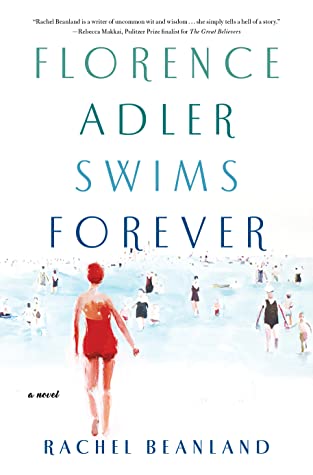
Florence Adler Swims Forever*****

It’s hard to believe that Florence Adler Swims Forever is a debut novel. Rachel Beanland has stormed our literary beaches, and I hope she does it forever. Big thanks go to Net Galley and Simon and Schuster for the review copy. This book is for sale now.

The title character dies almost immediately, which is a bit unusual all by itself. The central storyline centers on Fannie, Florence’s sister, who is in the midst of a dangerous pregnancy. She’s already had one premature baby that died at 3 weeks, and so this one Is being closely monitored. Because of this, the family closes rank in order to prevent Fannie from knowing that Florence has died until after the baby’s birth, lest she miscarry. However, Fannie isn’t the main character; the point of view shifts between the present and the past, from one family member to another, eight all told, in fairly even fashion.

My first reaction to this premise—keeping her sister’s death from Fannie for what, two months—is that it’s far-fetched to think such a plan could succeed. But as the story unfolds, I realize that information was not a constant presence during the late 1930s, as it is now. There was no television yet; a radio was desirable, but not everyone had one. Fannie asks for a radio for her hospital room, but she’s told they’re all in use. Too bad, hon. Newspapers and magazines were explicitly forbidden for visitors to bring in; the lack of news is explained in general terms as “doctor’s orders,” and back then, doctors were like little gods. If “Doctor” said to jump, everyone, the patient most of all, leapt without question. And then I see the author’s note at the end, that this story is based on an actual event from her family’s history! It blows me away.

Besides Fannie and Florence, we have the parents, Joseph and Esther, who have a meaty, complicated relationship; Fannie’s husband Isaac, who is an asshole; Fannie and Isaac’s daughter, Gussie, who is seven; Florence’s swim coach, Stuart; and Anna, a German houseguest whose presence creates all sorts of conflict among the other characters. Anna’s urgent need to help her parents immigrate before terrible things happen to them is the story’s main link to the war. All characters except Stuart are Jewish.

Because I missed the publication date but was eager to dive into this galley, I supplemented my digital copy with an audiobook from Seattle Bibliocommons. This is a wonderful way to read, because when something seems unclear to me, I can switch versions, and in the end, I feel well grounded. The audio version is read by eight different performers, and the result is magnificent.

Read it in print, or listen to the audio; you really can’t go wrong. The main thing is that you have to read this book. As for me, I’ll have a finger to the wind, because I can’t wait to see what Beanland writes next.

To Wake the Giant, by Jeff Shaara*****

“It’s the admirals, sir, playing with us like this is their own big-assed bathtub and we’re just toys.”

Jeff Shaara has written some of the best war stories ever published, and he’s done so for almost 25 years. I have read every last one of them. When I was invited to read and review his new novel about the Japanese attack on Pearl Harbor by Random House Ballantine and Net Galley, I was delighted, but also slightly apprehensive, because even after all these years, the subject remains an incendiary one; I needn’t have worried. This may be Shaara’s best book, and that’s saying a lot.

I’ll share a brief note about my own biases going in. My father was among the last men called to serve during World War II; he never left the U.S., however, where he was tasked with training new recruits to the still-new U.S. Air Force. But I grew up hearing about Japanese atrocities, and many of the bizarre stereotypes and misconceptions based on pseudoscience were told to me as fact. When as an adult I announced that I was about to marry a Japanese citizen, I sounded the waters with my family to see if there was resistance. I was told that my parents “still remember Pearl Harbor.” Meanwhile, my husband’s father also served during World War II—in the Japanese army. The topic was never raised by his parents around me, or at all as far as I know; but I asked my spouse a few questions to help me understand the Japanese perspective about this horrific conflict, and then I understood exactly how erroneous most of what I’d been raised to believe actually was.

So I was primed to read this book, and also a little afraid of what I might find. My internal map of Pearl Harbor was studded with emotional landmines, and at the book’s conclusion, none of them had been tripped.

Shaara tells this story primarily through the eyes of three people: Cordell Hull, U.S. Secretary of State under President Franklin Delano Roosevelt; Admiral Yamamoto, the Japanese architect of the invasion; and Tommy Biggs, a 19-year-old naval recruit from an impoverished Caucasian family in rural Florida.

Shaara faithfully incorporates a character from the rank and file in every story; he does this even if there is nobody on record that he can report on, and so often, he is forced to create a fictional character based on experiences and characteristics from several people. When I saw no such disclaimer in any of his notes, I grew curious and wrote and asked him whether this is the case with Biggs. He replied that this time there is a Tommy Biggs (though the name is not the same), but that he did add the experiences of others in order to flesh him out. So this time, each of the three chief characters is based on an historical figure.

I learned a great deal. Though it’s well known that this attack profoundly crippled the U.S. Navy, sinking or badly damaging most of the fleet, I had never considered it from the Japanese perspective. Looked at in that way, it was not only audacious, it was immaculately planned and wildly successful. I also had never considered what a blunder it was on the part of the U.S. military to leave its equipment, ships, planes, and more so unguarded. In the fallout after the attack, we learn that the Navy considered security to be the job of the U.S. Army and vice-versa. What a colossal bungle.

Japan had emerged victorious from the Russo-Japanese War, and its leadership was suffused with overwhelming confidence. Japanese racial superiority would lead to Japanese dominance throughout the China, Indochina, and across all of Asia, they claimed, because they were meant to dominate their portion of the globe. Japanese leaders were convinced that the U.S. would not seek retribution following an attack on its soil because American isolationist sentiment was so strong. They genuinely hoped that this attack would result in an end of the U.S. embargo that crippled Japan, and which existed in order to halt Japanese expansion and force Japan to withdraw from its alliance with the Axis powers. Americans, the Japanese brass told one another, were too big, too slow, too lazy to retaliate. There were voices of dissent, however:

“For any of you who believe the Americans are not worthy of a fight, that they do not have the stomach for blood, perhaps you are familiar with the American Civil War? In the 1860s, they divided and fought each other in the bloodiest war in their history. They did not require any enemy to inspire them. They fought each other. Are you familiar with football?”

Meanwhile the U.S. military, press and popular culture treated the Japanese as a bad joke. One myth dressed up as science suggested that Japan would never be able to build an air force because of an inherent defect in the inner ear of all Japanese. It was physically impossible for them to become pilots! The condescension was rife, everywhere one turned. Hollywood depicted the Japanese as ridiculous, rodent-like creatures with minds that didn’t function properly. The Chicago Tribune stated that for Japan to attack the U.S. was “a military impossibility.” Japanese were said to be too myopic to be effective against a military target. And it goes on.

There’s all sorts of blame to spread around. Nobody in Washington, D.C. had told the top brass at Pearl Harbor, Admiral Kimmel and Lieutenant General Short, about the project named Magic, which intercepted and broke Japanese code. They had no idea that Japan was rattling its sabers to such a degree.  And these two men appear to have been lazy, bureaucratic fools that ignored what little intelligence came their way. For example, shortly before the attack, the man on watch sees a Japanese sub in the water. Kimmel immediately assumes that the guard has seen a whale, and he goes back to bed.

There are three aspects of this novel that keep the pages turning for me. The first, of course, is my interest in military history. Shaara’s research is meticulous. The book is historical fiction at its best, which is when the contours of the story, even fairly detailed aspects of it, are correct, but the fictional genre is chosen so that dialogue and inner monologue can be added. Second is Shaara’s perceptive nature, and it’s this that permits him to choose the best details to include and cut what is inessential so that pacing never flags. And finally, his capacity to develop a character so that we feel we know him is matchless; in particular I bond to poor Tommy Biggs, a guy that can’t catch a break, until he can.

Nothing I can say will serve as well as what Shaara says himself. Get this book, even if you have to pony up full cover price. This is hands down the best fictional representation of Pearl Harbor on sale today. Believe it.

The Secret Guests, by Benjamin Black****

It’s World War II, and the Blitz has begun. The Royals are torn, wanting to remain with their subjects and share their misery, but not wanting the risk the well beings of their daughters. It’s decided that the girls must be moved, but with the shipping lanes and skies fraught with peril, where can they go and be safe? Ah, a fine idea: they’ll send them to a cousin in Ireland.

My thanks go to Net Galley and Henry Holt for the review copy. This book is for sale now.

As historical fiction goes, this is lightweight material, based on almost no historical event other than the war itself. However, as general fiction goes it’s terrific, immensely entertaining and droll as heck. I figure it’s 3.5 stars for historical fiction, 4.5 stars as general fiction; thus my 4 star rating.

Our protagonist is Garda Strafford-With-An-R, a marginally competent Irish detective who resembles Stan Laurel, tasked with the security the estate where the girls will be housed. Secondary characters are Celia Nashe, a British cop equivalent to a Secret Service agent, who is assigned to serve as personal security for the princesses; an arrogant, sleazy ambassador named Laschelles; and Strafford’s boss Hegarty, who resembles Oliver Hardy. We also have clueless but entitled Sir William, the girls’ host; two bored princesses that get up to things when nobody’s looking; some household servants that know more than they are supposed to; and a few local people that also know too much.

The fact is that I’m entirely burned out on World War II fiction, and that fact nearly prevents me from requesting this galley. But the spin—Ireland, which remained neutral and flirted with taking the side of Germany, what with its enmity toward the British—proves irresistible. The greatest surprise is how much wit is employed and how fast the story moves. I have never read Black’s work before, and this guy is hilarious. He shifts the point of view often, always from the third person omniscient but varying several times within a single chapter, so we get snippets of the person that’s bored, the person that’s nosy, the person that’s confused and so forth. The word smithery is so original and clever that I cannot put my highlighter down. Highlighting is pointless when I highlight close to half of the text, but I can’t help myself. And best of all, the cliched ending that I think I can see a mile away isn’t happening.

Those of us in the States have a three day weekend right around the corner, and the weather will be too miserable to want to go anywhere. This novel might be just the ticket. If you’re lucky enough to be planning a vacation soon, this would also be a fine beach read. But the humor will be a terrific pick-me-up for those stranded indoors with a case of the grumps. I recommend this book to you, and I would read this author’s work again in a heartbeat.

Best Biography of 2019: Madame Fourcade’s Secret War