Mot, by Sarah Einstein*****

Einstein_Mot.inddSarah is forty, and she’s floundering. Her life’s work, like her mother’s, has been to try to make the world a better place, and so she works at a homeless shelter as its director. But things are falling apart there; whereas once upon a time most of the mentally ill homeless were passive, now meth and other addictions have created so much anger and violence that she isn’t even safe there. She’s been physically attacked three times, one of which was sexual, and her life has been threatened on an ongoing basis. Too often she is the only staff member present, and it’s getting scary out there.

Many thanks to Net Galley and University of Georgia Press for the DRC. This title goes up for sale September 15.

In addition, her marriage, which was predicated upon a mutual dedication to social justice issues and the understanding that neither she nor her new husband would be around much because of the time and attention their work demanded, is coming undone as well. Her husband Scotti has at times sided with the population she is supposed to be managing at the shelter against her.

Think of it!

So maybe it isn’t so very strange that she has decided to load herself into her vehicle and drive 1400 miles to Texas to visit a homeless friend who has moved there. “Mot”, who used to be “Thomas”, is living in a beat-up car in a Walmart parking lot. And whereas most of us would regard her mission as either an immense personal sacrifice or even a little bit bizarre, the fact is that she needed to get away from West Virginia, that shelter (where she has given notice and is using up every possible minute of vacation time), and Scotti. She has rented a little cabin—the closest thing Mot will accept even temporarily in terms of living indoors—with two beds, one for herself, and one for him. And as the book opens, she is reflecting that even if he never shows up, a whole week in this primitive little yurt, all by herself, sounds positively wonderful.

Right away her spouse is ringing her cell to complain of how much inconvenience he is experiencing while she is gone. He sends unhappy e-mails constantly, but he also doesn’t want her to use her smart phone because that data costs money. So although she hasn’t explained to us yet about the state of her marriage, which should still be in its honeymoon phase but really, really isn’t, we start to get the picture.

Mot is a complicated fellow. Immediately, when she quotes him, I start asking myself whether this is schizophrenia, a dissociative disorder, both or neither? I’m not a professional by a long shot, but when a guy routinely refers to the other folks with whom he is sharing a body and that control his behavior, it’s pretty clear all is not well. And my jaw dropped on the floor later in the book when he commented, in a moment of total lucidity, that it was probably the latter.

Mot is a veteran, and Sarah’s documentation of the unconscionable way the USA treats its veterans is noteworthy. Advocates for veterans’ health care should be plugging this book all the time, everywhere.

Sarah’s time with Mot mixes with some odd bits of philosophy, most of them his, and so although plot wise there aren’t a lot of parallels, the overall flavor to this book is similar to that of Zen and the Art of Motorcycle Maintenance. (I have never compared any other book to that book before, and don’t expect to!)

I should also add that I came to this galley after having read a couple of Pulitzer winners and some books by my favorite bestselling authors. I dove into Mot not because I thought it would be my favorite of the remaining DRC’s I had to review, but because I had snagged it right before it was due to be archived, and I felt an obligation to the author and the publisher. In other words, although it looked interesting, I didn’t expect to give it five stars. But the sum of the book is so much more than its parts, and to get it, you really just have to read it.

Highly recommended to anyone and everyone.

Lucy Stone: An Unapologetic Life, by Sally McMillen ****

lucystonealifeThis well-documented, balanced yet sympathetic biography serves to advocate for the inclusion of Lucy Stone among the statues of great Americans at the Capitol rotunda in Washington DC. Currently there is a suffragist statue that includes Stanton, Cady, and Mott. McMillen makes a strong case that Stone should be there as well.

Thank you to Oxford and Net Galley for the ARC. The book will be available at the end of January.

The history of the American feminist movement is a cause near and dear to this reviewer’s heart. I have studied it, taught it, and lived it. I have marched on that Capitol numerous times in defense of the right of women’s reproductive freedom, despite the fact that most of my life has been on the West Coast of the USA, and that is one long ride. And so, having recently veered out of my historical comfort zone, here I found myself right back in it. And most of the information in this book, while useful, is not new to me.

The reader should know that although there is extraneous material that ought to be edited out, it is all at the beginning of the book. If you are interested in the history of the suffrage movement and/or American feminist history in general, get a copy of this book, and don’t be discouraged by the initial ten percent. It does get better. It probably won’t change the statues in DC., but regardless, what McMillen imparts here is (for the last 90%)thorough, well documented, scholarly, and unflinching when less attractive issues arrive (such as the race-baiting, anti-immigrant speech-making, and the squabbling after the split in the organization occurred).

Stone was a remarkable woman, strong, charismatic, and imbued with many ideas that were well ahead of her time. Unlike most of the women who participated in and lead the women’s movement of the nineteenth century, her own origins were not petit bourgeois, or middle class. She was born into a farm family that struggled financially, and still she attended Oberlin College, the first in the nation to accept women and permit them to attend college with men. Her education was not a gift doled out from parental largesse; she taught school in order to pay her way. (Her father relented when she was a senior and paid for the last year).There were a number of restrictions on women there that seem ridiculous now and that Stone fought against and sometimes won. Her steely determination, keen intelligence, and personal magnetism led her to be the first woman to enter the then-popular public speaking circuit.

In these days before the American Civil War and after the Industrial Revolution, there was of course no media beyond the printed word. Many people were hungry for new information and ideas, but books were very expensive and newspapers, though plentiful, were often incorrect and for many, insufficient. (This paragraph is not in the book; this is me speaking.) So it isn’t really surprising that those who had the time and the means would turn up to hear speakers on important issues of the day.

Many were shocked, McMillen tells us, to hear that a woman, a single, unescorted woman, had taken this path. Stone was considered a radical, but her musical, sweet-sounding voice and her petite countenance, which she deliberately dressed in black silk and lace to take off the edge, took many off guard, and newspaper reviews were often quite favorable. Over the course of time she became famous. She proposed things suggested by no one else, such as the advantage of a woman’s remaining single so that she could keep her own money and property rather than to turn it all over to her husband, as the law required should she wed. Further, she suggested, the law ought to be changed so that such a choice need not be necessary.

Later she met Susan B Anthony, and the two were, for a time, close friends, addressing one another by their first names at a time when only the most intimate of acquaintances did so. And just as their political agreement formed the basis for what appeared to be an unshakeable friendship, so it would later cause a rift, not only personally, but in the movement itself.

For those interested in women’s history, American history, contemporary history, or Stone herself, consider this a must-read. Skim through the extraneous bits at the beginning and once the narrative truly takes wing, it will keep your attention.

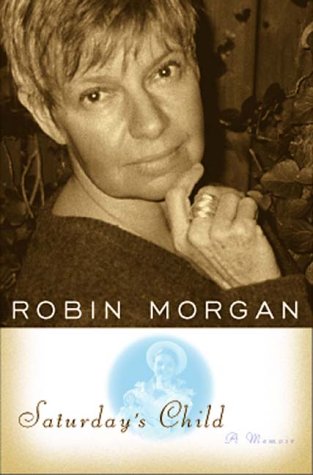
Saturday’s Child: A Memoir, by Robin Morgan *****

saturdayschildRobin Morgan is one of the mothers of contemporary feminism. She has charted history, together with other women and those who support them, in more ways than I can even keep track of. Although she was once famous for her performances as a child actor, it is for her feminism that I know her, and for that reason I was eager to read her memoir. Huge thanks to Net Galley and Open Road Integrated Media for the ARC.

Now a social warrior of advanced age, she is still undoubtedly one of the most articulate individuals alive. However the heat that came from her discussion of her childhood all but singed my eyebrows. Some of us grow mellower with age and learn to let go of things that happened when we were small, but I suppose for some, outrage and sorrow compound faster than interest on a credit card.

You see, Morgan was raised as a child celebrity. From the age of two years her life was a constant swirl of organdy dresses, auditions, and performances. She rode in parades and promoted a doll that resembled her, though she was not permitted to play with one. She wasn’t allowed to nurture friendships, and would not have had time for them in any case. Work, education, and rehearsal took up all of her time, and special arrangements had to be made in order for her education to be completed because of her exhausting schedule. She was a highly capable student and is clearly extremely literate, but her formal education ended with high school; her mother, who lived off of Morgan’s pay from Morgan’s toddlerhood until her death (including investments that lived on after Morgan retired from show business), told her that college was out of the question. She deals articulately and extensively with issues surrounding the exploitation of child actors by adults during this period, as well as the surprise revelation that came about when she tracked down the father she had never known.

I found my long dead and slightly famous great-uncle buried in her text; Sherman Billingsley, owner of The Stork Club, named a drink for her, similar to a Shirley Temple, but with a chunk of pineapple. Funny stuff, though Morgan’s childhood experiences were mostly grim.

The rest of the book gave me what I came for. Morgan came of age during the antiwar era of the late 1960’s and early 1970’s. The era of protest surrounding the US war against the people of Vietnam radicalized the youth who participated in it; the women who had been side-lined during this time period by their male counterparts began to realize that they should be taking part in the decision-making process instead of rustling up sandwiches and coffee while the men talked politics.

“Free love” really meant group sex, and Morgan learned quickly that it was not liberating for her, but rather it was traumatic. From Eldridge Cleaver to Abbie Hoffman, one radical male after another showed himself to be a member of the old boys’ club where women were concerned. It gave her and several other women pause, and soon led to a number of publications, including Sisterhood is Powerful, an anthology I treasure to this day. Morgan’s energy and achievements appear to have been boundless.

The urban myth in which feminists all burn their bras appears to have originated with Morgan and other feminists’ boycott and picket of the Miss America Pageant in 1968. At this event a certain amount of street theater took place to draw attention to the objectification and trivialization of women in US society. One of these involved whirling bras, symbol of the restriction and shaming of women, in the air and then dramatically dropping them in trash cans. (No fire.)

Morgan’s achievements are too many to enumerate here, but her history, and that of other feminists, from Betty Friedan, bell hooks and Bella Abzug to Gloria Steinem, founder of Ms. Magazine, should be part of every general course in American history, and here the author weighs in once more. She is absolutely correct in reminding us all that the history of women does not belong isolated in a women’s studies department, but is a part of history in general. Pick up a textbook and list the names; how many are male, and how many are female, even for the relatively recent period since World War II? Nor is this problem limited to the USA; in fact, it appears to extend all over the world. There can be no post-feminist era until women enjoy social, political, and economic equality. It hasn’t happened yet.

In fact, Morgan’s internationalism, which has been a large part of her career since the first publication of Sisterhood is Global, is where she shines brightest.

After reading Saturday’s Child, I have found myself once more becoming conscious of the imbalance in the world around me. I have noted that if I mention in one instance or another that women are under-represented, even my own children give me a look that says I am bringing up trivial, petty matters that I should have let pass. And then I hear Morgan, reminding me that trivializing women is part of the problem.

If you are a woman, or if you love one, reading Saturday’s Child may leave you feeling dissatisfied and in need of social change. And until the world becomes equal for everyone, that is as it should be. If Morgan’s legacy is that more women raise hell for their reproductive freedom and economic equality until both are gained, then what better thing could she have done for the world?

What Women Want, by Deborah L. Rhode *****

What Women Want

Yes, thank you, I am a feminist. And in the wake of the Supreme Court’s decision around the Hobby Lobby’s so-called “right” to deny its female employees the contraception of their choice via their health insurance, Rhode’s manifesto could not be more timely. The book is not only right on the money politically, but it is scholarly, accessible, and written by a woman whose credentials cannot be questioned. Rhode is a Stanford law professor who clerked for Thurgood Marshall. She founded the school’s course on gender, but still sees plenty of room for improvement…everywhere. She’s right. Thanks to Net Galley for promoting this important book.

Rhode points out that in spite of the all-too-common mistaken perception that gender bias is a thing of the past, women constitute less than one half percent of the content in the average history textbook. Furthermore:

In virtually every major dimension of social status, financial

well-being, and physical safety, women still fare worse than

men. Sexual violence remains common, and reproductive

rights are by no means secure.

Women are still primarily responsible for child care, and they are still penalized for this on the job. Abortion providers are rare due to local laws and increased insurance premiums, courtesy of virtually unfettered terrorism against women’s health clinics. Wealthy women will always be able to terminate an unwanted pregnancy because they can travel, but the poor, who often have the most urgent need to exercise this choice, are stuck if they can’t get to a county or state where the service is available, and pay for attendant travel costs associated with other red-tape hurdles such as waiting periods.

The USA has the second-highest rate of reported rape in the world, and a quarter of all women experience violence from their intimate partner; a fifth are raped or experience attempted rape.

Are you listening?

Rhode carefully delineates every problem faced by women in the USA today, and she argues, blow by blow, citation by citation, what is needed. Women should be organizing. We aren’t, at least not in the numbers that we need to in order to bring about social change. In fact, this reviewer would suggest that we are losing ground, and it is because so many of us don’t show up to carry a sign, wear an armband, or carry a bullhorn.

The only weak place in Rhode’s release, if there is one, has to do with women of color. Her analysis there is shallow. However, the other sections apply to all women, regardless of color or ethnicity. We all need respect in the workplace and parity with our male coworkers or colleagues in pay and advancement. We all need affordable–if not free–childcare. We all need reproductive freedom that is between ourselves and our doctors. And we all need to be able to speak up and be perceived as “assertive” rather than “aggressive”. We are not there yet.

This reviewer has twice marched in Washington DC for women’s right to reproductive freedom, and cannot believe that the Equal Rights Amendment is dead. What’s that about?

If you are female or care about someone who is, you should get this book. Rhode is crystal clear and absolutely correct; if women cannot be equal now, then when?

The American Sisterhood: Writings of the Feminist Movement from Colonial Times to the Present, by Wendy Martin*****

Please note that this resource is copyright dated 1972. You’ll have to consider the word “present” in the title with a grain of salt. It would be great to see an updated version published, but right now, the word “feminist” carries such strangely negative connotations that no new edition may be printed…at least, until the pendulum swings back where it belongs. This, like most political assertions, is a matter of perspective. Now you have mine.

This out-of-print, unpretentious-looking volume is a treasure trove of speeches and letters from feminist luminaries, from Sojourner Truth and Elizabeth Cady Stanton, on up through Emma Goldman and Charlotte Perkins Gilman, to the so-called radical feminists of the 1960’s, such as Gloria Steinem and Robin Morgan. If you are interested in American history, the history of women’s rights, or in need of primary sources regarding same, snap up a copy of this if you can lay your hands on it. Mine is in woeful condition, and the ISBN page fell out; I had to get it from Amazon’s website! A scholarly edition I am so glad to have kept over many years, many moves, and the occasional furtive looting of my shelves by children no longer at home. A must-have for students of the history of women.