
Emperor of the Seas, by Jack Weatherford*****

How much do you know about the Mongol empires? If you grew up in the U.S., chances are you answered, “Absolutely nothing.” The world is a big place, and world history has never been much of a priority in American schools; we study various phases of U.S. history, state history, and in a wild flurry of internationalism, some districts now teach a semester of Canadian history. The single year of world history in high school is usually devoted to World War II, which is impossible to teach without including information about Europe, and a smidgen about Japan along with, yes, more American history. There you go. Here’s your diploma.

In my retirement years, I have reveled in the freedom to learn about the history that wasn’t on the syllabus for what I studied, and later, what I was hired to teach. Having marched my way through various other times and places, I realized that I knew nothing about the Mongol khans. I read one novel about Genghis, and I was hooked.

My thanks go to NetGalley and Bloomsbury for the review copy. You can buy this book now.

If you’re going to read a single nonfiction book about the Mongols, this would be a fine choice. Jack Weatherford’s research is outstanding, including works in several non-English languages that most of us couldn’t hope to read on our own. His scholarship is so meticulous that he has been awarded both of Mongolia’s top national awards. Not half bad, for a boy from South Carolina. And while this book is not written as narrative nonfiction, the tone is conversational, the language accessible. I read it daily at lunch time, and it wasn’t long before I was shouting out random, amazing facts to family members that dared venture into the kitchen.

It began with Genghis, a young man whose family was left homeless, left to freeze or starve when his father and protector died. With desperation, talent, and ruthlessness that he learned well, he turned it around, and as he grew up he vanquished his enemies, brought the most talented and trustworthy elements to himself, and let the devil take the rest. His instinct for military strategy was a thing of pure genius. But this book is mostly not about him; it’s about his grandson, Kublai Khan, who expanded the empire Genghis began until his domain stretched from Baghdad to the far shores of China.

Until Kublai arrived, Mongols were an inland people, but it was Kublai who realized that in order to expand and become a world power, he had to have ocean-going vessels and people that knew how to use them. The peoples of Southern China were tough to defeat, but once it was done, he was able to use their technologies in ways that were of immeasurable value.

The progression looked like this (in a very simplified version): Genghis conquered, and took no prisoners, with a few rare exceptions. Kublai conquered, but also used diplomacy, highlighting the potential benefits of becoming a Mongol subject; he didn’t routinely kill everyone he defeated. And under Kublai’s son Temur, the Mongols segued from physical battle to economic dominance, making China’s ports the ideal destination of merchants from all over the world.

One of the most interesting things I learned had to do with the authority that was vested in the women of the highest placed families. When the men rode off to conquer, it was women that looked after the business interests and saw to local governance. It worked out nicely; Europeans should have taken note.

I can’t compare this book to others because I haven’t read any others on this topic cover to cover, but I wouldn’t let that stop you. If the Mongols are persuaded that Weatherford has done the work and done it well, who can argue? I learned a great deal and enjoyed it, and so I highly recommend it to you.
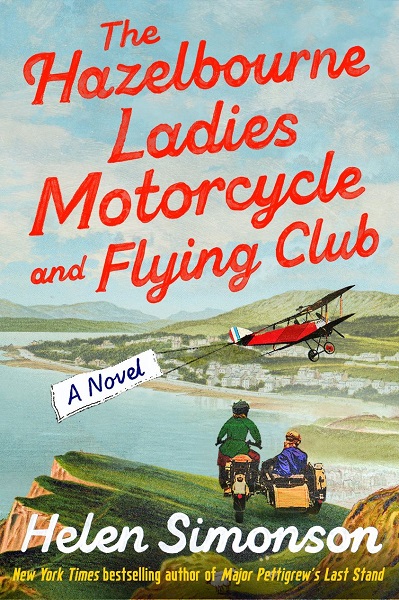
The Hazelbourne Ladies Motorcycle and Flying Club, by Helen Simonson*****

Helen Simonson is the author of the bestselling novel, Major Pettigrew’s Last Stand. With her new release, The Hazelbourne Ladies Motorcycle and Flying Club, she is once more in her element, creating believable characters and using them to skewer the pervasive racism and class snobbery of Britain, and also, in a smaller way, that of the U.S.  With outstanding word smithery and an unflagging pace, this historical novel should be number one on your summer reading list.

My thanks go to NetGalley and Random House for the review copy. This book is for sale now.

The year is 1919; the place is England. Constance Haverhill has been ousted from her job running an estate; the Great War has ended, and now the women that have been gainfully employed and done a fine job are unceremoniously ejected so that their jobs may go to the men that have returned from the conflict. For the time being, she has a position as a traveling companion to a family friend who’s recuperating at the seashore; once this situation ends, she has no idea where she’ll go or what she’ll do.

Out of nowhere comes Poppy, a daring young woman from a wealthy family. Poppy wears trousers and drives a motorcycle; she befriends Constance and sweeps her into her motorcycle club. Things become even more interesting when Poppy purchases a used biplane to bring home to her brother Harris, a handsome but severely depressed young man who’s lost a leg in the war. At one point he laments, “They look at me as if my brain has gone missing along with the leg. Or rather they refuse to look at me at all.”

Poppy is utterly fearless, challenging local authority and promoting women’s rights. She doesn’t care about the opinions of others; her eye is set on the horizon. And she can do that, because she has a soft nest in which to land. At the same time, Constance is always aware of the stark class division that prevents her from behaving as Poppy does.

“Respectability was the currency in which Constance knew she just trade for the foreseeable future. She…did not have Poppy’s wealth and position from which to defend herself against notoriety.”

There are a number of amusing side characters whose less progressive attitudes contrast with Poppy’s. The two women—also very wealthy—on the adjoining estate sniff at her exploits and declare them to be unladylike. The class division is also highlighted when Constance is offered a position with the hotel where she and Mrs. Fox, the family friend she accompanies, are staying. However, she is told that once she accepts the offer, she can no longer be a guest at the hotel, nor may she use the restaurant, which is a frequent gathering place of Constance’s new friends. No hobnobbing with the clientele will be tolerated; she must use the back door. Constance reflects to herself that wherever she goes, her friend Poppy will use the front door.

Britain’s racist attitudes toward people of color is also featured here, but in a way that does not hijack the plot. There’s an Indian guest of the hotel that is snubbed left and right; at one point, an American visitor attempts to have him excluded from the social events to which he’s been invited. This is resolved in a deeply satisfying manner, as is the issue of taboo friendships formed by Mrs. Fox.

If I could change one thing, it would be to add a bit more nuance. The bad characters are oh so bad; and while the good characters make the occasional mistake, we never doubt their complete goodness. However, this is a minor bone to pick, and overall this is a delightful book.

Highly recommended.

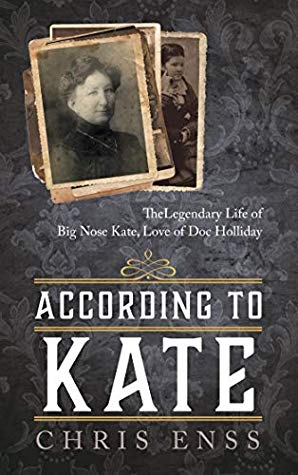
According to Kate, by Chris Enss***

Kate Elder, better known as Big Nose Kate, was a colorful character in the mercurial Wild West. Together with her paramour—possibly her husband—Doc Holliday, she shot, swindled and burned her way through Kansas, New Mexico, Texas and other parts of the American Southwest. My thanks go to Net Galley and Two Dot Publishing for the review copy. This book is for sale now.

Enss is a capable writer, and I enjoy seeing women about whom little has been written brought to the foreground. Enss amassed a fair amount of material on her subject, but some of it was contradictory, and the greatest contradictor of all was Kate herself, who decided to tell her own life story when she was too old to recall everything properly. Enss tells the reader in the title and introduction that she is telling Kate’s story from the subject’s point of view, and she adds numerous footnotes explaining  conflicting information throughout the narrative.

I read things I had never known before about this time and place, and general historical knowledge is where Enss shines best. For example, a ‘soiled dove’ was allowed to own real estate, whereas married women of the time were not. There were a number of financial advantages to owning a house of ill repute. Kate grew up in a middle class household and was not without choices, but she didn’t care to be married off in the way her family had proposed. In the end she was both a shrewd businesswoman and an adrenaline junkie, one that made a point of having at least one loaded gun handy when a situation called for it. I enjoyed reading about it.

Unfortunately there is a lot of conflicting information and the gaps in the story are numerous. Anytime I start seeing the words “might,” “must have, “ “likely” and so forth, I pull back from the narrative. I can’t get lost in a story when I have to mentally filter the things that are known to have happened from the things nobody knows for sure.  I think Enss has done as good a job as could be done with the documentation available, but Kate is a hard nut to crack.

What I would love to see is historical fiction written with Kate as the protagonist, viewed through the eyes of a feminist writer such as Enss. With historical fiction one can freely fill in the gaps, provide dialogue, and make notes at the end of the story letting the reader know what she has invented or changed.

Those with a special interest may want to read this biography, but I see it largely as a niche read.

Best Historical Fiction 2018

Image