Left for Dead, by Eric Jay Dolan***-****

When I saw this book, I was eager to read it. Shipwreck, treachery, and survival? It doesn’t get a lot more exciting than that. I signed myself up for both the digital and audio galleys, and settled in to immerse myself in history.

My thanks go to NetGalley, RB Media, and W.W. Norton and Company for the galleys. This book is available for purchase now.

The book is well paced and well researched, with plenty of quotes from primary sources. The events described take place during the War of 1812, and involves British and American ships and crew members, none of them particularly lovable, but definitely resilient and ingenious at surviving in extremely dangerous conditions. The men on the American ship have been at sea since before war was declared, and are astonished to find themselves prisoners of war when they are rescued by the British at one point. There are a great many twists and turns, and this is one of those stories that would be considered completely unrealistic if written as fiction. What an experience these sailors endured!

Nevertheless, I am not the best audience for this story after all. I came into it thinking of history and survival, but when I applied for the galleys, I didn’t appreciate the word “sealer” in the ship’s description. Sealer, as in clubbing the seals to death. Hundreds! So easy! Filling the hold of the ship and…I will spare you the rest, since I was unable to spare myself. I sternly reminded myself that this was a different time period with different societal expectations. No animal had been declared endangered, and there had been no technologies that would render the need to wear animal skins for warmth obsolete. People need to stay warm and dry; seal skins will do that for them. I vowed to let it slide past and focus on the rest of the book; but it never slid past, because it was mentioned again, and again, and again, not with a tremendous amount of detail, yet far more than I needed or wanted to hear.

Yes, a baby is born on the ship, but that babe gets about three sentences. Yes, there’s a dog on board, and he saves the crew members many times over, but his heroics don’t show up until the last portion of the tale, and although other reviewers have said that the book is worth reading for this alone, I must respectfully disagree.

Clearly there are a number of people that appreciate and enjoy this book, and I agree that it’s important to document historical events, but I finished reading this thing weeks ago, and I still get a sour gut remembering. If you still want to read it, then do so, but it’s important to go in with your eyes wide open.

Flags on the Bayou, by James Lee Burke****

James Lee Burke is one of the finest prose stylists the U.S. has to offer. His brilliant, lush descriptions, quirky, resonant characters with interesting names, and his passion for the rights of the working class are the stuff of legends. My thanks go to Net Galley and Simon and Schuster for the invitation to read and review his latest novel, Flags on the Bayou. This book is for sale now.

Our protagonist is Hannah Laveau, a former slave who’s on the run from the law. With her is Florence Milton, an abolitionist from Massachusetts. Hannah is determined not to be caught, but also to retrieve her little boy, Samuel, a preschooler from whom she was separated at the battle of Shiloh. Her determination is singular. Along the way we have officers from both sides of the Civil War, corrupt rich guys, and bushwhackers. The story is complex, as are all of Burke’s novels, and the setting atmospheric.

All of these things being said—and I’ve said them many times before, since I began reading his work about a decade ago—there are some things that I would like to see done differently. Burke has always intertwined social and political messages within his novels, and so it’s the subtext in this book that jars me. In fact, it bothers me enough that I abandoned this story twice before I finally dug in, determined to finish it.

The first category here is the American Civil War, and the fallout we still deal with today. In past novels, Burke has told us that the slaveocracy was wrong, and that the war was indefensible. I feel as if he has retreated from that here. We have some ugly Confederate characters, to be sure, but we also have ugly Union officers, and General Sherman—one of this reviewer’s most beloved heroes—gets run through the mud multiple times. It’s as if Burke wants us to know that actually, both sides were bad, and that war itself is just plain awful. This is weak tea indeed.

The second is one I’ve been eyeing for the last few of Burke’s novels, and I have soft-pedaled it because of my great admiration for the body of his work, and for his ageing dignity, but I do have to say something here. His development of female characters needs work. Lots of it. All of his females are either Madonnas or whores (and sometimes, Madonnas that are forced to be whores, through no real fault of their own.) I would dearly love to see a female character in his books who is not there for her sexuality, and who is not either a victim or a potential victim. With Burke’s Dave Robicheaux detective novels, progress was made with a lesbian cop character, and I was thrilled. But she came and then went, and his experience creating her hasn’t overflowed into his other work.

More than any one thing, I want to see Mr. Burke write a book—just one, seriously—where there is no sexual assault, no threat of sexual assault, and no memory of sexual assault. It’s getting old, sir. You surely have the ability to provide female characters with other motivations. I want to see it.

I was nearly annoyed enough to rate this book three stars, but I liked the ending a lot, and so the fourth star remains.

So that’s my two cents, because as much as I love his work in general, this is getting in the way. There will doubtless be some blowback from his other devoted fans once I publish this review; bring it.

A final note: because I was struggling with this book, I checked out the audio version from Seattle Bibliocommons. The voice actors that perform it are world class. However, because the story is so complex, bouncing back and forth in point of view and setting, it is hard to follow in audio alone. The best way to read this is with both the printed word, whether on paper or digitally, accompanied by the audio.

Another Kind of Eden, by James Lee Burke****

James Lee Burke is a living legend, a novelist who’s won just about every prize there is, and whose published work has spanned more than fifty years.  My thanks go to Net Galley and Simon and Schuster for the invitation to read and review. This book is for sale now.

Another Kind of Eden is a prequel to Burke’s Holland family trilogy. The time is the 1960s, and protagonist Aaron Holland Broussard is in Colorado working a summer job. He falls in love with a waitress named JoAnne, but there are obstacles to their happiness everywhere he looks. There’s a charismatic professor that won’t leave her alone, a bus full of drugged-out young people that have fallen under his influence, and of course, there’s corruption among the local wealthy residents, which is a signature feature in Burke’s work. Aaron is a Vietnam veteran, and he has residual guilt and grief that get in his way as well. He’s got some sort of an associative disorder, though I am not sure that’s the term used; at any rate, he blacks out parts of his life and cannot remember them. He also has anger issues, and he melts down from time to time; there’s an incident involving a gun that he forces a man to point at him that I will never get entirely out of my head, and kind of wish I hadn’t read.

I had a hard time rating this novel. If I stack it up against the author’s other titles, it is a disappointment; a lot of the plot elements and other devices feel recycled from his other work, dressed up a bit differently. But if I pretend that this is written by some unknown author, then I have to admit it’s not badly written at all. By the standards of Burke’s other work, it’s a three star book; compared to most other writers, it’s somewhere on the continuum between four and five. Since I have to come up with something, I decided to call it four stars.

All that being said, if you have never read anything by this luminary, I advise you to start with one of his earlier books–almost any of them, actually.

Bestiary, by K-Ming Chang

It’s the best of books, but it’s the worst of books. K-Ming Chang has made her mark on modern literature, and her debut novel, Bestiary, has already made a number of prestigious lists. My thanks go to Net Galley and Random House for the invitation to read and review; sadly, its twisted edginess is too intense for me.

This much-buzzed-about book is for sale now.

How many triggers are packed into this one little book? All of them. Every trigger you can possibly think of, plus she may have made a few more up on the spot. There is violence a-plenty here, and the graphic child abuse and elder abuse provide such visceral imagery that I may never get it out of my head. I abandoned this book faster than just about any I can recall, and although I was certain it was the right thing to do for myself, I nevertheless experienced a twinge of regret along with it, because it is obvious from the first page that this author can write.

My gut hunch is that younger adult readers with cast-iron stomachs and level dispositions will be the most appreciative demographic for this one, but wimps like me will need to give it a pass. It is to the former that this book is recommended.

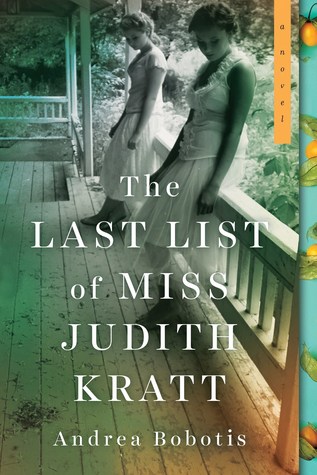
The Last List of Miss Judith Kratt, by Andrea Bobotis*****

“We will choose what we take with us.”

This thunderous debut by Andrea Bobotis bears a small resemblance to the work of Elizabeth Strout and the late Harper Lee. Issues of race and menacing family secrets simmer beneath the surface of this narrative like some otherworldly being biding its time in the swamp, till at last it rises and we must look at it.

As the story commences, Judith, who is quite elderly, is ready to take inventory. Her family home, all six thousand square feet of it, is jammed full of heirlooms, and each is fraught with history. The year is 1989, but as Judith examines one heirloom and then another, she takes us back to the period just before the stock market crashes, back when she was young and her parents and brother were still alive.

I have to confess that the first time I picked up this story—free to me, thanks to Net Galley and Sourcebooks Landmark—I thought, Huh. A boring old lady and her stuff. Pub date’s a ways off, so let’s put this one on the bottom of the pile. Of course, I picked it up again later. I read a bit farther this time and found I was acutely uncomfortable; I told myself I had to read it because I had requested the galley, but then I didn’t for awhile.

But like Judith, I pride myself on being reliable, so toward the end of June I squared my shoulders and opened the book. An hour later my jaw was on the floor and my husband was avoiding me, because he knew if he got too close I would start reading out loud. If you were to show up right now I’d do the same to you. I genuinely believe this novel and the characters and social issues they’re steeped in is one for our time.

Judith is the eldest of the Kratt children; her companion, Olva, lives with her, but her status is undetermined and remains that way far into the book. Part of the time she appears to be a live-in servant, hopping up whenever Judith wants a cup of tea or a blanket; at other times the two of them sit on the porch together and watch the world go by as if they were sisters or good friends. We know that they grew up together and share a history as well as the trauma of growing up with the vicious, unpredictable Daddy Kratt, the wealthiest man in Bound at the time.

As layer after layer is peeled back, using the household treasures that are inventoried as a framework of sorts, we see the gratuitous cruelty that was part of both women’s daily existence as children. Kratt can be generous at times, and yet at others—with increasing frequency—he is vicious and sadistic. We see the responses his unpredictable fury brings out of Judith as a child, her younger brother Quincy, who’s a chip off the old block, and their younger sister, Rosemarie. Kratt can ruin someone’s entire life purely on whim and never feel the slightest regret. He likes to watch. The entire town fears him.

Now he’s gone, and here we are. Judith acknowledges that her social skills are stunted, and she never knows what to say or do to smooth a difficult situation. She was never a pretty girl, and she has never married.  We can also see that she is solipsistic, insensitive to the feelings of others, and at times just straight-up mean, but she doesn’t see herself that way, because she measures herself against her late parents.  Judith is nowhere near as nasty as her daddy was; she has never permitted herself to be broken by him, as her mother was.  So Judith tends to let herself off the hook lightly. As she remembers back over the years the cataclysmic events that have taken place around her—or in some cases, because of her—her overall tone is self-congratulatory.

But her little sister, who is also an old lady now, returns to the family manse, and that overturns the apple cart in a big way.  How dare Rosemarie run out and leave Judith to contend with that awful man but now come back to claim her birthright?  Isn’t that right, Olva?

Olva just smiles.

In fact, this story is every bit as much about Olva as it is about Judith. . Every single one of these women is sitting on secrets; every one of them has a different story to tell. Every new revelation brings additional questions to mind, so that although this is not a mystery or a thriller, I cannot stand to put it down. I generally like to flop on my bed at night and read before I go to sleep, but I can’t do that with this book. I’d climb under the covers; open the book; read a little ways and then sit bolt upright. Eventually I realized that this cannot be the bedtime story. (It occurs to me just now that retelling one or another portion of this story in the voice of one of the characters not heard from would make a great creative writing assignment related to point of view.)

What Bobotis has done here is masterful. She begins with an old, wealthy white woman and yet develops her, and I cannot think of even a dozen books where that has been accomplished in a believable way in literature; once we get old, that’s pretty much who we are going to be. But the elderly Judith at the story’s end is a better person than the elderly Judith at the outset. And as if that weren’t enough, she also develops Olva, the dark-skinned elderly companion that seems to us, at the beginning, to be a live-in servant or nurse of some sort. But however circumspect Olva has been—a prerequisite for an African-American that wants to stay alive in the American South in the past and at times, maybe the present—Olva does in fact have some things to say. It is Rosemarie’s return that makes this possible.

This isn’t necessarily a fun novel to read, and yet the skill with which it is rendered is a beautiful thing in and of itself. I believed every one of these characters, those within this pathologically corrupt family and those around it. I suspect that the formidably talented Bobotis could pluck any one of these characters and create a sequel just as remarkable. This writer is going to be around for a long, long time, and as for me? I’m ready to read whatever she comes up with next.

Highly recommended.

The Line That Held Us, by David Joy****

thelinethatheldusDarl Moody and Calvin Hooper have been best friends forever, and so when Darl has the worst kind of accident, he knows who to turn to. You know what they say real friends will help you bury. The body in question is Carol Brewer; Darl was hunting out of season, and when he glimpsed something moving through the woods he thought it was a wild pig. Turned out he was wrong; turned out to be Carol, poaching ginseng on Coon Coward’s land. But you can’t bring the dead back to life, and you sure can’t call the cops for something like this. Carol is Dwayne’s brother, after all. Dwayne is a huge man, half- crazy and rattlesnake mean. There are no bygones in Dwayne Brewer’s world. There is only revenge.
My thanks go to G.P. Putnam and Net Galley for the galley, which I received free in exchange for this honest review.

“I’d be lucky if all he did was come after me,” Darl said, “But knowing him, knowing everything he’s done, you and me both know it wouldn’t end there. I bet he’d come after my mama and my little sister and my niece and nephews and anybody else he could get his hands on. That son of a bitch is crazy enough to dig up my daddy’s bones just to set him on fire.”

“[Calvin tells him] “You’re talking crazy, Darl.

“Am I?”

So Carol disappears…for awhile. But Dwayne won’t be satisfied till he knows what has happened to his brother, who is all the family he has left. Once he finds out, of course all hell breaks loose.
Joy is a champion at building visceral characters and using setting to develop them further. I know of no living writer better at describing hard core rural poverty to rival anything the Third World can offer:

“The house had been built a room at a time from scrap wood salvaged and stolen. Nothing here was permanent and as each addition rotted away, a new one was hammered together from plywood and bent nails off another side so that slowly through the decades, the five-room shanty shifted around the property like a droplet of water following the path of least resistance. Red Brewer was no carpenter. Chicken coops were built better. So were doghouses. But this place had been the roof over their heads and had kept the rain off the Brewer clan’s backs all Dwayne’s miserable life.”

The murderous rage of Dwayne Brewer contrasts with the tender, poignant love that exists between Calvin and his girlfriend Angie, who has just learned she is pregnant. Calvin understands throughout all of this that he has a lot to lose, and this makes the conflict between Dwayne and Calvin a more unequal one.

I would have liked to see Angie better developed, and I blanched a bit at the line where she thinks that the only important thing is what’s growing in her uterus. But the story isn’t really about Angie, and I have seen Joy develop a strong female character in one of his earlier books. I hope to see more of that in his future work.

Meanwhile, the passage where Dwayne visits Coon Coward—some four or five pages long—just about knocks me over. This is what great writing looks like.

I struggled a bit with the ending, and this is where the fifth star comes off. The first 96 percent of this tale is flat-out brilliant, but I feel as if Joy pulls the ending a bit, and I can’t see why. None of the rest of the book points us toward this conclusion.

Last, the reader should know that there is a great deal of truly grisly material here. We have a torture scene; we have numerous encounters with a decaying corpse. If you are a person that does most of your reading during mealtime, this might not be the best choice.

For those that love excellent literary fiction or Southern fiction, this story is recommended. It will be released August 14, 2018, but you can pre-order it now.

Best of the Year: 2017

Gallery

This gallery contains 3 photos.

2017 has been a stellar year for literature, and when I sat down to rate my top ten, I found myself stymied. Working up to it by offering the best of each genre seems more approachable, although still daunting. Most … Continue reading