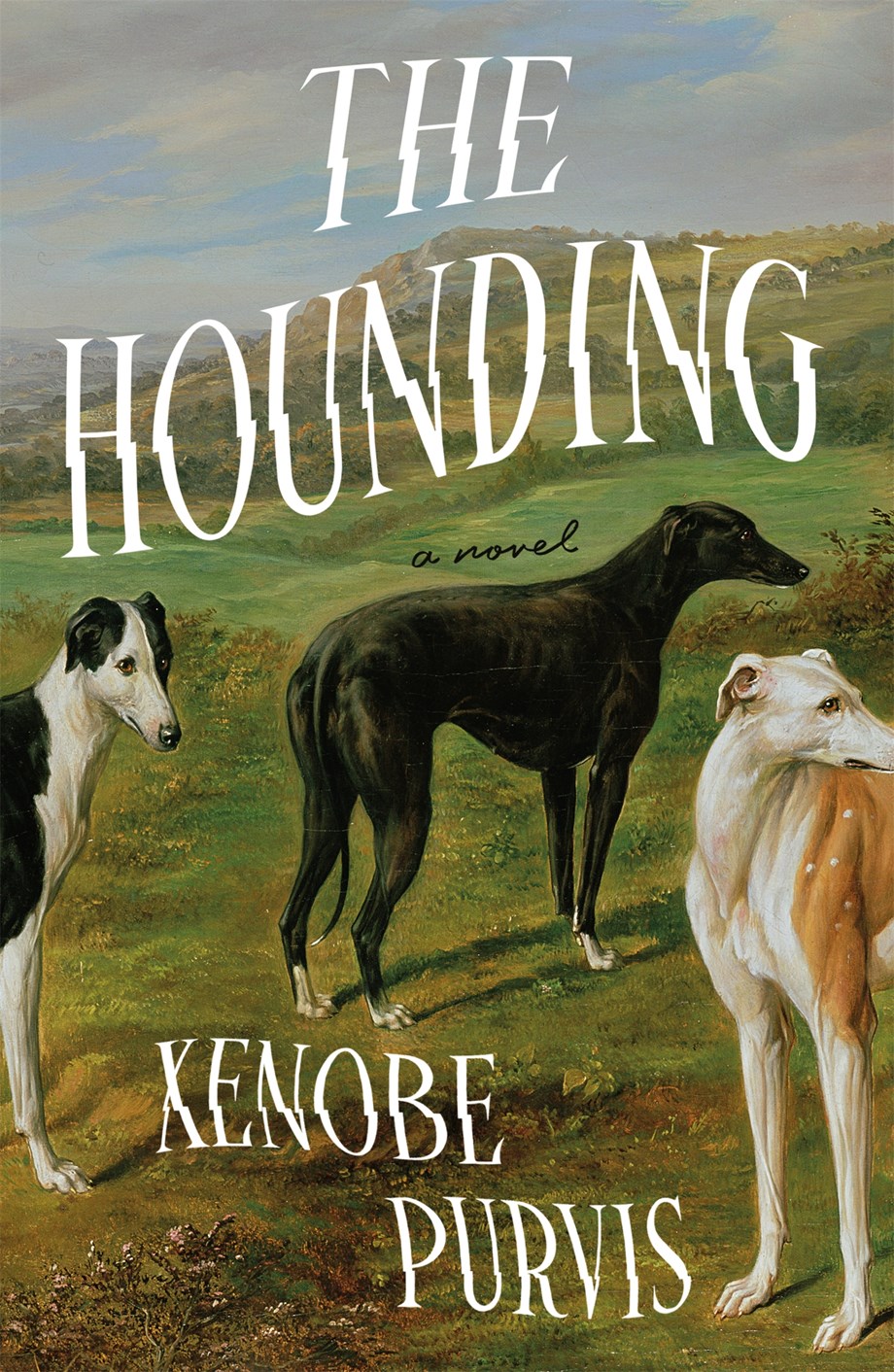
Who could walk away from this book cover? The Hounding, the arresting debut by Xenobe Purvis, is a story set during summer in eighteenth century England, in a tiny hamlet. Five motherless girls are given more freedom than is customary, and a rumor takes hold that the girls turn into dogs and wreak havoc on the village of Little Nettlebed.
My thanks go to NetGalley and Henry Holt for the invitation to read and review. This book will be available to the public August 5, 2025.
The Mansfield girls are being raised by their grandparents; their parents are long dead. But now, their beloved grandmother has died as well, leaving them in the care of their elderly grandfather, who is almost blind. It’s not a great summer for anyone else, either; there’s a dreadful drought that affects agriculture, and the riverbed is nearly dry. Then one day, Pete, the ferryman, tells the local gossip that he has seen the Mansfield sisters transform into dogs! Soon the rumor has spread, and others report that they’ve seen it happen, too; everyone wants to get in on the excitement.
The story tells a cautionary tale, not a new one, but a worthwhile one about the way society sometimes victimizes people that are a little different from most. There’s not much by way of character development, but this book is not about character or setting, it is purely plot-based. Purvis is a fine wordsmith, and since I was lucky enough to have both the digital and audio galleys, I found myself drawn into the narrative, first by the text, and then by the audio. Reader Olivia Vinall does a splendid job, and I recommend the audio version for those that enjoy the medium.
My only sorrow is that although this book is engaging, it could have been so much more. There are opportunities here that are left unfulfilled, and the plot twist at the end destroys the message that has been so carefully crafted up to that point. I find it frustrating. This is a good read, but it could have been a great one.
Overkill is the 18th book in the Ali Reynolds series. Ali and her husband, B. Simpson, run a cybersecurity firm. This mystery features two parallel problems. The first is when B’s first wife, Clarice, is accused of a murder that she didn’t commit. B. wants nothing to do with the problem—or Clarice—but Ali is convinced that she should look into it. The second problem is that Cami, the young woman that works for Ali and B., is being stalked while on a business trip. Both problems create a tremendous amount of suspense for the reader, and Jance is an expert at juggling many threads and details without dropping anything, while making the story clear enough that the reader can keep track. I enjoyed this book a great deal, and it’s for sale now.
My thanks go to NetGalley and Gallery Books for the review copy.
One of the things I love most about reading a J.A. Jance mystery is the feminist mojo she brings to every book. It’s subtle and built into the plot, rather than reading like a manifesto, but her sympathies toward working women, both professionals like Ali, and humble housekeepers such as the woman accused here, is manifest. It’s not an unusual mindset to encounter in a novel these days, but Jance has been doing it since long before it was common. In addition, her pacing never flags, and I don’t get confused by her plot lines, even when there are a good number of characters to track.
This is the first time I’ve used an audio version to read any of Jance’s books; I had fallen behind a bit, so I checked out the audio to keep me company on a road trip. Karen Ziemba does a fine job with the narration. I highly recommend this book to those that love the genre; you can read it as a stand alone if desired.
I am late to the party, but it would be a crime not to review Broken Country, the stirring love story by Clare Leslie Hall that can make even the hardest cynic weepy-eyed. My thanks go to NetGalley and Simon and Schuster for the review copy. This book is for sale now.
The story is set in a small village in Britain during the mid-1900s. The setting bounces back and forth between the present day and the past; it’s easy to keep track of, partly because the author takes care to delineate which chapter is which, and partly because there are few characters to keep track of. Our protagonist is Beth, and she and her husband, Frank, are farmers, have lived in the same community for their whole lives. A farm accident claimed the life of their only child, Bobby, a few years before, but they are both still fragile, ragged in their grief.
Then, oh my my, who comes back to town but Beth’s old flame, Gabriel, a man that came from money and went on to make a name for himself as a novelist. Gabriel has inherited the family house and land, and in the wake of his divorce, has brought his son Leo to live here. Here. Right next door to Beth and Frank. And to complicate old feelings all the more, his son Leo is about the same age as Bobby was when he died.
Is it possible to be in love with two men at the same time? Beth would tell you that it is. Frank can see what is unfolding, and he tries to reason with Beth, but she assures him that everyone is grown up now, the past is the past, and there’s no reason that they and their new old neighbor cannot be friends.
Well.
I seldom reach for novels like this one, wary as I am of schmalz and schlock, but reader, I see none of either one in this story. The writing is disciplined and restrained, yet oh, so intimate. When a formula or trope comes into view, Hall goes the other way instead. And though I may have thought I knew where we would all end up, I was mistaken; the ending is beautifully planned and executed.
Because I had fallen a bit behind, I checked out the audio version from Seattle Bibliocommons; reader Hattie Morahan does a stellar job with the narration.
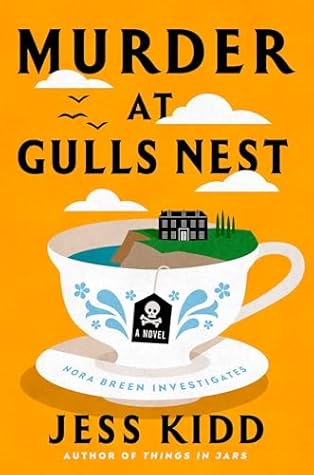
Nora Breen has sprung the coop, run away from her home of the past thirty years and come to Gull’s Nest, a rooming house near the sea. “Gull’s nest is that sort of place, isn’t it? Where the dreamers and schemers wash up.” And indeed, that’s our Nora. “A washed up nun…An abandoned friend. Flotsam and jetsam.”
Murder at Gull’s Nest is the first mystery in a series by one of my favorite novelists, Jess Kidd. I’m grateful to NetGalley and Atria Books for the review copy. This singular story will be available to buy in the U.S. April 8, 2025.
Nora is indeed a former nun; she’s shed her holy orders along with her tunic and scapular; she’s asked Christ for a divorce. Now she’s middle aged, and dressed in whatever castoffs were available when she departed. She has very little money, and is appalled at what inflation has done to prices between the time that she entered the monastery and the present day. Her first order of business now is clear, regardless: she must find her beloved friend Frieda, who left the order, came to live at Gull’s Nest, corresponded faithfully, then apparently dropped off the surface of the earth. If she’s alive, Nora will find her; if not, Nora will find her anyway.
She settles into the rooming house, and as she gets to know the other boarders, we get to know them along with her. The owner is a stickler for rules, and the cook and housekeeper—one person—is a tyrant. The food is dreadful! Nora resolves to float along beneath the radar for a bit, get the lay of the land before she does any obvious snooping about. However, since this is a murder mystery, someone dies while she’s still getting her bearings. And in time honored tradition, she irritates the very bejesus out of the local law man, Inspector Rideout, who is still deciding whether this death is due to murder at all.
“’I am not yet investigating a murder, Miss Breen.’
“’Are we not?’
“’No, I am not.’”
Don’t ask me to give away anything else about what happens here, because I won’t. I will tell you, however, that it crackles. Jess Kidd writes everything well: internal monologue? Check! Dialogue? Check! Denouement? Check, check, check!
Ruth Ware’s novels are one more reason to look forward to summer. I’ve read four of her mysteries, and this is among my favorites. My thanks go to Net Galley and Gallery Press for the review copy. This book is for sale today.
Our protagonist is Hannah, and the setting is England with alternate time periods about ten years apart. In the past, we are in Oxford, where Hannah is a poor-girl-making-good. Today she works in a bookstore, is married to Will, whom she met in school, and she’s pregnant with their first child.
Hannah doesn’t graduate from Oxford; she is too traumatized by the murder of her roommate, who was also her best friend, and whom she found that night. The flashback scenes—not only the night of the murder, but the close friendships that she developed there, along with her relationship with Will, and an assortment of memories, some of them good ones—are so well depicted that I feel as if I am there with her. The group in which she travels consists of herself, Will—who was her roommate April’s boyfriend at the outset—along with Emily, Ryan, and Hugh. These last three aren’t as intimately developed, but that doesn’t matter much, because the two that count for the most in terms of her memories are Hannah herself and April. I feel as though I could pick either of them out of a crowd.
April comes from a ruling class family, and she tells other students that she has been admitted largely due to her family’s money. Eventually Hannah realizes that this isn’t entirely true; yes, her family is rich, and they’ve been generous with the school, but April is also a highly capable student and a diligent one. In fact, April seems to be very everything; today we might say that April is a lot, that she sometimes sucks all the air out of the room. She’s effusive, she’s generous, and she’s given to pulling pranks that are nasty enough to cross a line. Perhaps it’s true that opposites attract, because though Hannah is a more low-key person from a working class household, the two of them bond immediately, and Hannah considers her friendship with April more important than her attraction to Will.
The night April is murdered, Hannah and Hugh see a security guard leaving their building. He’s not supposed to be there, but he is a sleaze bucket, that guy, sometimes using his passkey to enter Hannah and April’s room, and who knows what he was doing this time? When April’s body is discovered, freshly killed, it doesn’t take long before Neville, the creepy security guard, to be arrested, convicted, and put away for life. (A note: there are a lot of Britishisms here that I had to look up. Apparently, a security guard is called a proctor, at least at Oxford.)
Now, in the present day, a friend of Ryan’s that is also a journalist contacts Hannah. All of the students in their group have been overwhelmed by press requests since the murder, and usually, they avoid them like the plague, but Ryan thinks this pal of his is onto something. The friend, Durant, believes that Neville, who has died in prison, was innocent. Now Hannah is moving heaven and earth to find out whether her evidence has sent the wrong person to prison. But who might have done it? Not Hugh, since he entered with her that night; what about the others in their group, including her own husband?
I must confess that I have a bit of trouble accepting Hannah’s sense of mission, and the extent to which she pursues it. This man was not exactly a pillar of rectitude; today he might have been fired or even charged for his misbehavior toward the girls he was supposed to be protecting. And the fact is, he’s dead. He’s never coming back, no matter what Hannah’s amateur detective work reveals. Why upset the apple cart like this, especially when she considers her own husband might be implicated? But she is pregnant, and I know from experience that when our hormones are jumping, we can sometimes have over-the-top reactions. So okay. I guess.
The other thing that gives me pause is Will’s puppyish devotion. During the last half of the book, Hannah does something that I would think would be a marriage ender. That toothpaste is never going back into the tube. Why does Will come panting back to her? This one is harder to accept.
Nevertheless, I was riveted. By the forty percent mark it was impossible for me to read anything except this book until the last page was turned, and so I recommend it to you.
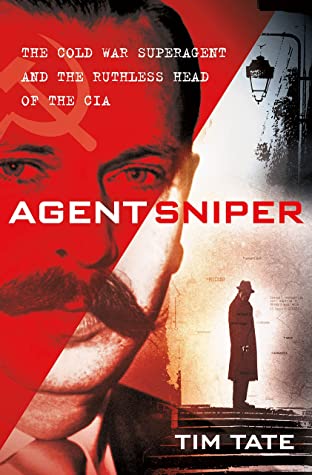
I was invited to read and review this book by Net Galley and St. Martin’s Press. I accepted because I do love a good spy story, and there aren’t many of them being published at this time. Tim Tate has had a long, illustrious career as a documentary filmmaker and as an author, but is new to me.
So, when I began reading and found my attention wandering, I thought it was a personal problem. Too many distractions. I tried again, and when that didn’t go well, I procured the audio version and listened to it while I prepared dinners during the week. Eventually, I threw in the towel and admitted that this is simply not an engaging book. The topic sounds fascinating, but just as a gifted, dedicated author can spin dull material to gold, so can an indifferent one tell an electrifying spy story in a way that leaves the reader checking the page numbers and the clock—is this thing over yet?
It’s not all bad news: the research here is top drawer. For the researcher, this book has use, although I would caution the uninitiated into reading carefully, because history is always politically charged. Every fact that is included, and every fact that is not; the interpretation; the language used, all give a biased account, even when a researcher and writer is endeavoring to be as balanced as possible. I don’t care for this writer’s interpretation, which makes him sound like a hardened right winger, but I have no doubt that the facts that he uses are accurate ones.
Then we come to the audio, and I must wonder why, if we’re primarily dealing with the CIA and its agents, we have a narrator with a clipped English accent (and a few pronunciations that sounded very odd to me,) telling the story. I found it disorienting, but if this had been a more engaging story, I would have overlooked it.
Ultimately it comes down to wordsmithery, and I didn’t find much of it. Those interested in dabbling in this genre would do better to read Ben McIntyre and Tim Weiner.
Eleanor Wilde is a sham medium, a fraud who’s used her dramatic talents and the trust of her clients to bilk them. But lately things have changed; she has received intelligence from the great beyond, specifically from her deceased sister. As a businesswoman that now resides in a small town in the UK and doesn’t want her neighbors to hate her, she’s shifted most of her business to herbal cures and such. As it happens, this doesn’t keep all hell from busting loose.
My thanks go to Kensington Books and Net Galley for the review copy. This book is for sale now.
Eleanor–you may call her Ellie—is the protagonist in a satirical cozy mystery series, and this is the fourth. I read and reviewed the first two, but somehow missed out on the third. The first two took place in a tiny village where the ruling family lives in an honest-to-goodness castle. She went there, in the first in the series, to conduct a bogus séance, but instead fell in love with Nicholas, heir to the estate. Now the castle is in need of serious repairs. It’s summer, and the castle is hot enough to be uninhabitable, and so Ellie accompanies the elderly Vivian, matriarch of the castle, to the seaside. Her brother Liam, who is visiting, joins them. And once there, all sorts of things go wrong. We have a menacing, possessed doll that reappears in or near Ellie’s room, no matter what she does to destroy it, and a sinister figure from Ellie’s checkered past shows up as well. And of course, of course, of course, Ellie witnesses a murder shortly after arriving, but nobody will believe her.
I came away of two minds about this particular installment. The thing I’ve appreciated most about this series is that Berry’s writing is hilarious, and whenever an obvious plot device is utilized, it’s done in such an over-the-top manner that we can imagine the author winking and guffawing. Nothing here is to be taken seriously. In the past there’s been very little character development, and I was okay with that, because I wasn’t looking for great literature; I was looking for a laugh.
Here I find some changes. There’s less humor, although two particular bits, one involving lobsters and another involving, per the title, hypnosis, made me snicker. But I also find more character development. Realistically speaking, a series can’t last long if there’s no character development, and so I’m pleased to see Berry adding a bit of depth, but at the same time, what I really want is to laugh out loud. We live in tense times, and there’s a growing body of evidence that we live longer if we laugh. A silly, escapist novel that lets us forget current events entirely for a brief while, forget our own troubles, whatever they may be, and sit back and howl at what our clever author has cooked up, is worth more than many can imagine.
Nonetheless, this story is better by far than most of what’s out there within the humor genre, and I recommend it to you. Now…where’s that cat?
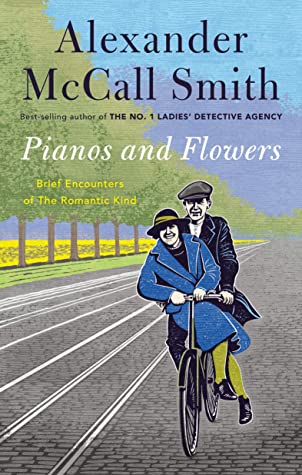
Well, heck. I have so loved this author’s most famous #1 Ladies Detective series, and more recently have loved his new, satirical series starring Mr. Varg. When I saw this stand-alone collection of short stories—a genre I enjoy—I leapt at the chance to read and review it. My thanks go to Net Galley and Doubleday, but this one fell flat for me.
The collection is scaffolded by vintage photographs from The Sunday Times. Smith provides one of these photos at the start of every story, and then writes something (fictional) about the people and events displayed. I am initially deflated by these, thinking it might be a good fit for some readers, but for me more of a cure for insomnia, because Zzzzzz, when I find the italicized portion, which is intended to be a you-are-there insert. Why, why, why does every Caucasian reader under the sun think that the best way to add some World War II spice to a story, is to interject some of the racist slurs used widely at that time against Japanese people? True, it was a much more mainstream practice back then for white people to use nasty, racist terms to describe anybody and everybody that wasn’t Caucasian; you weren’t entirely safe if you were from Eastern or Southern Europe, so predominant was this tendency. Yet every author understands that if your book is to see wide circulation, you’d better not go tossing anti-Black references in as casual conversational terms. But ah—the Japanese! Now, that’s different. The Japanese don’t fight back all that much, so probably it means they don’t care. (Pause while I retch for a moment or two.)
This cheap-and-easy bit of vile, racist pop culture took this collection down from three stars to two. However, I can assure the reader that had it initially been a four or five star read, it would nevertheless have dropped to an unfriendly rating when I ran across such ugly language.
When I requested the galley for this book, I was taking a chance. I do love good historical fiction, but I seldom enjoy a cozy mystery, and this story is but a whisker away from being one. I was afraid the story might be cutesy instead of quirky, cloying instead of life affirming. And how delightful it is to be wrong! I received my copy free and early, thanks to Net Galley and Harper Collins. It’s for sale now.
The premise is that Tilda has returned to the town where she and her mother lived after her parents separated. She was an only child, and her mother is dead, and so it falls to Tilda to tie up the loose ends of her mother’s small estate. And at this point, my snark is already peeking its beady eyes out, saying Oh geez, another story that starts with an only child cleaning up the estate. Lots of those lately! And a mean mother? That’s got to be my number one eye-roller right now! And I tell you these things, reader, because it underscores what a job Hogan had ahead of her in order to break down my resistance; and yet, she did.
The narrative is divided into two points of view which alternate. The first is young Tilly, the little girl that doesn’t understand what is happening between her parents, and is devastated when her father moves out. The second is the adult Tilda, whose capacity for trust in other people is limited.
The first part of the book is a hard read in places, because Tilly is in so much pain, and it feels drawn out, although one could argue that time passes more slowly when we are young. Tilly’s parents are always quarreling; then her daddy moves out, and Tilly, who was a daddy’s girl, takes out all of her hurt and rage on her mother. Her mother is brittle and not very stable, and she’s at wit’s end. First they move from the house where the family had lived to the hotel in the title; then, against her wishes, Tilly is sent off to boarding school. Tilly had loved living at the hotel and didn’t understand why she was exiled.
Tilda learns what her mother was thinking when she finds and reads the journals that her mother had left for her, and again, it’s not exactly an original device on the author’s part, but it’s done so well that it doesn’t matter. Tilda also finds one of her mother’s old friends, and she learns some things that way as well. There are some genuine surprises that are also believable and fit the characters and setting. It’s artfully done.
As to the quirky bits, they are what makes the story unique and successful. For starters, Tilly (and Tilda) see ghosts, not just now and then, but in some cases regularly. Let’s take, for example, the little dog named Eli. Not everyone can see Eli; Tilly can, and some others can as well, but most cannot. And our suspicion that Eli is not a corporeal critter is affirmed by the fact that decades later, this woman still has exactly the same dog, and he is as spry as ever.
Then—and I have saved the best for last—there’s the child’s narrative. Tilly explains things to us in the language, and with the frame of reference, of a small child of six or seven years. She is a bright girl, but she’s a child, and so her explanations for things are often a bit twisted, and her conclusions are often far-fetched ones that are based on the limited amount that the girl understands. My favorite bits are the mondegreens, and there are many. (A mondegreen is the word or phrase that results from someone that hears words that aren’t in her vocabulary, and thus replaces them with words she does know; one well known example is the American Pledge of Allegiance, starting with “I led the pigeons to the flag.”) My favorite of Tilly’s mondegreens is when she attends church and sings “The Old Rubber Cross.” And the thing I love most about Tilly’s mondegreens is that Hogan doesn’t explain them or beat them to death; she drops them in and then moves on as if nothing unusual has occurred.
I started reading this book using the review copy provided me, but because I was running behind, I checked out the audio version at Seattle Bibliocommons when I was a short way in, and I alternated versions. I especially want to give a shout out to Jane Collingwood, who reads the audio version. I can think of no more challenging narration than that of a child. Collingwood had to sound like a little girl half the time, but nobody wants to hear an actor’s version of baby talk at all, and surely not for half of a novel, so she has to walk a very fine line, not sounding like an adult, but also not sounding inane. On top of that, she must also voice the adult version, sounding like the same child, except grown up. It’s a tricky assignment and she carries it off perfectly; I tip my hat to her.
The ending is optimistic, yet credible. Those in need of a feel-good story—and there are an awful lot of us that do, right now—could do a whole lot worse. Recommended to those that enjoy quirky novels and historical fiction.
I read this copy free and early, thanks to Net Galley and Atria Books. From time to time I find myself reading too much dark material, which is the direction I’m generally drawn toward. I found this title and thought that it might balance my selection. And for what it’s worth, it did that.
The premise here is that Emmie has fallen hard for a young man that she met years ago by pure chance. At age 16, she had written a secret that she needed to share on a scrap of paper, along with her email address, stuffed it into a balloon and launched it into space. (How does one get a slip of paper inside a helium balloon without losing the gas inside it? But let’s not dwell there.) Rather than falling into the ocean and choking a seabird to death, the balloon makes it to dry land, and Lucas finds it. The two become fast friends, and as time progresses, she is sure they are meant to be more. She is devastated to learn that his plans are different from hers.
This story is a quick read with lots of dialogue. One of my pet literary peeves right now, however, is the terrible-mother-who-ruins-everything. Oh. Come. On. You can do better than this. However, other aspects of the story are more congenial. In the end Emmie takes control of her own life, as she should have done all along, and good things result.
Those looking for a pleasant beach read could do worse. However, the publicist that compares this book to Eleanor Oliphant is Completely Fine is completely delusional.







 Seattle Book Mama