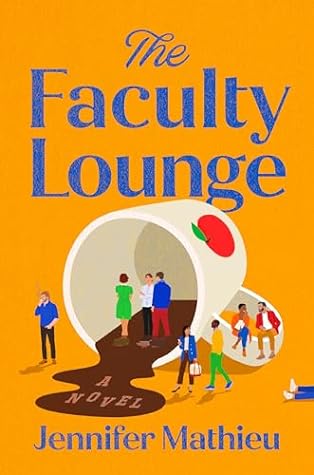
The Faculty Lounge, by Jennifer Mathieu****-*****

“You really had to hand it to Mr. Lehrer. While dying at work is never ideal, he had the decency to do it during his off period. And not only that, but at the start of it, too, giving the clerks in the main office plenty of time to find someone else to cover Ms. DeLaRosa’s Spanish II classes, even as they scrambled to figure out who should be telephoned when an eighty-two-year-old substitute teacher lies down on a ratty couch in a high school faculty lounge and dies. “

Jennifer Mathieu’s new novel, The Faculty Lounge, has been described as love letter to teachers. Though it is darkly funny in a number of places, the description isn’t wrong. By the ten percent mark, I had cackled out loud twice, it was so strangely accurate.

My thanks go to Penguin Group Dutton and NetGalley for the review copy. This book is for sale now.

Our school is Baldwin High, a Texas school with a solid reputation. After the stage is set, with poor Mr. Lehrer breathing his last breaths during his planning period, and another teacher being cranky when the paramedics make her leave before her photocopies are done so that they can work on him, the story is organized with a single chapter per character. Obviously there are a lot more people on Baldwin’s staff, but this method works quite nicely, and since the characters interact, the chapters that come later in the book are richer, because there’s more backstory to help us understand them.

The youngest teachers have grown up with the knowledge that they might be shot to death at school; first they grew aware of this when they were students, and now, as teachers, the danger is still there. While older staff members tend to be rattled by a lockdown, younger ones see it as almost routine. Take attendance, salute the flag, and whoops, there it is. Herd any students outside of your door into the room, then lock it. Everyone on the floor. Pull your window blinds. Wait till it’s over.

I appreciated every character in this book, and I was sorry when it ended.

There are crises at Baldwin, just as there always seem to be fires to put out in real schools; there are high maintenance parents with absurd complaints, as well as idiotic district directives. Bureaucrats! Toward the end, a veteran teacher explains to a newer one that some days, “the best you can do is show up and hang on.” So true! Your reviewer is retired from the profession, and I can recall a wise older teacher saying to me privately during difficult periods, “I’m here. And I’m dressed.”

The whole thing seems so familiar.

How much will this resonate to readers that aren’t educators? I have no idea, but I know that the in-jokes, the sense of the familiar, can’t be as strong. For a general readership, I’d say this is a four star read. Possibly this is true as well for those that have always taught early childhood, because many of the parameters are different. But for those of us that have taught middle and high school, particularly for those that are veterans, this is a solid five star read.

Cheerfully recommended to all, and highly recommended to veteran secondary teachers.

Such Good Work, by Johannes Lichtman****

I was invited to read this debut novel by Net Galley and Simon and Schuster, but when I first saw it in my inbox, I recoiled. Another addiction memoir! Another chance to live through someone else’s excruciating nightmare! But then I read a few early reviews—they didn’t bear the numbed courtesy of an obligatory write-up.  And then my own sense of courtesy tipped me over the edge. I was, after all, invited. Did I not want to be invited anymore? Of course I should read it.

The story is Lichtman’s own written as autofiction, and his unusual writing style drew me in. I was surprised to see how quickly I went through it. At the outset, he is teaching creative writing and is crestfallen to find that a student he has championed has plagiarized her work for him, and not only is his anecdote written with great humor, it is immediately familiar to me, and most likely will be to all English teachers.  We want to believe; we want to be supportive. And once in awhile, someone younger than ourselves comes along and manipulates the hell out of us. It is a humbling experience.

Jonas is half American, half Swede, and he finds that to get off of opiates and opiods, he needs to be in Sweden, where street drugs are much harder to procure.  He is enrolled in a graduate program in Malmo, but finds his time is primarily consumed by the refugee crisis as he volunteers to teach in a language school. Young men from the Middle East come by the thousands, and he is proud that Sweden doesn’t close its border, doesn’t set a cap to the number of immigrants it will welcome. At the same time, the Swedish government has some double standards where race is concerned; the Roma people that set up an encampment are quickly swept away. Then the nightclub bombing in Paris provides officials with an excuse to shut it all down; it’s a tremendous blow to the refugees and to those that want to help them.

At times I fear for this writer, because he seems to have no filters with which to protect his own heart as he hurls himself into his volunteer work; he wants to make a difference so desperately.  Many years ago I saw a short film that showed a Bambi-like deer grazing in a forest, and then the massive foot of Godzilla smashes it like a bug, and in his ragged, hungry quest for social justice, the author reminds me of that deer. Social justice work requires sacrifice to be sure, but a little care toward one’s own mental health is also essential. Lichtman’s master’s thesis focuses on a Swedish writer that ultimately succumbs to despair, turning on the car and closing the garage door, and I found myself urging this author to have a care, lest the same happen to him, a danger he refers to himself in the narrative. (From the acknowledgements at the end, I see that he appears to have emerged in one piece, at least so far.)

The stories of the refugee boys are searing ones. A young man told of walking through Iran, followed by Turkey, Greece, Macedonia, Serbia, Hungary, Austria, Germany, and Denmark on his way to Sweden. The whole journey was done on foot. So many families were dead that the boys’ tutors learned it was sometimes better not to inquire too deeply about those left behind. At one point, Jonas decides to become a mentor to one person, but things go amiss and he ruefully recalls his own role as that of “clumsy Samaritan.”

Lichtman’s prose is gently philosophical in a style that is slightly reminiscent of Zen and the Art of Motorcycle Maintenance, though in no way derivative. His perceptive commentary regarding the events that unfold around him, along with the lessons he learns about himself, is witty and absorbing. Along the way I picked up a little knowledge about Swedish culture and society that I didn’t have before.

The title has sharp edges.

Recommended to those interested in Swedish culture, the refugee crisis, and addiction issues, as well as to anyone that just enjoys a good memoir.