The Best Mystery Stories of the Year 2025, by John Grisham and Otto Penzler*****

John Grisham and Otto Penzler have teamed up and compiled a delightful, high-quality collection of short mystery stories to entertain you. My thanks go to NetGalley, High Bridge Audio, and Penzler Publishers for the review copies. You can buy this book now.

All told, there are 20 stories that made the cut, plus a “bonus” story at the end. This mystifies me; why not just say there are 21 stories? Maybe there’s a tradition of only selecting 20. At any rate, I liked all of them except one, which I’ll explain in a moment. They are all well written, and they encompass a wide variety of subgenres. My favorites are “Home Game,” by Craig Faustus Buck; “Only a Story,” by Kai Lovelace; and “Effie’s Oasis,” by Casey Stegman. I had never even heard of any of these writers, so now I have three new authors to watch for. I was not as fond of “Dream Stuff,” by Lou Manfredo, but that’s because I dislike noir mysteries for the way that women are disrespected. Here’s an example: “Mary Lou, my previously noted overpaid secretary, poked her cute little head into my office…” and it goes on in that vein. I haven’t deducted anything from my rating, because I know that the aspects that I find problematic are part and parcel of noir mysteries, and so I can’t see penalizing this one author in the collection, or Grisham and Penzler, when I know that there are a considerable number of readers that love these stories, and not all of them are men.

One other minor irritation is that I was provided with both the digital and audio versions of the galley, but the stories aren’t in the same order in both books, which led to a fair amount of panicked flipping around my digital copy to try to match up with the story being read. If they’re going to edit the order in one format, I’d appreciate it if they would do it in both so that they match; hopefully this is straightened out in the finished copies.

 But while I’m talking about the audio version, I should also mention that the readers, Marnye Young and Jamie Renell, are top notch. There’s a great deal of dialogue in most of these stories, and they are both pitch perfect in reading the characters’ voices.

Whether you prefer a print or digital copy to read with your eyes, or an audio book that can follow you around while you do other things, you can’t go wrong with this collection. Highly recommended to all that enjoy the genre, and perfect for Halloween.

Something to Look Forward to, by Fannie Flagg****

Nobody should ever say that Fannie Flagg doesn’t give us our money’s worth! There are over 30 short stories in this nifty collection, and I enjoyed it thoroughly. My thanks go to NetGalley and Random House for the invitation to read and review; had it been necessary, I would have paid hard cold cash for this collection, and I seldom say that.

This book is available to the public now.

Flagg has always been known for her feminist swagger and perceptive humor. Here she crosses into several genres, beginning with science fiction—a first for this author? —and continuing on more familiar ground with historical fiction, Southern fiction, contemporary fiction, LGTBQ, and of course, humor. There are a handful that start early and reemerge later, but most are just simple short stories, easy to read and for the most part, filled with the feel-good vibes that we all need right now.

My favorite of them all is “Darla Womble,” a story set in Pot Luck, Arkansas in 2004. Here’s how it begins:

“At 9:18 A.M., in and around Pot Luck, Arkansas, thirty-eight relatives of Darla Ann Womble received a frantic email, which read:

            ‘DARLA’S NOT DEAD, AND SHE’S MAD AS HELL!’

After seeing the email, two people threw up, one fainted, and another decided he would run for his life. This news came as quite a shock to all, especially since all thirty-eight had recently attended the reading of Darla’s ‘Last Will and Testament.’

It only gets better from there, and it was a near thing since I was eating lunch; I narrowly escaped spraying my cheese enchiladas all over my kitchen! Other favorites are “Beware of Weathermen” and “Don’t Mess with Texas,” both near the beginning of the collection, and “A Thinking Man,” which is near the conclusion.

As with her other works, these stories are primarily from female points of view and will appeal more to women than men; yet I suspect there are a good number of men that will enjoy them as well. I recommend this collection to Flagg’s faithful readers, and to anyone that needs to feel a little better than they do right now.

The Dilemmas of Working Women, by Fumio Yamamoto**

I haven’t been this disappointed in a book in quite some time. The Dilemmas of Working Women is Fumio Yamamoto’s collection of five stories about women that work (or that should but don’t,) and it is immensely successful and highly regarded in her native Japan. As I read, I kept looking for the greatness, a bit like scrounging for coins lost under sofa cushions, but it has completely eluded me, and my rating and review can only be based on my own experience and reaction.

I thank NetGalley, Blackstone Audio, and HarperCollins for the review copy. This book is for sale now.

As suggested in the title, each of the five stories focuses on a woman that has a problem. None of them makes a serious effort to do one damn thing about it. Lazy, neurotic, or…? Who can say. I sure can’t. One might expect a book that’s written by a woman and that has exclusively female protagonists to have a little feminist swagger, but this feels like the opposite. I found it hard to root for any of them, because they were all so useless.

When I took the galley, I expected there to be some humor. Look at the cover! It’s been years since I was taken in by a hilarious book cover that masked a crummy read, and I won’t do it again anytime soon.

I was given access to both the digital galley and the audio. The reader, Yuriri Naka, does as good a job as possible with this collection.

Not recommended.

Night and Day, by John Connolly****

“Surely, once a book is out in the world, and being read, the world is altered, for better or worse.”

John Connolly is one of my favorite authors, and because of this, I automatically snap up any book that appears with his name on it. But this one is unlike the others I’ve read, and that might be good news for some, but not for others. One way or the other, my thanks go to NetGalley and Atria Books for the review copy. This book is for sale now.

Night and Day is an odd one. The first half is dedicated to nine outstanding short stories, all in the horror genre; the second half is a nonfiction discussion of a film titled Horror Express. This is such a strange thing that I don’t believe it at first, and I read the first half of the film critique expecting the characters to come bursting onto a busy freeway, or commence kidnapping and eating employees at the film studio. Once I discover that this is truly the world’s longest film review, and of a film I haven’t seen, I am annoyed. The author says that one needn’t necessarily have seen the film to find interest in his article, but I must respectfully disagree. On the other hand, I am not much of a film buff.

Now let’s talk about the first half, where I have much nicer things to say. When Connolly writes fiction, he is incomparable. All of these short stories are of stellar quality, and hugely memorable. The last, titled “Our Friend Carlton,” is my favorite; it’s about a friend that really, really overstays his welcome. The first story, “The Pilgrim’s Progress: A Tale of the Caxton Private Lending Library and Book Depository,” is about a most unusual library. Here’s an excerpt that describes it:

“On a basic level, the operation of the Caxton was easily explained. When a novel achieved a singular status with the reading public (generally after the death of its author), a first edition of the book in question, wrapped in brown paper and tied with string, would appear on the Caxton’s doorstep, soon to be followed by the fictional character or characters responsible for its popularity.”

As you might have guessed, characters from The Canterbury Tales are squabbling in the back yard, and that’s just the beginning. It’s hilarious, despite the fact that I barely remember the Chaucer I studied in high school. Trust me, you don’t need a lot of backstory to enjoy it.

The above two stories are my favorites, but all of them are excellent.

Now comes the question of how to rate the book as a whole. Obviously, if you love brilliant horror short stories and have seen the movie discussed in the book’s second half, this is a five star book. My own sense is that the short stories are so wonderful that even if you stop reading after the first half, the book is worth having. But that’s easy for me to say; I read it free. Had I paid full cover price plus tax, and done so believing I was getting an entire book of the usual Connolly fare, I might be churlish enough to crank it down to three stars. Some readers will obtain the book for free via other means, such as libraries, subscription services and the like. And so, I will split the difference and rate it four stars; as for you, now you know what you’re getting, and you can decide accordingly.

The Answer is No, by Fredrik Backman****

Who can resist a story by Fredrik Backman? His soothing tone and positive message about the nature of humanity is balm for the soul. So although I seldom read stand alone short stories, I leapt on this one right away. My thanks go to NetGalley and Amazon for the review copy. This book is for sale now.

This is one of those stories where you can see what’s about to happen, in broad strokes, right out of the gate. The blurb gives us the contours, telling us that our protagonist, Lucas, is about to have his life ruined by a frying pan; his life is perfect, single with no entanglements. He has no friends that he owes favors; no girlfriend; his life is simple and uncomplicated. He has a nice little apartment that’s his alone; after work, he can eat his Thai food and play his videogames without harassment. He doesn’t bother anybody, and nobody bothers him.

Then there’s a knock at the door, an insistent one; it’s a small klatch of people that introduce themselves as “the board.” Someone has disposed of a frying pan in an unauthorized spot, and they are determined to root out the culprit and penalize them. Everyone is considered guilty until proven innocent! Lucas protests his innocence and makes a few hapless suggestions in hopes of mollifying them, but instead, they draft him to head a committee, and they won’t let him out of it.

This is a pleasant enough story, consistent with Backman’s usual style, but at the same time, because it is a short story, it lacks some of the most agreeable aspects of a Backman novel. In his full length books, Backman creates and develops a massive collection of characters, and he always juggles them brilliantly, developing several and keeping each of them so distinct that the reader can’t forget who is who. Here he is forced, due to the limited length of the thing, to keep it down to a small handful of characters, and while some will likely appreciate this, I miss the complex stories with infinite character back stories and interrelationships. So, as short stories go, this perfectly fine, but for those of us that are fond of Backman’s epic tales, it feels just a trifle anticlimactic.

Recommended to those that read everything Backman writes, and to those that prefer a more streamlined story.

American Spirits, by Russell Banks*****

American Spirits is a collection of three short stories that take place in the fictional New England town of Sam Dent. My thanks go to NetGalley and Alfred A. Knopf for the review copy. This book is for sale now.

I wasn’t sure this book would be up to Banks’s usual standard, as it was published posthumously, more than a year following his death. Sometimes a successful author will have a book that isn’t their best, and they’ll toss it in a drawer in hopes of improving and publishing it later. When they die, their heirs find the book and seeing dollar signs, send it off to a publisher. Still, though, Russell Banks’s sloppy seconds are still going to be vastly better than your average successful author’s best effort, so I decided to take a look. And holy crap, it’s actually one of his finest!

One thing any uninitiated reader must know is the Banks is brutal. If the story seems to be leading up to something pretty bad happening, the unwary might anticipate that the author will pull it out of the water at the last minute in order to send the readers away with smiles on their faces. Banks doesn’t do that. With stories by Banks, the main question is whether all of the important characters are going to die, or only some of them. He is unflinchingly brutal, but oh honey, he does it so well that I wish I could thank him for it!

One of the things that underlies everything Banks writes is his deep knowledge of, and appreciation for, the working class. His own hardscrabble background most likely plays a role, but one way or the other, the struggles of the ordinary man or woman, usually living in rural parts or small towns in New England are depicted with such care, distilling vast amounts of tiny details into the briefest of spaces that I believe the character and I believe the setting. Banks is also, to the best of my knowledge, the first to set a story in a manufactured home or mobile home court.

The first story, “Nowhere Man”, is about a man that sells off part of his land to a newcomer, partially because of a private agreement that the two make, but that isn’t ever codified. The new owner eventually goes back on his word; the original owner is having none of it; and then all hell breaks loose.

The second, “Homeschooling,” is about an average family whose life is changed when newcomers with a somewhat bizarre parenting style move in next door; when the emaciated children sneak over at night to beg for food, they become involved.

The final story, “Kidnapped,” is about a couple of senior citizens that are kidnapped and held until the drugs that their grandson’s addicted mother has filched are returned.

When I read Banks, I tell myself not to get attached to the characters, but he’s smarter than I am, so I can’t help myself.

There is something deeply satisfying in reading an author that has the confidence to buck literary trends. I wish that Banks, who was twice nominated for the Pulitzer Prize, could have lived and written fiction forever, but the legacy he has left us is the next best thing. Highly recommended.

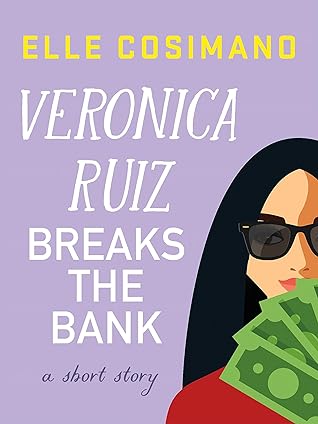
Veronica Ruiz Breaks the Bank, by Elle Cosimano****

Fans of Cosimano’s Finlay Donovan series will recognize her trusty sidekick and BFF, Vero. Over the course of the series, we’ve had many hints about Vero’s past, and Finlay sometimes wonders why Vero is so tightlipped about her personal history. This short story provides curious readers with some background, as well as some of the entertainment for which Cosimano is fast becoming legendary.

My thanks go to NetGalley and St. Martin’s Press for the review copy. This book is for sale now.

I generally avoid this sort of book, because often as not, the author returns to flesh it out into a full length novel, and as much as I enjoy reading it once, I don’t want to read it twice. But this was low hanging fruit, a shorty by an author I greatly enjoy, at a time when I couldn’t get up and move around much, and so I dove into it.

Vero is an honors student from a struggling family, and her academic career is short circuited when an envelope of money goes missing, and Vero is blamed by her sorority sisters. Vero makes a run for it; desperate for work, she takes a custodial job in a bank, and that’s where the fun begins.

This is an entertaining read, but it’s not up to the level of Cosimano’s novels. For a short story to work, a lot must be packed into it, with every single word pulling its own weight, and possibly that of its friends and family. Here, it feels like a chapter out of a book, one in which the author doesn’t want to give up any truly juicy information about the protagonist because she’s saving it for—you got it—a novel.

Of course, I cannot pretend to know what the author is thinking here; this is just an educated guess. But the product is the product, and whereas it was a fun read as a free galley, I might have felt a bit annoyed if I’d paid money for it.

Those looking for a quick, light read to take to the beach could do worse. Some people don’t have the time or stamina for a full length novel of any type; if that’s you, maybe this is your book. But as for me, I’ll hold out for the real deal in the future.

Liberation Day, by George Saunders*****

Liberation Day is a collection of the best short stories you will ever encounter. I had never read George Saunders before, but when I received an invitation from Random House and Net Galley to read and review this book, I remembered him by reputation and jumped at the chance. This book is for sale now.

Sometimes I feel conflicted when I see words like “Booker prize winner” and “exquisite” I feel torn. The book may be brilliant, but it also may be a whole lot of work to read. I am happy to report that is not the case here. Every one of these nine stories could serve as the cornerstone of a collection; the title selection is first, but I suspect that is more about length than anything, as it approaches novella length. It’s science fiction but also vaguely political; a group of people have had their brains scrubbed to near emptiness, and they are mounted on a “speaking wall.” Their sole purpose is to provide entertainment as a sort of scripted Greek chorus. They may only speak upon command; they assume this is a good arrangement, because they have no memories of their prior lives. But then the home (and Speaking Wall) owners are visited by their adult son, who concocts a scheme to liberate the speakers.

Many of these stories have stylized prose and invented words that might be difficult for a reader whose first language isn’t English.  “Mother’s Day,” which is one of my favorites, begins:

“This distinguished-looking gentleman would appear at your door somewhat sloshed and ask, Were your trees slaggard? Were they gublagging behind the other trees? Did they need to be prodderated? And hold up the little device. In this way they had nearly lost the house.”

Happily, for underconfident readers, there is an audio version available. I used it part of the time because I was running behind. There’s a different narrator for each story; actor Tina Fey does one of them! My notes are full of praise for these performers, who make a brilliant book even more so.

I especially enjoyed “The Mom of Bold Action,” which features the ultimate unreliable narrator, and my absolute favorite, “Ghoul”. Imagine, if you will, landing in Hell, or its amusement park equivalent, but there are still rules of etiquette to be observed; in particular, you are expected to be positive, and constantly encourage the other ghouls as they commit the ultimate misdeeds assigned to them. I laughed so hard at this one that it made my family a little cranky, and I had to go off by myself to hear the rest. Worth it.

The stories are a mixed bag in terms of genre, and all are outstanding.

Highly recommended in whatever format makes your heart happy.

The Man Who Sold Air in the Holy Land***-****

The Man Who Sold Air in the Holy Land marks the debut of a talented writer. Omer Friedlander’s short story collection has already made reviewers sit up and take notice. My thanks go to Random House and Net Galley for the invitation to read and review. This collection is for sale now.

All of Friedlander’s stories are set in Israel, and all of them evoke their setting in a way that is fresh and immediate. My favorite stories are the title story; High Heels (except for the ending; more on that in a minute,) and Alte Sachen.

Here’s my issue with these stories, and it’s true of nearly all of them: the author uses endings that don’t feel like endings, leaving the reader to figure out for herself what happens. This is particularly painful when a story builds in a most suspenseful manner and then ends on a cliff hanger.

I don’t think so.

I understand that this is considered a valid choice in literary fiction, but I doubt it will ever become a popular one. When an author leaves the rarified world of literary journals and writers’ groups and opens his work up to a general readership, adjustments need to be made.

The sweetness of a well-built story that culminates in tremendous frustration when the end is left dangling finally got the better of me, and I didn’t read the last story.

Now you know; if you want it, go get it.

Pianos and Flowers, by Alexander McCall Smith**

Well, heck. I have so loved this author’s most famous #1 Ladies Detective series, and more recently have loved his new, satirical series starring Mr. Varg. When I saw this stand-alone collection of short stories—a genre I enjoy—I leapt at the chance to read and review it. My thanks go to Net Galley and Doubleday, but this one fell flat for me.

The collection is scaffolded by vintage photographs from The Sunday Times. Smith provides one of these photos at the start of every story, and then writes something (fictional) about the people and events displayed. I am initially deflated by these, thinking it might be a good fit for some readers, but for me more of a cure for insomnia, because Zzzzzz, when I find the italicized portion, which is intended to be a you-are-there insert. Why, why, why does every Caucasian reader under the sun think that the best way to add some World War II spice to a story, is to interject some of the racist slurs used widely at that time against Japanese people? True, it was a much more mainstream practice back then for white people to use nasty, racist terms to describe anybody and everybody that wasn’t Caucasian; you weren’t entirely safe if you were from Eastern or Southern Europe, so predominant was this tendency. Yet every author understands that if your book is to see wide circulation, you’d better not go tossing anti-Black references in as casual conversational terms. But ah—the Japanese! Now, that’s different. The Japanese don’t fight back all that much, so probably it means they don’t care. (Pause while I retch for a moment or two.)

This cheap-and-easy bit of vile, racist pop culture took this collection down from three stars to two. However, I can assure the reader that had it initially been a four or five star read, it would nevertheless have dropped to an unfriendly rating when I ran across such ugly language.

I am so done with that.

This thing is for sale if you really want it.