
Murder at the Spirit Lounge*****

I would follow Jess Kidd anywhere! Murder at the Spirit Lounge is her sixth release in the U.S., and the second book in the Nora Breen series. My thanks go to NetGalley and Atria Books for the invitation to read and review; this engaging little mystery will be available to the North American public on June 16, 2026.
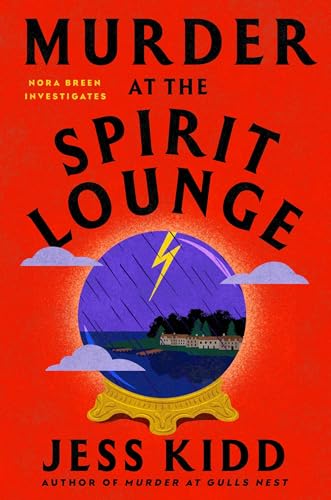
The time period is the late 1940s. We join Nora, a former nun who left the convent in order to find the whereabouts of the young nun that she mentored, and who had then left the order and disappeared. Her mission accomplished, Nora is still living in the rooming house, a cheap place that has terrible food and a grouchy proprietor, in a little seaside village called Gore-On-Sea. Nora left the convent with very little money and few possessions, and now she has even less money. In search of work, she finds a position at the local newspaper, working for an editor named Miss Hartigan:

Nora, having braved the smell of damp and mice to climb the narrow stairs of the Herald offices, finds the editor hunched over her ancient typewriter like a toad with a fly. Surrounded by empty booze bottles, stacks of back-copies. She turns a bull’s eye on Nora, who is reminded, curiously, of her former mother superior at High Dallow monastery. Perhaps it’s the same air of combative ruthlessness. Neither woman, in Nora’s estimation, would suffer fools gladly.

But Breen is soon sidetracked by a murder that occurs during a séance at the Spirit Lounge, and the medium is the victim—that is, the first victim. Since Nora has trained and worked as a nurse during her earlier life, she is summoned to the scene, and soon we’re off on another investigation. Inspector Rideout, the local man in charge of law enforcement, appears to be on the killer’s list, and as he and Nora have formed a warm friendship, she cannot allow that to happen!

Jess Kidd’s voice shines through here, and I love it. I would have liked to see more of the wit she’s displayed in some of her other novels, because she’s made me laugh out loud, but instead, we see greater depth of character development, and that’s crucial, particularly in a series. I wholeheartedly recommend this book, and this series, to those that love the genre. It can certainly be read as a stand-alone mystery, but once you’ve done that, you’ll want to scoop up the first as well.
The Devil Aspect, by Craig Russell

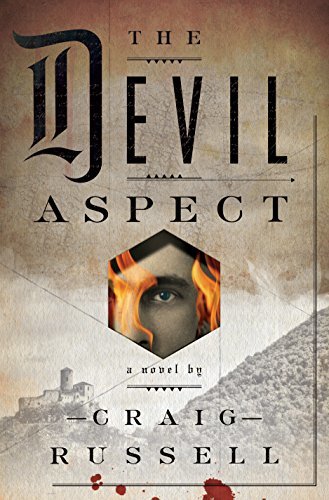
3.5 stars, rounded upward. I read this creepy tale during the last half of October, and it is indeed a good way to get into the Halloween spirit. I am disgracefully late with my review—3.5 years late, as it happens—but I do thank Net Galley and Doubleday for the review copy. This book is, of course, for sale now.

Here is what drew me in. This is horror of the old school variety, with gothic towers and half a dozen criminally insane inmates. It’s set in Czechoslovakia, which I seldom see. The flavor, overall, is similar to the stories we told as children around campfires or late at night during slumber parties. Of course, it has a more adult approach, but even so, this is classic horror.

Our protagonists are Viktor Kusarek, a Jungian psychiatrist who comes to the asylum to conduct experiments on the patients, or inmates, in order to prove a theory, and police chief Lukas Smolak, who is pursuing a serial killer that is running amok in Prague.

This is a story that is more about the journey than the destination, though perhaps not intentionally so. Hearing about each of the six savage killers as Viktor interviews them is vastly entertaining. There’s one spot about a third of the way in, where a patient, partially sedated, is explaining that he is innocent, and also that a guest sorely provoked him. Always so critical! He was determined to impress her with his cooking, and indeed, the longer he worked at the stove, the more reasonable she became. Viktor points out that the guest had stopped complaining because he had her head in the skillet. I laughed out loud! The middle of this novel is unmissable.

There are three things I would change. First, the book is a little overlong, and could bear some tightening. Second, the whole Nazi menace has nothing to do with the problem or its resolution. It seems more like window dressing than anything else, but it doesn’t add a thing to the story. If I were the editor, I would cut that part of it out and voila, some of the tightening would be achieved. And third, the ending is so, so predictable. I stuck with the story until around the 85 percent mark, at which point I figured all hope of an ending other than what I expected was pretty much gone. At that point I skipped to the end. Yup. There it was. I would have liked a less formulaic ending.

Still and all, fans of old fashioned horror could do a lot worse. If this sounds like your kind of book after everything I have said, then go for it. I am old and cranky, and what seems obvious to me might seem new and clever to those that haven’t read many books of this ilk. And one way or the other, getting there is a lot of fun.