
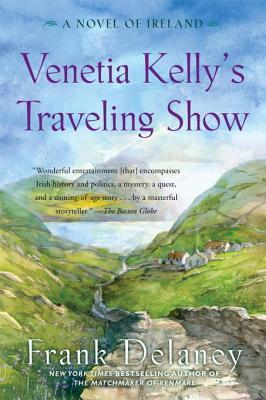
 Frank Delaney was well known in the UK before those of us in the United States had heard of him; NPR has called him “the most eloquent man in the world”, and after I had read Ireland, an epic novel that has to do with a storyteller and so much more, I was sold. I wasn’t blogging or reviewing back then, and after I had turned the last page, I told my family that I wanted to read everything else Delaney had written. Then I received this novel as a Christmas present, and was underwhelmed. I set it aside and figured I would give it away, but later I realized that it was the first in a trilogy for which I had also received the other two books. In February of this year, I took a deep breath and plunged in for another try.
This novel is much briefer than Ireland, and I’m a reader that often finishes a good book of this length in a weekend. The problem is that this one isn’t that good. In fact, I found myself wondering whether the author had perhaps been about to produce another similarly epic work and instead decided to chisel three books out of it. Whereas Ireland magically blends Irish history, culture, and political struggle with the fictional memoir of a young boy that has met and been captivated by a wandering story teller, creating a story one can sink into and forget the rest of the world even exists, this story, which is also a family’s fictional memoir, feels like a hamster on its wheel, going through the same stuff over..and over…and…
The setting is rural Ireland in 1932; the protagonist is Ben MacCarthy, and he spins the first person narrative that makes up the story. His family is one of humble farmers, and like so many families, they barely eke out a living. The farm has been in Ben’s mother’s family for generations. His father is frustrated, not meant to be a farmer it seems, and maybe that is why he is so easily caught up in the snare set for him by the Kelly family. The Kelly patriarch is Thomas “King” Kelly, a wealthy, connected man, and Venetia is his daughter. She travels as the main act in a caravan, and Ben’s father falls in love with her instantly, leaving Ben and his mother without a means of subsistence.
Almost the entire book is the account of Ben, whose mother sends him to bring his father home, though he is just an adolescent himself, as he goes after his father, is rejected, and then is sent back after him again. It’s monotonous and irritating. Part of the story has to do with Venetia’s ventriloquism and her dummy, Blarney. Clearly Blarney is intended to draw and amuse the reader, but I found another of my eye-rolling frenzies coming on. Right, I want to say. Cute. Now can we cut to the chase?
Delaney at his best doesn’t cut to the chase; that’s the whole point of weaving a story, to make the reader want to hear more detail, not less. In Ireland, he succeeded, and I grieved for a week when the story was over, because I wanted it back. With this story it was more the opposite; I hit the 78% mark after months of reading it in small snippets, basically only resorting to it when my electronic reader had to be charged. I kept it conveniently by my bedside so it would entice me, but just looking at the cover became a chore, and I finally resolved to skip to the end, then figure out how much of it could be skimmed to understand the outcome and give the other two books a try. Had my loving relatives not put full cover price into not only this title but the two that come after it—and oh I do hope they’re better!—I wouldn’t have bothered.
One side character that stands out and prevents this from being a 2 or 2.5 star novel is Billy Maloney, the handyman that swears profusely. Because his mother won’t hear profanity, young Ben repeats Billy’s messages verbatim, and rather than leave out the curses, he substitutes the word “flockin’” in their place. We will forget all about Billy as we get caught up—or not—in the MacCarthy family’s drama and the Kellys’ schemes, and then all of a sudden a whole stream of ‘flocks’ will appear. There were some other devices Delaney also used, but they didn’t work for me. This one did.
Well, what can I tell you? If you are a dedicated fan of Irish literature and you have deep pockets, go ahead. You’ve seen what I have to say, and if you still want the book, you can buy it.
But if you’re only getting one sumptuous, luxurious novel and you love tales of Ireland, then that’s the book I recommend to you. Read Frank Delaney’s Ireland, and let this one stay in its warehouse.
 James Lee Burke is a legend, a venerable and highly respected writer known for his luminous prose and quirky characters. In this, his second work of historical fiction in a planned trilogy, he demonstrates that he can still work magic better than ever. I received this DRC from Net Galley and Simon and Schuster in exchange for an honest review, but I would have paid full freight if I had to, and I rarely say that about any book anymore.
 Annie Bell could have chosen to marry a well-to-do member of the gentry in her home town, a man with fine china and a full time kitchen servant. Young and buoyant, she chooses love instead, and moves to Oklahoma with Samuel Bell to start a brand new life on the free land that’s been provided. What could go wrong when two young people are strong and dedicated to one another? Oh, it’s an old, old story in so many ways, but Meadows makes it brand new. Thanks to Net Galley and Henry Holt Publishers, I read it free and in advance in exchange for this honest review. It will be available to the public August 9, 2016.
 And you thought Fifty Shades of Gray was controversial. Just remember that you heard it here first: if this novel has legs and gets around, it’s going to create a lot of noise. I could almost smell the book-burning bonfires as I read the last half. And lucky me, I read it free thanks to Net Galley and St. Martin’s Press, from whom I received a DRC in exchange for this honest review.
 Annie Bell could have chosen to marry a well-to-do member of the gentry in her home town, a man with fine china and a full time kitchen servant. Young and buoyant, she chooses love instead, and moves to Oklahoma with Samuel Bell to start a brand new life on the free land that’s been provided. What could go wrong when two young people are strong and dedicated to one another? Oh, it’s an old, old story in so many ways, but Meadows makes it brand new. Thanks to Net Galley and Henry Holt Publishers, I read it free and in advance in exchange for this honest review. It will be available to the public August 9, 2016.
 The Last Road Home, bold and impressive new fiction by Pushcart Prize nominee Danny Johnson, came to me free thanks to Net Galley and Kensington Books in exchange for an honest review. It tells the story of Raeford “Junebug” Hurley and his friendship with neighboring twins, Fancy and Lightning Stroud. Junebug is Caucasian; the twins are African-American, politely referred to during that time as ‘colored’ or ‘Negro’. The story is set during the Civil Rights movement of the early 1960’s, but in rural North Carolina, the Klan stands tall and strong and absolutely nothing has changed in terms of race relations. Junebug finds himself riding on the fence rail from hell. This fascinating tale will be available to the public in late July. Those that love good historical fiction should read it.
 I received this title courtesy of Endeavor Press, who invited me to read and review their material directly; I thank them for the invitation to read and review this Digital Review Copy free in exchange for an honest review.
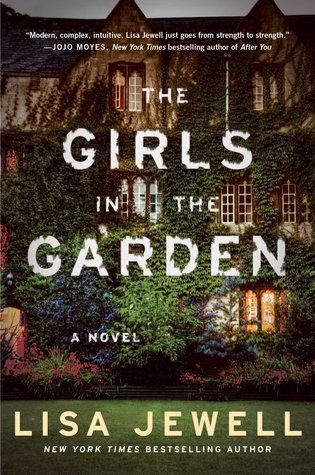 Lisa Jewell is an experienced author, but she is new to me. The Girls in the Garden, published in the UK last summer and soon to be in bookstores in the USA, is good strong fiction, and you should read it. I was fortunate and obtained an advance copy thanks to Net Galley and Atria Books for the purpose of a review. One night I stayed up late, unable to put it down until it was done.
 I decided to read and review this title because I anticipated that it would be, by and large, a depiction and critique of the American prison system and Homeland Security. As it happens, that is really only a small part of this memoir, which focuses more on the couple’s relationship and the way that addiction warps and undermines trust and affection. Nevertheless, I found it really compelling, and so thank you Net Galley and Random House Ballantine for the opportunity to read and review free and ahead of the public in exchange for this honest review. The memoir will be available to the public June 7, 2016.
 HE Bates wrote before, during, and after World War II. Many readers came to his work after seeing a televised version of it. It was different for me. I am fond of excellent fiction, military history, and short stories, and when I cruised Net Galley and found The Flying Officer X and Other Stories, I took a chance and scored a copy. Once I had read those, I knew I would want to read more of his work when I could. So although I came to this outstanding novel in a different way than most readers, I have to tell you that I loved it every bit as much as they did. Thank you Net Galley and Bloomsbury Reader for the complimentary DRC. I read multiple books at a time, and I feel a bit sorry for others I read at the same time I read this, because almost everything else looks shabby next to Bates’s work. Those that enjoy great literary fiction, romance, and historical fiction—which this technically isn’t, since it was written during that time rather than later, but the feeling it generates is similar—should get a copy. Once the reader opens it, she is destined to be lost to all other purposes until the last page is turned.
 Seattle Book Mama