The Family Recipe, by Carolyn Huynh*****

“We all need to feel needed. Otherwise, what’s the point of living?”

Carolyn Huynh made her authorial debut in 2022 with The Fortunes of Jaded Women. It was one of my favorite novels not only of that year, but of all the thousand-plus galleys I have read since I began reviewing. She’s back again with The Family Recipe, and it’s every bit as good as the first. My thanks go to NetGalley and Atria Books for the invitation to read and review, but make no mistake: I would have hunted this thing down and bought it with my Social Security check if it came down to it. I wouldn’t have been sorry, either.

This book is available to the public now.

Once again, our protagonists are Vietnamese and Vietnamese-Americans, mostly women, and once again, they are siblings and other family members that must come together; it isn’t a voluntary reunion. And that’s where the similarities between the first book and this one end.

Duc Tran, the patriarch, has laid out the terms by which his children may inherit his fortune. Once upon a time, he was the Vietnamese sandwich king, and in order to become his heir, each of his four daughters must relocate to a city she doesn’t want to live in, and revive a down-at-the-heels restaurant in a now undesirable end of town. It’s a contest; that is, unless Duc’s one son, Jude, succeeds in getting married within the one year’s time limit of the contest. If he can do that, he wins. (His sisters aren’t worried; who would marry Jude?)

The story is told from several points of view; these include the siblings, their uncle—a shady lawyer, and Duc’s best friend; their mother, who abandoned them when they were small, when her mental health collapsed, and never went back; Duc’s second wife; and briefly, Duc himself, who mostly serves as a mysterious figure that doesn’t even return to the States to lay out his children’s requirements, sending their uncle as his proxy.  As the story unfolds, we learn more about each sibling, and about the traumas they have experienced, as well as their successes.

The thing that makes it work so well is Huynh’s unerring sense of timing. It’s a dramatic tale, but it’s shot full of humor, as we see at the outset, when we learn the sisters’ names. Their father was a huge fan of the Beatles, and so the girls are named Jane, Paulina, Georgia, and (wait for it…) Bingo!

There are plenty of twists and turns, and the dialogue crackles. The internal monologues are mesmerizing. This book would make a fantastic movie.

Since I was reading this galley digitally, I highlighted quotes that I thought I’d like to use in this review, but there are 28 of them. Obviously, I cannot share them all here, but let that inform you, if nothing else here has, how much I love this book.

Highly recommended to anyone that has a beating heart, at least a passing interest in Vietnamese-American culture and/or family stories, and can use a few good laughs.

The Road to Tender Hearts, by Annie Hartnett*****

The Road to Tender Hearts is aptly named, possibly the most big-hearted novel of 2025. Author Annie Hartnett first came on my radar in 2022 when she published Unlikely Animals, which turned out to be one of my favorites that year. When I saw that she had a new one out, I tried to temper my expectations; not many authors can write more than one novel so hugely imaginative, genre defying, darkly funny, and yet heartwarming. And it’s true; not many can. As it happens, however, Hartnett can, and she has.

My thanks go to NetGalley and Random House Ballantine for the review copy; however, this is one of those rare instances where I would have paid full cover price if that was the only way for me to read it. It will be available to the public Tuesday, April 29, 2025.

Like Hartnett’s previous novel, The Road to Tender Hearts has quirky characters and at least one sentient animal with an internal monologue, but the structure of the plot is not as complex—a thing I am grateful for, near bedtime—and there are fewer characters and settings. Both are magical, and the distinctions show that Hartnett is not one to write the same book, more or less, over and over. She has more imagination than that; she may have more imagination than ten or twelve ordinary people.

Our protagonist, to the extent we can identify just one, is PJ Halliday. PJ was living the good life, a happy family, steady work, and the esteem of his neighbors in Pondville, Massachusetts, but then his elder daughter, Kate, died when she was eighteen, and PJ, and his marriage, came apart. Since then, he’s been doing two things: drinking, and giving away chunks of his huge lottery prize to every sad sack and every player that comes with an outstretched palm. But all that is about to change.

The son of PJ’s late brother, from whom he was estranged, dies, along with his wife, leaving two elementary aged children without a home or family. It seems that PJ is the only relative these little tikes have. Luna and Ollie aren’t sure that PJ can be trusted, since their own parents and skeezy grandpa never could be, but he actually has some strong if rusty parenting skills, and he is determined to clean up his act for them. There’s just one other thing he needs to do: his old high school flame, Michelle Cobb, has recently become a widow. He never forgot her, and now he intends to drive to her retirement community, Tender Hearts, in Arizona and see if he can try again with her. Two little kids in the car? No problem. And now, add his (still living) daughter Sophie, who figures she’d better keep an eye on him and the tots, and Pancakes, the cat that has adopted him.

Pancakes has a unique talent: he can tell who is about to die, and he goes to them, so that oftentimes, their last breaths are taken as they stroke a purring kitty. And so, Pancakes goes on the trip too, but every now and then, he disappears and is found on the lap of some elderly individual in poor health. (Or, not elderly. Hey, Pancakes just knows.) It’s no coincidence that the story begins and ends with Pancakes.

PJ is not always the best decision maker, and there are several times when I wince at the choices he makes. Sometimes, someone else swoops in and fixes his blunders, and at other times, they’re left hanging in the wind, and we have to wait to see how they will affect the story’s outcome.

Every single aspect of this book is golden. The dialogue flows naturally, and the internal monologues, all told in the third person omniscient, are authentic and full of character. In short—and I rarely say this—there’s not one single thing about this glorious redemption tale that I would change.

Highly recommended to everyone that loves fiction, and that has a beating heart.

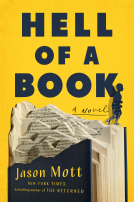
Hell of a Book, by Jason Mott*****

It really is.

This book is a standout in more ways than one. First the obvious: look at that cover! Then again, how many novels have a nameless protagonist all the way through the book? Get into it deeper, and the distinctions become more complex. The buzz around it is wholly justified. My thanks go to Net Galley and Random House for the review copy. This book is for sale now.

Our author is on an odyssey that takes the form of a book tour, and it lands him, in the end, back where he grew up. He doesn’t tour alone; apart from the various organizers he meets in various locations, he is accompanied by a small Black child he refers to as “The Kid.” Alternately, we also see the story of a young Black boy, a very Black boy, nicknamed “Soot,” who grows up in the American South.

As I read, I am always on the back foot, understanding most of what it being said, yet developing questions as I go. Our author says (often) that he has a condition, and that this is probably why he can see The Kid when others cannot. My notes ask whether his condition is dissociative, and is The Kid just part of himself? Or is The Kid Soot? Are Soot and The Kid both part of the author? Every time I come up with a plausible theory, something else happens to undercut it. Yet one other thing becomes clearer all the way through: to be born an African-American boy in the United States is to be perpetually on the back foot; perpetually having to guess how best to proceed; to perpetually guess at one’s welcome or lack of same, at the quality of one’s relationships with Caucasians, to perpetually guard one’s own safety. And to be very Black—“Nigga, I bet when you get out of the car your daddy’s oil light come on”—is to invite not only the suspicion and hostility of Caucasians, but to draw the enmity of lighter Black people, too.

The synopsis of this story that initially drew me billed it as humor, and in places, it is not only funny, but laugh-out-loud funny. But the further we get in, the darker it becomes.

There are a number of sardonic references to the publishing world; editors, agents, and other promoters have told the author that while it’s fine to write about Black characters, He must not write about being Black:

“The last thing people really want to hear about is being Black. Being Black’s a curse—no offense—and nobody wants to feel cursed when they read something they just finished paying $24.95 for…The future of this country is all about patriotic, unity-inducing language. Post-Racial. Trans-Jim Crow. Epi-Traumatic. Alt-Reparational. Omni-Restitutional. Jingoistic Body-Positive. Sociocultural-Transcendental. Indigenous-Ripostic. Treat of Fort Laramie-Perpendicular. Meta-Exculpatory. Pan-Political. Uber-Intermutual. MOK-Adjacent. Demi-Arcadian Bucolic. Write about love. Love and Disney endings…”

Later, an interviewer asks if the past doesn’t still matter, and the author says, “It does. Not just three-fifths of it, but all of it.”

So, my friend, you can see why this book should be called a love story. Race? Oh, no no no. Fear? Injustice? Police brutality? Of course not. After all, this is a hell of a book!

Highly recommended; one of the year’s finest.

The Sweet Taste of Muscadines, by Pamela Terry*****

Pamela Terry’s debut novel, The Sweet Taste of Muscadines, had me at hello. My great thanks go to Net Galley and Random House Ballantine for the review copy. You can buy it now.

Lila Bruce Breedlove (I even love the characters’ names) hasn’t gone home to Georgia in a good long while, and it’s not accidental, either. Her home in Maine with her dogs and fond memories of her late husband are the furthest thing from her mama’s censorious gaze and the smallminded thinking of the people of Wesleyan, Georgia. But now Mama has been found facedown in the Muscadine arbor, and Lila knows there’s nothing else to do. She packs her bag, gets a friend to look after the dogs, and buys a ticket. Her brother Henry, who has also made a permanent home up north, does the same, but he advises his life partner, Andrew, to stay put. Their sister, Abigail, is the lone family member that didn’t flee. She and Mama were best friends, as they told everyone  constantly, including Lila and Henry. Still,  duty calls. It wouldn’t be fair to leave Abigail to do this on her own.

The whole story is told by Lila in the first person limited. I find this refreshing. The tone is intimate, confidential at times, and downright conspiratorial at others. Lila lets us know that “Growing up in the South is not for the faint of heart…When you’re the slightest bit different, you stand out like a monkey in a chorus line.”

Before they’ve even touched down, Lila and Henry have questions. For example, why was Mama in the Muscadines at all? The arbor is nowhere near the house, and she never chose to visit it when she was a younger woman. It had been Lila’s special place. Once they arrive in Georgia, they confront more questions, and though not all of them are answered, a plethora of surprises greet them, some of them hilarious, others shocking. Lila tells us that

Secrets are spilled at southern funerals. Death, particularly when its inevitability has been ignored for generations, possesses a power to snap diffidence and dignity right in two, causing those left behind to be overcome with the need to unburden their consciences before they themselves are found sleeping in a slick, shiny coffin in their best Sunday suit.

The first surprise, it turns out, is that Geneva Bruce left an advance directive specifying no funeral at all upon her demise, which she had known to be imminent. For the widow of a Southern Baptist Georgia preacher to bail from her own funeral is unheard of! However, the lack of a proper funeral does not, cannot prevent family secrets from unspooling, and some of them are bombshells, too.

Terry is a gifted wordsmith, and her figurative language is original and at times, drop dead funny. The pacing never flags, and the transitions that take us from raucous levity, to bittersweet reflection, to aching sorrow, and then back again are buttery smooth. It was like hearing from my best friend. I generally read several books at a time, but this one proved to be the one I read when I would not be interrupted, and I was sorry to see it end.

It was only at about the eighty percent mark that I realized that one of my least favorite elements was included here, that of the Bad Mama. This is a trend right now, and I’m ready to be done with it. Novelists far and wide have enjoyed crafting stories centered around unworthy mothers, and when I see one coming in advance, I consider it a deal-breaker. But almost any device, character, or plot point can be forgiven when a novel is of exceptional quality, and that is what I see here.

Highly recommended.

This Tender Land, by William Kent Krueger*****

“God is a tornado.”

Odie and Albert are orphans, the only two Caucasian children at the hellish Lincoln School in Minnesota, which is primarily a boarding school for American Indian children. The year is 1932, and the Depression is in full swing. As things unravel, the two brothers sneak away, together with a mute Indian friend and a small girl whose parents have recently perished during a storm; the odyssey on which they embark raises questions for all of them about what they believe about themselves and the natures of God and man. My thanks go to Net Galley and Atria Books for the review copy. This book is for sale now.

This is the first of this author’s work that I have seen, and it’s clear that he is one gifted individual. At the same time, however, this is not easy to read. The first fifteen to twenty percent is brutal. There are triggers all over the place including sexual assault, child abuse, and both put together. I read only a few pages at a time because more would have wrecked my head, and I never let it be the last printed material my eyes saw before bed. Those that soldier through the beginning can be assured that the worst is over, although there are many other passages in which Odie, Albert and friends are tried severely. For me, though, it was worth it.

The get-away trip takes them down the mighty rivers of the North American interior. There’s a lot of rich historical detail along the way, and it will be especially interesting for those unaware of the culture that existed before anyone in America had food stamps, or subsidized housing, or a social worker, or compulsory education.  There was no safety net of any kind; people existed at each other’s mercy. The travelers meet all sorts of interesting people, but when others get too close or ask too many questions, they leave rather than be identified. Albert points out that others are often untrustworthy, and that those we love are often taken from us; he says that if God is a shepherd, He must be the sort that eats his flock. But a man that hires them to do farm labor says that God is in the land, the air, the trees, and in each person.

Ultimately the journey is a search for home, for family, and for a role in the world. The original destination is St. Louis, Missouri, where Odie and Albert’s families live, but as they make their way toward it, they find out that there is more than one kind of family, and more than one kind of home.

Highly recommended to those that love the genre and have robust literacy skills.

Best Humor 2018

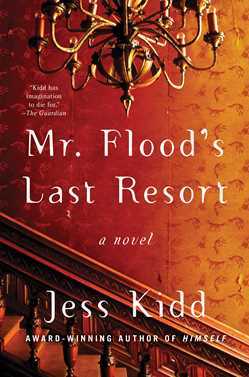
MrFloodsLastHonorable Mentions: