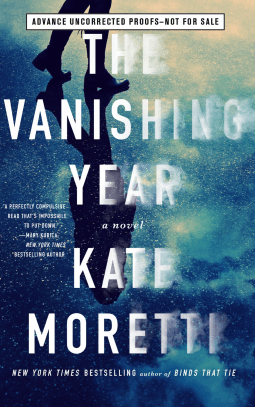
The Vanishing Year, by Kate Moretti****

thevanishingyear 3.5 stars, rounded up for this one. I received my copy from Atria Books and Net Galley in exchange for an honest review.  I am impressed most by the first half of the book, and particularly with regard to character, Kate Moretti is a rock star.
Our protagonist is Zoe Whitaker, and we learn that Zoe grew up as Hilary—with one “L”, and no political baggage—and then chose to adopt “Zoe”, the name on her birth certificate prior to her adoption. There’s a lot more mess here than there needs to be, the adopted-child angst, the guilt over having not given her mother Evelyn the funeral she deserved, and fear, fear, fear.

Moretti does a wonderful job of building suspense, and part of this is the vague but real tension, the constant shoulder-checking, wondering if someone has found her. It makes us wonder who, and it makes us wonder why. Bit by bit, she unspools tidbits of the past in the way you might expect someone that needs a friend and is learning to trust a new confidant might do.

Moretti’s main character is beautifully sculpted. Some novelists that withhold information to build tension hang onto so much that we don’t get to know our protagonist, but I was perched right on Zoe’s shoulder, or hanging out with her newly discarded friend Lydia, asking her why the heck Zoe is so passive. Is fear the only language Zoe knows? I felt close to Zoe, and I wanted her to tell me more.

Meanwhile, there’s the marriage. Henry Whitaker, an immensely wealthy man, sees Zoe across a crowd and homes in on her. Those familiar with the patterns common to abusive relationships know that this is a red flag; the guy whose gaze lights on a partner and from then on wants full possession of every move, every thought, and every minute. He makes a snap decision like lightning and then never lets up. And Henry has plenty of other red flags too, but he’s not a stereotypic abuser; Moretti is too cunning to permit any caricatures into her novel.

For the first half of this story, I relished the meaty ambiguity, not only in Zoe’s life but in what it represents. Yes, Henry is too possessive, too bossy, but on the other hand, this young woman that has never been known for her remarkable beauty or extraordinary talent has the Cinderella marriage without the stepsisters.

“I might be under someone’s thumb, but I have money now.”

Zoe has no living relatives to her knowledge, apart from the birth mom she hasn’t located and that may not want her when she does. She doesn’t have a degree, and is working at a florist’s shop in Manhattan when Henry finds her and whisks her away. He is devoted to her, provides her with every small thing her heart desires. She has a car and a driver, she has servants, she has clothes, jewels, and the whole nine yards. Everyone defers to her. There’s no restaurant that won’t make room for her at the front of the queue. Tickets to a sold out event? No problem.

It is easy for us to moralize from afar, we feminists with our principles, but economic want can shorten a woman’s life significantly. As this reviewer heads into retirement, I look at the lives of the women I knew when we were school girls, and no matter how clever or talented, their material well being seems tied, more than anything, to who they married and whether they remained married. Ask any woman over age 50 who’s looking for a job and watching those past-due notices land in her mailboxes, both electronic and physical, and many of those same women would be more than happy to let someone else tell them what to wear in exchange for such a well-padded safety net.

And so as Henry’s behavior escalates, I grow more entranced with the story’s Virginia Woolfish aspect, and I expect Moretti to take us up that mountain. How much is too much? At what point does one relinquish the guarantee, if there is one, of not only the basic requirements but luxuries one may quickly grow accustomed to, in exchange for breathing room, the dignity that comes with independence, self-respect, and with apologies to Woolf, possibly a room of one’s own?

But Moretti doesn’t go in that direction; at the last minute she tosses in a tremendous amount of new information that is original yet seriously far-fetched. Those that want a white-knuckle thriller with a female protagonist may be very happy here, but I was sad, left feeling as if the waiter had decided not to serve me and abandoned me after the hors d’oeuvres.

This title was released on October 4, and so if you are eager to see what all the buzz is about, get a copy, and then let me know what you think.

One way or another, Moretti will be a novelist to watch. The subtlety and nuance that escaped her as this novel progressed are still hers to be had, if she chooses to use them. I know I can’t wait to see what she publishes next.

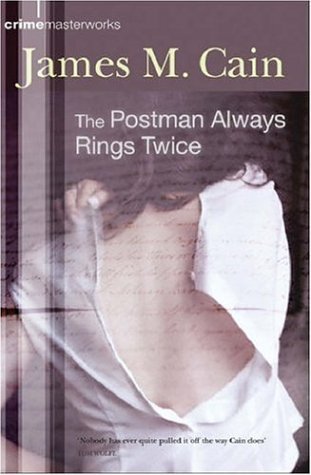
The Postman Always Rings Twice****

thepostmanalwaysringstwiceWell, they do say karma’s a bitch.

I fell heir to a first edition hard cover copy of this classic 1934 crime fiction. It’s too well worn to be a collector’s item, so instead of selling it, I decided to just enjoy holding a book in my hands that could have been held, hypothetically, by my great-grandparents. I think I enjoyed the crispy yellow pages and the old school print more than I enjoyed the story itself.  With wide margins and plenty of dialogue, it was a quick read, and before the weekend was over I’d finished it.

Our protagonist, Frank, is a drifter that does odd jobs and occasional crimes as he travels through Mexico and the Western USA; the story itself is set in California. He comes to an out-of-the-way place where a Greek immigrant and his wife run a small roadside restaurant. The owner is interested in expanding the business to include car repair, and hopes that a free meal and a bed for the night will lure Frank to stick around and work for him. Instead, Frank stays and finds a white-hot attraction to Cora, the owner’s wife. The two of them make love like cats in a pillowcase, snarling and biting and tearing at each other, and they like it so well that they decide to kill the Greek guy so they can do it together forever.

Those that don’t follow history may not know that at the time this story was published, U.S. xenophobia toward immigrants from Eastern and Southern Europe was at its pinnacle. Jim Crow and the Klan had silenced any open dissent from African-Americans with a reign of terror, but it was somewhat commonplace for Caucasians, who were by far the largest group in terms of population and certainly in terms of power and money, to make nasty assumptions and references about people from Greece, Turkey, Italy, and the surrounding area.

So it’s within that context that Cora declares that although her husband Nick loves her and treats her really well, he repulses her because he’s “a little soft greasy guy with kinky hair”. He wants her to have his baby, and she doesn’t want to touch him. She’d hate to go back to turning tricks, but she would far prefer to be with fair, blonde-haired Frank than Nick Papadakis.

The story arc here is flawless, and I can see how it became a classic, but it has many aspects that haven’t aged well. There are nasty remarks about Mexicans; Cora urgently wants Frank to know that she’s white, even though her hair is dark. She isn’t “Mex”. And although I understand that some people do like rough sex, I had to take a deep breath when Frank became aroused and showed it by blacking Cora’s eye for her.

Right. So you see what I mean.

The way the story is plotted is ingenious, and the characters are consistent all the way through; the ending is brilliantly conceived and executed.

For me, though, one reading is enough.

The Last Road Home, by Danny Johnson****

thelastroadhomeThe Last Road Home, bold and impressive new fiction by Pushcart Prize nominee Danny Johnson, came to me free thanks to Net Galley and Kensington Books in exchange for an honest review. It tells the story of Raeford “Junebug” Hurley and his friendship with neighboring twins, Fancy and Lightning Stroud. Junebug is Caucasian; the twins are African-American, politely referred to during that time as ‘colored’ or ‘Negro’. The story is set during the Civil Rights movement of the early 1960’s, but in rural North Carolina, the Klan stands tall and strong and absolutely nothing has changed in terms of race relations. Junebug finds himself riding on the fence rail from hell. This fascinating tale will be available to the public in late July. Those that love good historical fiction should read it.
The book begins with one horrible loss after another. At age 8, Junebug’s parents are both killed in a car wreck, and he goes to live with his grandparents.  His life is pleasant and stable, helping his grandpa run the farm, but then his grandpa dies too. And by the time his grandmother dies, I have decided that the theme of this story must be grief and loss, or given the number of religious references, perhaps there is some sort of Christian redemption theme here. And on both counts, I find I am mistaken. Johnson is a masterful storyteller, and there is nothing simplistic in how this novel unfurls.

For while Junebug has plenty of questions about the religious fervor that pervades small towns of the South during this era, by the time he buries his grandma, he has had it with religion. “The preacher said a prayer, asking the Lord to be with me in this time of grief. I’d had all of God’s shit I could take and didn’t need His sympathy. If he said it was ‘God’s Will’, I might choke him.”

I wanted to stand up and cheer.

At age 15, orphaned and the sole remaining member of his family, he is on his own. “Fifteen was considered adult in farm years.” Lightning leaves home suddenly, unhappy with the limitations placed on Black men in his part of the world. Fancy is left behind, and she is the only friend Junebug has within walking distance of home. As friendship turns to passion, both find themselves occupying a dangerous place in their community. Given that they are cold shouldered simply for appearing in town together to run an errand, the thought of letting their feelings for one another be known is terrifying.  He recalls his grandma’s admonition:

“’Junebug, you need to understand that cruelty and memory have been married together a long time in the South.’”

Johnson does an outstanding job of depicting white neighbors’ responses to the notion that our protagonist is linked romantically with Fancy. At first they are able to maintain the age-old fiction that she is his housekeeper, but she goes home at night, then sneaks back in darkest night to lay beside him. The muted references, little hints given by Caucasian elders nearby to guide the young white farmer away from a liaison that doesn’t fit local expectations, are rendered skillfully. There are a number of really vicious racial epithets tossed casually around by the local landowners, not always even in anger, sometimes in ugly jokes, as this writer knows from childhood experience is the way racists behave when a white supremacist perspective is not something being fought for as an outlier, but rather the dominant, even comfortable, norm. As the book continues, not only anti-Black pejoratives, but also nasty terms regarding Jews and Asians are tossed into the vernacular. None are gratuitous; they are an undeniable part of the setting, which would be revisionist without them.

Fancy and Junebug seem doomed. He tells her, “It feels like my life’s sprung a lot of leaks, and I’m running out of fingers.” She points out that she only has ten fingers too.

I was watching for the pat ending, the comfortable happy fiction that novelists are often drawn toward. Every time I thought I knew where the story was headed, it went somewhere else. Johnson is brilliant at breaking apart stereotypes, making setting real and immediate, and his character development is strong apart from some minor inconsistencies toward the end. And his framework is materialist by and large, showing that our surroundings and role in life shape us in ways we sometimes don’t expect.

Those interested in this period of history or that love excellent fiction should order this book. It will be available to the public July 26, 2016; strongly recommended.

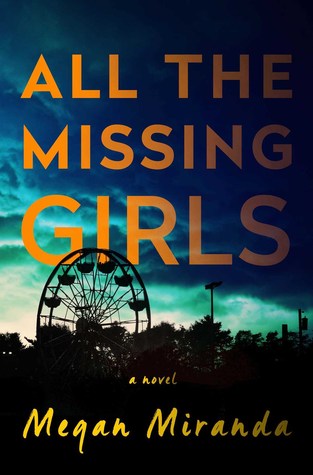
All the Missing Girls, by Megan Miranda*****

allthemissinggirlsI was invited to read by Net Galley and Simon and Schuster in exchange for an honest review, and I am so glad I did. It’s a juicy read that kept me transfixed through most of my Memorial Day weekend. You can order your copy now and have it when it comes out June 28.

The format is unique and very effective. We start in the present and step back to the day before, and before that, and so on, because just as is usually true when a person is missing, the most important information is what took place right at the beginning; that’s the part that has the key, and so we receive it last. It creates an electric sense of suspense I haven’t seen elsewhere in a long, long time.

We start with Nicolette Farrell driving away from her job, fiancé, and life in Philadelphia back to her hometown of Cooley Ridge, North Carolina. She couldn’t wait to get away from there when high school was over, and she isn’t eager to go back. And here, I felt her pain, urban snob that I am. Why would anyone want to return to a podunk place like that once they’d tasted life in a cosmopolitan city? But she has little choice; her father is in assisted living, his faculties fading, and Nic’s brother Daniel says they will have to sell the house in order to continue paying for Dad’s care. But Dad won’t agree to sell, and it’s up to Nic to reel him in.

But Nicolette, it turns out, had plenty of very personal reasons for needing to leave Cooley Ridge. Dark, mysterious questions about the disappearance of her best friend, Corinne, have never been answered, and once she is back, another girl disappears, this one the girlfriend of Nic’s old high school flame.  It doesn’t look good.

But Nic knows more than she’s telling; lots of people do.

“We were a town full of fear, searching for answers. But we were also a town full of liars.”

It’s been ten years since Corinne vanished, and now it’s happened again. Daniel is worried about Nic staying alone in that house, because the woods where the girls have last been seen is right behind it, and she’s there alone. He urges her to stay with him and his wife, but she doesn’t like to intrude; her relationship with Daniel hasn’t been strong since that last terrible night following graduation, and so she stays put.

This riveting psychological thriller grabbed me by the front of my shirt and didn’t let go till it was over.  Tantalizing bit by bit, Miranda takes us back to Nicolette’s earlier days, and one clue after another unspools until we sit stunned and amazed at the end. Miranda is a writer of formidable talent, and frankly, I can’t wait to see what else she has in store for us.

You can order your copy now so you can have it as soon as possible; go online, by car, by train, bus, foot, or skateboard, but reserve this book. It comes out Tuesday, and you won’t want to miss it!

Tears in the Grass, by Lynda Archer***

tearsinthegrassTears in the Grass marks the debut of novelist Lynda Archer. It tells the story of three generations of Cree women, and in doing so also provides the reader with that tribe’s rich history and culture. Thank you to Net Galley and Dundurn for the DRC, which I received in exchange for an honest review. This book is available for purchase now.

Elinor is old. She is old enough to have been through the shameful period in North America in which Native children were forcibly wrenched from the arms of their parents and forced to attend boarding schools in order to become assimilated and indoctrinated into the dominant culture. Her traumatic memories are harsh reading, but it’s the only way that story can be shared with any degree of honesty. And there’s something she has held back from her daughter Louise and her granddaughter Alice: she has another daughter out there somewhere. She was raped by a Caucasian man, carried the baby to term, and then it was stolen from her. She knows that baby, now a woman, is out there somewhere, and she wants to meet her before she dies. She turns to Alice to get the job done:


“’Are you listening? I want you to find that child.’

‘ I don’t know what you’re talking about.’

‘Your mother’s sister. Your aunt. My daughter. I was raped in that damned school.’”


The point of view shifts throughout the narrative, with the dominant one being that of Elinor, but also including those of Louise, Alice, and a bison. It doesn’t always flow in a way that makes sense; sometimes we are rolling right along through one of the women’s narrative and suddenly the thoughts being voiced are clearly those of an animal, with no transition to mark the change. The first time, it is that of a taxidermied bison in a museum, and the effect strikes me as somewhat cartoonish rather than reverent. At other times, there is no possible way that the animal in question could be a bison, unless we allow for some magical realism.  Remember, however, that I read a DRC, and sometimes details that are going to be present in the finished work, such as lines that mark a change of setting or point of view, are missing.  Your copy may make these changes clearer.

A lot of social justice issues are worked into the flow of these three generational narratives. Louise recalls the Vietnam War, which makes her a senior citizen also. She remembers the slaying of Dr. King, and if these details are to be utilized to establish setting and develop the character, they might be more effective if included earlier in Louise’s narrative.

Alice seems the easiest for the reader to relate to, even though my own age is closer to that of Louise. Her contemporary spin and flexible thinking are more in line with what most young people of any age are likely to resemble. Her affection for her grandmother comes through the page, and although all three women are effectively developed, she seems the most tangible. Alice is lesbian, and so there is also this aspect of social justice as a subscript, though it stays primarily in the background.

But let’s go back to the grandmother for a moment. Along with the need to meet her stolen daughter, Elinor has one more key task on her bucket list: she wants to know what the secret is that Louise has been hiding from her all these years. And Louise doesn’t want to tell her or even think about it. It’s an interesting twist, and adds to the characters of both Elinor and Louise.

Though shaky in places, Tears in the Grass is a worthy debut, and the subscript, the history of the Cree people at the hands of European settlers, is a tough read but an essential one, a story often left out of the core curriculums currently taught. Kudos to Archer, who will be a writer to watch in the future.