
The Twelve Lives of Samuel Hawley, by Hannah Tinti*****

thetwelvelivesofs “Everything breaks if you hit it hard enough.”

What would you do to protect those you love the most? Tinti’s epic father-daughter tale has already drawn accolades far and wide. What can I add to it all? There are only so many ways to say that someone is a genius and that her work deserves the highest praise and honors. I received my copy free and in advance, courtesy of Net Galley and Random House, in exchange for this honest review, and I’ve spent the last month trying to decide what I can add to the discussion. Although 2017 is clearly an outstanding year for literature, this title stands head and shoulders above everything else I’ve seen. It will likely be the best fiction published this year.

Our two protagonists are Samuel Hawley and his daughter, Loo. The story is arranged with alternate points of view, and also moves from present tense to the past, when Lily, Loo’s mother, was alive. Hawley is a career criminal, a man that has robbed and killed as part of a business transaction, but his tenderness for his daughter and his wife keep us connected to him.

As a parent, though, Hawley is kind of a mess. He does his best, teaching his daughter useful tasks like how to file the serial number off of a weapon and how to use it, but at the same time, he keeps his criminal business quiet and low, and she is nearly grown before she realizes what he actually does for a living. The two of them move around the country frequently, and they have a routine that gets them gone in a hurry when it’s necessary, but as she gets older he takes her to the Massachusetts town where her maternal grandmother lives. And I have to say, Mabel Ridge, Lily’s mother, is one of the most arresting side characters I have seen in a very long time.

For Loo’s sake, Hawley works as a fisherman and sets down roots. His participation in the Greasy Pole event, a cherished local tradition, wins him a place in the community. But he’s left enemies in his wake, and Hawley is constantly alert to the threat others pose. Who’s in prison, and who’s out? Who’s alive, and who isn’t anymore? Sooner or later, someone he doesn’t want to see is bound to rock the life he has established for himself and his daughter.

This is the sort of literary fiction that lets the reader forget that it’s art, because it reads a lot like a thriller. There are scenes that are laugh-out-loud funny; my favorite involves a car thief named Charlie.

Samuel Hawley seems to me to be a character for our time. Fifty years ago, a novel like this would have been controversial—and it may still be, who knows? Great literature often is. But today with the stratospheric growth of the American prison population, many more members of the book buying public either have done time, know someone that has, or know someone that barely escaped having to do so. It’s no longer unthinkable that a person that has done some truly reprehensible things, may also be a human being.

One way or the other, you have to read this book. The buzz it’s created is only the beginning. If you read one novel this year, let this be it. It’s available now.

It Happens All the Time, by Amy Hatvany***

ithappensallthetimeI was invited to read and review this title in advance by Net Galley and Atria Books; it is written by a rape survivor, who tells us bravely of her own experience in the introduction. I wanted to love this book and to scream it across the internet and from the top of the Space Needle, that everyone should get it and read it, but instead, I came away feeling ambivalent. The rape passage is resonant and horrifying, and it’s written in a courageous way, and I’ll go into that in a minute. The rest of the book, however, is flat, and so in some ways this proves to be an opportunity squandered. There are spoilers, so don’t proceed if you don’t want to know how the book ends. It is available for purchase today.
The premise is that Amber and Tyler are best friends. They dated when they were teenagers, but a lot of time has gone by, and they have agreed to be buddies, talking often. Amber does not know that Tyler’s torch is still burning for her, brighter than ever; he is waiting for her to come around. Meanwhile, she has become engaged to someone else.

Amber is also a recovering bulimic, and now she is a specialist in nutrition and fitness. The level of detail regarding Amber’s meals hijacks the narrative at times; I don’t care how many ounces of lean this, that, the other she is about to eat. If we’re going to write about diet and fitness, that should be another book, and otherwise it should stay in the background.

The rape itself is where the story shines, and of course, it is the central scene to the story. Hatvany wants us to recognize who rapists are, and who they aren’t:


“They’re not greasy-haired monsters who jump out from behind the bushes and tie up their victims in their basements.”


The story is told from alternating perspectives, so we hear from both Amber and Tyler. Amber is believable to a degree; a more richly developed character would be more convincing, but the story is one that countless girls and women have lived. It’s a date that goes badly wrong; sometimes the woman is one that expects that she will want sex, but then decides she doesn’t, and her date forces the issue. Is that rape? Unless she says yes to sex, it is. Sometimes it starts with kisses—drunken or otherwise—but when the man wants to go further, she decides she wants to keep her clothes on and not follow through. If she says stop, or wait, or fails to say she wants to do this, yes, it is rape. And so this part of the narrative is important, and once I have read it, I want more than ever to like the rest of the book so that I can promote it.

Tyler is just straight up badly written. I am sorry to say it, but I rolled my eyes when I read his portion of the narrative. The ending is way over the top, and it distracts us with morally questionable deeds done by Amber that we would never commit. If it was rendered brilliantly, it could perhaps come across heroically, like Thelma and Louise, but it isn’t, and it doesn’t.

What happens here, is that Amber kidnaps Tyler post-rape at gunpoint. She forces him to drive to her family’s vacation cabin, and she makes him say that he raped her. He won’t do it, so she shoots him. She refuses to take him to a hospital until he says what she wants him to say. Once all of this happens, he has a huge epiphany, and from then on, Tyler’s wails about what a bad thing he has done, and how he knows he deserves everything that will happen to him as a result.

Sure.

But in addition, I find myself squirming. At one point when Amber holds him hostage, Tyler points out to her that kidnapping is a felony. Having Amber muddy the waters morally by kidnapping and shooting her assailant is distracting and morally tenuous at best. He has to tell the truth; she doesn’t. He owes it to her to lose his job and career, and to serve his time; she never expresses any sort of remorse and never suffers the consequences of her actions. And whereas brilliant prose stylist could turn Amber into a vigilante folk hero, this isn’t that.

I know that the author intends to tell a story that is deeply moving and that will improve the social discourse regarding what rape is, and how we as a society deal with it, both institutionally and as individuals. Instead, the distractions and tired prose prevent this story from reaching its potential.

Skitter, by Ezekiel Boone****

skitter Skitter is the sequel to Boone’s monstrous horror novel, The Hatching. Mutant spiders are on the rampage, fulfilling the worst nightmares of every arachnophobe, and president Stephanie Pilgrim has to decide how to save the USA—if it isn’t too late. I received my copy free and in advance from Net Galley and Atria Books in exchange for this honest review; copies will be available to the public May 9, 2017. Don’t miss out.

The first portion of the book is dedicated to bringing the reader up to speed so that those that didn’t read the first book can jump right in. The pacing feels a little slow, and I am thumbing my reader impatiently, wanting to find out what happens next. There is a fair amount of time discovering and discussing cold egg sacks versus warm, throbbing, glowing ones, but the emphasis is there for a reason, and it also makes for a more accessible read to a wider audience. At the 34% mark the ground work is done—so to speak—and the story breaks loose and really flies. The scene in Japan is particularly arresting.

So…imagine a bag of nice, warm spider eggs roughly the size of a bus; think of it as a “giant packet of doom in the corner”. It might hatch at any moment, and although the spiders may kill you, there’s a chance they may not. They spare some people to use as incubators for the next generation to come.

Let me just ask: how is your stomach doing right now? Are you feeling okay?


“Somebody gets bitten and then, what, five hours later they’re opening up and spilling out spiders like a bag of frozen peas?”


After The Hatching came out, I suddenly began noticing the spiders that came into the bedroom at night. It was uncanny how one turned up right after my spouse had fallen asleep, every single night. The spider would start in a far corner of the room—nothing to worry about here, ma’am, just minding my own business—and then gradually either circle to where it was directly overhead, or make its way to a location above the very center of the king sized bed, start a nice web, and commence to rappel doooown. I had never been that aware of them before, but now they seemed ominous. What the hell? Every night? Before he knew it, my spouse, who is nimbler than I, found himself drafted into spider-bombing the attic.

So yes, there is risk in reading this mesmerizing horror tale, but on the other hand, how can you not?

Ultimately, everything that can go wrong on Earth, does. There are mutant spiders from the South Pacific to Scotland, from Asia to Michigan. Quarantine zones fail. Hospitals fail. Other nations have tried everything, including using nuclear weapons on their own soil. And ultimately the president and her advisers wonder whether it is time to break out the Spanish Protocol.

I won’t tell you more than this; you need the book itself, either to take with you on vacation, or to make you feel better about the fact that you can’t go anywhere this year. Afterward, you’ll look at every little spider web in your living space with suspicion, and you’ll know it’s time for spring cleaning…right away!

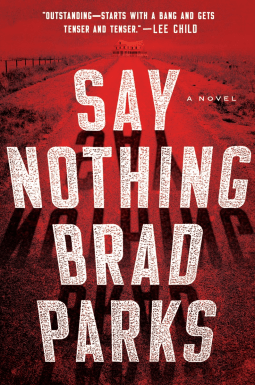
Say Nothing, by Brad Parks***

saynothingEvery parent with a baby or toddler has this one terrible, dark fear: that someone will take that baby.  In Say Nothing, that horrific event is doubled when Sam and Emma, twin sons of Scott and Alison, are taken and the note that sends frozen tendrils of fear up their spines instructs them not to tell anyone. No police; no one at all can know. “Say nothing.” Thanks go to Net Galley and Dutton Penguin for the DRC, which I received in exchange for an honest review. The book came out last week and is now available for purchase.
This story takes off like a rocket.  Scott Sampson is a Federal judge, and some devious criminals that know the family’s every habit snatch the children and send him a text message before either parent knows they are gone. Someone has impersonated Alison, swept by their preschool, and whisked the little ones away. How absolutely terrifying!

The purpose is soon clear: the kidnappers want to manipulate a major case on the Federal docket, assigned to Scott Sampson. Contacting police is out of the question. They’ve threatened to cut off their little fingers, one by one, and mail them to their parents.

Parks is a champ at building suspense. For me, the thrill is tarnished when I see a repetitive error—one many people won’t even notice—that has the effect of sweeping aside the curtain and showing me that the Great and Powerful Oz is just a guy in a chair. In this case, having had a judge in the family for many years and seeing the mistake in the text makes it hard to maintain the premise.  You see, when one is in court, the judge is “The Honorable” and is addressed as “your Honor”; in private life, his employees, friends and family all call him John, or Mr. W—. We used to eat out with this man frequently, and there was always a little family eye roll and slight smile when the obsequious maitre d’ at a downtown restaurant where we often ate came dashing out to the valet parking area calling, “Oh, Judge W—! Judge W—! We have your table ready now!”

In private life, if you need a title, a Supreme Court judge is called “Justice Jones”. Everyone else is called “Mr. Jones” or “Ms. Jones”.

I try to push past this obstacle but the error is made often in the dialogue, and so the memory of my relative’s patient courtesy is always lurking in the margins of my perception of the story. The upshot is that for me, it really gets in the way.

That said, I like the pacing of this story, and the solution is elegant and plausible.

Recommended to fans of the author’s Carter Ross series.

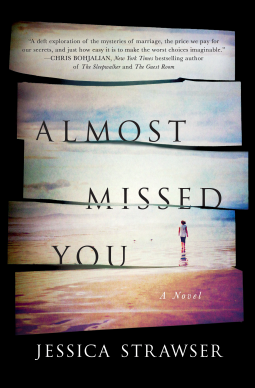
Almost Missed You, by Jessica Strawser****

almostmissedyo“Fate, people liked to call it. But Violet pictured it as dominoes. Somehow, they’d been positioned perfectly. And at the end of the line was Finn.”

Thanks go to Net Galley and St Martin’s Press for the DRC for this intricately crafted novel, which I received free in exchange for an honest review. Unique and tightly woven, it’s sure to arrest your attention until the last page is turned. This book goes up for sale March 28, 2017.

Violet meets Finn while on vacation in Miami, and wild coincidences draw them together. They went to the same obscure, short-lived summer camp, and they’re both from Cincinnati. How crazy is that? And so when they come together again, it feels like something out of a fairy tale. They marry and have an adorable son they call Bear. Later they return to Miami as a little family.

Then Violet returns, warm and fulfilled, to the hotel room…and both Finn and Bear are gone, along with their luggage.

This is a story that speaks to every mother’s worst nightmare, the abduction of her child. Her baby! And Strawser plots it cleverly, so that the obvious answers are no longer feasible. Of course the police are called, but since there was no divorce, no restraining order, there’s only so much they can do. They have other cases as well. Meanwhile, Violet is both frantic and bewildered. She had thought they were so happy together; what on Earth happened here?

Our main characters are these two parents as well as their closest friends, Caitlin and George. George is a ruling class scion, and at the start of the book it seems as if this is overemphasized. At one point I enter it in my digital notes: put the trowel away already, we get it! But here I am mistaken, because the frequent references are here for a reason; that’s all I will say about that lest I ruin the end for you.

An endearing side character is Gram, the woman that raised Violet after her parents died. Older women tend to be stereotyped in novels; they are either background characters that emerge with cookies or chicken soup and then depart again to make way for the real characters, or they are the cause of all that is bad—shrews, harpies, abusers, enablers, nags. Gram has shrewd advice and insights. She’s not just a cardboard cutout.

The inner narratives, which alternate and in doing so build suspense, are where the strongest voices are found. The dialogue is nicely done, but not as effective as the narratives. And more than anything I have read recently, this book is driven by the plot. The ending is a humdinger.

Ordinarily I would call this a strong beach read, but mothers of tiny children might want to read it somewhere else. It’s a fine debut novel, and Strawser will be an author to watch in the future. Recommended to those that like strong fiction.

The Weight of this World, by David Joy*****

It’s out! Get this one now, if you appreciate stark, immediate settings and hardscrabble characters. I will follow this author anywhere!

seattlebookmama's avatarSeattle Book Mama

theweightoftheworldDavid Joy is a writer that keeps it real, and that’s what made me lurch forward in my desk chair and grab my mouse when I saw his second novel was done.  Big thanks go to Net Galley and Putnam Penguin for the DRC, which I received in exchange for this honest review. This title will be available to the public March 7, 2017. Those that cherish strong fiction should buy it and read it.

The setting is Little Canada, North Carolina, a wide place in the road in the middle of nowhere. The family unit, such as it is, consists of April—the most unwilling of mothers—along with her son Thad, and his best friend, Aiden McCall, who shares the trailer at the rear of April’s property with Thad. The plot is centered on the inadvertent death of the local meth dealer, and a small fortune that is unexpectedly left…

View original post 448 more words

Ill Will, by Dan Chaon**

IllWillThe good news is that if you’re looking for something dark, then Chaon is your author. I received a copy free and in advance in exchange for an honest review; thank you Net Galley and Random House Ballantine. This book was released today and is available to the public.

The plot centers around a psychologist, recently widowed, who’s coming unstuck. One of his sons has developed an ugly drug habit right under his distracted father’s nose, but his dad just keeps giving him money and doesn’t ask questions. At the same time, the psychologist’s brother, who was sentenced to two life terms for the murders of their parents, aunt, and uncle, is exonerated when DNA analysis is done.  Simultaneously a patient of Dan’s comes to him with questions about a series of drowning of drunken college boys that he says he believes are linked. At first, Dan assumes these are paranoid ramblings, but over the course of time, the patient begins to assume greater and still greater importance in Dan’s life, until the reader begins to wonder which of the characters is the psychologist and which is the patient.

The quality of the prose is surreal and at times, dreamlike.

Every reader has a threshold for the level of violence he or she can sustain before a book ceases to be deliciously creepy and instead becomes a thing we wish we never read. I knew when I hit the term “snuff film” before the twenty percent mark that I might be in trouble, but it was a passing reference and since I had an obligation to the author and publisher, I brushed it off and kept reading.  I read multiple books at a time, usually half a dozen or so, and I found that this book was the one that I just didn’t want to read. With the publication date upon me, I forced myself through to the end, and have been slightly queasy ever since.

I didn’t have any fun here; it was just too disturbing.

I want to be fair, and so I read carefully in order to see whether there are any clever literary nuances that might improve my rating, and the second star is included here because of some interesting and innovative stylistic tools that are employed. I liked the triple narrative that appears to be taking place simultaneously, and am interested in the business employed with sentence endings that begins with the father and ends with someone else.

The story’s ending is both unpleasant and disappointing, in that it doesn’t present any sort of epiphany or surprise. My reaction to the end of this whole unfortunate thing is, “Oh.”

None of this means that you won’t like this story. There’s a lot of buzz right now about the now discredited belief in Satanic rituals that were in the news during the 1980s, and if this is in your wheelhouse, maybe you’ll like the book. If your tastes run way out on the edge of horror, you might find it more appealing than I do. On the other hand, it won’t make the ending any less anticlimactic.

Recommended to those interested in extreme horror stories and with a bottomless wallet, or that can read it free or cheaply.

The Devil’s Country, by Harry Hunsicker****

thedevilscountryHarry Hunsicker is the former executive vice president of the Mystery Writers of America as well as a successful author. Reading this suspenseful and at times almost surreal tale makes it easy to understand why so many people want to read his work. I’d do it again in a heartbeat. Thanks go to Net Galley and to Thomas and Mercer for the DRC, which I received in exchange for this honest review. This book will be available to the public April 11, 2017.

Arlo Baines, a former Texas Ranger, is on the road when it all unfolds; he’s stopped at the tiny town of Piedra Springs, traveling from one place to another by Greyhound Bus, and he doesn’t intend to stay. He finds a place to get some food, sticks his nose in a copy of Gibbon, and tries to ignore everyone around him. Friendly conversation? Thank you, but no.

Unfortunately for him, there’s a woman with kids, and she’s in big trouble. Clad in an outfit that screams sister-wife, she is terrified, tells him she is pursued, and next thing he knows, she is dead. What happened to the children? Before he knows it, Baines is hip deep in the smoldering drama of the Sky of Zion, a cult that has deep tentacles into the local business and law enforcement establishments.

The narrative shifts smoothly back and forth between the past and the present, and Baines’s motivation is revealed. He is on the move because his wife and child were murdered by corrupt cops, who he then had killed. One particularly chilling scene, the one in which Baines is told to leave town, gives me shivers. In general, however, I find that the scenes taking place in the present are more gripping and resonant than those in the past.

Interesting side characters are Boone, a retired professor with a crease on his head and flip-flops that are falling apart; the local sheriff, Quang Marsh; journalist Hannah Byrnes; and the bad guys in Tom Mix-style hats, with the crease down the front. Setting is also strong here, and I can almost taste the dust in my mouth as Baines pursues his quest in this little town with quiet determination. Every time I make a prediction, something else—and something better—happens instead. In places, it’s laugh-out-loud funny!

Readers that love a good thriller and whose world view leans toward the left will find this a deeply satisfying read. Hunsicker kicks stereotypes to the curb and delivers a story unlike anyone else’s. I would love to see this become a series.

Chaos, by Patricia Cornwell*****

chaos Patricia Cornwell has a publisher that doesn’t love bloggers, but her books kick ass. For this reason, this white-knuckle thriller was one of perhaps half a dozen books on my Christmas wish list for 2016. So here, in this spot where I traditionally thank the publisher and the site that facilitates them, I will instead thank Benjamin, his lovely wife Amie, and their baby boy. Between them, they gave me three delicious books, but this is the one I had to flip open as soon as the Christmas celebration was over; excuse me everyone, but I am off to bed with my box of Christmas candy and Patricia Cornwell. I am just now getting to the review, since DRCs get first priority, but I gobbled this book up before the New Year holiday.

Authors like Cornwell that write strong, long running thriller series have their work cut out for them. Whereas a debut novel and perhaps a few that follow can run along traditional lines, being trapped in a dark building with a killer on the premises somewhere; stuffed into the trunk of a vehicle (or the back seat with a gag and blindfold); held at gun point; family members kidnapped; it cannot go on forever. Eventually even the most faithful of readers is unwilling to buy into it anymore. Oh come on. No you didn’t.

The best of these writers—here I am thinking of Cornwell along with Sue Grafton, Sara Paretsky, James Lee Burke, GM Ford, and I know you are thinking of several more as you read this review—find a way to make the series deeper and richer through character development. There’s more inner narrative perhaps, and the tension is more of the psychological variety than constant action. And at this point in a series, the reader that really does want nonstop action will howl and toss down their book, but many others, myself among them, find myself more bonded to the character. And so it is with Kay Scarpetta, one of my favorite long running series protagonists.

This story is set in Boston, and at the outset, Kay is receiving some disturbing communications on her phone. The worst thing about them is that they play without her choosing to open them, and then they vanish, so she has no proof they were ever there. It doesn’t take long for her to conclude that the hack has been effected by nemesis Carrie Grethen, ex-lover of her beloved niece Lucy, whom she raised like a daughter and loves like no one else. Grethen has become Scarpetta’s Moriarty over the last several novels in this series. And Scarpetta wonders what these have to do with the young woman murdered in the park, a woman she spoke to briefly at an art exhibit and ran into later.

One of the things I love about this series is that Cornwell is unafraid to use her vocabulary. If someone out there doesn’t have the literacy level for it, let them stretch themselves to read this, or let them go away. In this era in which some writers are dumbing down their prose to meet the marketplace of American consumers with decreasing literacy levels, it’s a joy and a pleasure to find one that does not. The prose is richer, the descriptions more resonant than if she’d done otherwise.
As the story progresses, this psychological thriller takes on the contours of a nightmare in which everyone dear to Scarpetta—husband Benton, who’s with the FBI, Lucy, and Pete Marino—are all behaving in ways that make Scarpetta wonder whether they are deceiving her. Since every one of them has done so once before, the reader doesn’t regard Kay as paranoid, but rather fears for her.
Added into the picture is Kay’s sister Dorothy, who is Lucy’s mother. Kay and Dorothy hold a great deal of antagonism for one another, and an added twist is thrown in regarding sister Dorothy provides a huge surprise.

I note that cop Pete Marino, depicted in episodes gone by as a deeply flawed and disturbed individual, has been rehabilitated. Cornwell has tidied him up and Scarpetta has mostly forgiven his misdeeds of the past.

Should you pay full freight for this title? If you are a fan of the series and enjoyed the last one or two before this one, the answer is emphatically yes. Those new to the series might want to go for an earlier entry, as the series is much more fun when read in order. As of this writing, I also note that it’s available used online for less than five bucks, plus shipping charges. For others that are unsure, do remember that to develop character, Cornwell has to include a lot of details that have to do with the protagonist’s personal life. Some mystery readers just want the corpse, the puzzle, the guns, the action, and so if that describes you, see if you can read a sample before investing.

For fans of the series and of psychological thrillers, this book is highly recommended.

The Mercy of the Tide, by Keith Rosson****

themercyofthe The Mercy of the Tide is Keith Rosson’s debut novel, and it’s a strong one. Set in a tiny, depressed town on the Oregon Coast during the Reagan Administration, things start out dark, and they’re about to get a whole lot darker. Thank you, Net Galley and Meerkat Press for the DRC, which I received free of charge for this honest review. This book will be for sale February 21, 2017, and those that love good fiction with a working class perspective will want a copy.

The tiny town of Riptide, Oregon is knee deep in grief. A recent head-on collision claimed the lives of Melissa Finster, mother of Sam and Trina, and June Dobbs, the town’s beloved librarian and wife of Sheriff Dave Dobbs. The blow has left everyone reeling and on edge.

Someone else is missing Melissa too, though he can’t say so. Deputy Nick Hayslip–a Vietnam veteran who has no patience for the madness associated with that category, a vet who figures that you go home when the war is over, you put on your clothes and go to work and therapy is for losers–is coming unstuck. Nobody knows about his past with Melissa, and he finds terrible ways to keep her memory alive.

The teaser for this novel tells us that the story centers around Sam and Trina, and since the author generally writes the teaser, that must be his intention. However, I found Trina to be the weakest element here, and it was the other characters that made this story work for me. Part of this is just pure fickle bad luck for the author; I actually taught deaf kids of the same age as Trina, as well as gifted kids that age; and in one instance, a gifted deaf kid that age. It’s true that the gifts of highly capable children vary widely in scope and range, and that every child is unique, but the vocabulary and abstract concepts Rosson bestows on this kid are just not within the realm of the possible, and so Trina isn’t real to me until later in the book, when things other than her obsession with nuclear holocaust are used in the development of her character.

The most interesting character and unlikely hero here is Hayslip. Also beautifully developed are Sheriff Dodds and Sam’s closest friend, Todd, known familiarly as “Toad”. Alternating points of view from the third person omniscient give us ready access to their thoughts, impulses, and feelings.

An interesting side character is zealous Christian wingnut Joe Lyley, who says in a somewhat uncharacteristic understatement, “These are unlovely times.” I also liked Leon Davies, whose role I will let the reader discover, because it’s such a fun surprise.

The setting is almost an anti-tourist brochure. The Oregon Coast is well known for its wild, rugged beauty, but Rosson chooses to introduce the other reality, that of the many local denizens that endure a hardscrabble working class existence in small, chilly, damp coastal communities that rarely see the sun. The moldering smell of rotting wood, porches and floors with a sponge-like give under foot are dead accurate, although the town of Riptide is fictitious; the recession of the 80’s plunged small beach towns into a depression from which there has never been a moment’s relief.

This is a strong story with a tight, tense climax and a powerful resolution. This darkly delicious novel shows that Rosson is a force to be reckoned with; I look forward to seeing more of his work in the future.