This American Woman, by Zarna Garg*****

Zarna Garg is an immigrant, born and raised in India. She was rich, except for when she was poor; more on that in a minute. Ultimately, she came here for the same reason many people do: she had to make a break for it.

My thanks go to Random House and NetGalley for the invitation to read and review. This book is available to the public now.

Garg works now as a stand up comic, but she has done many things, and worn many hats. First, of course, she was a runaway bride, more or less, bailing from India before her very wealthy father could marry her off as part of a business arrangement.

“If I hadn’t done that, right now I would be a Mumbai grandma in an arranged marriage to a much older, boring industrialist. I would be draped in brocade silk saris, but I would have a giant padlock on my big mouth.”

Garg’s immigration—fast and sneaky, which was the only possible way–was made easier by her older sister, who was already living in Ohio. Since then, Garg has finished law school and passed the bar, married another Indian immigrant, had three children, and done a number of other impressive things, but it was her own daughter that asked her mother whether she’d ever considered a career in comedy. It takes someone that’s mentally tough to succeed in that realm, but the streets of Mumbai, where she’d lived hand-to-mouth for two years as a runaway teen following her mother’s death, prepared her well, so she was ready for the gritty world she was entering. She explains,   

            “…I had played a show at a club on the Upper East Side and a cockroach fell on my head. The night before that, as I walked to the stage I had to step over a communal puddle of throw up from a bachelorette part who refused to leave. They just kept throwing up and laughing. So far my comedy career had been physically revolting—but it was still my dream! Now here I was in my very first New York City green room that smelled like air…I walked out on stage. Two thousand white ladies politely applauded. Oh my god. What was I doing? Would this audience even understand my humor? For them India is incense and chanting. Were they ready for a foul-mouthed real-life Indian auntie who hated meditation? “

I wondered, after watching some of Garg’s stand up work online, whether the book would be a duplication of her routine, more or less; it’s happened with other comic authors. But although there’s a small smattering of shared content, the memoir is mostly unique, and I never had the sense that I’d already seen this before.

Garg is funny enough that I’ve let her speak for herself here. Anyone that needs to laugh hard, and that enjoys reading about the disorientation and culture shock experienced by those new to America should read this book. Highly recommended!  

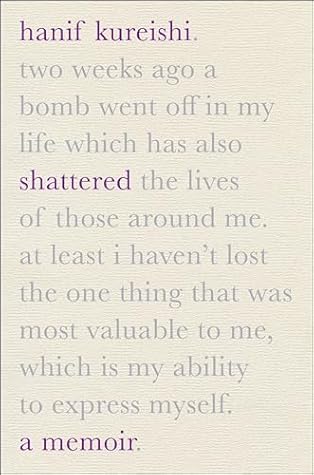
Shattered, by Hanif Kureishi***

A while back, I read a novel by Hanif Kureishi titled The Last Word.  It was not his most successful book in terms of sales, but I was gob-smacked by his cleverness, and so when I saw that he had a memoir coming out, I felt compelled to read it, even though it was likely going to be sad, since it is, at least in part, a memoir of what it’s like to be almost completely paralyzed.

My thanks go to Harper Collins and NetGalley for the review copy. This book is for sale now.

Kureishi is a seasoned writer and journalist, and as he writes about this horrifying event alternately with the earlier parts of his life, we see happier times as well. I thought it would be a narrative that I would need to take in small bursts because of its tragic nature, but that I would nevertheless appreciate it for its brilliance. What a surprise; I can read about his accident, hospitalization, and the experiences he has as a disabled person without a lot of difficulty, but I am drawn up short by the numerous passages about his sexuality.

You see, I am of the old school that believes that just because a thing is true, that doesn’t necessarily mean that its many details belong in a memoir. For example, sometime during nearly everyone’s life, we have digestive difficulties brought on by a case of the flu or some other thing. Has it happened? Yes. Do we need a detailed description of the writer’s vomit and bowel movements? Perhaps not. And this is the way I feel about his fondness for porn, for explorations of his own sexuality with various partners and all by himself (ew!) and even his fondness for street drugs and booze. Why would I want to read about any of this?

Sadly, Kureishi says that he no longer enjoys reading or writing fiction, and since that is the part of his work that I admire, I think we’re done here.

To be clear, he is a capable wordsmith, and those that are curious about what a disability might be like can get a taste of that here, which is why there are three stars and not fewer. I cringe when I read about his plane flight, with people shoving past him, even as they glance pityingly down at him. But like many Boomers, I have tasted a less extreme aspect of this myself, and so Kureishi’s version of it feels to this reviewer like a busman’s holiday.

This book is recommended to those of his readers that have appreciated his earlier nonfiction work, and to those with an interest in the lives of paraplegics and quadriplegics. For others, there are numerous online reviews that include large excerpts, and I recommend reading those before you invest in this book.

Carl Perkins, the King of Rockabilly, by Jeff Apter*****

“’I had only three childhood idols,’ John [Lennon] would tell a friend. ‘Elvis, Carl Perkins, and Jerry Lee Lewis.’ Paul McCartney would go one step further: ‘If there were no Carl Perkins,’ he’d state, ‘there would be no Beatles.’”

When I saw this book, I felt a slight buzzing at the back of my mind. Huh. Carl Perkins. Have I heard of him? Sounds familiar, but…? And then I read the synopsis, which said that he wrote Blue Suede Shoes, and was the first one to perform it. I went to my streaming service and typed it in; since he wasn’t the one to have made the song iconic, I figured his rendition of it would sound lame. But no! No, it didn’t. So now I knew that I had to read this biography.

My thanks go to NetGalley and Kensington Books for the review copy. This book will be available tomorrow, November 26, 2024.

Perkins was born in 1932,  grew up the son of a Tennessee sharecropper, and starting at age 6, he worked in the cotton fields with his family all day, “from can to can’t.” Had he not, he and his family might have starved. This was a time when no governmental safety net existed, nor did child labor laws. The man who would become his closest friend, John Cash—who would perform and record as Johnny—lived in nearly identical circumstances across the Mississippi River in Arkansas. The only good aspect of this grueling life was the singing. His family sang with the other field laborers, who were mostly African American, and while still a child talked his father into purchasing a guitar.

Perkins was 21 years old when he went to Memphis, where Sam Phillips, founder of Sun Records, had advertised that he would record anyone, anywhere, any time. He had some original music that Phillips liked; not long afterward, he and his wife, Valda, heard his record on the radio. Perkins said, “Valda, she dropped the baby, and I like to fainted.”

Phillips had three other promising musicians signed, and they got to know one another well, sometimes performing together. The other men were Johnny Cash, Elvis Presley, and Jerry Lee Lewis. The first two became Carl’s lifelong friends; Lewis was unpredictable, sometimes violent, and Perkins avoided him when he could. But on one occasion, when the four were together, Lewis complained that the three men with guitars could move around, whereas he was stuck at his piano. Perkins asked him whether he could play standing up, and suggested he “make a fuss” while he did it, advice which altered and improved Lewis’s career.

Perkins’s hit original song, “Blue Suede Shoes,” sold millions, and Perkins was on his way; but just as his momentum was growing, he and his brothers were in a serious car wreck and hospitalized. Once Perkins was able to play again, he felt that loyalty demanded he wait for his brothers—his bandmates—to heal. By the time they could play again, Elvis had also recorded the song, and his career was catapulted into the stratosphere. For a while it appeared that Perkins’s career was finished, but soon help came from an unlikely source: The Beatles wanted to meet him. They wanted to record his songs. They looked up to him as a mentor, and became his lifelong friends.

Reading about Perkins, I am amazed at his capacity to remain grounded and retain the values with which he was raised. Some men would have resented Elvis, but Perkins was delighted for him—and enjoyed the royalties when Presley recorded and performed Perkins’s music. How many men, raised in such horrifying poverty, would place family loyalty over fame and fortune? How many could be so reasonable? Perkins later said that when he saw Elvis perform, he could see why the man was rising so quickly. Elvis was immaculately turned out, and the girls went crazy for him. Perkins wasn’t much to look at, and he knew it, and he would never flirt with his audience, because “I was a married man.” And indeed, he remained faithful to Valda for all the decades of their lives together, and he counted himself lucky to have her. Meanwhile, the royalties from the Beatles, Elvis, and others enabled him to buy a modest but much loved house for himself, Valda, and their growing family, and later he would be able to do the same for his parents. And as it happened, his career as a performer was not dead, only sleeping.

I have read many musicians’ biographies and memoirs, and all of them had greater name recognition than Perkins; but from what I can see, Perkins was the most decent person among them. This is not to detract from others, but seriously…what a nice guy!

Meanwhile, author Jeff Apter writes in an intimate, conversational way that makes this book surprisingly hard to put down, and his research is beyond reproach. Highly recommended.

Emperor of the Seas, by Jack Weatherford*****

How much do you know about the Mongol empires? If you grew up in the U.S., chances are you answered, “Absolutely nothing.” The world is a big place, and world history has never been much of a priority in American schools; we study various phases of U.S. history, state history, and in a wild flurry of internationalism, some districts now teach a semester of Canadian history. The single year of world history in high school is usually devoted to World War II, which is impossible to teach without including information about Europe, and a smidgen about Japan along with, yes, more American history. There you go. Here’s your diploma.

In my retirement years, I have reveled in the freedom to learn about the history that wasn’t on the syllabus for what I studied, and later, what I was hired to teach. Having marched my way through various other times and places, I realized that I knew nothing about the Mongol khans. I read one novel about Genghis, and I was hooked.

My thanks go to NetGalley and Bloomsbury for the review copy. You can buy this book now.

If you’re going to read a single nonfiction book about the Mongols, this would be a fine choice. Jack Weatherford’s research is outstanding, including works in several non-English languages that most of us couldn’t hope to read on our own. His scholarship is so meticulous that he has been awarded both of Mongolia’s top national awards. Not half bad, for a boy from South Carolina. And while this book is not written as narrative nonfiction, the tone is conversational, the language accessible. I read it daily at lunch time, and it wasn’t long before I was shouting out random, amazing facts to family members that dared venture into the kitchen.

It began with Genghis, a young man whose family was left homeless, left to freeze or starve when his father and protector died. With desperation, talent, and ruthlessness that he learned well, he turned it around, and as he grew up he vanquished his enemies, brought the most talented and trustworthy elements to himself, and let the devil take the rest. His instinct for military strategy was a thing of pure genius. But this book is mostly not about him; it’s about his grandson, Kublai Khan, who expanded the empire Genghis began until his domain stretched from Baghdad to the far shores of China.

Until Kublai arrived, Mongols were an inland people, but it was Kublai who realized that in order to expand and become a world power, he had to have ocean-going vessels and people that knew how to use them. The peoples of Southern China were tough to defeat, but once it was done, he was able to use their technologies in ways that were of immeasurable value.

The progression looked like this (in a very simplified version): Genghis conquered, and took no prisoners, with a few rare exceptions. Kublai conquered, but also used diplomacy, highlighting the potential benefits of becoming a Mongol subject; he didn’t routinely kill everyone he defeated. And under Kublai’s son Temur, the Mongols segued from physical battle to economic dominance, making China’s ports the ideal destination of merchants from all over the world.

One of the most interesting things I learned had to do with the authority that was vested in the women of the highest placed families. When the men rode off to conquer, it was women that looked after the business interests and saw to local governance. It worked out nicely; Europeans should have taken note.

I can’t compare this book to others because I haven’t read any others on this topic cover to cover, but I wouldn’t let that stop you. If the Mongols are persuaded that Weatherford has done the work and done it well, who can argue? I learned a great deal and enjoyed it, and so I highly recommend it to you.

The Message, by Ta-Nehisi Coates****

Ta-Nehisi Coates is an eloquent writer, and I look forward to reading whatever he publishes. My thanks go to NetGalley and Random House for the invitation to read and review. This book is for sale now.

This book is brief, and it consists of four essays. The first and briefest is about returning to Howard University to teach writing. The second details his first trip to Africa, specifically Senegal; it’s surprising that it took him this long, he says, what with being raised in an Afrocentric home, the child of a Panther. But it’s expensive, it’s time consuming, and now, he can finally do it. As I read both of these, I admire the way he crafts an essay, but at the same time, I also feel as if I am not his intended audience; at times I feel almost as if I am listening in on someone else’s conversation. But I remind myself that I am reading this thing at the publisher’s invitation, so I push on, and it’s outstanding material.

The third essay is the one I enjoy the most, particularly because I had just finished reading a harrowing memoir about book banning. Coates attends a South Carolina school board meeting in which his own book, Between the World and Me, is being challenged. He’s invited by a teacher there that wants to continue using his book in her classroom, and he’s amazed at the assertions being made by some of the speakers in attendance, right in the shadow of George Floyd’s murder. And speaking of this, he says

“I understand the impulse to dismiss the import of the summer of 2020, to dismiss the ‘national conversations,’ the raft of TV specials and documentaries, even the protests themselves. Some of us see the lack of policy change and wonder if the movement itself was futile. But policy change is an end point, not an origin…and whereas white supremacy, like any other status quo, can default to the cliched claims and excuses for the world as it is—bad cops are rotten apples, American is guardian of the free world—we have the burden of crafting new language and stories that allow people to imagine that new policies are possible. And now, here in Chapin, some people, not most (it is hardly ever most), had, through the work of Black writers, begun that work of imagining.”

The final essay, which is also the lengthiest, is about his trip to the Middle East. At the outset he mentions his trip to the World Holocaust Remembrance Center, and seeing the vast Book of Names, which catalogs all of the nearly 5 million Jews killed in the Holocaust. But a few pages later he gets to the meat of the matter and decries the way that Israel is treating Hamas. No wait, that’s not the way he words it. He dislikes the treatment of the Palestinians that chose to be ruled by Hamas. Whatever. All I know is that when he states flatly that he isn’t interested in hearing the other side of this conflict, completely ignoring the pogrom that set this entire conflict in motion, he loses me. I skim the rest of the essay in case there’s a surprise for me somewhere in there, but of course, there isn’t. Bandwagons are easily joined, but I would have expected a writer of his caliber to think and write more critically.

So, should you read this book? There’s no denying that Coates is a skillful writer, and the essay regarding censorship is worth reading all by itself. And in that spirit, I won’t say that you shouldn’t read this because I happen to disagree with the last nearly fifty percent of the book; but when you do so, keep your brain engaged and don’t take everything he says at face value.

The Chinese Question, by Mae M. Ngai****-*****

Mae Ngai is an award-winning author and a professor at Columbia University. In her third book, The Chinese Question, she examines the race relations and to some degree, the economic underpinnings of the Chinese diaspora.

My thanks go to NetGalley and W.W. Norton and Company for the review copy. I am disgracefully late, but when I began reading this book I realized that if I were to absorb and retain anything here, I would need to take it in small bites. That said, this is an unusually well researched work, and it’s well worth the time and attention of anyone interested in the topic.

Usually when I see research having to do with Chinese immigration, it is within the context of immigration to the United States, or an examination of the push factors of emigration, examining why Chinese chose to leave their native land and embark upon an expensive, dangerous, and uncertain journey to a place they’d never visited—in most cases—and where they usually did not speak the language. Instead, Ngai examines it as a global diaspora that includes English speaking nations, namely South Africa, the United Kingdom, Canada, Australia, and the United States. In doing so she is able to highlight the similarities of treatment, to put it politely, and also to dismantle some of the stereotypes that have rooted themselves in English speakers’ knowledge of history.

For starters, she wants us to know that Chinese immigrants were not necessarily “coolies” or indentured workers, and they didn’t always face conflicts with Caucasian powerbrokers. But there certainly were a great many blood chilling abuses, sometimes brought about by White fear of the “other,” but oftener from greed and the desire to exploit the Chinese working class and eliminate competition from the businesses of better off Chinese.

This study is adjacent to my own graduate study topic of many years ago, when I examined the “Model Minority,” and the attempt to counter the demands of U.S. Civil Rights activists of the 1950s and 1960s with the suggestion that Black people quietly accept abuse and quietly climb the economic ladder, or not, as Asians of Chinese and Japanese descent had supposedly done. Ngai demonstrates that Chinese immigrants weren’t all that quiet, and they weren’t all that accepting of maltreatment at the hands of employers and local officials. This is interesting material indeed, and I wish I had known these things sooner.

As a general read for a wide audience, this may be a four star book because it is dense and has an academic approach that not all pleasure readers will appreciate; however, for those with a strong interest in the topic, whether for academic research or personal knowledge and growth, it is hands down the best work I’ve seen in decades.

Highly recommended to those passionate about the issue.

Guilty Creatures, by Mikita Brottman*****

Tallahassee, Florida is a city with more than its share of horrifying murders, which Brottman tells us has earned it the nickname, “Tallanasty.” Is it something in the water? No, wait. That’s the gators. One thing that we know is true: in the far right, conservative Christian enclave there, two upstanding young people decided to forego the disgrace and humiliation of divorce by committing the perfect murder. One of their spouses would have an accident while out duck hunting, and he would never be heard from again.

My thanks go to NetGalley and Atria Books for the review copy. This book is for sale now.

The four of them met when they were just kids, and while attending a private Christian high school, they developed a tight bond. Mike and Denise, Brian and Kathy were constantly in one another’s company, and they stayed tight after graduation. The two couples married, and then they cut loose, the four of them partying and engaging in edgy sexual practices that could make an old lady school teacher like me blush. Mike, a hardworking young man from the working class, and Kathy, who wanted to start a family, were ready to settle down and behave themselves; Mike’s wife, Denise, and Kathy’s husband, Brian, were not. In a heartbeat they began carrying out an affair, making elaborate arrangements to avoid shame within their families, church, and community. Ultimately, they decided that Mike, who was a stickler for a structured life and extreme attention to even the smallest financial expenditures, simply had to go. They devised a plan to disappear him, and although suspicions were raised, they got away with the crime for nearly twenty years, when they turned on each other and all hell broke loose.

I had never heard of the case before reading this book, though the author tells us that it has received extensive media coverage. Brottman does a fine job of relaying the story, with perfect pacing and just enough attention to detail. There’s extensive documentation in the end notes, and she relies primarily on primary sources. It reads almost like narrative nonfiction, with suspense building to where I couldn’t look away during the last 25% of the story. This is especially impressive given that I can usually walk away from murder mysteries and thrillers at any time.

I seldom read true crime, and when I finished reading this book, I recalled why that’s so. While I was reading it, it was a fine, trashy wallow, steeping myself in the misdeeds of people that live lives very different from my own. It’s riveting stuff. But once I was done, I felt as though I should take a shower and perhaps gargle.

A little of this type of story goes a long way, but for those that love true crime, it’s a hard one to beat. Highly recommended for those that enjoy the genre.

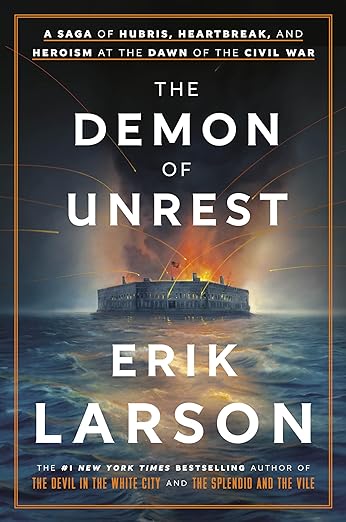
The Demon of Unrest, by Erik Larson*****

When it comes to history, it’s hard to conjure a more capable author than Erik Larson. I’ve thought this for some time, but his Churchill biography, The Splendid and the Vile (2020) cemented this impression.  I am therefore gushingly grateful to NetGalley and Crown Books for the review copy. I would have paid full cover price for this book if that was the only way that I could get it—or the only way that I could get it soon.

This book focuses on Fort Sumter, the Federal fort off the coast of South Carolina that became the catalyst for the opening guns of the American Civil War. The Southern states that seceded from the US, or that attempted to do so, believed themselves entitled to seize the forts, munitions, and indeed, every single ounce of American property located within the borders of their states—and although Fort Sumter and the lesser, partially constructed forts around it were on islands rather than inside the state’s boundaries, they expected to annex those, too.

Meanwhile, as most know, Major Robert Anderson was the fort’s commander, and he desperately wanted orders from Washington. The period following Lincoln’s election, up until he actually took office, was a critical one, but President Buchanan was determined to postpone any official acts until he could hand the responsibility to someone else. He didn’t want his legacy marred by the beginning of a civil war, or indeed, by any sort of noteworthy strife whatsoever, and so he mostly just hid from everyone. Representatives from South Carolina—would-be ambassadors that came to conduct international business—were turned away without official recognition, and that’s about the only worthwhile thing the guy did. And during this fraught period, Anderson and those he commanded waited tensely to learn whether they would be ordered to evacuate, or to defend the fort.

They waited a long damn time; too long.

This is a complex story and an interesting one, and so there are many historical characters discussed, but the primary three that take center stage are Major Anderson; Edmund Ruffin, a South Carolinian firebreather, stoking the fires of secession; and Mary Chesnut, the highly literate wife of a member of the ruling elite. Others of importance are, of course, President Lincoln; Allan Pinkerton, the head of the notorious Pinkerton Agency, which is tasked with keeping Lincoln alive; and a Southern power broker named Hammond, with whom the story begins.

In starting the narrative by discussing Hammond, Ruffin, and Chesnut, Larson gives us a fascinating window into the minds of the South Carolinian ruling elite, known among themselves as “the chivalry.” They style themselves as if they were characters from out of Arthurian legends, placing their own somewhat bizarre code of honor above every other possible principle, and beyond matters of simple practicality. I’ve always been fascinated by the way that leaders of morally bankrupt causes arrange their thoughts and rationales so that they can look at themselves in the mirror every morning and like what they see, and nobody can explain it quite the way Larson can. Everything is crystal clear and meticulously documented. I’m a stickler for documentation, and so although I feel a little silly doing so for someone of his stature, I pull two of his sources, Battle Cry of Freedom, by James McPherson, and Mary Chesnut’s Civil War, which is the diary she wrote leading up to and during the war, from my own shelves, and turn to the pages indicated in a couple of the notes. There they are, just where Larson said they’d be! This may not impress you, but it makes me ridiculously happy.

The story commences with Hammond, a wealthy planter with a highly elastic moral code. There’s a fair amount of trigger worthy material here—though the term had not been coined yet, he was a sexual predator of the highest order, and delighted in writing about the things he did to his nieces. Although this information, drawn from primary sources, does its job by letting us know exactly what kind of person helped shape the rebellion, it’s hard to stomach, and I advise readers that can’t stand it to either skim or skip these passages, because one can easily understand the majority of the text without them.

Once upon a time, this reviewer taught about the American Civil War to teens, and yet I learn a hefty amount of new information. In particular, I find the depiction of Anderson illuminating. I have never seen such a well rendered portrait of him before.

I could discuss this book all day, and very nearly have done so, but the reader will do far better to get the book itself. Highly recommended, this may well be the best nonfiction book of 2024.

Codename Nemo, by Charles Lachman****

3.5 stars, rounded upward.

Code Name Nemo is the true story of how U.S. Naval Commander Dan Gallery and his men captured a German U-boat during World War II. My thanks go to NetGalley, Diversion Books, and Dreamscape Media for the review copies. This book will be available to the public June 4, 2024.

German U-boats were brilliantly engineered submarines that were the terror of the seas for Allied forces in the Atlantic theater during World War II. They were extremely difficult to detect, and were responsible for sending not only Allied ships, but also Merchant Marine vessels and other commercial craft to the bottom of the ocean. Until Gallery took the initiative to capture one, the U.S. Navy had been hard pressed just to sink the treacherous subs rather than be sunk by them. To capture one was an intelligence coup of the highest order, providing the Allies with not only the technical details of the U-boats themselves, but also a host of military secrets kept onboard, including the codes that in turn led to the plans and locations of other German subs.

No Naval officer had even attempted such a thing before. Nazis were expected to destroy their subs rather than allow them to be taken; this, even if it meant all or part of the crews had to drown with the vessels. But lately, it was known that there were sailors that were conscripted and who were not Germans, men from conquered European nations. Gallery believed that some of these men would now choose to surrender and live, rather than drown themselves for the Fuhrer. Gallery was right.

Lachman does a presentable job of describing the events leading up to the sub’s capture, and he chooses to tell it from dual perspectives, and so we see it through both American eyes and those of the Germans. I am not a fan of this trend. For starters, I don’t see this as a good time, if such exists, to depict Nazis as warm and fuzzy fellows that just happened to be on the losing side of history. Furthermore—and I’ve said it before, so forgive me if you are my longtime reader and growing sick of my saying this—you never see historical writers take this tack when detailing the events of the Pacific theater. It’s as if there’s an implied requirement, saying, Look here. We are all (Caucasian) human beings, after all.

That aside, I enjoyed this book, particularly the most exciting part when they board the sub and have to prevent its exploding, or sinking fast along with the U.S. sailors that have come on deck. There is a certain amount of information dumping up front that slows things down a bit up front, and that might also confuse a reader or listener trying to remember the many names and personal histories of those involved. I can see the reasoning behind all of it; some of those mentioned in this book will have descendants that swell with pride as they hear of the courage and cleverness of their great-great whatevers, and who may be devastated to see their late relative omitted. However, the narrative would flow better if the details were streamlined.

I primarily use the audio version, with the Kindle version as backup for rechecking facts. Some of the time I used both at once. Qarie Marshall is the reader for the audio, and does an outstanding job of taking me back in time, once the story gets moving.

The research is adequate, but not stellar. Certain sources get the lion’s share of use, primarily Dan Gallery himself, who has written at length about his experience. I found myself wondering, from time to time, if I would have been better served to read his own account rather than this one. But by then I had this one well underway, so I went with it.

Those that enjoy military history might enjoy this story, and for them, I rate this book four stars. As a general read for history buffs, it may be more of a three star read. If you are the latter and considering reading it, you may want to get it free or cheap, rather than investing full cover price.

The Backyard Bird Chronicles, by Amy Tan****

My thanks go to Net Galley and Alfred A. Knopf for the review copy. This book will be available to the public April 23, 2024.

I probably should have read the promotional blurb more carefully, because here’s a fact: I have very little interest in birds. But I saw the name Amy Tan, and her work is always wonderful; I figured that the birds would sometimes be metaphors for other things, and that there would be a significant nonbird component to her essays. However, this little book is exactly what the description indicates: a book about the birds she’s seen in her backyard, along with her very own illustrations. And so, even though the book is by an iconic author, I soon found my eyes glazing over. I tried changing sections, since sequential reading isn’t important here; no joy.

It’s really just birds.

So, as a general read for fans of Tan’s writing, I have to call this a three star read. However, as a niche read for birding aficionados, particularly in California, this might well be a five star read. I’ll split the difference and call if four stars.

Recommended to those that love birds and bird art.