The Chinese Question, by Mae M. Ngai****-*****

Mae Ngai is an award-winning author and a professor at Columbia University. In her third book, The Chinese Question, she examines the race relations and to some degree, the economic underpinnings of the Chinese diaspora.

My thanks go to NetGalley and W.W. Norton and Company for the review copy. I am disgracefully late, but when I began reading this book I realized that if I were to absorb and retain anything here, I would need to take it in small bites. That said, this is an unusually well researched work, and it’s well worth the time and attention of anyone interested in the topic.

Usually when I see research having to do with Chinese immigration, it is within the context of immigration to the United States, or an examination of the push factors of emigration, examining why Chinese chose to leave their native land and embark upon an expensive, dangerous, and uncertain journey to a place they’d never visited—in most cases—and where they usually did not speak the language. Instead, Ngai examines it as a global diaspora that includes English speaking nations, namely South Africa, the United Kingdom, Canada, Australia, and the United States. In doing so she is able to highlight the similarities of treatment, to put it politely, and also to dismantle some of the stereotypes that have rooted themselves in English speakers’ knowledge of history.

For starters, she wants us to know that Chinese immigrants were not necessarily “coolies” or indentured workers, and they didn’t always face conflicts with Caucasian powerbrokers. But there certainly were a great many blood chilling abuses, sometimes brought about by White fear of the “other,” but oftener from greed and the desire to exploit the Chinese working class and eliminate competition from the businesses of better off Chinese.

This study is adjacent to my own graduate study topic of many years ago, when I examined the “Model Minority,” and the attempt to counter the demands of U.S. Civil Rights activists of the 1950s and 1960s with the suggestion that Black people quietly accept abuse and quietly climb the economic ladder, or not, as Asians of Chinese and Japanese descent had supposedly done. Ngai demonstrates that Chinese immigrants weren’t all that quiet, and they weren’t all that accepting of maltreatment at the hands of employers and local officials. This is interesting material indeed, and I wish I had known these things sooner.

As a general read for a wide audience, this may be a four star book because it is dense and has an academic approach that not all pleasure readers will appreciate; however, for those with a strong interest in the topic, whether for academic research or personal knowledge and growth, it is hands down the best work I’ve seen in decades.

Highly recommended to those passionate about the issue.

Guilty Creatures, by Mikita Brottman*****

Tallahassee, Florida is a city with more than its share of horrifying murders, which Brottman tells us has earned it the nickname, “Tallanasty.” Is it something in the water? No, wait. That’s the gators. One thing that we know is true: in the far right, conservative Christian enclave there, two upstanding young people decided to forego the disgrace and humiliation of divorce by committing the perfect murder. One of their spouses would have an accident while out duck hunting, and he would never be heard from again.

My thanks go to NetGalley and Atria Books for the review copy. This book is for sale now.

The four of them met when they were just kids, and while attending a private Christian high school, they developed a tight bond. Mike and Denise, Brian and Kathy were constantly in one another’s company, and they stayed tight after graduation. The two couples married, and then they cut loose, the four of them partying and engaging in edgy sexual practices that could make an old lady school teacher like me blush. Mike, a hardworking young man from the working class, and Kathy, who wanted to start a family, were ready to settle down and behave themselves; Mike’s wife, Denise, and Kathy’s husband, Brian, were not. In a heartbeat they began carrying out an affair, making elaborate arrangements to avoid shame within their families, church, and community. Ultimately, they decided that Mike, who was a stickler for a structured life and extreme attention to even the smallest financial expenditures, simply had to go. They devised a plan to disappear him, and although suspicions were raised, they got away with the crime for nearly twenty years, when they turned on each other and all hell broke loose.

I had never heard of the case before reading this book, though the author tells us that it has received extensive media coverage. Brottman does a fine job of relaying the story, with perfect pacing and just enough attention to detail. There’s extensive documentation in the end notes, and she relies primarily on primary sources. It reads almost like narrative nonfiction, with suspense building to where I couldn’t look away during the last 25% of the story. This is especially impressive given that I can usually walk away from murder mysteries and thrillers at any time.

I seldom read true crime, and when I finished reading this book, I recalled why that’s so. While I was reading it, it was a fine, trashy wallow, steeping myself in the misdeeds of people that live lives very different from my own. It’s riveting stuff. But once I was done, I felt as though I should take a shower and perhaps gargle.

A little of this type of story goes a long way, but for those that love true crime, it’s a hard one to beat. Highly recommended for those that enjoy the genre.

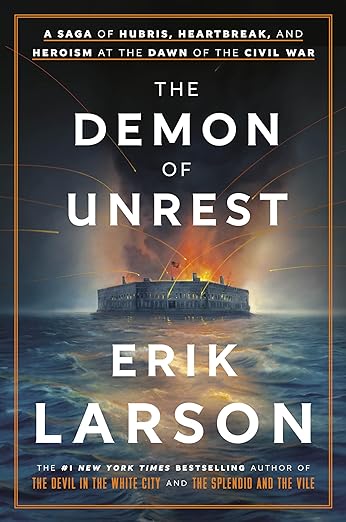
The Demon of Unrest, by Erik Larson*****

When it comes to history, it’s hard to conjure a more capable author than Erik Larson. I’ve thought this for some time, but his Churchill biography, The Splendid and the Vile (2020) cemented this impression.  I am therefore gushingly grateful to NetGalley and Crown Books for the review copy. I would have paid full cover price for this book if that was the only way that I could get it—or the only way that I could get it soon.

This book focuses on Fort Sumter, the Federal fort off the coast of South Carolina that became the catalyst for the opening guns of the American Civil War. The Southern states that seceded from the US, or that attempted to do so, believed themselves entitled to seize the forts, munitions, and indeed, every single ounce of American property located within the borders of their states—and although Fort Sumter and the lesser, partially constructed forts around it were on islands rather than inside the state’s boundaries, they expected to annex those, too.

Meanwhile, as most know, Major Robert Anderson was the fort’s commander, and he desperately wanted orders from Washington. The period following Lincoln’s election, up until he actually took office, was a critical one, but President Buchanan was determined to postpone any official acts until he could hand the responsibility to someone else. He didn’t want his legacy marred by the beginning of a civil war, or indeed, by any sort of noteworthy strife whatsoever, and so he mostly just hid from everyone. Representatives from South Carolina—would-be ambassadors that came to conduct international business—were turned away without official recognition, and that’s about the only worthwhile thing the guy did. And during this fraught period, Anderson and those he commanded waited tensely to learn whether they would be ordered to evacuate, or to defend the fort.

They waited a long damn time; too long.

This is a complex story and an interesting one, and so there are many historical characters discussed, but the primary three that take center stage are Major Anderson; Edmund Ruffin, a South Carolinian firebreather, stoking the fires of secession; and Mary Chesnut, the highly literate wife of a member of the ruling elite. Others of importance are, of course, President Lincoln; Allan Pinkerton, the head of the notorious Pinkerton Agency, which is tasked with keeping Lincoln alive; and a Southern power broker named Hammond, with whom the story begins.

In starting the narrative by discussing Hammond, Ruffin, and Chesnut, Larson gives us a fascinating window into the minds of the South Carolinian ruling elite, known among themselves as “the chivalry.” They style themselves as if they were characters from out of Arthurian legends, placing their own somewhat bizarre code of honor above every other possible principle, and beyond matters of simple practicality. I’ve always been fascinated by the way that leaders of morally bankrupt causes arrange their thoughts and rationales so that they can look at themselves in the mirror every morning and like what they see, and nobody can explain it quite the way Larson can. Everything is crystal clear and meticulously documented. I’m a stickler for documentation, and so although I feel a little silly doing so for someone of his stature, I pull two of his sources, Battle Cry of Freedom, by James McPherson, and Mary Chesnut’s Civil War, which is the diary she wrote leading up to and during the war, from my own shelves, and turn to the pages indicated in a couple of the notes. There they are, just where Larson said they’d be! This may not impress you, but it makes me ridiculously happy.

The story commences with Hammond, a wealthy planter with a highly elastic moral code. There’s a fair amount of trigger worthy material here—though the term had not been coined yet, he was a sexual predator of the highest order, and delighted in writing about the things he did to his nieces. Although this information, drawn from primary sources, does its job by letting us know exactly what kind of person helped shape the rebellion, it’s hard to stomach, and I advise readers that can’t stand it to either skim or skip these passages, because one can easily understand the majority of the text without them.

Once upon a time, this reviewer taught about the American Civil War to teens, and yet I learn a hefty amount of new information. In particular, I find the depiction of Anderson illuminating. I have never seen such a well rendered portrait of him before.

I could discuss this book all day, and very nearly have done so, but the reader will do far better to get the book itself. Highly recommended, this may well be the best nonfiction book of 2024.

Codename Nemo, by Charles Lachman****

3.5 stars, rounded upward.

Code Name Nemo is the true story of how U.S. Naval Commander Dan Gallery and his men captured a German U-boat during World War II. My thanks go to NetGalley, Diversion Books, and Dreamscape Media for the review copies. This book will be available to the public June 4, 2024.

German U-boats were brilliantly engineered submarines that were the terror of the seas for Allied forces in the Atlantic theater during World War II. They were extremely difficult to detect, and were responsible for sending not only Allied ships, but also Merchant Marine vessels and other commercial craft to the bottom of the ocean. Until Gallery took the initiative to capture one, the U.S. Navy had been hard pressed just to sink the treacherous subs rather than be sunk by them. To capture one was an intelligence coup of the highest order, providing the Allies with not only the technical details of the U-boats themselves, but also a host of military secrets kept onboard, including the codes that in turn led to the plans and locations of other German subs.

No Naval officer had even attempted such a thing before. Nazis were expected to destroy their subs rather than allow them to be taken; this, even if it meant all or part of the crews had to drown with the vessels. But lately, it was known that there were sailors that were conscripted and who were not Germans, men from conquered European nations. Gallery believed that some of these men would now choose to surrender and live, rather than drown themselves for the Fuhrer. Gallery was right.

Lachman does a presentable job of describing the events leading up to the sub’s capture, and he chooses to tell it from dual perspectives, and so we see it through both American eyes and those of the Germans. I am not a fan of this trend. For starters, I don’t see this as a good time, if such exists, to depict Nazis as warm and fuzzy fellows that just happened to be on the losing side of history. Furthermore—and I’ve said it before, so forgive me if you are my longtime reader and growing sick of my saying this—you never see historical writers take this tack when detailing the events of the Pacific theater. It’s as if there’s an implied requirement, saying, Look here. We are all (Caucasian) human beings, after all.

That aside, I enjoyed this book, particularly the most exciting part when they board the sub and have to prevent its exploding, or sinking fast along with the U.S. sailors that have come on deck. There is a certain amount of information dumping up front that slows things down a bit up front, and that might also confuse a reader or listener trying to remember the many names and personal histories of those involved. I can see the reasoning behind all of it; some of those mentioned in this book will have descendants that swell with pride as they hear of the courage and cleverness of their great-great whatevers, and who may be devastated to see their late relative omitted. However, the narrative would flow better if the details were streamlined.

I primarily use the audio version, with the Kindle version as backup for rechecking facts. Some of the time I used both at once. Qarie Marshall is the reader for the audio, and does an outstanding job of taking me back in time, once the story gets moving.

The research is adequate, but not stellar. Certain sources get the lion’s share of use, primarily Dan Gallery himself, who has written at length about his experience. I found myself wondering, from time to time, if I would have been better served to read his own account rather than this one. But by then I had this one well underway, so I went with it.

Those that enjoy military history might enjoy this story, and for them, I rate this book four stars. As a general read for history buffs, it may be more of a three star read. If you are the latter and considering reading it, you may want to get it free or cheap, rather than investing full cover price.

The Backyard Bird Chronicles, by Amy Tan****

My thanks go to Net Galley and Alfred A. Knopf for the review copy. This book will be available to the public April 23, 2024.

I probably should have read the promotional blurb more carefully, because here’s a fact: I have very little interest in birds. But I saw the name Amy Tan, and her work is always wonderful; I figured that the birds would sometimes be metaphors for other things, and that there would be a significant nonbird component to her essays. However, this little book is exactly what the description indicates: a book about the birds she’s seen in her backyard, along with her very own illustrations. And so, even though the book is by an iconic author, I soon found my eyes glazing over. I tried changing sections, since sequential reading isn’t important here; no joy.

It’s really just birds.

So, as a general read for fans of Tan’s writing, I have to call this a three star read. However, as a niche read for birding aficionados, particularly in California, this might well be a five star read. I’ll split the difference and call if four stars.

Recommended to those that love birds and bird art.

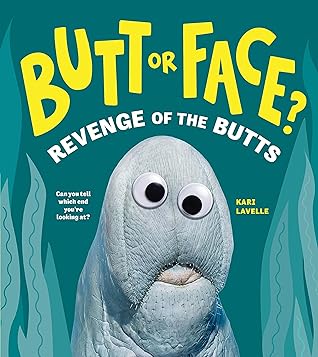
Butt or Face? Volume 2, by Kari Lavelle****

This engaging little science book for early readers is a gem. My thanks go to Net Galley and Sourcebooks Landmark for the review copy. This book will be available to the public April 2, 2024.

The title is the content in a nutshell. One page has a large, sometimes whole page photograph, but we don’t know what animal it belongs to, or what end we’re looking at. These are cleverly chosen and stumped me about half the time. When I set it down, my spouse picked it up, began leafing through it, and I heard him say, “What? You’re kidding!”

There is no real story here. You open the book, and you leap right in. Picture, then the solution, right down the line. Whereas I like a bit of scaffolding and accompanying narrative myself, I also know that there are children that will prefer this book exactly the way that it’s written. Children in early elementary school that are in the stage of development in which they find potty jokes gut-bustingly funny will absolutely adore it.

I was previously unfamiliar with Lavelle’s work, and hadn’t seen the first in the series, but after perusing this one, I knew my grandsons had to have it, and since this one won’t be out till spring, I bought the first volume of Butt or Face for the second grader’s Christmas gift. That’s a strong endorsement.

What the Taliban Told Me, by Ian Fritz****

Ian Fritz was an Airborne Cryptologic Linguist who served with the U.S. Air Force in Afghanistan for five years. Trained in both Dari and Pashto, he became one of only two people that could understand what was being said by all of the people on the ground before and during battle. Following his service, he became a physician and writer. This is his memoir.

My thanks go to Simon and Schuster Publishing and NetGalley for the invitation to read and review. This book is for sale now.

Fritz was in many ways the perfect recruit; his family didn’t have any money, and he was brilliant, which meant that if he was going to have any opportunities, they would most likely come from the U.S. armed forces. He blew through his public school years, as gifted students that aren’t challenged often do.

This is where I long to stand on a big box and yell through a bullhorn: gifted students are at risk children! We must provide them with challenging, interesting curriculum, or they will stop bothering with school. I’ve been saying so for decades, and I’m saying it again right now. So many times educators and school districts assume these kids will automatically be fine. If the student is bored, they use them as unpaid tutors for their peers, which distorts relationships among the students and does nothing to provide the highly capable student with new, interesting material. These kids need different educations from those in the mainstream. Ian’s story is a powerful example of why this is so.

Ian was sent to an elite language training program, and then he was deployed. Initially, the successful flights in which targets were found, identified, and killed—often partly or solely because of his contribution—were exhilarating, but as time went on, he began to feel conflicted. On the one hand, the Taliban were responsible for the horrific, cowardly attacks on American civilians on 9/11, and were therefore a legitimate target. On the other hand, being able to understand what enemy soldiers were saying to one another made him aware that these were normal people, attempting to live their lives and repel the U.S. invaders. It’s hard to hate someone, or to be indifferent to them, when you overhear them discussing their plans for after the day’s fighting is done, or declaring that it’s just plain “too hot for Jihad today.” Sometimes a threat on the ground would be identified, and the Americans wouldn’t realize that this was an error until after the person they’d targeted was dead. And he knew the names of the dead, sometimes hear the survivors below desperately trying to get their comrade to a medic, but then…oh. Too late.

Then there was this culture among others he served with, those not trained in the language and who were therefore able to demonize the targets, howling with laughter at the way a body on the ground could be made to bounce if you shot it at just the right angle. He realized that “no one else had heard, and no one else ever would hear, the simultaneous screams of the JTAC [U.S. officer on the ground] and the Talibs. Or the sudden quiet when the Talibs died.”

Ultimately, he learned that Afghanistan was actually a lot safer without U.S. forces than with them.

As Fritz began to internalize his despair, he grew suicidal, and he knew he had to get out. It’s at this point that he was charged with malingering and cowardice; he would later learn that it was a trend among the linguists serving in this theater.

Fritz is one hell of a fine writer, and the narrative flows smoothly. I was surprised to find that this was a quick read, despite the intensity of the material. Surely there must be other military memoirs relating to Afghanistan, but as he points out, nobody else is writing about this experience, because almost nobody else has done what he has.

For those with the interest and the courage, this memoir is recommended.

Charlie Chaplin vs. America, by Scott Eyman*****

Charlie Chaplin rose to fame over 100 years ago, but his fame hasn’t faded over the years. One of the most visionary movie makers in modern history, he rose from desperate poverty and homelessness during his childhood to become one of the wealthiest and most respected men in his chosen profession. And yet, for some odd reason, the U.S. government relentlessly pursued him as if he were an enemy agent, eventually forcing him to retire abroad. It’s a bizarre episode in U.S. history, and a fascinating one.

When I saw that Scott Eyman, an author whose biographies of actors I have previously enjoyed—John Wayne, Jimmy Stewart, Henry Fonda—had written about this case, I had to read it. My thanks go to NetGalley and Simon and Schuster for the invitation to read and review. This book is for sale now.

Charlie was born in 1889 in London. His mother Hannah was an actress, a loving mother whose health was dreadful. In addition to more conventional illnesses, she was sent repeatedly, and for longer stretches each time, to mental hospitals; it has been speculated that she suffered from syphilis, which eventually had devastating effects on her brain. Charlie’s father was a businessman who left the family and refused to pay a single shilling of child support because one of Charlie’s brothers was conceived with another man. And as an aside, if there is an afterlife, I sincerely hope that Charles Chaplin, Senior is roasting eternally in the flames of hell.

For a while, Hannah’s relatives cared for Charlie and his older brother, Syd, but eventually the boys found themselves in a workhouse, beaten, abused, sickened, and barely fed. It was his brother Syd who first discovered that acting could keep him out of the workhouse and put food on the table, and once he was so employed, Syd took his pale, sickly little brother to the theater and persuaded his boss to use Charlie, too. Thus was a star born.

His tremendous suffering during his childhood gave Charlie a lifelong sympathy with the working class, the impoverished, and the down and out. Early in his career, a director gave Charlie a costume and told him to come up with a character, and this was when he invented The Little Tramp.

I’ve known for most of my life about Charlie’s expulsion from the U.S., but I’ve never been sure whether he was a Communist. I’ve known people brought up in Communist households in America, and for many years, they existed strictly underground, so I wondered, did Chaplin deny his affiliation because he wasn’t a Communist, or because he was? Eyman’s meticulous research demonstrates once and for all that Charlie was not political. He told the truth about himself: “I am not a Communist. I am a peace monger.”

Nevertheless, once he gained prominence in the American movie industry, he had a target on his back. It’s difficult to understand why politicians and bureaucrats in California and in Washington, D.C. hated him so fiercely.

“A month after the revocation of [Chaplin’s] reentry permit, the FBI issued a massive internal report documenting more than thirty years of investigations focused on Chaplin, a copy of which was dispatched to the attorney general. The report revealed that, besides the FBI, Army and Navy Intelligence, the Internal Revenue Service, the Central Intelligence Agency, the Department of State, and the U.S. Postal Service had all been surveilling Chaplin at one time or another. In short, the entire security apparatus of the United States had descended upon a motion picture comedian.”

Eyman has done a wonderful job here. Because I had fallen behind, I checked out the audio version of this book from Seattle Bibliocommons, and I alternately listened to it and read the digital review copy. Of course, anyone reading this book for the purpose of academic research should get a physical copy, but those reading for pleasure may enjoy the audio, which is well done; this is a through, and a lengthy biography, and the audio makes it go by more quickly.

I confess I haven’t read any other Chaplin biographies, so I cannot say for certain whether this one is the best, but it’s hard to imagine a better one. For those sufficiently interested to take on a full length biography, this book is highly recommended.

A Fever in the Heartland, by Timothy Egan*****

Timothy Egan, winner of the Pulitzer Prize, is one of my favorite historians to read. His most recent book, A Fever in the Heartland occupied the bestseller lists for months, and rightly so. I took my time with it because it is a very uncomfortable read most of the way through, with the first half being much rougher than the last. I learned a lot from it, and this is clearly a case of truth being stranger than fiction.

The Klan was originally formed by former Confederate officers after the Union’s victory in the American Civil War. However, it was stamped out during Reconstruction, and was gone for fifty years. It was revived on Stone Mountain, Georgia, and the horrifically racist film by D.W. Griffin, The Birth of a Nation, which depicts African-American men as crazed rapists that drink to excess and lose their minds when a Caucasian woman is anywhere nearby, not only aided its reincarnation, but contributed one of its most feared symbols. No crosses were burned until it showed up on movie screens around the United States; the pointy hoods were shaped that way to make the men underneath them appear taller. Later, the women’s organization had robes with cardboard forms in their own pointy hats, because a night of terrorism is no excuse for a woman to let her hair get out of control.

At one point, one Caucasian man in three belonged to the Klan. There was even a children’s organization, with activities similar to boy and girl scouts.

The woman that is at the center of this story, Madge Oberholzer, was the secretary in the office of D.C. Stephenson, the Grand Dragon of the newly revived Klan. Despite the hugely moral speeches he gave around the country extolling traditional values (for the time) including the avoidance of alcohol; women that remain virgins until marriage and then live their lives in service to their husbands and young children; Protestantism, with regular church attendance; Caucasian separation from other races and ethnicities; and unquestioning patriotism, Stephenson himself was a drunk, as well as a serial rapist and sexual sadist, fond of using his teeth to mutilate the women that he savaged. Madge was the one victim that would not crawl into the shadows, and she literally used her last dying breaths to expose him.

I was given a hardcover copy of this book when it was at its height of popularity, but it took me a long time to get through it, because I could only stand to read a few pages at a time. The end was enormously satisfying, however, and even in the worst parts, there are occasional moments that made me want to stand up and cheer. For example: the Klan plot to go the University of Notre Dame—a Catholic university– and burn the golden dome there was foiled by its football team, and the melee that ensued when they physically attacked the Klan is the origin of their nickname, The Fighting Irish. (The dome survived.)

Often when I read nonfiction history, I can’t help imagining how much more interesting it would be if it were written as historical fiction. That was never the case here. Firstly, if this were a fictional account, reviewers everywhere would have been brutal, because nobody would ever believe a story like this one. But the fact is, it’s entirely true, and Egan is second to none when it comes to research. Also, his conversational narrative style is as interesting as the best historical fiction; the pace here is slowed in places, not by any lack of authorial fluency, but by the horrifying nature of this true story.

For those that have the capacity to read something like this without becoming morbidly depressed or coming unstuck, this book is highly recommended. For everyone else, I recommend finding something lighter and more uplifting to alternate with it, and to never read this at bedtime. You won’t want it in your dreams.

The Last Outlaws, by Tom Clavin***

Tom Clavin is the author of Blood and Treasure: Daniel Boone and the Fight for America’s First Frontier, which is one of the best nonfiction galleys I’ve ever had the pleasure of reading, and so when I saw his new book, The Last Outlaws: The Desperate Final Days of the Dalton Gang, I jumped at the chance. My thanks go to NetGalley and Macmillan Audio for the review copy. This book is for sale now.

Sadly, I didn’t find the same level of fascination this time around. Outlaws! The Dalton Gang! How could this not be absorbing? And yet.

It is possible that had I read it rather than listened to it, I might have thought better of it. The narrator speaks in a clipped voice that at times approaches a monotone. I recall having an older male relative fast-reading some sort of legal agreement out loud. He obviously didn’t want to read it but had been told he must read every word before signing, and so he rushed through it, out loud, without pausing between the sentences, just to get through it. This seemed a little like that, as if the voice actor was bored to tears and wanted to be done. There is a place about a quarter of the way in where both he and the narrative perked up some, and I thought, Ah, here we go.

But we didn’t.

On the plus side, Tom Clavin gets his information straight before he writes anything, ever, so whereas those looking for entertainment should look elsewhere, those that genuinely want the information should get this book, either digitally or as a bound copy, and read it. Those doing research for a history essay or the like could do a lot worse than this.

So there you have it. Clavin is a capable author, and I am not done with him, but this narrator and I are finished.