Charlie and Me, by Mary Neiswender, Kate Neiswender

Mary Neiswender was the first and primary journalist that the notorious serial killer Charles Manson was willing to talk to. She did so at a time in history in which women in journalism were exceedingly rare, and she put up with a whole lot of crap, first in order to remain in her field, and then later to rise to its pinnacle, receiving a Pulitzer nomination.

My thanks go to the University of Nebraska press and NetGalley. This book is for sale now.

Charles Manson was the leader of a group that called itself “The Family,” almost entirely made up of girls and young women that had nowhere else to go. However, people came and went within it, and so those that spoke of it as a cohesive entity were mistaken. Manson was handsome and charismatic despite his small physical form, and he was convicted of the 1969 Tate-LaBianca murders even though he was almost certainly not present at the time.

Neiswender regarded him as a killer, but also was convinced that he hadn’t had a fair trial. She makes a good case. She delayed writing this book until Manson’s death in prison in 2017, as she had promised to keep much of what he said off the record. Once he died, she considered herself to be freed from that agreement. Neiswender died in March of this year, and her daughter has assisted her in seeing that the book was completed and published.

I don’t read a lot of true crime, but I couldn’t put this book down. Neiswender’s observations and insights are fascinating, and she does a fine job of bringing Manson to life—in a way that the public can appreciate without the physical threat the man represented in person.

Highly recommended.

Tonight in Jungleland, by Peter Ames Carlin*****

“And then the door flew open, and the wolf of doubt came slinking in.”

Springsteen fans, get your plastic out. Peter Ames Carlin has crafted a riveting Springsteen biography about the making of the iconic album, “Born to Run.” Having read it, I have gained even greater appreciation for the Boss’s rock and roll genius. My thanks go to NetGalley and Doubleday for the review copy. This book is for sale now.

“Born to Run” is Springsteen’s third album; the first and second albums received rave reviews from industry publications, but they sold poorly, and Columbia Records had Bruce on their kill list. He was contracted for three albums, but since they had already decided he wasn’t going anywhere, it was difficult to get them to finance the third album’s production or even listen to it once it was done. Take a brilliant, charismatic singer/songwriter, a talented, loyal band, and a couple of industry influencers that would all but starve themselves in order to see this album succeed, and it was nevertheless a nail-biter.

Mike Appel was Bruce’s manager, and he believed in his client so passionately that he was ready to bend a few rules and take a blow torch to a few others. When expenses exceeded the support from Columbia, when everyone’s charge cards were maxed and there was still a record to finish, he dumped his children’s college funds into the general kitty so that the album could see daylight. Columbia Records had told him they’d review his client’s work if he could make a hit single, so “Born to Run” became the song on which the album’s success was hinged. Then Jon Landau, a much-revered industry journalist, heard Bruce’s music and wrote, “I saw rock and roll future and its name is Bruce Springsteen.” Landau became his producer, and it is due to this holy musical trinity that Springsteen and the E Street Band became world renowned. In fact, they went so far as to send bootleg copies to friendly deejays, since the record company was doing absolutely no promotion, and it worked!

I have never been a sufficiently rabid fan to go into the weeds on this band or any other. I didn’t know who else was in his band, apart from his wife. I also had no idea what was required of anyone attempting to get an album financed and promoted by a major house—particularly during the pre-digital days of the late 1900s. Two things have always drawn me to Springsteen’s music: tunes so impossibly resonant that I am unable to sit still when I listen to them, and the lyrics that speak to the industrial working class. These are not the songs of a pretender. Bruce grew up lean and hungry, and because of that, and his rare talent for communication, the songs ring true.

Springsteen was, and I suspect still is, a perfectionist. The following quote is lengthy, but that seems appropriate, given the amount of time, toil and sweat they put into this album:

Ensconced in 914 in the wee hours, Appel and Bruce seemed to try every idea that occurred to them. A string section. An ascending guitar riff repeating through the verse. A chorus of women chiming in on the chorus. An even bigger chorus of women oooh-ing behind the third verse. Still more strings on the bridge and on the last verse, doing those disco-style swoops, like sciroccos whipping up from the dance floor. They’d work out a part, hire whatever musicians or singers were needed to get it on tape, then mix it all together to see what they had. Sometimes it would stick, sometimes they’d just laugh, shake their heads, and slice it out… Work on the instrumental track went on and on, but it still didn’t rival Bruce’s laboring over the lyrics. He had always put energy into his narratives but the pressure he felt to get “Born to Run” just exactly right pushed him to a whole other level of perfectionism, determined to get every word, every nuance, every syllable, something like flawless. No, exactly flawless. Sometimes he’d be in the midst of a take, sing a few lines of a verse, shake it off, then take his notebook to a folding a chair. He’d find a pen, open the book, look at the page, and just …think. He’d be there for a while. An hour, two hours, maybe more. Meanwhile in the control room Appel would be at his place at the board, Louis Lahav in his. This happened a lot. How long would it be this time? They’d peer through the glass, chat a bit. Fiddle with paperwork, try to see what Bruce was up to. Still staring into space? Reading back through his pages? Writing? Impatience was not an option. Appel was paying the bills but as far as he was concerned Bruce could have all the time he needed. Eventually he’d look up, reach for his headphones, and say he was ready to record. Lahav would roll the tape and they’d begin again.

When I read a musical memoir or biography, I take frequent breaks to stream the music in question. Ames’s narrative has made me appreciate the musician and his band more deeply. I also have to say—as a person that once aspired to become a musician also—that I am dumbfounded by anyone that can write and then play their music without knowing how to read music, or assembling a score to help them recall it later. The same is true for band members that can hear a song and create their own accompaniment without benefit of a written score. As a youngster, I thought such an approach was stupid. Now I stand in awe of it.

If you’ve made it all the way through this review, the book will be a snap. If possible, read it in a time and place where you’ll be free of distraction. It’s worth it. Highly recommended.

Heartbreaker, by Mike Campbell and Ari Surdoval*****

Mike Campbell is a musician and songwriter who served as Tom Petty’s lead guitarist and songwriting partner from the band’s inception until Petty’s death in 2017. I’m a sucker for a strong musical memoir when I can find it; although the galley for this book was available, I chose not to request it, instead using an audiobook from Seattle Bibliocommons. I didn’t want the pressure of a deadline. I wanted to be able to lose myself in Campbell’s story, to take unlimited side trips to stream songs that he refers to, either because I haven’t heard of the song and want to listen to it, or because he’s identified a song that I have loved for a long time and want to hear again.

Although I listened to Tom Petty and the Heartbreakers from the late ‘80s onward, I was never one to follow the news about individual band members. In fact, before I read Warren Zanes’ biography of Petty, I didn’t even know who was in the band. I just knew that when I was in the car and I heard Petty’s voice on the radio, it was time to turn up the volume. And so I come to this memoir without any preconceived ideas, and also without a lot of prior knowledge. Sometimes when a luminary dies, people that have only known them peripherally come out of the woodwork with their stories, looking to make some quick money by inflating their own importance in that person’s life. Once I begin listening to Campbell—who narrates his own audiobook—I can see that this is definitely not that.

It’s also not a Tom-and-me kind of memoir. Petty appears in it of course, but this story is about Campbell, not about Petty, and once it gets rolling, I can tell that Campbell has plenty of interesting experiences worth hearing about independent of anyone else.

The audio takes me a little while to get used to. As it begins, I note the delivery that is nearly a monotone, and a less than fluid reading style. In a strange way, it reminds me of being in an elementary school classroom that’s doing round robin reading aloud. We have come to the student that doesn’t want to read aloud because he knows he won’t sound good. And just as I am thinking that surely for a book that has the kind of reach I expect it to have, they could have found a more engaging narrator, the penny drops, and I realize—oooh, this guy is reading his own book! That being the case, I resolve to stop being so picky and accept the author’s narrative style. Eventually I grow accustomed to it, and it’s a good thing, because I find Campbell’s experiences fascinating! What a lot these musicians endured in order to be heard. Hunger, homelessness, and the derision of their elders; broken down cars, unfriendly cops, and shifty bar owners that want the music, but don’t really want to pay for it. And I am so glad they persevered, because the world of rock and roll would have been so much poorer without them.

I strongly recommend this memoir to those that enjoy listening to Tom Petty and the Heartbreakers.

Heal the Beasts, by Philipp Schott***-****

Veterinarian Philipp Schott brings us another charming book, Heal the Beasts: A Jaunt Through the Curious History of Veterinary Arts. My thanks go to NetGalley and ECW Press for the invitation to read and review. This book is for sale now.

In his trademark style, Schott provides veterinary history through a series of brief vignettes. My favorite deals with Manvir, the constipated elephant. And with that, a word of caution: there’s plenty of gross material here, as one might expect; be advised in case, like me, you are fond of reading and eating simultaneously.

Among other things, we see a series of firsts—for example, Dr. Elinor McGrath was the first veterinarian in the world to perform tonsillectomies in dogs, in 1888. Chicagoans, be proud! The ancient Egyptians tended to spoil their pets every bit as much as many of us do today, and it was a crime to mistreat an animal.

There are also some fictional anecdotes and myths woven into the narrative, and I am not a fan of this, particularly since they are interspersed with factual material within the same chapter. My first preference would be to have everything here be nonfiction, but failing that, for goodness’ sake, separate out the fictional material. Put a little border around those anecdotes or something, don’t just drop them into the middle of true information!

That aside, I like this collection. Most animal lovers will enjoy it, but it would be especially nice to have in veterinary office or hospital waiting rooms. Recommended to those that love their pets—or other people’s.

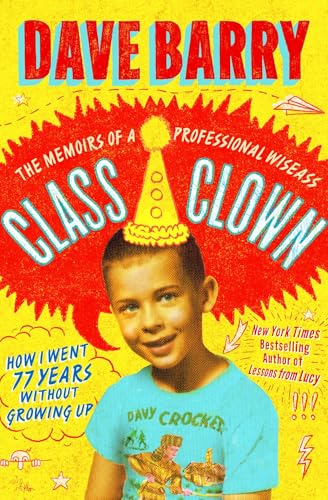
Class Clown, by Dave Barry****-*****

4.5 stars, rounded upwards.

The first time I read a Dave Barry column, it was 1984, and a friend sent it to me. We had only snail mail back then, but it was so funny that she snipped it out of the airline magazine she’d read on a business trip and mailed it to me. I don’t remember which column it was, but it left me gasping for air, I laughed so hard. This was a difficult time for me, a young mother with two small children, a third on the way, and almost no money, and I floated along on the laughter that article brought me for a solid month. I hung it on the fridge where I could reread it whenever the urge struck me. That is how I became a Dave Barry fan.

Since then, his work has either hit or missed for me; almost all of the time, it has hit and although times are easier for me now, laughter is always a balm. When he misses—which is rare—he misses bigtime. But this time he’s golden, the Dave I remember reading that first time.

My thanks go to NetGalley and Simon and Schuster for the invitation to read and review. This book is for sale now.

It strikes me again how frequently the funniest humorists, be they journalists, novelists, standup comedians, or comic actors, have tragic backgrounds. Barry has experienced more than his fair share, with a schizophrenic sister who’s been institutionalized, a father that died too young, and a mother that couldn’t recover from his loss, and took her own life. Barry wrote about her when it happened, and he reprints some of it here.

He reprints some other things, too, and I expected that. I don’t think that it cheats the reader when he documents parts of his professional journey by reprinting some of the things he wrote; he’s been writing prolifically for thirty years, and it seems to me that it was probably a lot of work just choosing what to include and what to leave out. It feels strangely like a school reunion, rereading the excerpts from drop dead funny columns that I enjoyed for the first time when they were originally published. Oh, my heart, “Ask Mr. Language Person!” I’m an English teacher, and I’m in stitches all over again.

The thing about an autobiography is that the author is also the subject, and so when he decides what parts of his own life to write about and what to keep private, we readers need to accept that. At the same time, it does seem disingenuous to completely pass over his marriages and divorces. A paragraph for each, maybe? Just give us the benchmarks.

I hadn’t known that he was responsible for Talk Like a Pirate Day, and both I and my middle school students owe him for that one! But the thing that is most striking to me, and that I appreciate most, is his reflection about the political discourse in the U.S., and the way we have become polarized and too often, uncivil. In the past—and he cites the Kennedy/Nixon campaign—arguments between family and friends were “heated, emotional, sometimes angry, but never nasty. At the end of the night everybody hugged everybody, because they were friends, and they understood that they could disagree about politics without believing the other side was evil. Mistaken, maybe. Evil, no.” All I can say about that is thank you, Dave, and amen.

Because I was running late, I checked out the audio version from Seattle Bibliocommons. Barry does his own reading, and it’s even better that way.

There are a lot of hilarious experiences he recounts, but the thing about Barry that binds all of the experiences, the columns, and the books he’s written is his refusal to take himself too seriously, and it is his complete and delightful intolerance toward pretentiousness that keeps me coming back. I cannot imagine Dave Barry snubbing anybody, ever. Wouldn’t the world be a better place if everyone was like that?

Highly recommended.

This American Woman, by Zarna Garg*****

Zarna Garg is an immigrant, born and raised in India. She was rich, except for when she was poor; more on that in a minute. Ultimately, she came here for the same reason many people do: she had to make a break for it.

My thanks go to Random House and NetGalley for the invitation to read and review. This book is available to the public now.

Garg works now as a stand up comic, but she has done many things, and worn many hats. First, of course, she was a runaway bride, more or less, bailing from India before her very wealthy father could marry her off as part of a business arrangement.

“If I hadn’t done that, right now I would be a Mumbai grandma in an arranged marriage to a much older, boring industrialist. I would be draped in brocade silk saris, but I would have a giant padlock on my big mouth.”

Garg’s immigration—fast and sneaky, which was the only possible way–was made easier by her older sister, who was already living in Ohio. Since then, Garg has finished law school and passed the bar, married another Indian immigrant, had three children, and done a number of other impressive things, but it was her own daughter that asked her mother whether she’d ever considered a career in comedy. It takes someone that’s mentally tough to succeed in that realm, but the streets of Mumbai, where she’d lived hand-to-mouth for two years as a runaway teen following her mother’s death, prepared her well, so she was ready for the gritty world she was entering. She explains,   

            “…I had played a show at a club on the Upper East Side and a cockroach fell on my head. The night before that, as I walked to the stage I had to step over a communal puddle of throw up from a bachelorette part who refused to leave. They just kept throwing up and laughing. So far my comedy career had been physically revolting—but it was still my dream! Now here I was in my very first New York City green room that smelled like air…I walked out on stage. Two thousand white ladies politely applauded. Oh my god. What was I doing? Would this audience even understand my humor? For them India is incense and chanting. Were they ready for a foul-mouthed real-life Indian auntie who hated meditation? “

I wondered, after watching some of Garg’s stand up work online, whether the book would be a duplication of her routine, more or less; it’s happened with other comic authors. But although there’s a small smattering of shared content, the memoir is mostly unique, and I never had the sense that I’d already seen this before.

Garg is funny enough that I’ve let her speak for herself here. Anyone that needs to laugh hard, and that enjoys reading about the disorientation and culture shock experienced by those new to America should read this book. Highly recommended!  

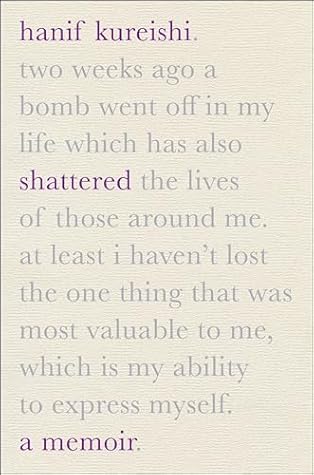
Shattered, by Hanif Kureishi***

A while back, I read a novel by Hanif Kureishi titled The Last Word.  It was not his most successful book in terms of sales, but I was gob-smacked by his cleverness, and so when I saw that he had a memoir coming out, I felt compelled to read it, even though it was likely going to be sad, since it is, at least in part, a memoir of what it’s like to be almost completely paralyzed.

My thanks go to Harper Collins and NetGalley for the review copy. This book is for sale now.

Kureishi is a seasoned writer and journalist, and as he writes about this horrifying event alternately with the earlier parts of his life, we see happier times as well. I thought it would be a narrative that I would need to take in small bursts because of its tragic nature, but that I would nevertheless appreciate it for its brilliance. What a surprise; I can read about his accident, hospitalization, and the experiences he has as a disabled person without a lot of difficulty, but I am drawn up short by the numerous passages about his sexuality.

You see, I am of the old school that believes that just because a thing is true, that doesn’t necessarily mean that its many details belong in a memoir. For example, sometime during nearly everyone’s life, we have digestive difficulties brought on by a case of the flu or some other thing. Has it happened? Yes. Do we need a detailed description of the writer’s vomit and bowel movements? Perhaps not. And this is the way I feel about his fondness for porn, for explorations of his own sexuality with various partners and all by himself (ew!) and even his fondness for street drugs and booze. Why would I want to read about any of this?

Sadly, Kureishi says that he no longer enjoys reading or writing fiction, and since that is the part of his work that I admire, I think we’re done here.

To be clear, he is a capable wordsmith, and those that are curious about what a disability might be like can get a taste of that here, which is why there are three stars and not fewer. I cringe when I read about his plane flight, with people shoving past him, even as they glance pityingly down at him. But like many Boomers, I have tasted a less extreme aspect of this myself, and so Kureishi’s version of it feels to this reviewer like a busman’s holiday.

This book is recommended to those of his readers that have appreciated his earlier nonfiction work, and to those with an interest in the lives of paraplegics and quadriplegics. For others, there are numerous online reviews that include large excerpts, and I recommend reading those before you invest in this book.

Carl Perkins, the King of Rockabilly, by Jeff Apter*****

“’I had only three childhood idols,’ John [Lennon] would tell a friend. ‘Elvis, Carl Perkins, and Jerry Lee Lewis.’ Paul McCartney would go one step further: ‘If there were no Carl Perkins,’ he’d state, ‘there would be no Beatles.’”

When I saw this book, I felt a slight buzzing at the back of my mind. Huh. Carl Perkins. Have I heard of him? Sounds familiar, but…? And then I read the synopsis, which said that he wrote Blue Suede Shoes, and was the first one to perform it. I went to my streaming service and typed it in; since he wasn’t the one to have made the song iconic, I figured his rendition of it would sound lame. But no! No, it didn’t. So now I knew that I had to read this biography.

My thanks go to NetGalley and Kensington Books for the review copy. This book will be available tomorrow, November 26, 2024.

Perkins was born in 1932,  grew up the son of a Tennessee sharecropper, and starting at age 6, he worked in the cotton fields with his family all day, “from can to can’t.” Had he not, he and his family might have starved. This was a time when no governmental safety net existed, nor did child labor laws. The man who would become his closest friend, John Cash—who would perform and record as Johnny—lived in nearly identical circumstances across the Mississippi River in Arkansas. The only good aspect of this grueling life was the singing. His family sang with the other field laborers, who were mostly African American, and while still a child talked his father into purchasing a guitar.

Perkins was 21 years old when he went to Memphis, where Sam Phillips, founder of Sun Records, had advertised that he would record anyone, anywhere, any time. He had some original music that Phillips liked; not long afterward, he and his wife, Valda, heard his record on the radio. Perkins said, “Valda, she dropped the baby, and I like to fainted.”

Phillips had three other promising musicians signed, and they got to know one another well, sometimes performing together. The other men were Johnny Cash, Elvis Presley, and Jerry Lee Lewis. The first two became Carl’s lifelong friends; Lewis was unpredictable, sometimes violent, and Perkins avoided him when he could. But on one occasion, when the four were together, Lewis complained that the three men with guitars could move around, whereas he was stuck at his piano. Perkins asked him whether he could play standing up, and suggested he “make a fuss” while he did it, advice which altered and improved Lewis’s career.

Perkins’s hit original song, “Blue Suede Shoes,” sold millions, and Perkins was on his way; but just as his momentum was growing, he and his brothers were in a serious car wreck and hospitalized. Once Perkins was able to play again, he felt that loyalty demanded he wait for his brothers—his bandmates—to heal. By the time they could play again, Elvis had also recorded the song, and his career was catapulted into the stratosphere. For a while it appeared that Perkins’s career was finished, but soon help came from an unlikely source: The Beatles wanted to meet him. They wanted to record his songs. They looked up to him as a mentor, and became his lifelong friends.

Reading about Perkins, I am amazed at his capacity to remain grounded and retain the values with which he was raised. Some men would have resented Elvis, but Perkins was delighted for him—and enjoyed the royalties when Presley recorded and performed Perkins’s music. How many men, raised in such horrifying poverty, would place family loyalty over fame and fortune? How many could be so reasonable? Perkins later said that when he saw Elvis perform, he could see why the man was rising so quickly. Elvis was immaculately turned out, and the girls went crazy for him. Perkins wasn’t much to look at, and he knew it, and he would never flirt with his audience, because “I was a married man.” And indeed, he remained faithful to Valda for all the decades of their lives together, and he counted himself lucky to have her. Meanwhile, the royalties from the Beatles, Elvis, and others enabled him to buy a modest but much loved house for himself, Valda, and their growing family, and later he would be able to do the same for his parents. And as it happened, his career as a performer was not dead, only sleeping.

I have read many musicians’ biographies and memoirs, and all of them had greater name recognition than Perkins; but from what I can see, Perkins was the most decent person among them. This is not to detract from others, but seriously…what a nice guy!

Meanwhile, author Jeff Apter writes in an intimate, conversational way that makes this book surprisingly hard to put down, and his research is beyond reproach. Highly recommended.

Emperor of the Seas, by Jack Weatherford*****

How much do you know about the Mongol empires? If you grew up in the U.S., chances are you answered, “Absolutely nothing.” The world is a big place, and world history has never been much of a priority in American schools; we study various phases of U.S. history, state history, and in a wild flurry of internationalism, some districts now teach a semester of Canadian history. The single year of world history in high school is usually devoted to World War II, which is impossible to teach without including information about Europe, and a smidgen about Japan along with, yes, more American history. There you go. Here’s your diploma.

In my retirement years, I have reveled in the freedom to learn about the history that wasn’t on the syllabus for what I studied, and later, what I was hired to teach. Having marched my way through various other times and places, I realized that I knew nothing about the Mongol khans. I read one novel about Genghis, and I was hooked.

My thanks go to NetGalley and Bloomsbury for the review copy. You can buy this book now.

If you’re going to read a single nonfiction book about the Mongols, this would be a fine choice. Jack Weatherford’s research is outstanding, including works in several non-English languages that most of us couldn’t hope to read on our own. His scholarship is so meticulous that he has been awarded both of Mongolia’s top national awards. Not half bad, for a boy from South Carolina. And while this book is not written as narrative nonfiction, the tone is conversational, the language accessible. I read it daily at lunch time, and it wasn’t long before I was shouting out random, amazing facts to family members that dared venture into the kitchen.

It began with Genghis, a young man whose family was left homeless, left to freeze or starve when his father and protector died. With desperation, talent, and ruthlessness that he learned well, he turned it around, and as he grew up he vanquished his enemies, brought the most talented and trustworthy elements to himself, and let the devil take the rest. His instinct for military strategy was a thing of pure genius. But this book is mostly not about him; it’s about his grandson, Kublai Khan, who expanded the empire Genghis began until his domain stretched from Baghdad to the far shores of China.

Until Kublai arrived, Mongols were an inland people, but it was Kublai who realized that in order to expand and become a world power, he had to have ocean-going vessels and people that knew how to use them. The peoples of Southern China were tough to defeat, but once it was done, he was able to use their technologies in ways that were of immeasurable value.

The progression looked like this (in a very simplified version): Genghis conquered, and took no prisoners, with a few rare exceptions. Kublai conquered, but also used diplomacy, highlighting the potential benefits of becoming a Mongol subject; he didn’t routinely kill everyone he defeated. And under Kublai’s son Temur, the Mongols segued from physical battle to economic dominance, making China’s ports the ideal destination of merchants from all over the world.

One of the most interesting things I learned had to do with the authority that was vested in the women of the highest placed families. When the men rode off to conquer, it was women that looked after the business interests and saw to local governance. It worked out nicely; Europeans should have taken note.

I can’t compare this book to others because I haven’t read any others on this topic cover to cover, but I wouldn’t let that stop you. If the Mongols are persuaded that Weatherford has done the work and done it well, who can argue? I learned a great deal and enjoyed it, and so I highly recommend it to you.

The Message, by Ta-Nehisi Coates****

Ta-Nehisi Coates is an eloquent writer, and I look forward to reading whatever he publishes. My thanks go to NetGalley and Random House for the invitation to read and review. This book is for sale now.

This book is brief, and it consists of four essays. The first and briefest is about returning to Howard University to teach writing. The second details his first trip to Africa, specifically Senegal; it’s surprising that it took him this long, he says, what with being raised in an Afrocentric home, the child of a Panther. But it’s expensive, it’s time consuming, and now, he can finally do it. As I read both of these, I admire the way he crafts an essay, but at the same time, I also feel as if I am not his intended audience; at times I feel almost as if I am listening in on someone else’s conversation. But I remind myself that I am reading this thing at the publisher’s invitation, so I push on, and it’s outstanding material.

The third essay is the one I enjoy the most, particularly because I had just finished reading a harrowing memoir about book banning. Coates attends a South Carolina school board meeting in which his own book, Between the World and Me, is being challenged. He’s invited by a teacher there that wants to continue using his book in her classroom, and he’s amazed at the assertions being made by some of the speakers in attendance, right in the shadow of George Floyd’s murder. And speaking of this, he says

“I understand the impulse to dismiss the import of the summer of 2020, to dismiss the ‘national conversations,’ the raft of TV specials and documentaries, even the protests themselves. Some of us see the lack of policy change and wonder if the movement itself was futile. But policy change is an end point, not an origin…and whereas white supremacy, like any other status quo, can default to the cliched claims and excuses for the world as it is—bad cops are rotten apples, American is guardian of the free world—we have the burden of crafting new language and stories that allow people to imagine that new policies are possible. And now, here in Chapin, some people, not most (it is hardly ever most), had, through the work of Black writers, begun that work of imagining.”

The final essay, which is also the lengthiest, is about his trip to the Middle East. At the outset he mentions his trip to the World Holocaust Remembrance Center, and seeing the vast Book of Names, which catalogs all of the nearly 5 million Jews killed in the Holocaust. But a few pages later he gets to the meat of the matter and decries the way that Israel is treating Hamas. No wait, that’s not the way he words it. He dislikes the treatment of the Palestinians that chose to be ruled by Hamas. Whatever. All I know is that when he states flatly that he isn’t interested in hearing the other side of this conflict, completely ignoring the pogrom that set this entire conflict in motion, he loses me. I skim the rest of the essay in case there’s a surprise for me somewhere in there, but of course, there isn’t. Bandwagons are easily joined, but I would have expected a writer of his caliber to think and write more critically.

So, should you read this book? There’s no denying that Coates is a skillful writer, and the essay regarding censorship is worth reading all by itself. And in that spirit, I won’t say that you shouldn’t read this because I happen to disagree with the last nearly fifty percent of the book; but when you do so, keep your brain engaged and don’t take everything he says at face value.